
Matthew 27:43
in Matthew 27He trusts in God. Let God deliver Him now if He wants Him. For He said, ‘I am the Son of God.’”
BSB
The same verse in ASV and KJV ▾
ASV
He trusteth on God; let him deliver him now, if he desireth him: for he said, I am the Son of God.
KJV
He trusted in God; let him deliver him now, if he will have him: for he said, I am the Son of God.
⋯
This verse in Matthew 27
Commentary
13 notes on this verse(V. 43) If he is the king of Israel, let him come down now from the cross, and we will believe in him. He trusted in God; let Him deliver him now if He wants. For he said, 'I am the Son of God.' A fraudulent promise. What is more difficult, to come down from the cross while still alive, or to rise from the grave when dead? He has risen, and you did not believe. Therefore, even if he were to come down from the cross, you would not believe.
This site's exposition
shaking their heads
on Matthew 27:39-44
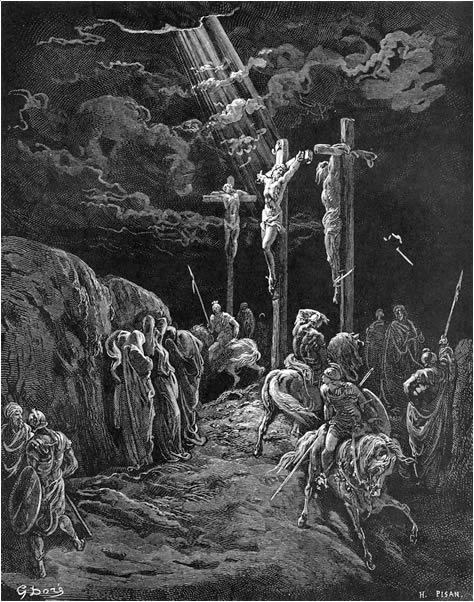
Passersby turn his words from 26:61 into a taunt, though John 2:19-21 says he meant his body. The chief priests promise that "we will believe in Him" if he comes down, the sign Jesus refused them at 12:38-39. Even "the robbers who were crucified with Him" join the abuse.
The record, by era
The Church Fathers2 voices
Wherefore they said those things, and also these. If "He is the king of Israel, let Him come down now from the cross. He saved others, Himself He cannot save," aiming hereby to bring discredit even on His former miracles. And again, "If He be Son of God, and He will have Him, let Him save Him." O execrable; most execrable! What, were not the prophets prophets, nor the righteous men righteous, because God rescued them not out of their dangers. Nay surely they were, though suffering these things. What then could be equal to your folly? For if the coming of the dangers upon them did not injure their honor with you, how much more in the case of this man, was it wrong for you to be offended, when both by what He did, by what He said, He was ever correcting beforehand this suspicion of yours. Yet nevertheless, even when these things were said and done, they prevailed nothing, not even at the very time. At any rate, he, who was depraved in such great wickedness, and who had spent his whole life in murders and house-breakings, when these things were being said, then confessed Him, and made mention of a kingdom, and the people bewailed Him. And yet the things that were done seemed to testify the contrary in the eyes of those who knew not the mysterious dispensations, that He was weak and of no power, nevertheless truth prevailed even by the contrary things.
O execrable; most execrable! What, were not the prophets prophets, nor the righteous men righteous, because God rescued them not out of their dangers. Nay surely they were, though suffering these things. What then could be equal to your folly? For if the coming of the dangers upon them did not injure their honor with you, how much more in the case of this man, was it wrong for you to be offended, when both by what He did, by what He said, He was ever correcting beforehand this suspicion of yours.
The Medieval Church3 voices
Had He then been prevailed on by their taunts to leave the cross, He would not have proved to us the power of endurance; but He waited enduring their mockery; and He who would not come down from the cross, rose again from the tomb.
Likewise, they reproach him for saying he was the Son of God: "he trusted in God, let him deliver him now, if he will have him." Psalm 21:9: "he hoped in the Lord, let him deliver him; let him save him, seeing he delighteth in …
And they that passed by reviled Him, shaking their heads, and saying, Thou that destroyest the temple, and buildest it in three days, save Thyself. If Thou be the Son of God, come down from the cross. Likewise also the chief priests mocking Him, with …
6 more voices on this verse
The Puritans and the Awakening1 voice
He trusted in God,....
The Nineteenth Century5 voices
If he will have him - Or, if he delight in him - ει θελει αυτον. The verbs θελω and εθελω, are used by the Septuagint in more than forty places for the Hebrew חפץ chaphets, which signifies, earnestly to desire, or delight in.
THESE WORDS ARE a fulfilment of the prophecy contained in the twenty-second Psalm. Read from the seventh verse’"All they that see me laugh me to scorn: they shoot out the lip, they shake the head, saying, He trusted on the Lord that he would deliver him: let him deliver him, seeing he delighted in him." Thus to the letter doth our Lord answer to the ancient prophecy.
These verses describe the sufferings of our Lord Jesus Christ after his condemnation by Pilate, his sufferings in the hands of the brutal Roman soldiers, and his final sufferings on the cross. They form a marvelous record. They are marvelous when we remember the sufferer—the eternal Son of God. They are marvelous when we remember the persons for whom these sufferings were endured. We and our sins were the cause of all this sorrow! He “died for our sins” ( 1 Corinthians 15:3 ). Let us observe in the first place the extent and reality of our Lord’s sufferings. The catalogue of all the pains endured by our Lord’s body is indeed a fearful one: seldom has such suffering been inflicted on one body in the last few hours of a life. The most savage tribes, in their refinement of cruelty, could hardly have heaped more agonizing tortures on an enemy than were accumulated on the flesh and bones of our beloved Master. Never let it be forgotten that he had a real human body, a body exactly like our own, just as sensitive, just as vulnerable, just as capable of feeling intense pain. And then let us see what that body endured. Our Lord, we must remember, had already passed a night without sleep, and endured excessive fatigue. He had been taken from Gethsemane to the Jewish council, and from the Council to Pilate’s judgment hall. He had been twice placed on his trial, and twice unjustly condemned. He had been already scourged and beaten cruelly with rods. And now, after all this suffering, he was delivered up to the Roman soldiers, a body of men no doubt expert in cruelty, and, of all people, least likely to behave with delicacy or compassion. These hard men at once proceeded to work their will.
THESE WORDS ARE a fulfilment of the prophecy contained in the twenty-second Psalm. Read from the seventh verse’"All they that see me laugh me to scorn: they shoot out the lip, they shake the head, saying, He trusted on the Lord that he would deliver him: let him deliver him, seeing he delighted in him." Thus to the letter doth our Lord answer to the ancient prophecy. It is very painful to the heart to picture our blessed Master in his death-agonies, surrounded by a ribald multitude, who watched him and mocked him, made sport of his prayer and insulted his faith. Nothing was sacred to them: they invaded the Holy of holies of his confidence in God, and taunted him concerning that faith in Jehovah which they were compelled to admit. See, dear friends, what an evil thing is sin, since the Sin-bearer suffers so bitterly to make atonement for it! See, also, the shame of sin, since even the Prince of Glory, when bearing the consequences of it, is covered with contempt! Behold, also, how he loved us! For our sake he "endured the cross, despising the shame." He loved us so much that even scorn of the most cruel sort he deigned to bear, that he might take away our shame and enable us to look up unto God. Beloved, the treatment of our Lord Jesus Christ by men is the clearest proof of total depravity which can possibly be required or discovered. Those must be stony hearts indeed which can laugh at a dying Saviour, and mock even at his faith in God! Compassion would seem to have deserted humanity, while malice sat supreme on the throne. Painful as the picture is, it will do you good to paint it. You will need neither canvas, nor brush, nor palette, nor colours. Let your thoughts draw the outline, and your love fill in the detail; I shall not complain if imagination heightens the colouring.
These verses describe the sufferings of our Lord Jesus Christ after his condemnation by Pilate, his sufferings in the hands of the brutal Roman soldiers, and his final sufferings on the cross. They form a marvelous record. They are marvelous when we remember the sufferer—the eternal Son of God. They are marvelous when we remember the persons for whom these sufferings were endured. We and our sins were the cause of all this sorrow! He “died for our sins” ( 1 Corinthians 15:3 ). Let us observe in the first place the extent and reality of our Lord’s sufferings.
The words behind it
15 Greek wordsEvery Greek word of this verse in the order it stands, with what it means and the door to its own study. The last column counts the times a word stands in the whole Bible: the rarer the word, the more the places it appears belong together.
| Greek | Sound | Meaning | Word study | In the Bible |
|---|---|---|---|---|
| πέποιθεν | pepoithen | He has trusted | G3982 → | 51 times |
| ἐπὶ | epi | on | G1909 → | 883 times |
| τὸν | ton | <the> | G3588 → | 19766 times |
| θεόν· | theon | God; | G2316 → | 1312 times |
| ῥυσάσθω | rhusastho | he should deliver | G4506 → | |
| νῦν | nun | now | G3568 → | 145 times |
| εἰ | ei | if | G1487 → | 508 times |
| θέλει | thelei | He wants | G2309 → | 208 times |
| αὐτόν· | auton | Him; | G846 → | 5565 times |
| εἶπεν | eipen | He said | G2036 → | 925 times |
| γὰρ | gar | for | G1063 → | 1039 times |
| ὅτι | hoti | that | G3754 → | 1292 times |
| θεοῦ | theou | Of God | G2316 → | 1312 times |
| εἰμι | eimi | I am | G1510 → | 2333 times |
| υἱός.¶ | huios | [the] Son. | G5207 → | 377 times |
πέποιθενHe has trusted
pepoithenG3982 →51 times
ἐπὶon
epiG1909 →883 times
τὸν<the>
tonG3588 →19766 times
θεόν·God;
theonG2316 →1312 times
ῥυσάσθωhe should deliver
rhusasthoG4506 →
νῦνnow
nunG3568 →145 times
εἰif
eiG1487 →508 times
θέλειHe wants
theleiG2309 →208 times
αὐτόν·Him;
autonG846 →5565 times
εἶπενHe said
eipenG2036 →925 times
γὰρfor
garG1063 →1039 times
ὅτιthat
hotiG3754 →1292 times
θεοῦOf God
theouG2316 →1312 times
εἰμιI am
eimiG1510 →2333 times
υἱός.¶[the] Son.
huiosG5207 →377 times
A shaded row is a word that stands 400 times or fewer in the Bible.
The walk
8 stopsEach card is a verse this one points to, and under it the verses that one points to in turn. Where several paths arrive at the same place, that place is listed first: the text keeps returning to it.
Through
John 10:30I and the Father are one.”
it leads to
- John 1:1–2
In the beginning was the Word, and the Word was with God, and the Word was God.
- John 14:9
Jesus replied, “Philip, I have been with you all this time, and still you do not know Me? Anyone who has seen Me has seen the Father. How can you say, ‘Show us the…
- John 17:21–23
that all of them may be one, as You, Father, are in Me, and I am in You. May they also be in Us, so that the world may believe that You sent Me.
- John 5:23
so that all may honor the Son just as they honor the Father. Whoever does not honor the Son does not honor the Father who sent Him.
- John 8:58
“Truly, truly, I tell you,” Jesus declared, “before Abraham was born, I am!”
- John 1:1–2
Through
Psalms 22:8“He trusts in the LORD, let the LORD deliver him; let the LORD rescue him, since He delights in him.”
it leads to
- Matthew 27:42–43
“He saved others, but He cannot save Himself. He is the King of Israel! Let Him come down now from the cross, and we will believe in Him.
Reached by 2 separate paths from here.
- Mark 15:30–32
come down from the cross and save Yourself!”
- Matthew 27:42–43
Through
John 19:7“We have a law,” answered the Jews, “and according to that law He must die, because He declared Himself to be the Son of God.”
it leads to
- Leviticus 24:16
Whoever blasphemes the name of the LORD must surely be put to death; the whole assembly must surely stone him, whether he is a foreign resident or native; if he blasphemes the Name, he…
- Leviticus 24:16
Where this verse is studied
On this page
Studies18
On this chapter
About Matthew
This page draws on 11 works. Open the list of works
This page draws on Adam Clarke, Commentary on the Bible; Charles Spurgeon, The Metropolitan Tabernacle Pulpit, Sermon No. 2026: “Let Him Deliver Him Now” (lightly modernized text, CCEL edition); J.C. Ryle, Expository Thoughts on the Gospels: Matthew; Jerome, Commentary on Matthew; John Chrysostom, Homilies on the Gospel of Matthew; John Chrysostom, Homily on the Gospel of Matthew 87; John Gill, Exposition of the New Testament (1746-1748); Matthew Henry, Commentary on the Whole Bible; Rabanus Maurus, Catena Aurea by Aquinas; Theophylact of Ohrid, Commentary on Matthew and Thomas Aquinas, Commentary on Matthew.