
Matthew 27:40
in Matthew 27and saying, “You who are going to destroy the temple and rebuild it in three days, save Yourself! If You are the Son of God, come down from the cross!”
BSB
The same verse in ASV and KJV ▾
ASV
and saying, Thou that destroyest the temple, and buildest it in three days, save thyself: if thou art the Son of God, come down from the cross.
KJV
And saying, Thou that destroyest the temple, and buildest it in three days, save thyself. If thou be the Son of God, come down from the cross.
⋯
This verse in Matthew 27
Commentary
20 notes on this verseAnd saying, thou that destroyest the temple,.... The Vulgate Latin, and Munster's Hebrew Gospel, read, "the temple of God"; and add "ah!" here, as in Mar 15:29, and so Beza says it is read in a certain copy. They refer to the charge of the false witnesses against him, who misrepresenting his words in Joh 2:19, declared that he gave out that he was able to destroy the temple of Jerusalem, and rebuild it in three days time; wherefore it is added, and buildest it in three days, save thyself.
This site's exposition
shaking their heads
on Matthew 27:39-44
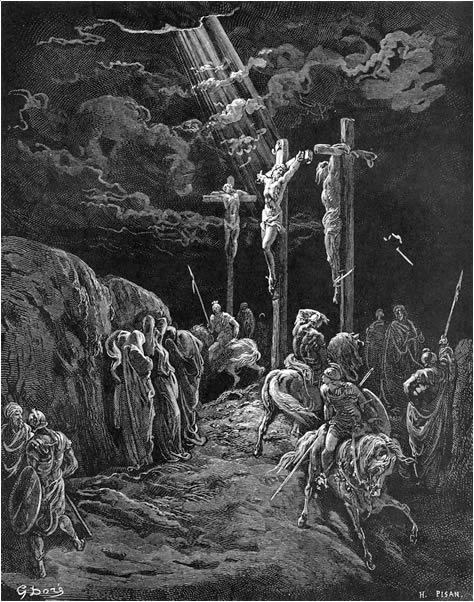
Passersby turn his words from 26:61 into a taunt, though John 2:19-21 says he meant his body. The chief priests promise that "we will believe in Him" if he comes down, the sign Jesus refused them at 12:38-39. Even "the robbers who were crucified with Him" join the abuse.
This site's exposition
save Yourself
The words If You are the Son of God repeat the tempter's at Matthew 4:3 and 4:6, a call to prove Sonship by power. Here the call is to come down from the cross and save Himself. Adam Clarke says cruelty must take refuge in lies.
The record, by era
The Church Fathers5 voices
There are various forms of blasphemy. One of them is uttered by those who do not understand or hear what is being said or acknowledge what is true. Now Jesus had said, "Destroy this temple, and in three days I will raise it up." But those who were passing along, like "false witnesses" against Jesus, related what he had not said, attacking him: "Aha, you who would destroy the temple and build it in three days, save yourself." The truth is, he will not destroy the temple, but what others destroy he will build, whether it be the "temple of his body," which the Jews delivered up to death, or the temple of his witnesses and all those who had God's word in them and who, because of the snares of the wicked, died out of love for God (for "the hour is coming, and now is, when the dead will hear the voice of the Son of God, and those who hear it will live"). And they lied not only when they said, "You who would destroy the temple," but also when they said, "And I will build it in three days." For he did not say that he would build the temple but raise it up. The verb build does not designate a sudden action, but "raise up" does.
What forgiveness then for them, when by the resurrection of His body they shall see the temple of God rebuilt within three days?
Aha! is an interjection of taunt and mockery.
(Serm. 55. 2.) From what source of error, O Jews, have ye sucked in the poison of such blasphemies? What teacher delivered it to you? What learning moved you to think that the true King of Israel, that the veritable Son of God, would be He who would not suffer Himself to be crucified, and would set free His body from the fastenings of the nails? Not the hidden meaning of the Law, not the mouths of the Prophets. Had ye indeed ever read, I hid not my face from the shame of spitting; (Is. 50:6.) or that again, They pierced my hands and my feet, they told all my bones. (Ps. 22:16.) Where have ye ever read that the Lord came down from the cross? But ye have read, The Lord hath reigned from the tree.e
The foolish rabble cast the same taunt against Him that the false witnesses had invented, Aha! thou that destroyest the temple of God and rebuildest it in three days.
12 more voices on this verse
The Church Fathers4 voices
(Verse 39 seqq.) And those passing by were blaspheming him, shaking their heads, and saying, 'Vah! You who destroy the temple of God and rebuild it in three days, save yourself; if you are the Son of God, come down from the cross.' Similarly, the chief priests, mocking with the scribes and elders, said, 'He saved others; he cannot save himself. He is the King of Israel; let him come down now from the cross, and we will believe in him.
And as beginning to extenuate His former miracles, they add, Save thyself; if thou be the Son of God, come down from the cross. (Hom. de Cruc. et Latr. ii.) But He, on the contrary, does not come down from the cross, because He is the Son of God; for He therefore came that He might be crucified for us.
And yet who would not have been moved by the multitude that was following Him, and lamenting Him? Nay, not these wild beasts. Wherefore also He to the multitude vouchsafes an answer, but to these men not so. For after having done what they would, they endeavor also to injure His honor, fearing His resurrection. Therefore they say these things publicly, and crucified thieves with Him, and wishing to prove Him a deceiver, they say, "Thou that destroyest the temple, and buildest it in three days come down from the cross." For since on telling Pilate to remove the accusation (this was the writing, "The king of the Jews"), they prevailed not, but he persevered in saying, "What I have written, I have written," they then endeavor by their derision of Him to show that He is not a king.
But attend to this speech of these children of the Devil, how they imitate their father's speech. The Devil said, If thou be the Son of God, cast thyself down; (Matt. 4:6.) and they say now, If thou be the Son of God, come down from the cross.
The Medieval Church4 voices
A commentator
BonaventureCollations on the Hexaemeron, Collation 1 · Written in the 13th century.
proposed
The major proposition existed from all eternity, the minor came about on the cross, and the conclusion appeared in the resurrection. The Jews believed they had confounded Christ, and they taunted Him: "If Thou art the Son of God, come down from the cross!" For …
In three things they deride him. First, in his words; second, concerning the works he did; third, concerning the dignity he claimed for himself. Concerning the first, he says "vah, thou that destroyest the temple of God etc." "Vah" is an interjection of derision. For …
Had He then been prevailed on by their taunts to leave the cross, He would not have proved to us the power of endurance; but He waited enduring their mockery; and He who would not come down from the cross, rose again from the tomb.
And they that passed by reviled Him, shaking their heads, and saying, Thou that destroyest the temple, and buildest it in three days, save Thyself. If Thou be the Son of God, come down from the cross. Likewise also the chief priests mocking Him, with …
The Nineteenth Century4 voices
Thou that destroyest - Who didst pretend that thou couldst have destroyed the temple, and built it up again in three days. This malicious torturing of our Lord’s words has been noticed before. Cruelty is obliged to take refuge in lies, in order to vindicate its infamous proceedings.
These verses describe the sufferings of our Lord Jesus Christ after his condemnation by Pilate, his sufferings in the hands of the brutal Roman soldiers, and his final sufferings on the cross. They form a marvelous record. They are marvelous when we remember the sufferer—the eternal Son of God. They are marvelous when we remember the persons for whom these sufferings were endured. We and our sins were the cause of all this sorrow! He “died for our sins” ( 1 Corinthians 15:3 ). Let us observe in the first place the extent and reality of our Lord’s sufferings.
These verses describe the sufferings of our Lord Jesus Christ after his condemnation by Pilate, his sufferings in the hands of the brutal Roman soldiers, and his final sufferings on the cross. They form a marvelous record. They are marvelous when we remember the sufferer—the eternal Son of God. They are marvelous when we remember the persons for whom these sufferings were endured. We and our sins were the cause of all this sorrow! He “died for our sins” ( 1 Corinthians 15:3 ). Let us observe in the first place the extent and reality of our Lord’s sufferings. The catalogue of all the pains endured by our Lord’s body is indeed a fearful one: seldom has such suffering been inflicted on one body in the last few hours of a life. The most savage tribes, in their refinement of cruelty, could hardly have heaped more agonizing tortures on an enemy than were accumulated on the flesh and bones of our beloved Master. Never let it be forgotten that he had a real human body, a body exactly like our own, just as sensitive, just as vulnerable, just as capable of feeling intense pain. And then let us see what that body endured. Our Lord, we must remember, had already passed a night without sleep, and endured excessive fatigue. He had been taken from Gethsemane to the Jewish council, and from the Council to Pilate’s judgment hall. He had been twice placed on his trial, and twice unjustly condemned. He had been already scourged and beaten cruelly with rods. And now, after all this suffering, he was delivered up to the Roman soldiers, a body of men no doubt expert in cruelty, and, of all people, least likely to behave with delicacy or compassion. These hard men at once proceeded to work their will.
A commentator
Albert Barnes1798–1870
Notes, Explanatory and Practical, on the Old and New Testaments (1832-1869)
proposed
Thou that destroyest the temple ... - Meaning, Thou that didst boast that thou couldst do it. This was one of the things that had been falsely charged on him. It was intended for painful sarcasm and derision. If he could destroy the “temple,” they thought he might easily come down from the cross.
The words behind it
23 Greek wordsEvery Greek word of this verse in the order it stands, with what it means and the door to its own study. The last column counts the times a word stands in the whole Bible: the rarer the word, the more the places it appears belong together.
| Greek | Sound | Meaning | Word study | In the Bible |
|---|---|---|---|---|
| καὶ | kai | and | G2532 → | 9120 times |
| λέγοντες· | legontes | saying; | G3004 → | 1325 times |
| ὁ | ho | You who [are] | G3588 → | 19766 times |
| καταλύων | kataluon | destroying | G2647 → | 17 times |
| τὸν | ton | the | G3588 → | 19766 times |
| ναὸν | naon | temple | G3485 → | 45 times |
| καὶ | kai | and | G2532 → | 9120 times |
| ἐν | en | in | G1722 → | 2738 times |
| τρισὶν | trisin | three | G5140 → | 69 times |
| ἡμέραις | hemerais | days | G2250 → | 389 times |
| οἰκοδομῶν, | oikodomon | building [it], | G3618 → | 40 times |
| σῶσον | soson | do save | G4982 → | 105 times |
| σεαυτόν· | seauton | Yourself! | G4771 → | 2973 times |
| εἰ | ei | If | G1487 → | 508 times |
| υἱὸς | huios | [the] Son | G5207 → | 377 times |
| εἶ | ei | You are | G1510 → | 2333 times |
| τοῦ | tou | <the> | G3588 → | 19766 times |
| θεοῦ, | theou | of God, | G2316 → | 1312 times |
| καὶ | kai | also | G2532 → | 9120 times |
| κατάβηθι | katabethi | do descend | G2597 → | 81 times |
| ἀπὸ | apo | from | G575 → | 640 times |
| τοῦ | tou | the | G3588 → | 19766 times |
| σταυροῦ. | staurou | cross! | G4716 → | 27 times |
καὶand
kaiG2532 →9120 times
λέγοντες·saying;
legontesG3004 →1325 times
ὁYou who [are]
hoG3588 →19766 times
καταλύωνdestroying
kataluonG2647 →17 times
τὸνthe
tonG3588 →19766 times
ναὸνtemple
naonG3485 →45 times
καὶand
kaiG2532 →9120 times
ἐνin
enG1722 →2738 times
τρισὶνthree
trisinG5140 →69 times
ἡμέραιςdays
hemeraisG2250 →389 times
οἰκοδομῶν,building [it],
oikodomonG3618 →40 times
σῶσονdo save
sosonG4982 →105 times
σεαυτόν·Yourself!
seautonG4771 →2973 times
εἰIf
eiG1487 →508 times
υἱὸς[the] Son
huiosG5207 →377 times
εἶYou are
eiG1510 →2333 times
τοῦ<the>
touG3588 →19766 times
θεοῦ,of God,
theouG2316 →1312 times
καὶalso
kaiG2532 →9120 times
κατάβηθιdo descend
katabethiG2597 →81 times
ἀπὸfrom
apoG575 →640 times
τοῦthe
touG3588 →19766 times
σταυροῦ.cross!
staurouG4716 →27 times
A shaded row is a word that stands 400 times or fewer in the Bible.
The walk
8 stopsEach card is a verse this one points to, and under it the verses that one points to in turn. Where several paths arrive at the same place, that place is listed first: the text keeps returning to it.
Through
Matthew 4:6“If You are the Son of God,” he said, “throw Yourself down. For it is written: ‘He will command His angels concerning You, and they will lift You up in their hands, so that…
it leads to
- Psalms 91:11–12
For He will command His angels concerning you to guard you in all your ways.
- Hebrews 1:14
Are not the angels ministering spirits sent to serve those who will inherit salvation?
- Psalms 34:7
The angel of the LORD encamps around those who fear Him, and he delivers them.
- 2 Corinthians 11:14
And no wonder, for Satan himself masquerades as an angel of light.
- Psalms 34:20
He protects all his bones; not one of them will be broken.
- Psalms 91:11–12
Through
Matthew 4:3The tempter came to Him and said, “If You are the Son of God, tell these stones to become bread.”
it leads to
- 1 Thessalonians 3:5
For this reason, when I could bear it no longer, I sent to find out about your faith, for fear that the tempter had somehow tempted you and caused our labor to be in…
- Genesis 3:1–5
Now the serpent was more crafty than any beast of the field that the LORD God had made. And he said to the woman, “Did God really say, ‘You must not eat from any…
- 1 Thessalonians 3:5
Through
Luke 16:31Then Abraham said to him, ‘If they do not listen to Moses and the prophets, they will not be persuaded even if someone rises from the dead.’”
it leads to
- 2 Corinthians 4:3
And even if our gospel is veiled, it is veiled to those who are perishing.
- 2 Corinthians 4:3
Where this verse is studied
On this page
Studies18
About Matthew
This page draws on 19 works. Open the list of works
This page draws on Adam Clarke, Commentary on the Bible; Albert Barnes, Notes, Explanatory and Practical, on the Old and New Testaments (1832-1869); Bonaventure, Collations on the Hexaemeron, Collation 1; Hilary of Poitiers, Catena Aurea by Aquinas; J.C. Ryle, Expository Thoughts on the Gospels: Matthew; Jerome, Catena Aurea by Aquinas; Jerome, Commentary on Matthew; John Chrysostom, Homilies on the Gospel of Matthew; John Chrysostom, Catena Aurea by Aquinas; John Chrysostom, Homily on the Gospel of Matthew 87; John Gill, Exposition of the New Testament (1746-1748); Leo the Great, Catena Aurea by Aquinas; Matthew Henry, Commentary on the Whole Bible; Origen of Alexandria, COMMENTARY ON MATTHEW 132; Pseudo-Chrysostom, Catena Aurea by Aquinas; Rabanus Maurus, Catena Aurea by Aquinas; Remigius of Rheims, Catena Aurea by Aquinas; Theophylact of Ohrid, Commentary on Matthew and Thomas Aquinas, Commentary on Matthew.