
Matthew 27:45
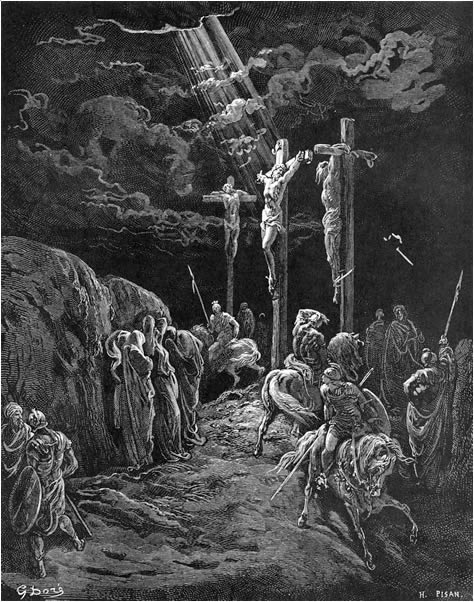
in Matthew 27From the sixth hour until the ninth hour darkness came over all the land.
BSB
The same verse in ASV and KJV ▾
ASV
Now from the sixth hour there was darkness over all the land until the ninth hour.
KJV
Now from the sixth hour there was darkness over all the land unto the ninth hour.
⋯
This verse in Matthew 27
Commentary
21 notes on this verse(Verse 45) But at the sixth hour, darkness came over the whole land until the ninth hour. Those who wrote against the Gospels suspect a solar eclipse, which usually occurs at certain fixed times, as the reason for the disciples of Christ being misunderstood about the resurrection of the Lord: since a solar eclipse only occurs when the moon is rising. However, there is no doubt that during the time of Passover, the moon was full.
This site's exposition
there was darkness over all the land
Three hours of darkness at midday, from the sixth hour to the ninth, noon to three in the afternoon, cannot be a natural eclipse since Passover fell at full moon when the moon stands opposite the sun, so the bench reads it as a direct divine act rather than an astronomical coincidence some ancient writers tried to explain away. The darkness answers Amos 8:9, I will cause the sun to go down at noon, and darken the earth in the clear day, a prophecy of judgment now falling in the very hour Israel's own judgment is being borne by her King. Creation itself seems to hide its face at the sight, the same instinct that soon tears the temple veil and splits the rocks in the same chapter's next verses.
The record, by era
The Church Fathers5 voices
Certain believers, wishing to offer some defense of the gospel in a few brief words, have said that if no new miracle had been performed at the time of Christ's Passion but everything happened in the normal manner, then it would also have to be believed that the eclipse of the sun occurred as usual. Since it is agreed, however, that other prodigies which happened at that time were not customary events but new and wondrous (for the veil of the temple was torn in two from top to bottom and the earth shook and rocks were split apart and graves were opened and many bodies of the saints rose from the dead), it follows that neither did the eclipse of the sun happen as it normally does.
Some take occasion from this text to cavil against the truth of the Gospel. For indeed from the beginning eclipses of the sun have happened in their proper seasons; but such an eclipse as would be brought about by the ordinary course of the seasons could only be at such time as the sun and moon come together, when the moon passing beneath intercepts the sun's rays. But at the time of Christ's passion it is clear that this was not the case, because it was the paschal feast, which it was customary to celebrate when the moon was full. Some believers, desiring to produce some answer to this objection, have said, that this eclipse in accordance with the other prodigies was an exception to the established laws of nature. Against this the children of this world urge, How is it that of the Greeks and Barbarians, who have made observations of these things, not one has recorded so remarkable a phenomenon as this? Phlegon indeed has recorded such an event as happening in the time of Tiberius Caesar, but he has not mentioned that it was at the full moon. I think therefore that, like the other miracles which took place at the Passion, the rending of the veil, and the earthquake, this also was confined to Jerusalem. Or, if any one chooses, it may be extended to the whole of Judæa; as in the book of Kings, Abdias said to Elias, As the Lord thy God liveth, there is no nation or kingdom whither my lord hath not sent to seek thee, (1 Kings 18:10.) meaning that he had been sought in the countries round about Judæa. Accordingly we might suppose many and dense clouds to have been brought together over Jerusalem and Judæa, enough to produce thick darkness from the sixth to the ninth hour. […]
(ad Polycarp. Ep. 7.) When we were together at Heliopolis, we both observed such an interference of the moon with the sun quite unexpectedly, for it was not the season of their conjunction; and then from the ninth hour until evening, beyond the power of nature, continuing in a direct line between us and the sun. And this obscuration we saw begin from the east, and so pass to the extreme of the sun's orb, and again return back the same way, being thus the very reverse of an ordinary eclipse.
But My People hath changed their glory: whence no profit shall accrue to them: the heaven turned pale thereat" (and when did it turn pale? undoubtedly when Christ suffered), "and shuddered," he says, "most exceedingly; " and "the sun grew dark at mid-day: " (and when did it "shudder exceedingly" except at the passion of Christ, when the earth also trembled to her centre, and the veil of the temple was rent, and the tombs were burst asunder? "because these two evils hath My People done; Me," He says, "they have quite forsaken, the fount of water of life, and they have digged for themselves worn-out tanks, which will not be able to contain water.
And so the "pressure" must be maintained up to that hour in which the orb-involved from the sixth hour in a general darkness-performed for its dead Lord a sorrowful act of duty; so that we too may then return to enjoyment when the universe regained its sunshine. If this savours more of the spirit of Christian religion, while it celebrates more the glory of Christ, I am equally able, from the self-same order of events, to fix the condition of late protraction of the Station; (namely), that we are to fast till a late hour, awaiting the time of the Lord's sepulture, when Joseph took down and entombed the body which he had requested.
14 more voices on this verse
The Church Fathers3 voices
Creation could not bear the outrage offered to the Creator; whence the sun withdrew his beams, that he might not look upon the crime of these impious men.
A commentator
John ChrysostomHomily on the Gospel of Matthew 88 · Written in the 5th century.
proposed
This is the sign which before He had promised to give them when they asked it, saying, "An evil and adulterous generation seeketh after a sign, and there shall no sign be given to it, but the sign of the prophet Jonas;" meaning His cross, and His death, His burial, and His resurrection. And again, declaring in another way the virtue of the cross, He said, "When ye have lifted up the Son of Man, then shall ye know that I am He." And what He saith is to this purport: "When ye have crucified me, and think ye have overcome me, then, above all, shall ye know my might." For after the crucifixion, the city was destroyed, and the Jewish state came to an end, they fell away from their polity and their freedom, the gospel flourished, the word was spread abroad to the ends of the world; both sea and land, both the inhabited earth and the desert perpetually proclaim its power. These things then He meaneth, and those which took place at the very time of the crucifixion. For indeed it was much more marvellous that these things should be done, when He was nailed to the cross, than when He was walking on earth. And not in this respect only was the wonder, but because from heaven also was that done which they had sought, and it was over all the world, which had never before happened, but in Egypt only, when the passover was to be fulfilled. For indeed those events were a type of these. And observe when it took place. At midday, that all that dwell on the earth may know it, when it was day all over the world; which was enough to convert them, not by the greatness of the miracle only, but also by its taking place in due season. […]
It is my opinion that just as the other signs which accompanied Christ's Passion were performed only in Jerusalem, so also the darkness which covered the land until the ninth hour occurred only in Judea. For in Jerusalem alone was the veil of the temple rent asunder and the earth shook and rocks split apart and graves opened. … By the power of Christ, however, darkness fell upon all the land of Judea for three hours, but the light which illumines every church of God in Christ shone upon the rest of the land. Although darkness fell upon Judea until the ninth hour, it is clear that the light shone on it again, "until the full number of Gentiles come in, and so all Israel will be saved." The fact that darkness fell upon the land of Judea for three hours demonstrates that it was because of its sins that Judea was deprived of the light of three moments, that is, the light of God the Father, the splendor of Christ and the illumination of the Holy Spirit.
The Medieval Church2 voices
"Now from the sixth hour there was darkness over the whole earth." Above, the Evangelist narrated how the Lord suffered on the cross; here, how he worked magnificent things. And first, he sets forth what he worked before death; second, what happened after death, at …
Now from the sixth hour there was darkness over all the land unto the ninth hour. The darkness which occurred was not according to the natural order of events, as when a solar eclipse occurs in nature. For there is never a solar eclipse on …
The Puritans and the Awakening1 voice
Now from the sixth hour,.... Which was twelve o'clock at noon, there was darkness over all the land unto the ninth hour; till three o'clock in the afternoon, the time the Jews call "between the two evenings"; and which they say (c) is "from the sixth hour, and onwards". Luke says, the sun was darkened, Luk 23:
The Nineteenth Century8 voices
A commentator
Albert Barnes1798–1870
Notes, Explanatory and Practical, on the Old and New Testaments (1832-1869)
Now from the sixth hour - That is, from our twelve o’clock. The Jews divided their day into twelve hours, beginning to count at sunrise. There was darkness - This could not have been an eclipse of the sun, for the Passover was celebrated at the time of the full moon, when the moon is opposite to the sun. Luke says Luk 23:45 that “the sun was darkened,” but it was not by an eclipse.
In these verses we read the conclusion of our Lord Jesus Christ’s passion. After six hours of agonizing suffering, he became obedient even unto death, and “yielded up the ghost.” Three points in the narrative demand a special notice: to them let us confine our attention. Let us observe in the first place the remarkable words which Jesus uttered shortly before his death: “My God, my God, why hast thou forsaken me?” There is a deep mystery in these words, which no mortal man can fathom. No doubt they were not wrung from our Lord by mere bodily pain: such an explanation is utterly unsatisfactory, and dishonorable to our blessed Saviour. They were meant to express the real pressure on his soul of the enormous burden of a world’s sins; they were meant to show how truly and literally he was our substitute—was made sin, and a curse for us, and endured God’s righteous anger against a world’s sin in his own person. At that awful moment the iniquity of us all was laid on him to the uttermast. It pleased the Lord to bruise him and put him to grief ( Isaiah 53:10 ). He bore our sins: he carried our transgressions. Heavy must have been that burden, real and literal must have been our Lord’s substitution for us when he, the eternal Son of God, could speak of himself as for a time “forsaken.” Let the expression sink down into our hearts, and not be forgotten. We can have no stronger proof of the sinfulness of sin, or of the vicarious nature of Christ’s sufferings, than his cry, “My God, my God, why hast thou forsaken me?” It is a cry that should stir us up to hate sin, and encourage us to trust in Christ. Let us observe in the second place how much is contained in the words which describe our Lord’s end. We are simply told, “he yielded up the ghost.” There never was a last breath drawn of such deep import as this. There never was an event on which so much depended.
FROM nine till noon the usual degree of light was present, so that there was time enough for our Lord's adversaries to behold and insult His sufferings. There could be no mistake about the fact that He was really nailed to the Cross, for He was crucified in broad daylight. We are fully assured that it was Jesus of Nazareth, for both friends and foes were eyewitnesses of His agonies—for three long hours the Jews sat down and watched Him on the Cross, making jests of His miseries.
FROM nine till noon the usual degree of light was present, so that there was time enough for our Lord's adversaries to behold and insult His sufferings. There could be no mistake about the fact that He was really nailed to the Cross, for He was crucified in broad daylight. We are fully assured that it was Jesus of Nazareth, for both friends and foes were eyewitnesses of His agonies—for three long hours the Jews sat down and watched Him on the Cross, making jests of His miseries. I feel thankful for those three hours of light, for otherwise the enemies of our faith would have questioned whether, in very deed, the blessed body of our Master was nailed to the tree and would have started false rumors as many as the bats and owls which haunt the darkness! Where would have been the witnesses of this solemn scene if the sun had been hidden from morn till night? As three hours of light gave opportunity for inspection and witness-bearing, we see the wisdom which did not allow it to close too soon. Never forget that this miracle of the closing of the eye of day at high noon was performed by our Lord in His weakness. He had walked the sea, raised the dead and healed the sick in the days of His strength, but now He has come to His lowest—the fever is on Him—He is faint and thirsty. He hangs on the borders of dissolution. Yet He has power to darken the sun at noon! He is still very God of very God— "Behold, a purple torrent runs Down from His hands and head! The crimson tide puts out the sun! His groans awake the dead!" If He can do this in His weakness, what is He not able to do in His strength? Fail not to remember that this power was displayed in a sphere in which He did not usually put forth His might. The sphere of Christ is that of goodness and benevolence and, consequently, of light.
A commentator
Charles Spurgeon1834–1892
The Metropolitan Tabernacle Pulpit, Sermon No. 3471: “The Three Hours' Darkness” (lightly modernized text, CCEL edition) · Written before 1892.
proposed
THIS darkness was not occasioned by any of the natural causes which generally produce darkness. It was in the middle of the day, precisely at noon, that the darkness came. It could not have been caused by an eclipse, for, it being the time of the Passover, we know that the moon was just then at its fullest—at which period no such thing as an eclipse of the sun could possibly occur. It could not, then, have been produced from that cause.
A commentator
Charles Spurgeon1834–1892
The Metropolitan Tabernacle Pulpit, Sermon No. 3471: “The Three Hours' Darkness” (lightly modernized text, CCEL edition) · Written before 1892.
proposed
THIS darkness was not occasioned by any of the natural causes which generally produce darkness. It was in the middle of the day, precisely at noon, that the darkness came. It could not have been caused by an eclipse, for, it being the time of the Passover, we know that the moon was just then at its fullest—at which period no such thing as an eclipse of the sun could possibly occur. It could not, then, have been produced from that cause. And from the way in which Luke describes it, it does not seem to have been occasioned by the sun being eclipsed by any other body, for if you look to his narrative you will find he seems to say that the darkness came first, and that afterwards the sun became dark. Whether this was through some dense vapor coming over the face of the earth, an intensification of some of these fogs to which we are so accustomed, or whether it was through a miraculous action upon the atmosphere, so that while the sun shone its light was no longer able to reach the eye, we cannot tell, but in some way or other darkness prevailed over all the land from twelve o'clock till three in the afternoon. We suppose that this darkness came on suddenly and, if so, it must have been most striking. Just in the midst of their ribald mirth, while they were staring at the naked body of their Victim and insulting Him with their jests and jeers, wagging their heads, and thrusting out their tongues—just at that very moment total darkness came on! We suppose it to have been total, or, at any rate, such a gloom as to be a "darkness" which "was over all the land." We suppose, too, that just as suddenly this darkness was withdrawn.
In these verses we read the conclusion of our Lord Jesus Christ’s passion. After six hours of agonizing suffering, he became obedient even unto death, and “yielded up the ghost.” Three points in the narrative demand a special notice: to them let us confine our attention. Let us observe in the first place the remarkable words which Jesus uttered shortly before his death: “My God, my God, why hast thou forsaken me?” There is a deep mystery in these words, which no mortal man can fathom.
There was darkness over all the land - I am of opinion that πασαν την γην does not mean all the world, but only the land of Judea. So the word is used Mat 24:30; Luk 4:25, and in other places. Several eminent critics are of this opinion: Beza defends this meaning of the word, and translates the Greek, super universam Regionem over the whole Country. Besides, it is evident that the evangelists speak of things that happened in Judea, the place of their residence. It is plain enough there was a darkness in Jerusalem, and over all Judea; and probably over all the people among whom Christ had for more than three years preached the everlasting Gospel; and that this darkness was supernatural is evident from this, that it happened during the passover, which was celebrated only at the full moon, a time in which it was impossible for the sun to be eclipsed. But many suppose the darkness was over the whole world, and think there is sufficient evidence of this in ancient authors. Phlegon and Thallus, who flourished in the beginning of the second century, are supposed to speak of this. The former says: “In the fourth year of the 202nd Olympiad, there was an extraordinary eclipse of the sun: at the sixth hour, the day was turned into dark night, so that the stars in heaven were seen; and there was an earthquake in Bithynia, which overthrew many houses in the city of Nice.” This is the substance of what Phlegon is reputed to have said on this subject: - but 1. All the authors who quote him differ, and often very materially, in what they say was found in him. 2. Phlegon says nothing of Judea: what he says is, that in such an Olympiad, (some say the 102nd, others the 202nd), there was an eclipse in Bithynia, and an earthquake at Nice. 3. Phlegon does not say that the earthquake happened at the time of the eclipse. 4. […]
The words behind it
13 Greek wordsEvery Greek word of this verse in the order it stands, with what it means and the door to its own study. The last column counts the times a word stands in the whole Bible: the rarer the word, the more the places it appears belong together.
| Greek | Sound | Meaning | Word study | In the Bible |
|---|---|---|---|---|
| Ἀπὸ | apo | From | G575 → | 640 times |
| δὲ | de | then | G1161 → | 2765 times |
| ἕκτης | hektes | [the] sixth | G1623 → | |
| ὥρας | horas | hour | G5610 → | 106 times |
| σκότος | skotos | darkness | G4655 → | 31 times |
| ἐγένετο | egeneto | was | G1096 → | 667 times |
| ἐπὶ | epi | over | G1909 → | 883 times |
| πᾶσαν | pasan | all | G3956 → | 1235 times |
| τὴν | ten | the | G3588 → | 19766 times |
| γῆν | gen | land | G1093 → | 248 times |
| ἕως | he'os | until | G2193 → | 146 times |
| ὥρας | horas | [the] hour | G5610 → | 106 times |
| ἐνάτης. | enates | ninth. | G1766 → | 10 times |
ἈπὸFrom
apoG575 →640 times
δὲthen
deG1161 →2765 times
ἕκτης[the] sixth
hektesG1623 →
ὥραςhour
horasG5610 →106 times
σκότοςdarkness
skotosG4655 →31 times
ἐγένετοwas
egenetoG1096 →667 times
ἐπὶover
epiG1909 →883 times
πᾶσανall
pasanG3956 →1235 times
τὴνthe
tenG3588 →19766 times
γῆνland
genG1093 →248 times
ἕωςuntil
he'osG2193 →146 times
ὥρας[the] hour
horasG5610 →106 times
ἐνάτης.ninth.
enatesG1766 →10 times
A shaded row is a word that stands 400 times or fewer in the Bible.
The walk
8 stopsEach card is a verse this one points to, and under it the verses that one points to in turn. Where several paths arrive at the same place, that place is listed first: the text keeps returning to it.
Through
Revelation 9:2The star opened the pit of the Abyss, and smoke rose out of it like the smoke of a great furnace, and the sun and the air were darkened by the smoke from the…
it leads to
- Joel 2:10
Before them the earth quakes; the heavens tremble. The sun and moon grow dark, and the stars lose their brightness.
- Genesis 19:28
He looked down toward Sodom and Gomorrah and all the land of the plain, and he saw the smoke rising from the land like smoke from a furnace.
- Joel 2:2
a day of darkness and gloom, a day of clouds and blackness. Like the dawn overspreading the mountains a great and strong army appears, such as never was of old, nor will ever be…
- Joel 2:10
Through
Amos 8:9And in that day, declares the Lord GOD, I will make the sun go down at noon, and I will darken the earth in the daytime.
it leads to
- Mark 15:33
From the sixth hour until the ninth hour darkness came over all the land.
- Luke 23:44
It was now about the sixth hour, and darkness came over all the land until the ninth hour.
- Jeremiah 15:9
The mother of seven will grow faint; she will breathe her last breath. Her sun will set while it is still day; she will be disgraced and humiliated. And the rest I will put…
- Micah 3:6
Therefore night will come over you without visions, and darkness without divination. The sun will set on these prophets, and the daylight will turn black over them.
- Matthew 24:29
Immediately after the tribulation of those days: ‘The sun will be darkened, and the moon will not give its light; the stars will fall from the sky, and the powers of the heavens will…
- Mark 15:33
Where this verse is studied
About Matthew
This page draws on 19 works. Open the list of works
This page draws on Adam Clarke, Commentary on the Bible; Albert Barnes, Notes, Explanatory and Practical, on the Gospels; Albert Barnes, Notes, Explanatory and Practical, on the Old and New Testaments (1832-1869); Charles Spurgeon, The Metropolitan Tabernacle Pulpit, Sermon No. 1896: “The Three Hours of Darkness” (lightly modernized text, CCEL edition); Charles Spurgeon, The Metropolitan Tabernacle Pulpit, Sermon No. 3471: “The Three Hours' Darkness” (lightly modernized text, CCEL edition); J.C. Ryle, Expository Thoughts on the Gospels: Matthew; Jerome, Commentary on Matthew; John Chrysostom, Homily on the Gospel of Matthew 88; John Gill, Exposition of the New Testament; John Gill, Exposition of the New Testament (1746-1748); Origen of Alexandria, COMMENTARY ON MATTHEW 134; Origen of Alexandria, Catena Aurea by Aquinas; Origen of Alexandria, COMMENTARY ON MATTHEW 134.7; Pseudo-Chrysostom, Catena Aurea by Aquinas; Pseudo-Dionysius the Areopagite, Catena Aurea by Aquinas; Tertullian, An Answer to the Jews; Tertullian, On Fasting; Theophylact of Ohrid, Commentary on Matthew and Thomas Aquinas, Commentary on Matthew.