
Matthew 27:35
in Matthew 27When they had crucified Him, they divided up His garments by casting lots.
BSB
The same verse in ASV and KJV ▾
ASV
And when they had crucified him, they parted his garments among them, casting lots;
KJV
And they crucified him, and parted his garments, casting lots: that it might be fulfilled which was spoken by the prophet, They parted my garments among them, and upon my vesture did they cast lots.
⋯
This verse in Matthew 27
Commentary
4 notes on this verse(Verse 35.) And when they had crucified him, they divided his garments, casting lots, that it might be fulfilled which was spoken by the prophet, saying: They divided my garments among themselves, and upon my vesture they cast lots. And this was prophesied in the same psalm: They divided my garments among themselves, and upon my vesture they cast lots (Psalm 22:18).
This site's exposition
parted his garments, casting lots
Crucifixion itself Matthew states in a single clause, and parted his garments, casting lots, receiving all the narrative weight instead, because the fulfillment formula fixes the reader's attention on Psalm 22:18, they parted my garments among them, and upon my vesture did they cast lots, a psalm of David written centuries before crucifixion existed as a Roman practice yet describing its details with exactness. John 19:23-24 fills in the mechanics the citation assumes, four soldiers dividing the outer garments and casting lots only for the inner coat, woven without a seam, rather than tearing it. Psalm 22 opens with the very cry Jesus will voice eleven verses from now, My God, my God, why hast thou forsaken me, so the soldiers gambling at the foot of the cross are unknowingly acting out a psalm whose opening line the dying man above them is about to speak.
The record, by era
The Puritans and the Awakening1 voice
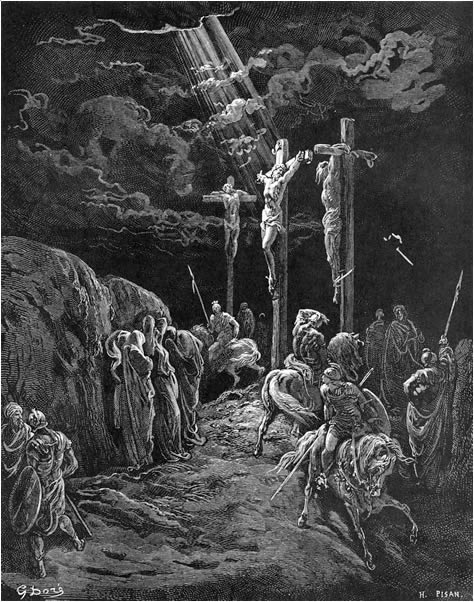
And they crucified him,.... That is, the soldiers: they laid the cross upon the ground, and stretched Christ upon it; they extended his two arms as far as they could, to the transverse part of it, and nailed his hands unto it: his two feet they fixed by each other on a basis, in the body of the cross, through which they also drove nails; and then raising it up, fixed it in the earth, and left him hanging on it till he expired.
The Nineteenth Century1 voice
A commentator
Albert Barnes1798–1870
Notes, Explanatory and Practical, on the Old and New Testaments (1832-1869)
And they crucified him - To “crucify” means to put to death on a cross. The “cross” has been described at Mat 27:32. The usual manner of the crucifixion was as follows: After the criminal had carried the cross, attended with every possible gibe and insult, to the place of execution, a hole was dug in the earth to receive the foot of it. The cross was laid on the ground; the person condemned to suffer was stripped and was extended on it, and the soldiers fastened the hands and feet either by nails or thongs.
The words behind it
9 Greek wordsEvery Greek word of this verse in the order it stands, with what it means and the door to its own study. The last column counts the times a word stands in the whole Bible: the rarer the word, the more the places it appears belong together.
| Greek | Sound | Meaning | Word study | In the Bible |
|---|---|---|---|---|
| σταυρώσαντες | staurosantes | having crucified | G4717 → | 46 times |
| δὲ | de | now | G1161 → | 2765 times |
| αὐτὸν | auton | Him | G846 → | 5565 times |
| διεμερίσαντο | diemerisanto | they divided | G1266 → | |
| τὰ | ta | the | G3588 → | 19766 times |
| ἱμάτια | himatia | garments | G2440 → | 60 times |
| αὐτοῦ | autou | of Him | G846 → | 5565 times |
| βάλλοντες | ballontes | casting | G906 → | 121 times |
| κλῆρον, | kleron | lots, | G2819 → |
σταυρώσαντεςhaving crucified
staurosantesG4717 →46 times
δὲnow
deG1161 →2765 times
αὐτὸνHim
autonG846 →5565 times
διεμερίσαντοthey divided
diemerisantoG1266 →
τὰthe
taG3588 →19766 times
ἱμάτιαgarments
himatiaG2440 →60 times
αὐτοῦof Him
autouG846 →5565 times
βάλλοντεςcasting
ballontesG906 →121 times
κλῆρον,lots,
kleronG2819 →
A shaded row is a word that stands 400 times or fewer in the Bible.
The walk
8 stopsEach card is a verse this one points to, and under it the verses that one points to in turn. Where several paths arrive at the same place, that place is listed first: the text keeps returning to it.
Through
Luke 23:34Then Jesus said, “Father, forgive them, for they do not know what they are doing.” And they divided up His garments by casting lots.
it leads to
- Matthew 5:44
But I tell you, love your enemies and pray for those who persecute you,
- Acts 7:60
Falling on his knees, he cried out in a loud voice, “Lord, do not hold this sin against them.” And when he had said this, he fell asleep.
- 1 Peter 3:9
Do not repay evil with evil or insult with insult, but with blessing, because to this you were called so that you may inherit a blessing.
- 1 Peter 2:20–23
How is it to your credit if you are beaten for doing wrong and you endure it? But if you suffer for doing good and you endure it, this is commendable before God.
- Luke 6:27–28
But to those of you who will listen, I say: Love your enemies, do good to those who hate you,
- Matthew 5:44
Through
Psalms 22:18They divide my garments among them and cast lots for my clothing.
it leads to
- Luke 23:34
Then Jesus said, “Father, forgive them, for they do not know what they are doing.” And they divided up His garments by casting lots.
- John 19:23–24
When the soldiers had crucified Jesus, they divided His garments into four parts, one for each soldier, with the tunic remaining. It was seamless, woven in one piece from top to bottom.
- Mark 15:24
And they crucified Him. They also divided His garments by casting lots to decide what each of them would take.
- Luke 23:34
Where this verse is studied
About Matthew
This page draws on Albert Barnes, Notes, Explanatory and Practical, on the Old and New Testaments (1832-1869); Jamieson, Fausset & Brown, Commentary Critical and Explanatory on the Whole Bible; Jerome, Commentary on Matthew; John Gill, Exposition of the New Testament (1746-1748) and Matthew Henry, Commentary on the Whole Bible.