
Luke 22:19
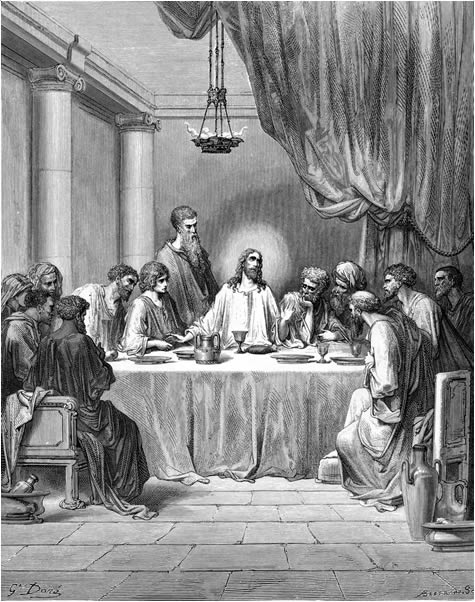
in Luke 22And He took the bread, gave thanks and broke it, and gave it to them, saying, “This is My body, given for you; do this in remembrance of Me.”
BSB
The same verse in ASV and KJV ▾
ASV
And he took bread, and when he had given thanks, he brake it, and gave to them, saying, This is my body which is given for you: this do in remembrance of me.
KJV
And he took bread, and gave thanks, and brake it, and gave unto them, saying, This is my body which is given for you: this do in remembrance of me.
⋯
This verse in Luke 22
Commentary
31 notes on this verseIsrael ate the meat of a dumb lamb to complete the Passover. Having done so, they smeared their doorposts with blood and laughed at the destroyer. We eat of the Word of the Father, the Son, our Savior. We have the lintels of our hearts sealed with the blood of the new covenant.
This site's exposition
He took the bread, gave thanks
Jesus said, This is My body, given for you; do this in remembrance of Me. The disputed word is the verb is: Roman Catholic and Lutheran traditions read a real presence, and Reformed and Zwinglian traditions read a memorial sign. Luke and Paul alone record the command to remember.
The record, by era
The Church Fathers5 voices
A commentator
Desert FathersThe Desert Fathers, Sayings of the Early Christian Monks · Written before 500.
proposed
Daniel the disciple of Arsenius used to talk also about a hermit in Scetis, saying that he was a great man but simple in the faith, and in his ignorance he thought and said that the bread which we receive is not in very truth …
(de Con. Ev. lib. iii. c. 1.) Or because Luke has twice mentioned the cup, first before Christ gave the bread, then after He had given it, on the first occasion he has anticipated, as he frequently does, but on the second that which he has placed in its natural order, he had made no mention of before. But both joined together make the same sense which we find in the others, that is, Matthew and Mark.
You hold the sacraments in their order. First, after the prayer, you are admonished to lift up your hearts; this befits the members of Christ. For if you have become members of Christ, where is your head? Members have a head. If the head had not gone before, the members would not follow. Where did our head go? What did you recite in the Creed? On the third day, He rose again from the dead, He ascended into heaven, He sits at the right hand of the Father. Therefore, our head is in Heaven. Thus when it is said: Lift up your hearts, you answer: We have them with the Lord. And so that you do not attribute the fact that you have your hearts with the Lord to your own strengths, merits, or labors—for it is a gift of God to have your heart lifted up to Him—the bishop or the priest who offers the sacrifice continues and says—when the people respond: We have them with the Lord—: Let us give thanks to the Lord our God, because we have our hearts with the Lord. Let us give thanks because if he did not give it, we would have our hearts on earth. And you attest by saying: It is right and just, that we should give thanks to Him who made us have our hearts lifted up to our head. Then, after the sanctification of God's sacrifice, because he willed that we ourselves should be his sacrifice—this was shown when the first sacrifice of God was laid down and we—meaning the sign of the reality—which we are; behold where the sanctification has been accomplished, we say the Lord's Prayer, which you have received and rendered. After it has been said: Peace be with you, and the Christians give each other a holy kiss. It is a sign of peace: as the lips show, let it be done in conscience, that is, just as your lips approach your brother's lips, let your heart not depart from his heart. Great indeed are the sacraments and very great indeed. Do you wish to know how they are commended? […]
(Orat. de Bapt. Christ.) For the bread before the consecration is common bread, but when the mystery has consecrated it, it is, and it is called, the Body of Christ.
We may not, I say, we may not call into question the truth of the (poor vilified) senses, lest we should even in Christ Himself, bring doubt upon the truth of their sensation; lest perchance it should be said that He did not really "behold Satan as lightning fall from heaven; " that He did not really hear the Father's voice testifying of Himself; or that He was deceived in touching Peter's wife's mother; or that the fragrance of the ointment which He afterwards smelled was different from that which He accepted for His burial; and that the taste of the wine was different from that which He consecrated in memory of His blood. On this false principle it was that Marcion actually chose to believe that He was a phantom, denying to Him the reality of a perfect body.
24 more voices on this verse
The Church Fathers9 voices
Then, having taken the bread and given it to His disciples, He made it His own body, by saying, "This is my body," that is, the figure of my body.
A commentator
Apostolic ConstitutionsConstitutions of the Holy Apostles Book 5 · Written before 380.
proposed
For this reason do you also, now the Lord is risen, offer your sacrifice, concerning which He made a constitution by us, saying, "Do this for a remembrance of me;" and thenceforward leave off your fasting, and rejoice, and keep a festival, because Jesus Christ, the pledge of our resurrection, is risen from the dead. And let this be an everlasting ordinance till the consummation of the world, until the Lord come. For to Jews the Lord is still dead, but to Christians He is risen: to the former, by their unbelief; to the latter, by their full assurance of faith. For the hope in Him is immortal and eternal life.
A commentator
Apostolic ConstitutionsApostolic Constitutions (Book VIII), Section 2, XII · Written before 380.
proposed
Being mindful, therefore, of those things that He endured for our sakes, we give You thanks, O God Almighty, not in such a manner as we ought, but as we are able, and fulfil His constitution: "For in the same night that He was betrayed, He took bread" [1 Corinthians 11:23] in His holy and undefiled hands, and, looking up to You His God and Father, "He broke it, and gave it to His disciples, saying, This is the mystery of the new covenant: take of it, and eat. This is my body, which is broken for many, for the remission of sins." In like manner also "He took the cup," and mixed it of wine and water, and sanctified it, and delivered it to them, saying: "Drink all of this; for this is my blood which is shed for many, for the remission of sins: do this in remembrance of me. For as often as you eat this bread and drink this cup, you do show forth my death until I come." Being mindful, therefore, of His passion, and death, and resurrection from the dead, and return into the heavens, and His future second appearing, wherein He is to come with glory and power to judge the quick and the dead, and to recompense to every one according to his works, we offer to You, our King and our God, according to His constitution, this bread and this cup, giving You thanks, through Him, that You have thought us worthy to stand before You, and to sacrifice to You; and we beseech You that You will mercifully look down upon these gifts which are here set before You, O God, who standest in need of none of our offerings. […]
(Moral. Reg. 21. c. 3. Reg. Brev. ad int. 172.) Learn then in what manner you ought to eat the Body of Christ, namely, in remembrance of Christ's obedience even unto death, that they who live may no more live in themselves, but in Him who died for them, and rose again. (2 Cor. 5:15.)
We should eat the body and drink the blood of the Lord as a commemoration of the Lord's obedience unto death. They who live might then no longer live for themselves but to him who died for them and rose again.
Now concerning the Thanksgiving (Eucharist), thus give thanks. First, concerning the cup: We thank thee, our Father, for the holy vine of David Thy servant, which Thou madest known to us through Jesus Thy Servant; to Thee be the glory for ever. And concerning the broken bread: We thank Thee, our Father, for the life and knowledge which Thou modest known to us through Jesus Thy Servant; to Thee be the glory for ever. Even as this broken bread was scattered over the hills, and was gathered together and became one, so let Thy Church be gathered together from the ends of the earth into Thy kingdom; for Thine is the glory and the power through Jesus Christ for ever. But let no one eat or drink of your Thanksgiving (Eucharist), but they who have been baptized into the name of the Lord; for concerning this also the Lord hath said, Give not that which is holy to the dogs. But after ye are filled, thus give thanks: We thank Thee, holy Father, for Thy holy name which Thou didst cause to tabernacle in our hearts, and for the knowledge and faith and immortality, which Thou modest known to us through Jesus Thy Servant; to Thee be the glory for ever. Thou, Master almighty, didst create all things for Thy name's sake; Thou gavest food and drink to men for enjoyment, that they might give thanks to Thee; but to us Thou didst freely give spiritual food and drink and life eternal through Thy Servant. Before all things we thank Thee that Thou art mighty; to Thee be the glory for ever. Remember, Lord, Thy Church, to deliver it from all evil and to make it perfect in Thy love, and gather it from the four winds, sanctified for Thy kingdom which Thou hast prepared for it; for Thine is the power and the glory for ever. Let grace come, and let this world pass away. Hosanna to the God (Son) of David! If any one is holy, let him come; if any one is not so, let him repent. Maran atha. Amen. […]
For the apostles, in the memoirs composed by them, which are called Gospels, have thus delivered unto us what was enjoined upon them; that Jesus took bread, and when He had given thanks, said, "This do ye in remembrance of Me, this is My body;" and that, after the same manner, having taken the cup and given thanks, He said, "This is My blood;" and gave it to them alone.
(in Luc.) Nor doubt that this is true; for He plainly says, This is my body; but rather receive the words of thy Saviour in faith. For since He is the Truth, He lies not. (Ep. ad Calosyr.). a They rave foolishly then who say that the mystical blessing loses its power of sanctifying, if any remains are left till the following day. For the most holy Body of Christ will not be changed, but the power of blessing and the life-giving grace is ever abiding in it. (in Luc. ut sup.). For the life-giving power of God the Father is the only-begotten Word, which was made flesh not ceasing to be the Word, but making the flesh life-giving. What then? since we have in us the life of God, the Word of God dwelling in us, will our body be life-giving? But it is one thing for us by the habit of participation to have in ourselves the Son of God, another for Himself to have been made flesh, that is, to have made the body which He took from the pure Virgin His own Body. He must needs then be in a certain manner united to our bodies by His holy Body and precious Blood, which we have received for a life-giving blessing in the bread and wine. For lest we should be shocked, seeing the Flesh and Blood placed on the holy altars, God, in compassion to our infirmities, pours into the offerings the power of life, changing them into the reality of His own flesh, that the body of life may be found in us, as it were a certain life-giving seed. He adds. Do this in commemoration of me.
(Hom. 46. in Joan.) Christ did this to bring us to a closer bond of friendship, and to betoken His love toward us, giving Himself to those who desire Him, not only to behold Him, but also to handle Him, to eat Him, to embrace Him with the fulness of their whole heart. Therefore as lions breathing fire do we depart from that table, rendered objects of terror to the devil. (Hom. 46. in Joan.) For this Blood moulds in us a royal image, it suffers not our nobleness of soul to waste away, moreover it refreshes the soul, and inspires it with great virtue. This Blood puts to flight the devils, summons angels, and the Lord of angels. This Blood poured forth washed the world, and made heaven open. They that partake of it are built up with heavenly virtues, and arrayed in the royal robes of Christ; yea rather clothed upon by the King Himself. And since if thou comest clean, thou comest healthfully; so if polluted by an evil conscience, thou comest to thy own destruction, to pain and torment. For if they who defile the imperial purple are smitten with the same punishment as those who tear it asunder, it is not unreasonable that they who with an unclean heart receive Christ should be beaten with the same stripes as they were who pierced Him with nails.
The Medieval Church7 voices
And taking bread etc. After he has treated the eating of the Passover, here secondly he treats the institution of the Eucharist: concerning which three things are introduced, namely the consecration of the Lord's body, the conferral of power, and the consecration of the blood …
(Eutychius Patriarch.) He that communicates receives the whole Body and Blood of our Lord, even though he receive but a part of the Mysteries. For as one seal imparts the whole of its device to different substances, and yet remains entire after distribution, and as one word penetrates to the hearing of many, so there is no doubt that the Body and Blood of our Lord is received whole in all. But the breaking of the sacred bread signifies the Passion.
And having taken the bread, he gave thanks, and broke it, and gave it to them, saying: This is my body, which is given for you. Do this in remembrance of me. With the old solemnities of the Passover having been completed, which were celebrated …
Having finished the rites of the old Passover, He passes on to the new, which He desires the Church to celebrate in memory of His redemption, substituting for the flesh and blood of the lamb, the Sacrament of His own Flesh and Blood in the figure of the bread and wine, being made a Priest for ever after the order of Melchisedech. (Ps. 110:4.) Hence it is said, And he took bread, and gave thanks, (Heb. 7:21.) as also He had given thanks upon finishing the old feast, leaving us an example to glorify God at the beginning and end of every good work. It follows, And brake it. He Himself breaks the bread which He holds forth, to show that the breaking of His Body, that is, His Passion, will not be without His will. And gave unto them, saying, This is my body which is given for you. He gave to them, is here understood to complete the sentence. Because the bread strengthens, and the wine produces blood in the flesh, the former is ascribed to the Body of Christ, the latter to His Blood. But because both we ought to abide in Christ, and Christ in us, the wine of the Lord's cup is mixed with water, for John bears witness, The people are many waters. (Rev. 17:15.) For this reason then the Apostles communicated after supper, because it was necessary that the typical passover should be first completed, and then they should pass on to the Sacrament of the true Passover. But now in honour of so great a Sacrament, the masters of the Church think right that we should first be refreshed with the spiritual banquet, and afterward with the earthly.
Receive the communion of the spotless mysteries of Christ, believing in fact that they are the body and blood of Christ our God, which he gave to the faithful for the forgiveness of sins. On the same night when he was betrayed, he ordained a new covenant with his holy disciples and apostles and through them for all that should believe on him. He said, " 'Take, eat, this is my body, which is broken for you, for the forgiveness of sins.' In the same way he also took the cup and gave it to them saying, 'Drink all of this. This is my blood of the new covenant, which is shed for you for the forgiveness of sins. Do this in memory of me.' " He, the Word of God, is quick, powerful and working all things by his might. He makes and transforms the bread and wine of the sacrifice through his divine operation into his own body and blood, by the visitation of the Holy Spirit, for the sanctification and enlightenment of those who eagerly participate in it.
Now Luke mentions two cups; of the one we spoke above, Take this, and divide it among yourselves, which we may say is a type of the Old Testament; but the other after the breaking and giving of bread, He Himself imparts to His disciples. Hence it is added, Likewise also the cup after supper. Our Lord calls the cup the New Testament, as it follows, This cup is the New Testament in my blood, which shall be shed for you, signifying that the New Testament has its beginning in His blood. For in the Old Testament the blood of animals was present when the law was given, but now the blood of the Word of God signifies to us the New Testament. But when He says, for you, He does not mean that for the Apostles only was His Body given, and His Blood poured out, but for the sake of all mankind. And the old Passover was ordained to remove the slavery of Egypt; but the blood of the lamb to protect the first-born. The new Passover was ordained to the remission of sins; but the Blood of Christ to preserve those who are dedicated to God. But first the bread is given, next the cup. For in spiritual things labour and action come first, that is, the bread, not only because it is toiled for by the sweat of the brow, but also because while being eaten it is not easy to swallow. Then after labour follows the rejoicing of Divine grace, which is the cup.
It seems that Luke mentions two cups. He speaks of one: "Take this and divide it among yourselves" (Luke 22:17), which one might call a figure of the Old Testament, and he speaks of the other after the breaking and distribution of the bread. The …
The Puritans and the Awakening3 voices
And he took bread - Namely, some time after, when supper was ended, wherein they had eaten the paschal lamb. This is my body - As he had just now celebrated the paschal supper, which was called the passover, so in like figurative language, he calls this bread his body.
The breaking of Christ's body as a sacrifice for us is here commemorated by the breaking of bread; and the sacrifices under the law were called the bread of our God ( Lev. xxi. 6, 8, 17 ): This is my body which is given for you. And there is a feast upon that sacrifice instituted, in which we are to apply it to ourselves, and to take the benefit and comfort of it.
And he took bread and gave thanks,.... Or blessed it, as in Mat 26:26. Here begins the account of the Lord's supper after the passover was eaten; and brake it, and gave unto them; the disciples, as is expressed in Mat 26:26 saying, this is my body; See Gill on Mat 26:26. which is given for you; or will be given for you, as an offering for sin in your room and stead; and accordingly it was given into the hands of men, and of justice, and unto death.
The Nineteenth Century5 voices
Took bread - See the nature and design of the Lord’s Supper explained in the notes on Mat 26:26-29 (note). This do in remembrance of me - That the Jews, in eating the passover, did it to represent the sufferings of the Messiah, as evident from the tract Pesachim, fol. 119, quoted by Schoettgen. Why do we call this the great hallel? (i.e. the hymn composed of several psalms, which they sung after the paschal supper). Ans. Because in it these five things are contained: 1. The exodus from Egypt. 2. The dividing of the Red Sea.
A commentator
J.C. Ryle1816–1900
Expository Thoughts on the Gospels: Luke (lightly modernized text, Grace Gems edition) (1858)
proposed
These verses contain Luke's account of the institution of the Lord's supper. It is a passage which every true Christian will always read with deep interest. How astonishing it seems that an ordinance, so beautifully simple at its first appointment, should have been obscured and mystified by man's inventions! What a painful proof it is of human corruption — that some of the bitterest controversies which have disturbed the Church, have been concerning the table of the Lord. Great indeed is the ingenuity of man, in perverting God's gifts!
A commentator
J.C. Ryle1816–1900
Expository Thoughts on the Gospels: Luke (lightly modernized text, Grace Gems edition) (1858)
proposed
These verses contain Luke's account of the institution of the Lord's supper. It is a passage which every true Christian will always read with deep interest. How astonishing it seems that an ordinance, so beautifully simple at its first appointment, should have been obscured and mystified by man's inventions! What a painful proof it is of human corruption — that some of the bitterest controversies which have disturbed the Church, have been concerning the table of the Lord. Great indeed is the ingenuity of man, in perverting God's gifts! The ordinance that should have been for his wealth — is too often made an occasion of stumbling. We should notice, for one thing in these verses — that the principal object of the Lord's supper was to remind Christians of Christ's death for sinners. In appointing the Lord's supper, Jesus distinctly tells His disciples that they were to do what they did, "in remembrance of Me." In one word, the Lord's supper is not a sacrifice. It is eminently a commemorative ordinance. The bread that the believer eats at the Lord's table, is intended to remind him of Christ's body given to death on the cross for his sins. The wine that he drinks, is intended to remind him of Christ's blood shed to make atonement for his transgressions. The whole ordinance was meant to keep fresh in his memory — the sacrifice of Christ on the cross, and the satisfaction which that sacrifice made for the sin of the world. The two elements of bread and wine were intended to preach Christ crucified as our substitute under lively emblems. They were to be a visible sermon, appealing to the believer's senses, and teaching the old foundation-truth of the Gospel — that Christ's death on the cross, is the life of man's soul. We shall do well to keep this simple view of the Lord's supper steadily in view.
It is this that we are to do and not something else which may be supposed to grow out of it. He does not say, "Do something else in remembrance of Me—something which you may choose to do, retaining this act as the backbone of it. But this do." This which has just been done—this in all its simplicity, solemnity and intent. Alas, how sadly have men forgotten this! The plain supper has not been a grand enough display.
It is this that we are to do and not something else which may be supposed to grow out of it. He does not say, "Do something else in remembrance of Me—something which you may choose to do, retaining this act as the backbone of it. But this do." This which has just been done—this in all its simplicity, solemnity and intent. Alas, how sadly have men forgotten this! The plain supper has not been a grand enough display. To break bread and to drink wine have not seemed to them to be sufficiently solemn, or sufficiently gorgeous and so they have added all kinds of rites and institutions. That which was only a table, they have made into an altar and that which was a supper and nothing more, they have changed into a celebration. They do not this but they do something else which they have devised and elaborated. Imagine Paul or Peter attending mass and observing the various genuflections—the moving to and fro, the lifting up and the stooping down and all the various operations of the Roman priesthood—too many to describe! Paul would pluck Peter by the sleeve and say, "Our Master did nothing like this when He took bread and gave thanks and broke it." Peter would reply, "Very different this from the guest-chamber at Jerusalem!" And Paul would add, "Yes, indeed, my Brother, very different this from the time when the first Believers met together and broke bread and drank of the cup in common, in remembrance of their Lord." Whatever other communities may do, be it ours, my Brethren, to stand fast by, "This do in remembrance of Me." "This," simply "this," and nothing more and nothing less. Bread, not a wafer. Fruit of the vine, not the concoction of chemistry inflamed with fiery spirit. We use this fruit of the vine in a cup and that cup not reserved but partaken of by all. We have before us bread and that not worshipped, as at the elevation of the host—but broken and eaten.
How the passage was read
On Luke 22:1-23On Luke 22:1-23
The cups on the table
Luke alone records TWO cups (22:17, 22:20), and the detail is at home in the feast: the Passover meal was ordered around four cups of wine, a structure already fixed in the Mishnah, the first written code of Jewish oral law (Pesachim 10:1). Passover (Pesach) is the spring feast remembering the exodus; its meal, the seder (“order”), moved through blessing, story, and psalm with a cup at each station. Jesus takes the feast's own furniture, and at the cup after supper says the words that made it new: “this cup... is the new covenant in my blood.”
The seder as Jewish families keep it today descends from the same order, reshaped after the Temple fell in AD 70; the lamb on the table then is matzah and remembrance now.
This section is reception history: how the passage was read and kept in the Jewish tradition. Where a reading parts from an essential of the Christian faith, the section says so at that point.
Sources: Mishnah Pesachim 10:1 (the four cups) · The Lord's Supper (this site's study)
The words behind it
24 Greek wordsEvery Greek word of this verse in the order it stands, with what it means and the door to its own study. The last column counts the times a word stands in the whole Bible: the rarer the word, the more the places it appears belong together.
| Greek | Sound | Meaning | Word study | In the Bible |
|---|---|---|---|---|
| Καὶ | kai | And | G2532 → | 9120 times |
| λαβὼν | labon | having taken | G2983 → | 257 times |
| ἄρτον | arton | [the] bread | G740 → | 97 times |
| εὐχαριστήσας | eucharistesas | having given thanks | G2168 → | 38 times |
| ἔκλασεν | eklasen | He broke [it] | G2806 → | |
| καὶ | kai | and | G2532 → | 9120 times |
| ἔδωκεν | edoken | He gave | G1325 → | 412 times |
| αὐτοῖς | autois | to them | G846 → | 5565 times |
| λέγων· | legon | saying; | G3004 → | 1325 times |
| τοῦτό | touto | This | G3778 → | 1381 times |
| ἐστιν | estin | is | G1510 → | 2333 times |
| τὸ | to | the | G3588 → | 19766 times |
| σῶμά | soma | body | G4983 → | 142 times |
| μου | mou | of Mine | G3165 → | 1936 times |
| τὸ | to | which | G3588 → | 19766 times |
| ὑπὲρ | huper | for | G5228 → | 155 times |
| ὑμῶν | humon | you | G4771 → | 2973 times |
| διδόμενον· | didomenon | is given; | G1325 → | 412 times |
| τοῦτο | touto | this | G3778 → | 1381 times |
| ποιεῖτε | poieite | do perform | G4160 → | 569 times |
| εἰς | eis | in | G1519 → | 1755 times |
| τὴν | ten | the | G3588 → | 19766 times |
| ἐμὴν | emen | My | G1473 → | 839 times |
| ἀνάμνησιν. | anamnesin | remembrance. | G364 → |
ΚαὶAnd
kaiG2532 →9120 times
λαβὼνhaving taken
labonG2983 →257 times
ἄρτον[the] bread
artonG740 →97 times
εὐχαριστήσαςhaving given thanks
eucharistesasG2168 →38 times
ἔκλασενHe broke [it]
eklasenG2806 →
καὶand
kaiG2532 →9120 times
ἔδωκενHe gave
edokenG1325 →412 times
αὐτοῖςto them
autoisG846 →5565 times
λέγων·saying;
legonG3004 →1325 times
τοῦτόThis
toutoG3778 →1381 times
ἐστινis
estinG1510 →2333 times
τὸthe
toG3588 →19766 times
σῶμάbody
somaG4983 →142 times
μουof Mine
mouG3165 →1936 times
τὸwhich
toG3588 →19766 times
ὑπὲρfor
huperG5228 →155 times
ὑμῶνyou
humonG4771 →2973 times
διδόμενον·is given;
didomenonG1325 →412 times
τοῦτοthis
toutoG3778 →1381 times
ποιεῖτεdo perform
poieiteG4160 →569 times
εἰςin
eisG1519 →1755 times
τὴνthe
tenG3588 →19766 times
ἐμὴνMy
emenG1473 →839 times
ἀνάμνησιν.remembrance.
anamnesinG364 →
A shaded row is a word that stands 400 times or fewer in the Bible.
The walk
8 stopsEach card is a verse this one points to, and under it the verses that one points to in turn. Where several paths arrive at the same place, that place is listed first: the text keeps returning to it.
Through
1 Corinthians 10:16Is not the cup of blessing that we bless a participation in the blood of Christ? And is not the bread that we break a participation in the body of Christ?
it leads to
- Matthew 26:26–28
While they were eating, Jesus took bread, spoke a blessing and broke it, and gave it to the disciples, saying, “Take and eat; this is My body.”
- 1 Corinthians 11:23–29
For I received from the Lord what I also passed on to you: The Lord Jesus, on the night He was betrayed, took bread,
- Acts 2:42
They devoted themselves to the apostles’ teaching and to the fellowship, to the breaking of bread and to prayer.
- Hebrews 3:14
We have come to share in Christ if we hold firmly to the end the assurance we had at first.
- 1 John 1:7
But if we walk in the light as He is in the light, we have fellowship with one another, and the blood of Jesus His Son cleanses us from all sin.
- Matthew 26:26–28
Through
Luke 22:20In the same way, after supper He took the cup, saying, “This cup is the new covenant in My blood, which is poured out for you.
it leads to
- Zechariah 9:11
As for you, because of the blood of My covenant, I will release your prisoners from the waterless pit.
- Matthew 26:28
This is My blood of the covenant, which is poured out for many for the forgiveness of sins.
- 1 Corinthians 11:25
In the same way, after supper He took the cup, saying, “This cup is the new covenant in My blood; do this, as often as you drink it, in remembrance of Me.”
- Zechariah 9:11
Where this verse is studied
On this page
Studies25
On this verse
On this chapter
About Luke
This page draws on 29 works. Open the list of works
This page draws on Adam Clarke, Commentary on the Bible; Ancient Greek Expositor, Catena Aurea by Aquinas; Apostolic Constitutions, Constitutions of the Holy Apostles Book 5; Apostolic Constitutions, Apostolic Constitutions (Book VIII), Section 2, XII; Athanasius of Alexandria, FESTAL LETTER 4; Augustine of Hippo, Catena Aurea by Aquinas; Augustine of Hippo, SERMON 227; Basil of Caesarea, Catena Aurea by Aquinas; Basil of Caesarea, THE MORALS 21; Bede, On the Gospel of Luke; Bede, Catena Aurea by Aquinas; Bonaventure, Commentary on Luke, Chapter 22; Charles Spurgeon, The Metropolitan Tabernacle Pulpit, Sermon No. 2038: “The Lord's Supper—a Remembrance Of Jesus” (lightly modernized text, CCEL edition); Cyril of Alexandria, Catena Aurea by Aquinas; Desert Fathers, The Desert Fathers, Sayings of the Early Christian Monks; Didache, The Didache, Chapters 9-10; Gregory of Nyssa, Catena Aurea by Aquinas; J.C. Ryle, Expository Thoughts on the Gospels: Luke (lightly modernized text, Grace Gems edition); John Calvin, Commentary on a Harmony of the Evangelists; John Chrysostom, Catena Aurea by Aquinas; John Damascene, BARLAAM AND JOSEPH 19.165-66; John Gill, Exposition of the New Testament (1746-1748); John Wesley, Explanatory Notes upon the New Testament; Justin Martyr, The First Apology, Chapter LXVI; Matthew Henry, Commentary on the Whole Bible; Tertullian, A Treatise on the Soul; Tertullian, Against Marcion Book IV; Theophylact of Ohrid, Catena Aurea by Aquinas and Theophylact of Ohrid, Commentary on Luke.