
Luke 22:21
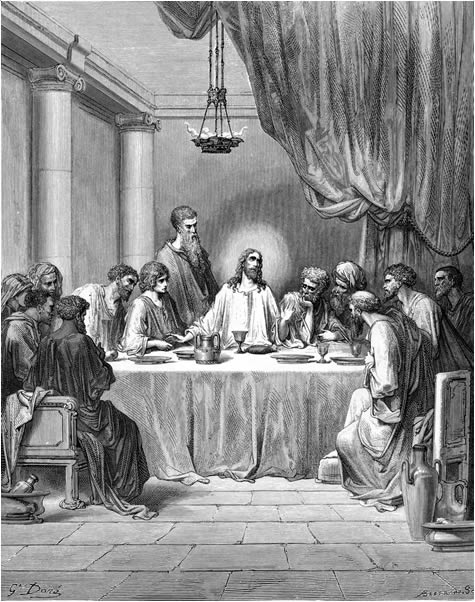
in Luke 22Look! The hand of My betrayer is with Mine on the table.
BSB
The same verse in ASV and KJV ▾
ASV
But behold, the hand of him that betrayeth me is with me on the table.
KJV
But, behold, the hand of him that betrayeth me is with me on the table.
⋯
This verse in Luke 22
Commentary
17 notes on this verseThe hand of him that betrayeth me, etc. - What can be desired more, says Dr. Lightfoot, as a demonstration that Judas was present at the eucharist? And, whereas the contrary is endeavored to be proved out of John 13, nothing is made out of nothing; for there is not one syllable throughout that whole chapter of the paschal supper, but of a supper before the feast of the passover.
This site's exposition
The hand of My betrayer
on Luke 22:21-23
Jesus says the Son of Man will go as it has been determined, yet pronounces woe on the man who betrays Him. The text holds God's plan and Judas's guilt together.
The record, by era
The Church Fathers5 voices
(de Con. Ev. l. iii. c. 1.) When our Lord had given the cup to His disciples, He again spoke of His betrayer, saying, But, behold, the hand of him that betrayeth me, &c.
Some who read carelessly ask if Judas received Christ's body. Understand that the Lord had already distributed the sacrament of his body and blood to all of them when Judas himself also was there, as holy Luke most clearly tells us. After that came this event where, according to John's narrative, the Lord most openly exposes his traitor through the morsel dipped and offered, perhaps signifying through the dipping of the bread that man's pretense. Not everything that is dipped is washed, but some are dipped to be dyed. If the dipping here signifies something good, then damnation rightly followed the one ungrateful for this good.When the bread entered the stomach, the enemy entered the mind of the ungrateful man. Judas was not possessed by the Lord but by the devil. The full effect of so great an evil already conceived in the heart still awaited completion; the damnable intention to do it had already been effected.
It is certain that when the Lord gave the bread to his disciples, he gave them the mystery of his body. One must also then believe that when he gave the bread to his murderer, he gave it to him as the mystery of his …
(Hom. 82. in Matt.) Yet though partaking of the mystery, he was not converted. Nay, his wickedness is made only the more awful, as well because under the pollution of such a design, he came to the mystery, as that coming he was not made better, either by fear, gratitude, or respect.
For we now affirm: This is lawful to the Lord alone: may the power of His indulgence be operative at the present day! At those times, however, in which He lived on earth we lay this down definitively, that it is no prejudgment against us if pardon used to be conferred on sinners-even Jewish ones. For Christian discipline dates from the renewing of the Testament, and (as we have premised) from the redemption of flesh-that is, the Lord's passion.
10 more voices on this verse
The Medieval Church5 voices
And this He said not only to show that He knew all things, but also to declare unto us His own especial goodness, in that He left nothing undone of those things which belonged to Him to do; (for He gives us an example, that even unto the end we should be employed in reclaiming sinners;) and moreover to point out the baseness of the traitor who blushed not to be His guest.
But yet behold, the hand, etc. After having described the eating of the Passover and the consecration of the Eucharist, here thirdly he describes the denunciation of the traitor Judas: concerning the description of which three things are introduced, namely the perversity of the ungrateful …
And yet our Lord does not especially point him out, lest being so plainly detected, he might only become the more shameless. But He throws the charge on the whole twelve, that the guilty one might be turned to repentance. He also proclaims his punishment, that the man whom shame had not prevailed upon, might by the sentence denounced against him be brought to amendment. Hence it follows, And truly the Son of man goeth, &c.
Nevertheless, behold the hand of the one betraying me is with me on the table. And indeed, the Son of Man goes as it has been determined, but woe to that man by whom he is betrayed. He who foretold the passion also foretells the …
There is nothing more wretched than a soul hardened in obstinacy. For see what the Lord says: "Behold, the hand of him who betrays Me is with Me on the table," yet the madman did not come to his senses. The Lord says this not …
The Puritans and the Awakening3 voices
The hand of him that betrayeth me is with me on the table - It is evident Christ spake these words before he instituted the Lord's Supper: for all the other evangelists mention the sop, immediately after receiving which he went out: John xiii, 30.
By placing this after the institution of the Lord's supper, though in Matthew and Mark it is placed before it, it seems plain that Judas did receive the Lord's supper, did eat of that bread and drink of that cup; for, after the solemnity was over, Christ said, Behold, the hand of him that betrayeth me is with me on the table.
But behold the hand of him that betrayeth me,....
The Nineteenth Century2 voices
A commentator
J.C. Ryle1816–1900
Expository Thoughts on the Gospels: Luke (lightly modernized text, Grace Gems edition) (1858)
proposed
These verses contain Luke's account of the institution of the Lord's supper. It is a passage which every true Christian will always read with deep interest. How astonishing it seems that an ordinance, so beautifully simple at its first appointment, should have been obscured and mystified by man's inventions! What a painful proof it is of human corruption — that some of the bitterest controversies which have disturbed the Church, have been concerning the table of the Lord. Great indeed is the ingenuity of man, in perverting God's gifts!
A commentator
J.C. Ryle1816–1900
Expository Thoughts on the Gospels: Luke (lightly modernized text, Grace Gems edition) (1858)
proposed
These verses contain Luke's account of the institution of the Lord's supper. It is a passage which every true Christian will always read with deep interest. How astonishing it seems that an ordinance, so beautifully simple at its first appointment, should have been obscured and mystified by man's inventions! What a painful proof it is of human corruption — that some of the bitterest controversies which have disturbed the Church, have been concerning the table of the Lord. Great indeed is the ingenuity of man, in perverting God's gifts! The ordinance that should have been for his wealth — is too often made an occasion of stumbling. We should notice, for one thing in these verses — that the principal object of the Lord's supper was to remind Christians of Christ's death for sinners. In appointing the Lord's supper, Jesus distinctly tells His disciples that they were to do what they did, "in remembrance of Me." In one word, the Lord's supper is not a sacrifice. It is eminently a commemorative ordinance. The bread that the believer eats at the Lord's table, is intended to remind him of Christ's body given to death on the cross for his sins. The wine that he drinks, is intended to remind him of Christ's blood shed to make atonement for his transgressions. The whole ordinance was meant to keep fresh in his memory — the sacrifice of Christ on the cross, and the satisfaction which that sacrifice made for the sin of the world. The two elements of bread and wine were intended to preach Christ crucified as our substitute under lively emblems. They were to be a visible sermon, appealing to the believer's senses, and teaching the old foundation-truth of the Gospel — that Christ's death on the cross, is the life of man's soul. We shall do well to keep this simple view of the Lord's supper steadily in view.
How the passage was read
On Luke 22:1-23On Luke 22:1-23
The cups on the table
Luke alone records TWO cups (22:17, 22:20), and the detail is at home in the feast: the Passover meal was ordered around four cups of wine, a structure already fixed in the Mishnah, the first written code of Jewish oral law (Pesachim 10:1). Passover (Pesach) is the spring feast remembering the exodus; its meal, the seder (“order”), moved through blessing, story, and psalm with a cup at each station. Jesus takes the feast's own furniture, and at the cup after supper says the words that made it new: “this cup... is the new covenant in my blood.”
The seder as Jewish families keep it today descends from the same order, reshaped after the Temple fell in AD 70; the lamb on the table then is matzah and remembrance now.
This section is reception history: how the passage was read and kept in the Jewish tradition. Where a reading parts from an essential of the Christian faith, the section says so at that point.
Sources: Mishnah Pesachim 10:1 (the four cups) · The Lord's Supper (this site's study)
The words behind it
12 Greek wordsEvery Greek word of this verse in the order it stands, with what it means and the door to its own study. The last column counts the times a word stands in the whole Bible: the rarer the word, the more the places it appears belong together.
| Greek | Sound | Meaning | Word study | In the Bible |
|---|---|---|---|---|
| πλὴν | plen | But | G4133 → | 31 times |
| ἰδοὺ | idou | behold | G2400 → | 200 times |
| ἡ | he | the | G3588 → | 19766 times |
| χεὶρ | cheir | hand | G5495 → | 175 times |
| τοῦ | tou | of the [one] | G3588 → | 19766 times |
| παραδιδόντος | paradidontos | betraying | G3860 → | 119 times |
| με | me | Me | G3165 → | 1936 times |
| μετ᾽ | met᾽ | [is] with | G3326 → | 461 times |
| ἐμοῦ | emou | Me | G1473 → | 839 times |
| ἐπὶ | epi | on | G1909 → | 883 times |
| τῆς | tes | the | G3588 → | 19766 times |
| τραπέζης. | trapezes | table. | G5132 → | 15 times |
πλὴνBut
plenG4133 →31 times
ἰδοὺbehold
idouG2400 →200 times
ἡthe
heG3588 →19766 times
χεὶρhand
cheirG5495 →175 times
τοῦof the [one]
touG3588 →19766 times
παραδιδόντοςbetraying
paradidontosG3860 →119 times
μεMe
meG3165 →1936 times
μετ᾽[is] with
met᾽G3326 →461 times
ἐμοῦMe
emouG1473 →839 times
ἐπὶon
epiG1909 →883 times
τῆςthe
tesG3588 →19766 times
τραπέζης.table.
trapezesG5132 →15 times
A shaded row is a word that stands 400 times or fewer in the Bible.
The walk
8 stopsEach card is a verse this one points to, and under it the verses that one points to in turn. Where several paths arrive at the same place, that place is listed first: the text keeps returning to it.
Through
Psalms 41:9Even my close friend whom I trusted, the one who shared my bread, has lifted up his heel against me.
it leads to
- Matthew 26:23
Jesus answered, “The one who has dipped his hand into the bowl with Me will betray Me.
Reached by 2 separate paths from here.
- John 13:18
I am not speaking about all of you; I know whom I have chosen. But this is to fulfill the Scripture: ‘The one who shares My bread has lifted up his heel against Me.’
- Psalms 55:12–14
For it is not an enemy who insults me; that I could endure. It is not a foe who rises against me; from him I could hide.
- Psalms 55:20–22
My companion attacks his friends; he violates his covenant.
- John 13:26–27
Jesus answered, “It is the one to whom I give this morsel after I have dipped it.” Then He dipped the morsel and gave it to Judas son of Simon Iscariot.
- Matthew 26:23
Through
John 13:26Jesus answered, “It is the one to whom I give this morsel after I have dipped it.” Then He dipped the morsel and gave it to Judas son of Simon Iscariot.
it leads to
- Mark 14:19–20
They began to be grieved and to ask Him one after another, “Surely not I?”
- John 13:30
As soon as he had received the morsel, Judas went out into the night.
- John 6:70–71
Jesus answered them, “Have I not chosen you, the Twelve? Yet one of you is a devil!”
- Mark 14:19–20
Where this verse is studied
On this page
Studies25
On this verse
On this chapter
- The Covenants
- Forgiving Yourself: What Scripture Says
- Gethsemane (The Garden Called the Oil Press)
- Hospitality
- Jesus on Discipleship
- Jesus on the Kingdom
Show the next 6 titles
About Luke
This page draws on 16 works. Open the list of works
This page draws on Adam Clarke, Commentary on the Bible; Augustine of Hippo, Catena Aurea by Aquinas; Augustine of Hippo, TRACTATES ON THE GOSPEL OF JOHN 62.3-4; Bede, Catena Aurea by Aquinas; Bede, On the Gospel of Luke; Bonaventure, Commentary on Luke, Chapter 22; Ephrem the Syrian, COMMENTARY ON TATIAN'S DIATESSARON 19.3; J. C. Ryle, Expository Thoughts on the Gospels, Luke; J.C. Ryle, Expository Thoughts on the Gospels: Luke (lightly modernized text, Grace Gems edition); John Chrysostom, Catena Aurea by Aquinas; John Gill, Exposition of the New Testament (1746-1748); John Wesley, Explanatory Notes upon the New Testament; Matthew Henry, Commentary on the Whole Bible; Tertullian, On Modesty; Theophylact of Ohrid, Catena Aurea by Aquinas and Theophylact of Ohrid, Commentary on Luke.