
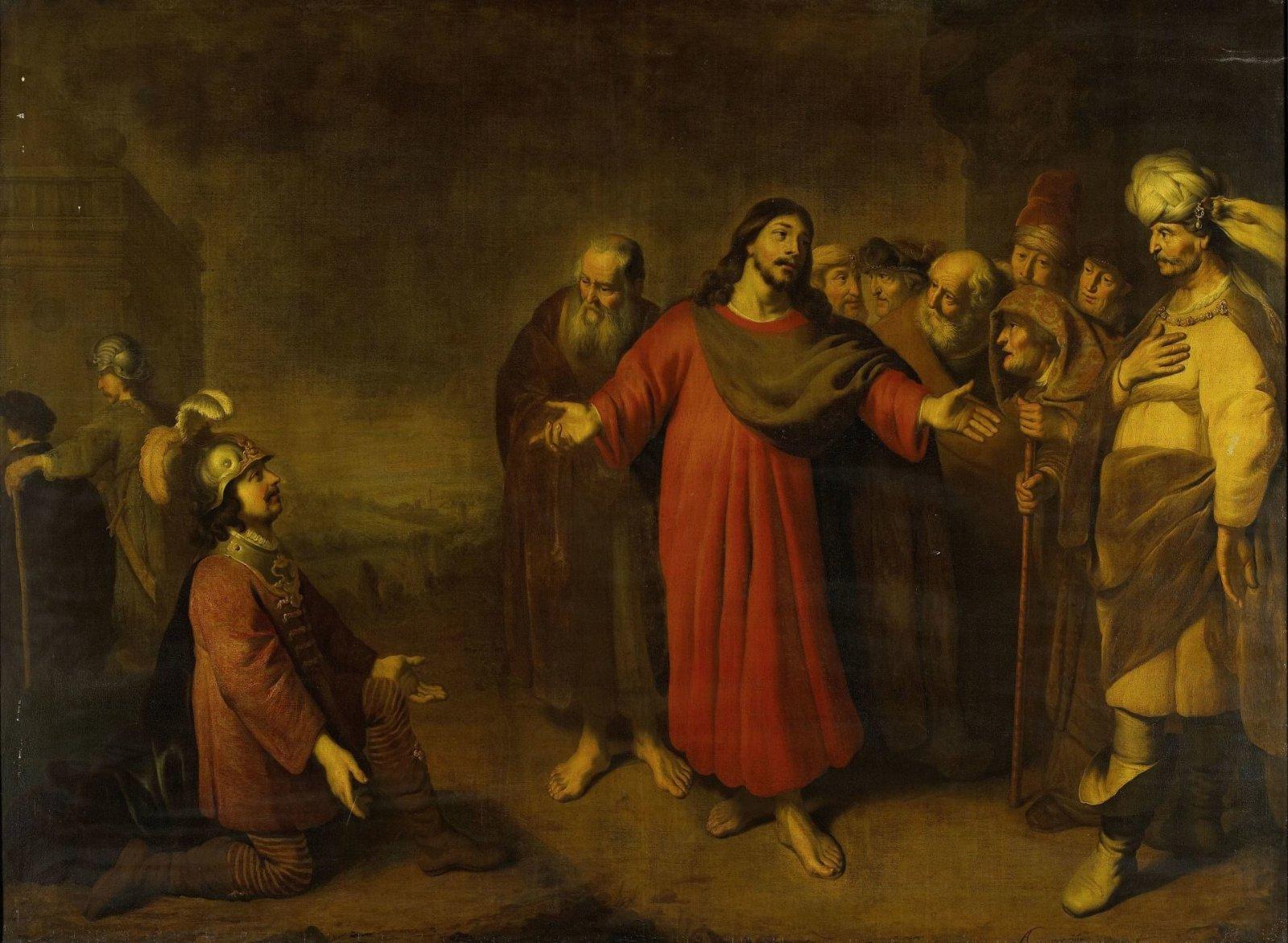
Adam Camerarius, Christ and the Centurion, 1644 to 1665. Public domain.
Luke 7:4 to 5 · Subject · Featured Study
Honor, Patronage and the Household in the New Testament World
Luke and Paul wrote for readers who lived inside the customs of patrons, clients and the household.
They came to Jesus and pleaded with Him earnestly, “This man is worthy to have You grant this, for he loves our nation and has built our synagogue.”
- Book
- Luke
- Hold in memory
- Luke 14:13, Luke 22:27
Seneca wrote that the giver of a gift should forget it at once, and the receiver should never forget it.
Summary
In the Roman world a gift bound the one who received it to the giver. Paul's letters speak to both masters and slaves.
- Seneca called ingratitude the most common of the great vices.
- Dionysius traced Rome's custom of patrons and clients back to Romulus.
- Roman law, Lightfoot wrote, set almost no limit on a master's power over his slave.
A Roman Officer and a Jewish Town
Luke shows a patron's bond with the people he had helped.
There a highly valued servant of a centurion was sick and about to die. When the centurion heard about Jesus, he sent some Jewish elders to ask Him to come and heal his servant.The elders' errand shows the claim a benefactor held on those he had helped.
The Three Pairs of the Household
Each pair of the household appears in Colossians 3:18 to 4:1.
In each pair Colossians speaks to the wife before the husband, the child before the father and the slave before the master.
| The pair | Spoken to first | Spoken to second |
|---|---|---|
| Husband and wife | Wives | Husbands |
| Father and children | Children | Fathers |
| Master and slave | Slaves | Masters |
The Household and Its Head
Aristotle wrote that a city is made of households, and a complete household holds slaves and free people.
He named the first and fewest parts of a family as master and slave, husband and wife, and father and children.
In Acts 16 Lydia of Thyatira, a dealer in purple cloth, came to believe.
And when she and her household had been baptized, she urged us, “If you consider me a believer in the Lord, come and stay at my house.” And she persuaded us.The verse shows the head of a household bringing her house and her home with her into the church.
Seneca on Gifts and Gratitude
The Roman writer Seneca wrote On Benefits about gifts and the thanks owed for them.
Seneca read the three Graces, dancing hand in hand, as a picture of a benefit passing from hand to hand and back to the giver.
But when you host a banquet, invite the poor, the crippled, the lame, and the blind, and you will be blessed. Since they cannot repay you, you will be repaid at the resurrection of the righteous.”The command cuts across the circle of giving and repaying that Seneca describes.
Patrons and Clients in Rome
Dionysius of Halicarnassus set down the duties owed on both sides.
The patron explained the laws to his clients and cared for their money and contracts, as fathers do for their sons.
The clients in turn helped their patron pay his daughters' dowries, and paid his ransom if enemies took him or his children captive.
Four Greek Words of the House and the Gift
Two words name the house and its servant, and two name the giver and the helper.
οἶκος oikos, house or household
112 uses in the canon
A dwelling, and the people who live in it, the word for the households baptized in Acts 16.
οἰκέτης oiketēs, household slave
4 uses in the canon
A fellow resident of the house who serves in it, the servant who cannot serve two masters.
εὐεργέτης euergetēs, benefactor
1 use in the canon
A worker of good, the title Jesus says the rulers of the nations give themselves.
προστάτις prostatis, patroness
1 use in the canon
A woman who stands by others as a helper, the word Paul uses of Phoebe.
Benefactors and the One Who Serves
At the table in Luke 22 Jesus set His own service against kings who called themselves benefactors.
But you shall not be like them. Instead, the greatest among you should be like the youngest, and the one who leads like the one who serves.Jesus sets His disciples' way of leading against the custom of the benefactor.
Thayer's lexicon notes that Benefactor was a title of honour given to those who had served their country, and to princes.
Plummer adds that some of the Greek kings of Egypt carried the title as a lasting name.
A Slave Sent Back as a Brother
Paul wrote to Philemon about a slave of his household.
For perhaps this is why he was separated from you for a while, so that you might have him back for good— no longer as a slave, but better than a slave, as a beloved brother. He is especially beloved to me, but even more so to you, both in person and in the Lord.The verses show the bond of faith reaching into the relation of a master and his slave.
Lightfoot wrote that Onesimus was a thief and a runaway. In going back he put himself wholly at his master's mercy.
Lightfoot added that slaves were often crucified for lesser offences than his.
Sources
Scripture is the Berean Standard Bible.
- Aristotle, Politics, book 1, chapter 3, translated by Benjamin Jowett (1885)
- Dionysius of Halicarnassus, Roman Antiquities 2.9 to 2.10, translated by Earnest Cary, Loeb Classical Library (1937)
- Seneca, On Benefits 1.1, 1.3, 2.10 and 3.1, translated by Aubrey Stewart (1887)
- J. H. Thayer, A Greek-English Lexicon of the New Testament (New York: Harper and Brothers, 1889), the entry euergetes.
- Alfred Plummer, A Critical and Exegetical Commentary on the Gospel According to S. Luke, International Critical Commentary, 10th edition (1914), on Luke 22:25.
- J. B. Lightfoot, Saint Paul's Epistles to the Colossians and to Philemon (London: Macmillan, 1875), Introduction to the Epistle to Philemon.
Keep Studying
Studies1
Values3
People and groups4
Doctrines1
Go further1