
Luke 22:14
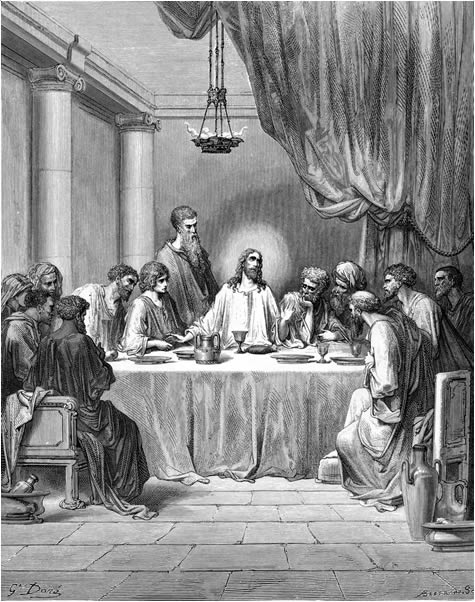
in Luke 22When the hour had come, Jesus reclined at the table with His apostles.
BSB
The same verse in ASV and KJV ▾
ASV
And when the hour was come, he sat down, and the apostles with him.
KJV
And when the hour was come, he sat down, and the twelve apostles with him.
⋯
This verse in Luke 22
Commentary
17 notes on this verseAnd when the hour was come,.... When it was evening, the last of the two evenings, when it was dark, at least after six o'clock; See Gill on Mat 26:20. he sat down; or lay along on a couch, as was the custom; see the note, as before: and the twelve apostles with him; for Judas, after he had made his bargain with the chief priests, Scribes, and elders, came and took his place with the rest of the apostles, both to cover his sin, and to watch the best opportunity of betraying his master.
This site's exposition
the twelve apostles with him
on Luke 22:14-16
When the hour was come, he sat down, and the twelve apostles with him, and said, with desire I have desired to eat this passover with you before I suffer, the Hebrew idiom of doubled verb intensifying the longing to its greatest strength, a desire the bench reads as reaching toward the meal's fulfillment rather than merely its enjoyment. I will not any more eat thereof, until it be fulfilled in the kingdom of God, Jesus naming this Passover as his last until a greater one, the meal's ancient deliverance from Egypt about to be completed in a deliverance the Passover had always pointed toward without yet naming. The bench reads his suffering, spoken of here directly to the twelve, as the lens through which the whole meal that follows must be read.
The record, by era
The Church Fathers4 voices
On its way to Jerusalem, Israel was purified in the wilderness and was trained to forget the customs of Egypt. Similarly the Word has graciously prescribed for us the holy fast of forty days of Lent. Let us make it a time of purification and purging, so that after the fast we will be prepared to go to the upper room and eat with him, to be partakers of the joys of heaven. There is no other way for us to be prepared to go up to Jerusalem and eat the Passover but to apply ourselves to the forty-day fast.
Above all, however, I wish to remind you and myself along with you that the Lord does not want us to come irreverently or unprepared to the Easter feast. We must have our doctrine straight, follow the proper liturgy, and do all things properly. The historical record of Israel's feast tells us, "No foreigner, no slave purchased with money, no uncircumcised man, may eat the Passover." It is not supposed to be eaten in just any house. There is a proper place.
From the moment when he broke his body for his disciples and gave it to his apostles, three days are numbered during which he was counted among the dead, like Adam. Although Adam lived for many years after having eaten of the fruit of the …
As soon as the disciples had prepared the Passover, they proceed to eat it; as it is said, And when the hour was come, &c. He says this, because the covetous disciple was looking out for the time for betraying Him; but that he might not betray Him before the feast of the Passover, our Lord had not divulged either the house, or the man with whom He should keep the Passover. That this was the cause is very evident from these words.
The Medieval Church1 voice
But how is our Lord said to sit down, whereas the Jews eat the Passover standing? They say, that when they had eaten the legal Passover, they sat down, according to the common custom, to eat their other food.
10 more voices on this verse
The Medieval Church4 voices
And when the hour had come, etc. After having described the preparation of the paschal meal, he here describes the consecration of the Sacrament of the altar. And since this Sacrament is the fulfillment of the Law and is fruitless for the ungrateful, this section …
And when the hour had come, he reclined at the table, and the twelve apostles with him. The hour of eating the Passover is designated, which, as it has been often emphasized, occurred on the fourteenth day of the first month, brought to evening, and …
By the hour of eating the Passover, He signifies the fourteenth day of the first month, far gone towards evening, the fifteenth moon just appearing on the earth.
They ate the Passover standing; so how is it said of the Lord that He reclined? They say that, having eaten the lawful Passover, they then reclined afterward, according to the common custom, to eat whatever other foods there were.
The Nineteenth Century6 voices
A commentator
J.C. Ryle1816–1900
Expository Thoughts on the Gospels: Luke (lightly modernized text, Grace Gems edition) (1858)
proposed
These verses contain Luke's account of the institution of the Lord's supper. It is a passage which every true Christian will always read with deep interest. How astonishing it seems that an ordinance, so beautifully simple at its first appointment, should have been obscured and mystified by man's inventions! What a painful proof it is of human corruption — that some of the bitterest controversies which have disturbed the Church, have been concerning the table of the Lord. Great indeed is the ingenuity of man, in perverting God's gifts!
A commentator
J.C. Ryle1816–1900
Expository Thoughts on the Gospels: Luke (lightly modernized text, Grace Gems edition) (1858)
proposed
These verses contain Luke's account of the institution of the Lord's supper. It is a passage which every true Christian will always read with deep interest. How astonishing it seems that an ordinance, so beautifully simple at its first appointment, should have been obscured and mystified by man's inventions! What a painful proof it is of human corruption — that some of the bitterest controversies which have disturbed the Church, have been concerning the table of the Lord. Great indeed is the ingenuity of man, in perverting God's gifts! The ordinance that should have been for his wealth — is too often made an occasion of stumbling. We should notice, for one thing in these verses — that the principal object of the Lord's supper was to remind Christians of Christ's death for sinners. In appointing the Lord's supper, Jesus distinctly tells His disciples that they were to do what they did, "in remembrance of Me." In one word, the Lord's supper is not a sacrifice. It is eminently a commemorative ordinance. The bread that the believer eats at the Lord's table, is intended to remind him of Christ's body given to death on the cross for his sins. The wine that he drinks, is intended to remind him of Christ's blood shed to make atonement for his transgressions. The whole ordinance was meant to keep fresh in his memory — the sacrifice of Christ on the cross, and the satisfaction which that sacrifice made for the sin of the world. The two elements of bread and wine were intended to preach Christ crucified as our substitute under lively emblems. They were to be a visible sermon, appealing to the believer's senses, and teaching the old foundation-truth of the Gospel — that Christ's death on the cross, is the life of man's soul. We shall do well to keep this simple view of the Lord's supper steadily in view.
A commentator
Charles Spurgeon1834–1892
The Metropolitan Tabernacle Pulpit, Sermon No. 3107: “Christ and His Table Companions” (lightly modernized text, CCEL edition) · Written before 1892.
proposed
THE outward ordinances of the Christian religion are but two—and those two are exceedingly simple—yet neither of them has escaped human alteration. And, alas, much mischief has been worked and much of precious teaching has been sacrificed by these miserable perversions! For instance, the ordinance of Baptism, as it was administered by the Apostles, represented the burial of the Believer with Christ and his rising with his Lord into newness of life. Men had to exchange immersion for sprinkling and the intelligent Believer for an unconscious child—and so the ordinance is slain!
A commentator
Charles Spurgeon1834–1892
The Metropolitan Tabernacle Pulpit, Sermon No. 3107: “Christ and His Table Companions” (lightly modernized text, CCEL edition) · Written before 1892.
proposed
THE outward ordinances of the Christian religion are but two—and those two are exceedingly simple—yet neither of them has escaped human alteration. And, alas, much mischief has been worked and much of precious teaching has been sacrificed by these miserable perversions! For instance, the ordinance of Baptism, as it was administered by the Apostles, represented the burial of the Believer with Christ and his rising with his Lord into newness of life. Men had to exchange immersion for sprinkling and the intelligent Believer for an unconscious child—and so the ordinance is slain! The other sacred institution, the Lord's Supper, like Believers' Baptism, is simplicity itself. It consists of broken bread and wine poured out—these items being eaten and drunk at a festival—a delightful picture of the sufferings of Christ for us and of the fellowship which the saints have with one another and with Him. But this ordinance, also, has been tampered with by men. By some, the wine has been taken away altogether, or reserved only for a priestly caste. And the simple bread has been changed into a consecrated host. As for the table, the very emblem of fellowship in all nations—for what expresses fellowship better than surrounding a table and eating and drinking together? This, indeed, must be put away and an "altar" must be erected! And the bread and wine which were to help us to remember the Lord Jesus are changed into an "unbloody sacrifice," and so the whole thing becomes an unscriptural celebration instead of a holy institution for fellowship! Let us be warned by these mistakes of others never either to add to or take from the Word of God so much as a single jot or tittle! Keep upon the foundation of the Scriptures and you stand safely, and have an answer for those who question you.
And when the hour was come - That is, the evening. See Mat 26:20, and Mar 14:17.
A commentator
Albert Barnes1798–1870
Notes, Explanatory and Practical, on the Old and New Testaments (1832-1869)
proposed
When the hour was come - The hour of eating the paschal lamb, which was in the evening. See the notes at Mat 26:20.
How the passage was read
On Luke 22:1-23On Luke 22:1-23
The cups on the table
Luke alone records TWO cups (22:17, 22:20), and the detail is at home in the feast: the Passover meal was ordered around four cups of wine, a structure already fixed in the Mishnah, the first written code of Jewish oral law (Pesachim 10:1). Passover (Pesach) is the spring feast remembering the exodus; its meal, the seder (“order”), moved through blessing, story, and psalm with a cup at each station. Jesus takes the feast's own furniture, and at the cup after supper says the words that made it new: “this cup... is the new covenant in my blood.”
The seder as Jewish families keep it today descends from the same order, reshaped after the Temple fell in AD 70; the lamb on the table then is matzah and remembrance now.
This section is reception history: how the passage was read and kept in the Jewish tradition. Where a reading parts from an essential of the Christian faith, the section says so at that point.
Sources: Mishnah Pesachim 10:1 (the four cups) · The Lord's Supper (this site's study)
The words behind it
11 Greek wordsEvery Greek word of this verse in the order it stands, with what it means and the door to its own study. The last column counts the times a word stands in the whole Bible: the rarer the word, the more the places it appears belong together.
| Greek | Sound | Meaning | Word study | In the Bible |
|---|---|---|---|---|
| καὶ | kai | And | G2532 → | 9120 times |
| ὅτε | hote | when | G3753 → | 103 times |
| ἐγένετο | egeneto | was come | G1096 → | 667 times |
| ἡ | he | the | G3588 → | 19766 times |
| ὥρα, | hora | hour, | G5610 → | 106 times |
| ἀνέπεσεν | anepesen | He reclined | G377 → | 12 times |
| καὶ | kai | and | G2532 → | 9120 times |
| οἱ | hoi | the | G3588 → | 19766 times |
| ἀπόστολοι | apostoloi | apostles | G652 → | 79 times |
| σὺν | sun | with | G4862 → | 128 times |
| αὐτῷ. | auto | Him. | G846 → | 5565 times |
καὶAnd
kaiG2532 →9120 times
ὅτεwhen
hoteG3753 →103 times
ἐγένετοwas come
egenetoG1096 →667 times
ἡthe
heG3588 →19766 times
ὥρα,hour,
horaG5610 →106 times
ἀνέπεσενHe reclined
anepesenG377 →12 times
καὶand
kaiG2532 →9120 times
οἱthe
hoiG3588 →19766 times
ἀπόστολοιapostles
apostoloiG652 →79 times
σὺνwith
sunG4862 →128 times
αὐτῷ.Him.
autoG846 →5565 times
A shaded row is a word that stands 400 times or fewer in the Bible.
The walk
8 stopsEach card is a verse this one points to, and under it the verses that one points to in turn. Where several paths arrive at the same place, that place is listed first: the text keeps returning to it.
Through
Mark 6:30Meanwhile, the apostles gathered around Jesus and brought Him news of all they had done and taught.
it leads to
- Luke 9:10
Then the apostles returned and reported to Jesus all that they had done. Taking them away privately, He withdrew to a town called Bethsaida.
- Luke 10:17
The seventy-two returned with joy and said, “Lord, even the demons submit to us in Your name.”
- Matthew 10:2
These are the names of the twelve apostles: first Simon, called Peter, and his brother Andrew; James son of Zebedee, and his brother John;
- Luke 9:10
Through
Matthew 26:20When evening came, Jesus was reclining with the twelve disciples.
it leads to
- Mark 14:17–21
When evening came, Jesus arrived with the Twelve.
- John 13:21
After Jesus had said this, He became troubled in spirit and testified, “Truly, truly, I tell you, one of you will betray Me.”
- Exodus 12:11
This is how you are to eat it: You must be fully dressed for travel, with your sandals on your feet and your staff in your hand. You are to eat in haste; it…
- Mark 14:17–21
Through
Mark 14:17When evening came, Jesus arrived with the Twelve.
it leads to
- Matthew 26:20–24
When evening came, Jesus was reclining with the twelve disciples.
- John 13:21–26
After Jesus had said this, He became troubled in spirit and testified, “Truly, truly, I tell you, one of you will betray Me.”
- Matthew 26:20–24
Where this verse is studied
On this page
Studies12
On this verse
About Luke
This page draws on 16 works. Open the list of works
This page draws on Adam Clarke, Commentary on the Bible; Albert Barnes, Notes, Explanatory and Practical, on the Old and New Testaments (1832-1869); Athanasius of Alexandria, FESTAL LETTER 6; Athanasius of Alexandria, FESTAL LETTER 11; Bede, On the Gospel of Luke; Bede, Catena Aurea by Aquinas; Bonaventure, Commentary on Luke, Chapter 22; Charles Spurgeon, The Metropolitan Tabernacle Pulpit, Sermon No. 3107: “Christ and His Table Companions” (lightly modernized text, CCEL edition); Cyril of Alexandria, Catena Aurea by Aquinas; Ephrem the Syrian, COMMENTARY ON TATIAN'S DIATESSARON 19.4; J. C. Ryle, Expository Thoughts on the Gospels, Luke; J.C. Ryle, Expository Thoughts on the Gospels: Luke (lightly modernized text, Grace Gems edition); Jamieson, Fausset & Brown, Commentary Critical and Explanatory on the Whole Bible; John Gill, Exposition of the New Testament (1746-1748); Theophylact of Ohrid, Catena Aurea by Aquinas and Theophylact of Ohrid, Commentary on Luke.