
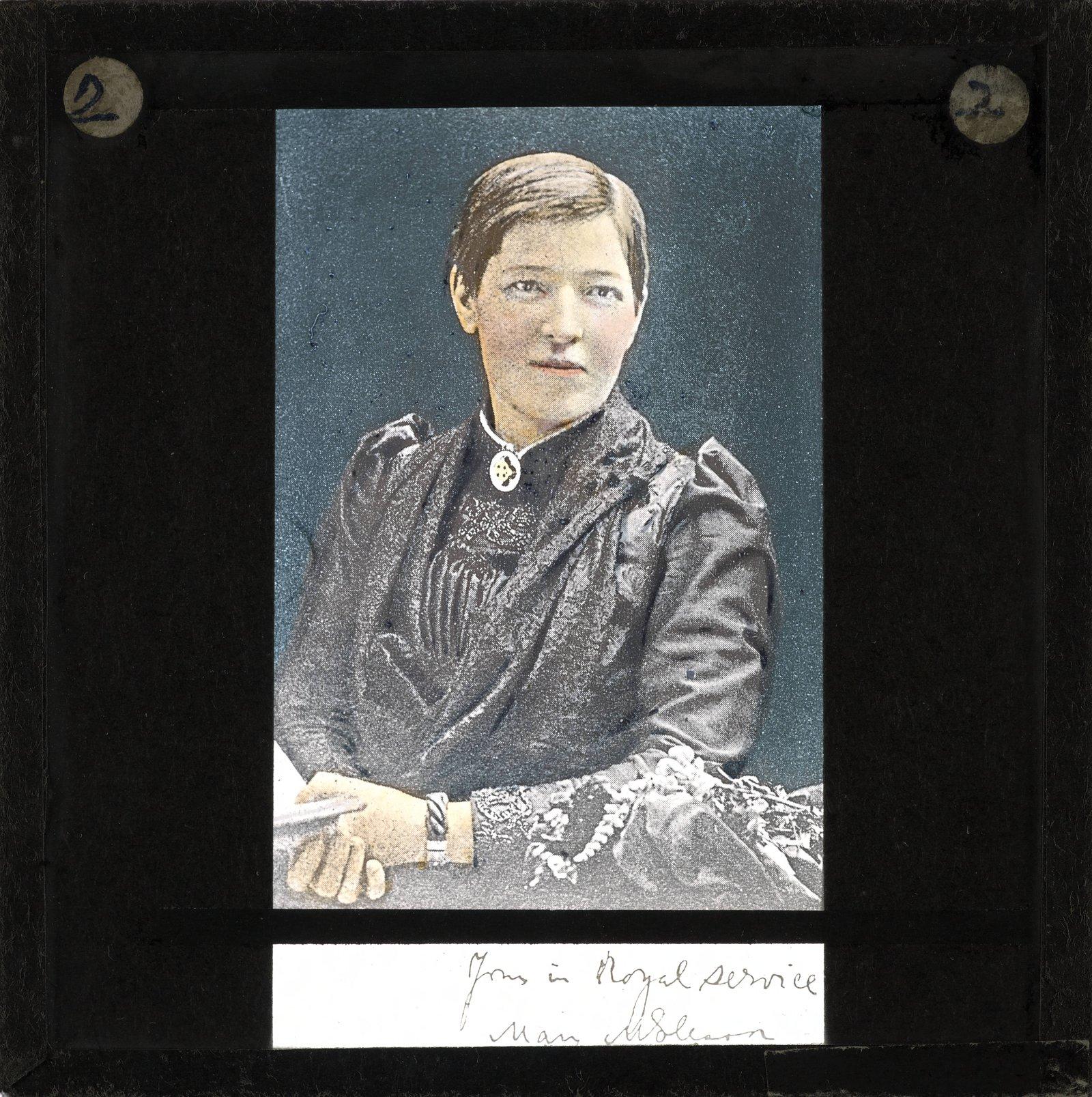
Unknown photographer, Mary Slessor, about 1880. Public domain.
Dundee and the Calabar country, 1848 to 1915 · Person · Featured Study
Mary Slessor
She sailed for Calabar in 1876 and lived among the people of Okoyong from 1888.
A mill girl who read at her loom became the judge of a native court in Okoyong.
And if the Spirit of Him who raised Jesus from the dead is living in you, He who raised Christ Jesus from the dead will also give life to your mortal bodies through His Spirit, who lives in you.
- Born
- 2 December 1848 at Gilcomston, Aberdeen
- Died
- 13 January 1915, at Use or at Itu
- Family
- father: Robert Slessor; adopted daughter: Janie
- Places
- Aberdeen, Dundee, Calabar, Okoyong, Ekenge, Itu, Use
Summary
Mary Slessor went into a Dundee mill at eleven and later sailed for Calabar. In Okoyong the colonial government let her run the native court. She took in twins whom custom left to die. She died on 13 January 1915 and was buried on Mission Hill at Duke Town.
- W. P. Livingstone's life of 1916 prints her letters and her own paper of 1903.
- She studied her Bible at dawn and wrote her comments in its margins.
- The Government Gazette and her biographer place her death in two places.
The Promise She Marked
She marked a verse of Romans as a promise for her body, and she wrote her own reply beside a question of Jesus.
About 1912 her friends sent her to rest in the Canary Islands, and the rest restored her. She turned to the verse in her Bible that she had marked as a promise before she left. She saw that it meant something besides the resurrection, because the voyage and the food had worked a miracle in her.
Then Jesus asked them, “When I sent you out without purse or bag or sandals, did you lack anything?” “Nothing,” they answered.She answered this question in the margin of her Bible.
The Life in Order
Her biographer gives the dates from her letters and from the mission's records.
She spent thirty-eight years in the Calabar mission.
- 2 December 1848She was born at Gilcomston in AberdeenW. P. Livingstone (1916)
- About 1859She began as a half-timer in a Dundee mill at elevenW. P. Livingstone (1916)
- 5 August 1876She sailed for CalabarW. P. Livingstone (1916)
- October 1886Okoyong was chosen for her, as she had askedW. P. Livingstone (1916)
- 1888She settled at Ekenge in OkoyongW. P. Livingstone (1916)
- April 1883She went home to Scotland, too weak to standW. P. Livingstone (1916)
- 1903She asked for freer work in the fieldW. P. Livingstone (1916)
- May 1905She was offered a seat on the Itu Native CourtW. P. Livingstone (1916)
- About 1912She rested in the Canary IslandsW. P. Livingstone (1916)
- 13 January 1915She died, and was buried at Duke TownW. P. Livingstone (1916)
Each step of the life stands with its witness.
1903, May 1905, About 1912, 13 January 1915
From the Mill to Okoyong
Her life ran from the Dundee mill to the inland districts of Calabar.
Mary Slessor was born in Aberdeen, and her family moved to Dundee. At eleven she went into the textile works of Baxter Brothers as a half-timer, working half the day and schooling the other half. She carried a book to the mill and laid it on the loom to read in her free moments.
She sailed for Calabar on 5 August 1876.
In April 1883 she was carried aboard ship for home, too ill to walk, with a girl twin she had rescued. The child was baptized at the Wishart Sunday School and called Janie after her sister.
In October 1886 the mission committee decided to send her to Okoyong, as she wished. She went up in 1888 and settled at Ekenge. She went barefoot, ate the food of the country, and did not boil her water.
When the colonial government came, Sir Claude Macdonald empowered her to organise and run a native court at Okoyong. In 1905 she took a seat on the Itu Native Court as its permanent vice-president, and she refused any salary for it.
In her last years she made her home at Use, on high land near Itu. She died in January 1915, and the girls of her house mourned her as their mother. Her coffin went down the river by launch to Duke Town, and she was buried in the cemetery on Mission Hill.
The Twins of Okoyong
The custom of the country put twins to death, and she set her house against it.
Her biographer lists the killing of twins among the Calabar customs. Their mother was banished to the bush.
She took in twins and their mothers and raised the children in her own household. The people of the district called her Eka kpukpru owo, Everybody's Mother.
At the end of her life Lugard's recommendation brought her admission to the Order of the Hospital of St. John of Jerusalem. The Governor-General of Nigeria wrote that her death was a great loss to the country.
In Their Own Words
Four sayings from her paper of 1903 and the margins of her Bible, on the work, time, slavery and lack.
Mary Slessor (1848 to 1915)
paper to the Mission Council, in Mary Slessor of Calabar (1916)
The methods are not adequate
“I think it is an open secret that for many years the workers here have felt that our methods and modes were very far from adequate to overtake the needs of our immense field […]”
Presbyterian missionary
About this saying1 paragraph
She wrote this paper for a November meeting of the Mission Council, in 1903 by her own count of her years in the field.
Mary Slessor
Notes in the margins of her Bible, page 303
Always on time
“God is never behind time.”
Presbyterian missionary
About this saying1 paragraph
She wrote this in the margin of one of her later Bibles, which still existed in 1916.
Mary Slessor
Notes in the margins of her Bible, page 304
Slavery never pays
“Slavery never pays; the slave is spoiled as a man, and the master not less so.”
Presbyterian missionary
About this saying1 paragraph
This note stands among the same margins, as W. P. Livingstone printed them in 1916.
Mary Slessor
Notes in the margins of her Bible, page 306
Every need met
“No, Lord, never was lack with Thee!”
Presbyterian missionary
About this saying1 paragraph
Beside Luke 22:35, where Jesus asks whether the disciples lacked anything, she wrote this note, which W. P. Livingstone printed in 1916.
The People Around Her
The witnesses name her family, the children she raised, the officials who gave her a court and the friends who buried her.
Her household was made of the children she saved.
| Person | Tie to Slessor | The witness |
|---|---|---|
| Robert Slessor | Her father, a man of Buchan. | W. P. Livingstone (1916) |
| Janie | A twin girl she saved and took home to Scotland in 1883. | W. P. Livingstone (1916) |
| Alice | A girl of her house who nursed her at the end. | W. P. Livingstone (1916) |
| Sir Claude Macdonald | The consul-general who took her advice on bringing in the new laws. | W. P. Livingstone (1916) |
| Miss Peacock | A missionary of Ikotobong who came to her at the end. | W. P. Livingstone (1916) |
| Mammy Fuller | An old friend who sat at the head of her grave. | W. P. Livingstone (1916) |
| W. P. Livingstone | Her biographer, who wrote from her letters in 1916. | W. P. Livingstone (1916) |
The Places of Her Life
Her life runs from two Scottish cities to the coast of Calabar and up its rivers.
She moved inland, away from the mission's stations.
| Place | What the witnesses say | The witness |
|---|---|---|
| Aberdeen | She was born there, in the suburb of Gilcomston. | W. P. Livingstone (1916) |
| Dundee | She worked there in the mill from the age of eleven. | W. P. Livingstone (1916) |
| Duke Town | The mission's town on the Calabar coast, where she is buried. | W. P. Livingstone (1916) |
| Okoyong | The district she went to live in from 1888. | W. P. Livingstone (1916) |
| Ekenge | She settled there and kept her first house in Okoyong. | W. P. Livingstone (1916) |
| Itu | She sat on its native court from 1905. | W. P. Livingstone (1916) |
| Use | Her last home, near Itu, where a rose bush grew. | W. P. Livingstone (1916) |
The Bible in the Margins
She read Scripture slowly and wrote her own commentary beside it.
She read at first light, about half past five, with a fine pen in her hand. She underlined the governing words and would not leave a chapter until she saw its purpose, though it took her three days.
She was her own commentator. In a hard palaver she would say, "Let us see what the Bible says on this point."
She found the early books of the Old Testament close to what she saw in Calabar, and her biographer says St. John was her favourite book.
She believed that spreading the Bible was the simplest and most direct way of preaching the gospel and keeping it pure.
The Voices
One teacher on Romans 8:11.
Matthew Henry (1662 to 1714)
Commentary on the Whole Bible
We shall rise in the virtue of Christ's resurrection
“The body of Christ lay in the grave, under the sin of all the elect imputed, and broke through it. O grave, then, where is thy victory? It is in the virtue of Christ's resurrection that we shall rise.”
on Romans 8:11Puritan
What the Witnesses Leave Open
The witnesses differ on her title, the place of her death and a saying given to her.
Her title in OkoyongW. P. Livingstone
Her biographer of 1916 says that Sir Claude appointed vice-consuls for the districts and gave her the native court of Okoyong, so that her position was akin to that of a consular agent. He names no title of vice-consul for her there.
Use or Ituthe Government Gazette; W. P. Livingstone
The Gazette announced her death at Itu. Her biographer tells of her last days in her own house, of a messenger sent to the doctor at Itu, and of people coming from Itu to see her body.
God and one are a majoritythe Sunday School Times (1888); W. P. Livingstone
The saying is often given to her. Its oldest printing found is unsigned, in the Sunday School Times of 24 November 1888, and her biography of 1916 does not carry it.
Books to Read Next
Mary Slessor of Calabar: Pioneer Missionary
W. P. Livingstone · 1916
W. P. Livingstone wrote it from her letters the year after she died.
Read it free at the Internet ArchiveWhat Slessor Left
She left a household of saved children and Bibles full of her notes.
Sources
Scripture is the Berean Standard Bible.
- The Holy Bible, Berean Standard Bible (read 2026)
- W. P. Livingstone, Mary Slessor of Calabar: Pioneer Missionary, tenth edition (London: Hodder and Stoughton, 1916)
- Matthew Henry, Commentary on the Whole Bible, on Romans 8:11.
Keep Studying
Studies1
People and groups5