
Luke 22:23
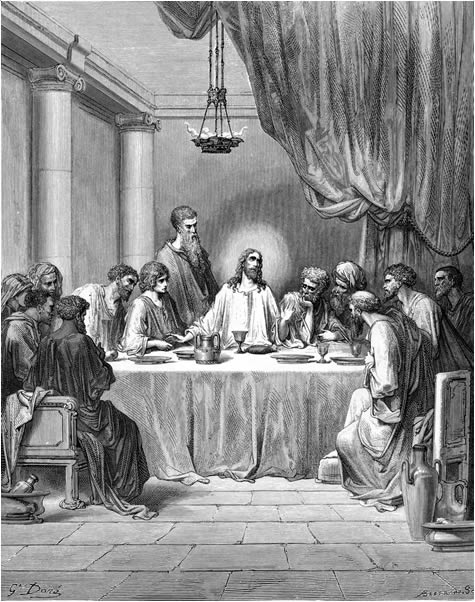
in Luke 22Then they began to question among themselves which of them was going to do this.
BSB
The same verse in ASV and KJV ▾
ASV
And they began to question among themselves, which of them it was that should do this thing.
KJV
And they began to enquire among themselves, which of them it was that should do this thing.
⋯
This verse in Luke 22
Commentary
12 notes on this verseAnd they began to inquire among themselves,.... Two days before, at the supper in Bethany, when the same thing was hinted to them, they looked at one another, Joh 13:22 as persons in the utmost surprise and consternation, not being able, for a while, either to speak to Christ, or one another; but now they inquired among themselves, and of Christ likewise, Mat 26:21 which of them it was that should do this thing; so barbarous, shocking, and horrible.
This site's exposition
The hand of My betrayer
on Luke 22:21-23
Jesus says the Son of Man will go as it has been determined, yet pronounces woe on the man who betrays Him. The text holds God's plan and Judas's guilt together.
This site's exposition
which of them was going to do this
John Gill places an earlier hint at a supper in Bethany, where the disciples only looked at one another in dismay. Now they question each other openly. Matthew Henry calls what follows a self-contradiction of the deceitful heart, for the same men soon argue over who is greatest.
The record, by era
The Church Fathers1 voice
(in Reg. Brev. ad int. 301.) For as in bodily diseases there are many of which the affected are not sensible, but they rather put faith in the opinion of their physicians, than trust their own insensibility; so also in the diseases of the soul, though a man is not conscious of sin in himself, yet ought he to trust to those who are able to have more knowledge of their own sins.
The Medieval Church4 voices
Third, regarding the purity of the Apostles of Christ, he adds: And they began to inquire among themselves which of them it was who would do this. Bede: "The eleven knew that they had thought nothing of the sort, but they trusted the Master more …
And they themselves began to inquire among themselves who it might be from them who was going to do this. And certainly, the eleven apostles knew that they had not conceived such a thing against the Lord, but they believed the teacher more than themselves, …
Although the eleven Apostles knew that they were meditating nothing against their Lord, yet notwithstanding because they trust more to their Master than themselves, fearing their own infirmities, they ask concerning a sin of which they had no consciousness.
Having heard this, the disciples were troubled. You will learn about this more extensively in the commentary on the Gospel of John (see ch. 13).
4 more voices on this verse
The Puritans and the Awakening1 voice
What a self-contradiction is the deceitful heart of man! See what Christ said to this dispute. He was not sharp upon them, as might have been expected (he having so often reproved them for this very thing), but mildly showed them the sin and folly of it.
The Nineteenth Century3 voices
A commentator
J.C. Ryle1816–1900
Expository Thoughts on the Gospels: Luke (lightly modernized text, Grace Gems edition) (1858)
proposed
These verses contain Luke's account of the institution of the Lord's supper. It is a passage which every true Christian will always read with deep interest. How astonishing it seems that an ordinance, so beautifully simple at its first appointment, should have been obscured and mystified by man's inventions! What a painful proof it is of human corruption — that some of the bitterest controversies which have disturbed the Church, have been concerning the table of the Lord. Great indeed is the ingenuity of man, in perverting God's gifts!
A commentator
J.C. Ryle1816–1900
Expository Thoughts on the Gospels: Luke (lightly modernized text, Grace Gems edition) (1858)
proposed
These verses contain Luke's account of the institution of the Lord's supper. It is a passage which every true Christian will always read with deep interest. How astonishing it seems that an ordinance, so beautifully simple at its first appointment, should have been obscured and mystified by man's inventions! What a painful proof it is of human corruption — that some of the bitterest controversies which have disturbed the Church, have been concerning the table of the Lord. Great indeed is the ingenuity of man, in perverting God's gifts! The ordinance that should have been for his wealth — is too often made an occasion of stumbling. We should notice, for one thing in these verses — that the principal object of the Lord's supper was to remind Christians of Christ's death for sinners. In appointing the Lord's supper, Jesus distinctly tells His disciples that they were to do what they did, "in remembrance of Me." In one word, the Lord's supper is not a sacrifice. It is eminently a commemorative ordinance. The bread that the believer eats at the Lord's table, is intended to remind him of Christ's body given to death on the cross for his sins. The wine that he drinks, is intended to remind him of Christ's blood shed to make atonement for his transgressions. The whole ordinance was meant to keep fresh in his memory — the sacrifice of Christ on the cross, and the satisfaction which that sacrifice made for the sin of the world. The two elements of bread and wine were intended to preach Christ crucified as our substitute under lively emblems. They were to be a visible sermon, appealing to the believer's senses, and teaching the old foundation-truth of the Gospel — that Christ's death on the cross, is the life of man's soul. We shall do well to keep this simple view of the Lord's supper steadily in view.
They began to inquire among themselves - See the notes on Mat 26:23, Mat 26:24.
How the passage was read
On Luke 22:1-23On Luke 22:1-23
The cups on the table
Luke alone records TWO cups (22:17, 22:20), and the detail is at home in the feast: the Passover meal was ordered around four cups of wine, a structure already fixed in the Mishnah, the first written code of Jewish oral law (Pesachim 10:1). Passover (Pesach) is the spring feast remembering the exodus; its meal, the seder (“order”), moved through blessing, story, and psalm with a cup at each station. Jesus takes the feast's own furniture, and at the cup after supper says the words that made it new: “this cup... is the new covenant in my blood.”
The seder as Jewish families keep it today descends from the same order, reshaped after the Temple fell in AD 70; the lamb on the table then is matzah and remembrance now.
This section is reception history: how the passage was read and kept in the Jewish tradition. Where a reading parts from an essential of the Christian faith, the section says so at that point.
Sources: Mishnah Pesachim 10:1 (the four cups) · The Lord's Supper (this site's study)
The words behind it
16 Greek wordsEvery Greek word of this verse in the order it stands, with what it means and the door to its own study. The last column counts the times a word stands in the whole Bible: the rarer the word, the more the places it appears belong together.
| Greek | Sound | Meaning | Word study | In the Bible |
|---|---|---|---|---|
| καὶ | kai | And | G2532 → | 9120 times |
| αὐτοὶ | autoi | they themselves | G846 → | 5565 times |
| ἤρξαντο | erxanto | began | G757 → | 85 times |
| συζητεῖν | suzetein | to question | G4802 → | |
| πρὸς | pros | among | G4314 → | 700 times |
| ἑαυτοὺς | he'autous | themselves | G1438 → | 322 times |
| τὸ | to | <the> | G3588 → | 19766 times |
| τίς | tis | who | G5101 → | 563 times |
| ἄρα | ara | then | G686 → | 49 times |
| εἴη | eie | it would be | G1510 → | 2333 times |
| ἐξ | ex | of | G1537 → | 911 times |
| αὐτῶν | auton | them | G846 → | 5565 times |
| ὁ | ho | who | G3588 → | 19766 times |
| τοῦτο | touto | this | G3778 → | 1381 times |
| μέλλων | mellon | is about | G3195 → | 109 times |
| πράσσειν.¶ | prassein | to do. | G4238 → | 39 times |
καὶAnd
kaiG2532 →9120 times
αὐτοὶthey themselves
autoiG846 →5565 times
ἤρξαντοbegan
erxantoG757 →85 times
συζητεῖνto question
suzeteinG4802 →
πρὸςamong
prosG4314 →700 times
ἑαυτοὺςthemselves
he'autousG1438 →322 times
τὸ<the>
toG3588 →19766 times
τίςwho
tisG5101 →563 times
ἄραthen
araG686 →49 times
εἴηit would be
eieG1510 →2333 times
ἐξof
exG1537 →911 times
αὐτῶνthem
autonG846 →5565 times
ὁwho
hoG3588 →19766 times
τοῦτοthis
toutoG3778 →1381 times
μέλλωνis about
mellonG3195 →109 times
πράσσειν.¶to do.
prasseinG4238 →39 times
A shaded row is a word that stands 400 times or fewer in the Bible.
The walk
6 stopsEach card is a verse this one points to, and under it the verses that one points to in turn. Where several paths arrive at the same place, that place is listed first: the text keeps returning to it.
Through
Matthew 26:22They were deeply grieved and began to ask Him one after another, “Surely not I, Lord?”
it leads to
- John 13:22–25
The disciples looked at one another, perplexed as to which of them He meant.
- Mark 14:19–20
They began to be grieved and to ask Him one after another, “Surely not I?”
- John 21:17
Jesus asked a third time, “Simon son of John, do you love Me?” Peter was deeply hurt that Jesus had asked him a third time, “Do you love Me?” “Lord, You know all things,”…
- John 13:22–25
Through
Mark 14:19They began to be grieved and to ask Him one after another, “Surely not I?”
it leads to
- Luke 22:21–23
Look! The hand of My betrayer is with Mine on the table.
- John 13:22
The disciples looked at one another, perplexed as to which of them He meant.
- Matthew 26:22
They were deeply grieved and began to ask Him one after another, “Surely not I, Lord?”
- Luke 22:21–23
Where this verse is studied
On this page
Studies25
On this verse
On this chapter
- The Covenants
- Forgiving Yourself: What Scripture Says
- Gethsemane (The Garden Called the Oil Press)
- Hospitality
- Jesus on Discipleship
- Jesus on the Kingdom
Show the next 6 titles
About Luke
This page draws on 10 works. Open the list of works
This page draws on Adam Clarke, Commentary on the Bible; Basil of Caesarea, Catena Aurea by Aquinas; Bede, On the Gospel of Luke; Bede, Catena Aurea by Aquinas; Bonaventure, Commentary on Luke, Chapter 22; J. C. Ryle, Expository Thoughts on the Gospels, Luke; J.C. Ryle, Expository Thoughts on the Gospels: Luke (lightly modernized text, Grace Gems edition); John Gill, Exposition of the New Testament (1746-1748); Matthew Henry, Commentary on the Whole Bible and Theophylact of Ohrid, Commentary on Luke.