
Luke 22:5
in Luke 22They were delighted and agreed to give him money.
BSB
The same verse in ASV and KJV ▾
ASV
And they were glad, and covenanted to give him money.
KJV
And they were glad, and covenanted to give him money.
⋯
This verse in Luke 22
Commentary
13 notes on this verseAnd they were glad,.... For nothing could be more opportune and agreeable to them, than that one of his disciples should meet them at this juncture, and offer to put him into their hands in the most private manner; and covenanted to give him money. The Ethiopic version read, "thirty pieces of silver"; which was the sum they agreed to give him, and he accepted of; see Mat 26:15.
This site's exposition
Then Satan entered Judas Iscariot
on Luke 22:3-6
Then Satan entered Judas Iscariot, who was one of the Twelve; Luke names the spiritual power at work alongside the man's own choice. The chief priests agreed to give him money; Matthew's Gospel names the sum, thirty pieces of silver, the price of a slave under Exodus 21:32.
This site's exposition
agreed to give him money
Luke gives no sum. John Gill and Adam Clarke supply it from Matthew 26:15, thirty pieces of silver, and Clarke calls it the common price of the meanest slave. Gill reads the priests' delight as relief, since a disciple now offered them the private arrest they wanted.
The record, by era
The Church Fathers2 voices
(ut sup.) By covetousness then Judas became what he was, for it follows, And they covenanted to give him money. Such are the evil passions which covetousness engenders, it makes men irreligious, and compels them to lose all knowledge of God, though they have received a thousand benefits from Him, nay, even to injure Him, as it follows, And he contracted with them.
Jesus Christ our Savior has been crucified. The author of this crime and father of this wickedness is, without doubt, the devil. It is written: "When, however, the devil had entered the heart of Judas Iscariot that he should betray him." The devil is the father of sin. He fathered Judas as his first son in this wickedness, but Judas alone could not execute the betrayal. What then is written?
The Medieval Church3 voices
And he went and spoke with the chief priests and magistrates about how he might betray him to them, and they were glad. His saying: He went and spoke, shows that he was invited by the chiefs, not constrained by any necessity, but of his …
On account of which he adds: And they were glad and covenanted to give him money. They were glad over malice, according to that passage in Proverbs two: "They rejoice when they have done evil," etc. They covenanted, as if they made a pact, and …
And they agreed to give him money. And he promised. And he sought an opportunity to betray him without a crowd. Many today shudder at the crime of Judas, who sold his Lord, Master, and God for money, as something monstrous and nefarious, yet they …
5 more voices on this verse
The Puritans and the Awakening1 voice
20 Likewise also the cup after supper, saying, This cup is the new testament in my blood, which is shed for you. What a hopeful prospect had we of Christ's doing a great deal of good by his preaching in the temple during the feast of unleavened bread, which continued seven days, when the people were every morning, and early in the morning, so attentive to hear him!
The Nineteenth Century4 voices
They - covenanted to give him money - Matthew says thirty pieces, or staters, of silver, about 4£. 10s. English, the common price of the meanest slave. See the note on Mat 26:15.
A commentator
Jamieson, Fausset & Brown1802–1910
Commentary Critical and Explanatory on the Whole Bible (1871)
proposed
money--"thirty pieces of silver" (Mt 26:15); thirty shekels, the fine payable for man- or maid-servant accidentally killed (Ex 21:32), and equal to between four and five pounds of our money--"a goodly price that I was priced at of them" (Zec 11:13).
quarantine:debris (2026-07-29) — starts-lowercase
A commentator
J.C. Ryle1816–1900
Expository Thoughts on the Gospels: Luke (lightly modernized text, Grace Gems edition) (1858)
proposed
The chapter which opens with these verses, begins Luke's account of our Lord's sufferings and death. No part of the Gospels is so important as this. The death of Christ — was the life of the world. No part of our Lord's history is so fully given by all the gospel writers as this. Only two of them describe the circumstances of Christ's birth. All four dwell minutely on Christ's death. And of all the four, no one supplies us with such full and interesting details as Luke.
A commentator
J.C. Ryle1816–1900
Expository Thoughts on the Gospels: Luke (lightly modernized text, Grace Gems edition) (1858)
proposed
The chapter which opens with these verses, begins Luke's account of our Lord's sufferings and death. No part of the Gospels is so important as this. The death of Christ — was the life of the world. No part of our Lord's history is so fully given by all the gospel writers as this. Only two of them describe the circumstances of Christ's birth. All four dwell minutely on Christ's death. And of all the four, no one supplies us with such full and interesting details as Luke. We see, firstly, in these verses — that high offices in the church do not preserve the holders of them from great blindness and sin. We read that "the chief priests and scribes sought how they might kill Jesus." The first step in putting Christ to death, was taken by the religious teachers of the Jewish nation. The very men who ought to have welcomed the Messiah — were the men who conspired to kill Him. The very teachers who ought to have rejoiced at the appearing of the Lamb of God — had the chief hand in slaying Him. They sat in Moses' seat. They claimed to be "guides of the blind," and "lights of those who were in darkness." (Romans 2:19.) They belonged to the tribe of Levi. They were, most of them — in direct succession and descent from Aaron. Yet they were the very men who crucified the Lord of glory! With all their boasted knowledge — they were far more ignorant than the few Galilean fishermen who followed Christ. Let us beware of attaching an excessive importance to Christian ministers because of their office. Ordination and religious office confer no exemption from error. The greatest heresies have been sown, and the greatest practical abuses have been introduced into the church — by ordained men! Respect is undoubtedly due to high official position. Order and discipline ought not to be forgotten.
How the passage was read
On Luke 22:1-23On Luke 22:1-23
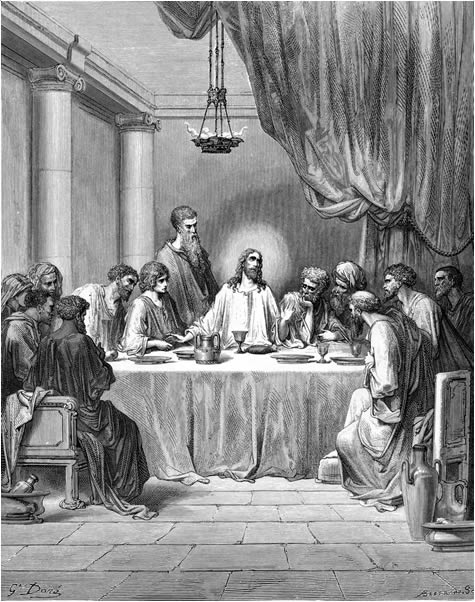
The cups on the table
Luke alone records TWO cups (22:17, 22:20), and the detail is at home in the feast: the Passover meal was ordered around four cups of wine, a structure already fixed in the Mishnah, the first written code of Jewish oral law (Pesachim 10:1). Passover (Pesach) is the spring feast remembering the exodus; its meal, the seder (“order”), moved through blessing, story, and psalm with a cup at each station. Jesus takes the feast's own furniture, and at the cup after supper says the words that made it new: “this cup... is the new covenant in my blood.”
The seder as Jewish families keep it today descends from the same order, reshaped after the Temple fell in AD 70; the lamb on the table then is matzah and remembrance now.
This section is reception history: how the passage was read and kept in the Jewish tradition. Where a reading parts from an essential of the Christian faith, the section says so at that point.
Sources: Mishnah Pesachim 10:1 (the four cups) · The Lord's Supper (this site's study)
The words behind it
7 Greek wordsEvery Greek word of this verse in the order it stands, with what it means and the door to its own study. The last column counts the times a word stands in the whole Bible: the rarer the word, the more the places it appears belong together.
| Greek | Sound | Meaning | Word study | In the Bible |
|---|---|---|---|---|
| καὶ | kai | And | G2532 → | 9120 times |
| ἐχάρησαν | echaresan | they rejoiced | G5463 → | 74 times |
| καὶ | kai | and | G2532 → | 9120 times |
| συνέθεντο | sunethento | they agreed | G4934 → | |
| αὐτῷ | auto | with him | G846 → | 5565 times |
| ἀργύριον | argurion | money | G694 → | 20 times |
| δοῦναι. | dounai | to give. | G1325 → | 412 times |
καὶAnd
kaiG2532 →9120 times
ἐχάρησανthey rejoiced
echaresanG5463 →74 times
καὶand
kaiG2532 →9120 times
συνέθεντοthey agreed
sunethentoG4934 →
αὐτῷwith him
autoG846 →5565 times
ἀργύριονmoney
argurionG694 →20 times
δοῦναι.to give.
dounaiG1325 →412 times
A shaded row is a word that stands 400 times or fewer in the Bible.
The walk
5 stopsEach card is a verse this one points to, and under it the verses that one points to in turn. Where several paths arrive at the same place, that place is listed first: the text keeps returning to it.
Through
Acts 1:18(Now with the reward for his wickedness Judas bought a field; there he fell headlong and burst open in the middle, and all his intestines spilled out.
it leads to
- Matthew 27:3–10
When Judas, who had betrayed Him, saw that Jesus was condemned, he was filled with remorse and returned the thirty pieces of silver to the chief priests and elders.
- Psalms 55:23
But You, O God, will bring them down to the Pit of destruction; men of bloodshed and deceit will not live out half their days. But I will trust in You.
- Psalms 55:15
Let death seize them by surprise; let them go down to Sheol alive, for evil is with them in their homes.
- Matthew 26:14–15
Then one of the Twelve, the one called Judas Iscariot, went to the chief priests
- Numbers 22:7
The elders of Moab and Midian departed with the fees for divination in hand. They came to Balaam and relayed to him the words of Balak.
- Matthew 27:3–10
Where this verse is studied
On this page
Studies25
On this verse
On this chapter
- The Covenants
- Forgiving Yourself: What Scripture Says
- Gethsemane (The Garden Called the Oil Press)
- Hospitality
- Jesus on Discipleship
- Jesus on the Kingdom
Show the next 6 titles
About Luke
This page draws on 11 works. Open the list of works
This page draws on Adam Clarke, Commentary on the Bible; Bede, On the Gospel of Luke; Bonaventure, Commentary on Luke, Chapter 22; J. C. Ryle, Expository Thoughts on the Gospels, Luke; J.C. Ryle, Expository Thoughts on the Gospels: Luke (lightly modernized text, Grace Gems edition); Jamieson, Fausset & Brown, Commentary Critical and Explanatory on the Whole Bible; John Chrysostom, Catena Aurea by Aquinas; John Gill, Exposition of the New Testament (1746-1748); John Gill, Exposition of the New Testament; Matthew Henry, Commentary on the Whole Bible and Origen of Alexandria, HOMILIES ON EXODUS 8.6.