
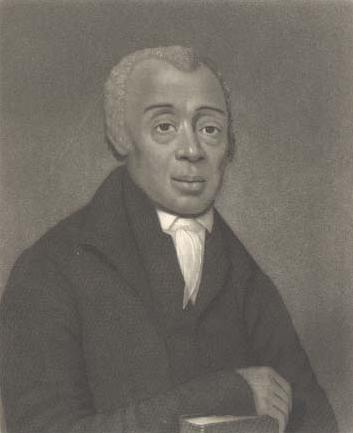
Richard Allen, frontispiece of Daniel A. Payne, 1891. Public domain.
Delaware and Philadelphia, 1760 to 1831 · Person · Featured Study
Richard Allen
He was born a slave, bought his own time, and became the first bishop of the African Methodist Episcopal Church.
Converted as a slave, he wrote that all of a sudden his dungeon shook and his chains flew off.
and he called that place Bethel, though previously the city had been named Luz.
- Born
- 14 February 1760, by his own account
- Died
- March 1831
- Family
- born a slave to: Benjamin Chew of Philadelphia; with him: his mother, his father and three other children
- Places
- Philadelphia, Delaware, Radnor, Baltimore
Summary
Allen tells his own life in a narrative printed in 1833, two years after his death. Converted while a slave near Dover, he and his brother later paid their master for their freedom. He preached through Delaware, New Jersey and Pennsylvania and came to Philadelphia in 1786. Bishop Asbury opened his church, Bethel, and in time Bethel joined other Black congregations in a church of their own.
- He set down much of his story long after the events, as his own preface admits.
- He and Absalom Jones nursed the sick and buried the dead when yellow fever struck the city.
- His book gives no year for the walkout from St. George's, and later sources differ on it.
The Verses Behind Bethel
No verse names him, and his church took its name from Jacob's Bethel in Genesis 28.
No verse of Scripture names Allen, who was born in 1760. When his church was opened in 1794, John Dickins prayed that it might be a bethel, and Allen's note on the page sends the reader to Genesis 28.
The question of this life is how a man born a slave came to found a church. His own narrative answers it, and it leaves two years unstated: the year he bought his time and the year of the walkout.
And he was afraid and said, “How awesome is this place! This is none other than the house of God; this is the gate of heaven!”Jacob called the place the house of God, and Bethel means house of God.
God is Spirit, and His worshipers must worship Him in spirit and in truth.”Allen's company answered the elder with the words of this verse.
The Life in Order
Most steps stand on his own narrative, and the last on the records Payne printed.
His own narrative dates few of its steps to the year.
- 1760Birth in slaveryAllen, Life, page 5
- In his youthHe was sold with his family to a master near Dover and was convertedAllen, Life, page 5
- A year the book leaves blankHe and his brother bought their time from their masterAllen, Life, page 7
- 3 September 1783He left his native place to preachAllen, Life, page 8
- February 1786He came to Philadelphia and preached at St. George'sAllen, Life, page 12
- No year givenThe walkout from St. George'sAllen, Life, pages 13 to 14
- 1793He and Absalom Jones served the sick and the dead in the yellow feverJones and Allen, Narrative, in Allen, Life, page 29
- July 1794Bethel's openingAllen, Life, page 18
- 1799He was ordained a deaconPayne, page 69
- April 1816Delegates of several cities form one churchAllen, Life, page 21
- April 1816He was consecrated its bishopPayne, page 14
- March 1831His deathPayne, page 69
Each step of the life stands with its witness.
1793, July 1794, 1799, April 1816, March 1831
From a Delaware Farm to Bethel
A slave converted under the Methodists bought his time, preached on the roads and built a church.
Allen was born on 14 February 1760, a slave to Benjamin Chew of Philadelphia. His parents and four children were sold to a master in Delaware, near Dover. There he was awakened, and after a time of doubt he found peace in Christ. He joined the Methodist society and met in John Gray's class.
His master, Stokeley, sold Allen's mother and three of the children. He let the rest go to meeting, and in time he let Allen bring Methodist preachers to his house. After Freeborn Garrettson preached there, the master could no longer hold slaves with a clear conscience. He let Allen and his brother buy their time for sixty pounds in gold and silver, or two thousand dollars in Continental money.
Allen cut cordwood, worked in a brickyard and drove a wagon hauling salt during the war, preaching at his stops on the road. He left home on 3 September 1783 and preached in New Jersey and Pennsylvania, and at Radnor most of his hearers were white. In 1785 Asbury asked him to travel with him, on terms that kept him apart from the slaves in the South, and Allen refused.
In February 1786 he came to Philadelphia, where he preached at five in the morning at St. George's. That year he gathered a society of forty-two members. One Sunday a trustee pulled Absalom Jones up from his knees in the gallery at prayer, and the Black members went out of the church in a body.
In the yellow fever of 1793 Allen and Jones answered the city's call for help. They nursed the sick and carried away the dead. In 1793 the African Church asked him to be its minister, and he declined because he would remain a Methodist. He bought the frame of an old blacksmith shop, hauled it to Sixth Street near Lombard, and fitted it for worship. Bishop Asbury opened it in July 1794.
For years the white elders claimed the church through its first incorporation, and Bethel won its case in the Supreme Court. In April 1816 delegates from Philadelphia, Baltimore and other places resolved to become one body, the African Methodist Episcopal Church. Allen was consecrated its bishop on 11 April 1816, and he died in March 1831.
In Their Own Words
He speaks here of his conversion, his answer to the elder, the fever and his choice of the Methodists.
Richard Allen (1760 to 1831)
The Life, Experience, and Gospel Labours of the Rt. Rev. Richard Allen, page 5
My dungeon shook
“I cried unto Him who delighteth to hear the prayers of a poor sinner; and all of a sudden my dungeon shook, my chains flew off, and glory to God, I cried. My soul was filled.”
African Methodist Episcopal
About this saying1 paragraph
He told of his conversion as a young slave in Delaware on page 5 of the narrative printed in 1833.
Richard Allen
The Life, Experience, and Gospel Labours of the Rt. Rev. Richard Allen, page 15
Heaven is free
“We believe heaven is free for all who worship in spirit and truth.”
African Methodist Episcopal
About this saying1 paragraph
Allen's company gave this answer to the elder who threatened to disown them, and Allen printed it in 1833.
Richard Allen
A Narrative of the Proceedings of the Coloured People during the Awful Calamity in Philadelphia, in the Year 1793, by Absalom Jones and Richard Allen, in The Life, Experience, and Gospel Labours of the Rt. Rev. Richard Allen, page 29
A freedom to go forth
“After some conversation, we found a freedom to go forth, confiding in him who can preserve in the midst of a burning fiery furnace.”
African Methodist Episcopal
About this saying1 paragraph
The two men set this down in their account dated January 1794.
Richard Allen
The Life, Experience, and Gospel Labours of the Rt. Rev. Richard Allen, page 16
The plain and simple gospel
“I was confident that there was no religious sect or denomination would suit the capacity of the coloured people as well as the Methodist; for the plain and simple gospel suits best for any people, for the unlearned can understand, and the learned are sure to understand”
African Methodist Episcopal
About this saying1 paragraph
He gave this reason for staying with the Methodists on page 16 of his narrative, printed in 1833.
The People Around Him
His narrative names his masters, the preachers who shaped him and the friends who built with him.
Absalom Jones stood with him from the gallery to the fever.
| Person | Tie to Allen | The witness |
|---|---|---|
| Stokeley | His master in Delaware, who let him buy his time. | Allen, Life, pages 6 to 7 |
| Freeborn Garrettson | His sermon turned Allen's master against holding slaves. | Allen, Life, page 7 |
| Absalom Jones | The friend beside him in the gallery and in the fever. | Allen, Life, pages 12 to 13 and 29 |
| Benjamin Rush | He gave toward the first African church and advised its builders. | Allen, Life, page 14 |
| Francis Asbury | He asked Allen to travel with him in 1785 and opened Bethel in 1794. | Allen, Life, pages 11 and 18 |
| John Dickins | The Methodist preacher who prayed at the dedication. | Allen, Life, page 18 |
Allen calls Rush and Robert Ralston "the two first gentlemen who espoused the cause of the oppressed" and helped build the house.
The Places of His Life
His life ran from a farm near Dover to a corner of Sixth Street in Philadelphia.
The record of his life centres on Philadelphia.
| Place | What the witnesses say | The witness |
|---|---|---|
| Philadelphia | He was born a slave there in 1760 and returned in 1786 to preach. | Allen, Life, pages 5 and 12 |
| Near Dover, Delaware | He was sold there as a child and converted there. | Allen, Life, page 5 |
| Radnor | He preached there in 1784 to a mostly white congregation. | Allen, Life, pages 9 to 10 |
| Baltimore | The first General Conference met there in 1784, and delegates from Baltimore joined his in 1816. | Allen, Life, pages 10 and 21 |
| Sixth Street near Lombard | He hauled the old frame there that became Bethel. | Allen, Life, page 17 |
Why He Stayed a Methodist
He left the white elders' rule and kept the Methodists' plain preaching and discipline.
When the first African church voted to join the Church of England, only Allen and Absalom Jones voted for the Methodists. Allen wrote that the plain and simple gospel suits any people and that the Methodists had a good discipline.
He also wrote that the Methodists were the first people who brought glad tidings to the coloured people. The church the delegates formed kept the Methodist name, and Allen wrote that its discipline would preserve them from "that spiritual despotism" they had known.
How the Key Verse Was Taught
Matthew Henry and Adam Clarke read the naming of Bethel.
Matthew Henry (1662 to 1714)
Commentary on the Whole Bible
Matthew Henry said God's appearing to Jacob gave the place its honour.
“This gracious appearance of God to him put a greater honour upon it, and made it more remarkable, than all the almond-trees that flourished there. This is that Beth-el where, long after, it is said, God found Jacob, and there (in what he said to him) he spoke with us, Hos. xii.”
on Genesis 28:19Puritan
Adam Clarke (1762 to 1832)
Commentary on the Bible
Adam Clarke explained the name as the house of God.
“The Hebrew has אולם לוז Ulam Luz, which the Roman edition of the Septuagint translates Ουλαμλουζ Oulamlouz; the Alexandrian MS., Ουλαμμους Oulammaus; the Aldine, Ουλαμμαους Oulammaous; Symmachus, Λαμμαους Lammaous; and some others, Ουλαμ Oulam.”
on Genesis 28:19Evangelical
What the Sources Leave Open
The sources leave three dates uncertain, among them the walkout and the day of his death.
The year of the walkoutRichard Allen (1833), the AME Church and Historic St. George's
Allen tells the walkout from St. George's and gives no year. The AME Church's own history places it after the Free African Society of 1787. Historic St. George's dates it "In 1794 (date disputed)".
The year he bought his timeRichard Allen (1833)
The printed narrative gives the year of the bargain as "17--", with the last two figures left blank. His preface says that much of the book was written many years after the events.
The day he diedThe conference's notice in Payne's History (1891)
Payne prints the conference's notice that Allen died in March 1831, in the seventy-second year of his life. The figure of the day on that printed page cannot be read with certainty.
Books to Read Next
The Life, Experience, and Gospel Labours of the Rt. Rev. Richard Allen
Richard Allen · 1833
It holds his own narrative, the fever narrative and his addresses.
Read Allen free at Documenting the American SouthHistory of the African Methodist Episcopal Church
Daniel A. Payne · 1891
Payne's history holds the church's early records.
Read Payne free at the Internet ArchiveWhat Allen Left
Allen left Bethel, the African Methodist Episcopal Church and his own account of how both were won.
Sources
Scripture is the Berean Standard Bible.
- The Holy Bible, Berean Standard Bible (read 2026)
- Richard Allen, The Life, Experience, and Gospel Labours of the Rt. Rev. Richard Allen, with the narrative of the yellow fever by Absalom Jones and Richard Allen and the address To the People of Colour (Philadelphia: Martin and Boden, 1833)
- Daniel A. Payne, History of the African Methodist Episcopal Church, ed. C. S. Smith (Nashville: A. M. E. Sunday-School Union, 1891)
- African Methodist Episcopal Church, Our History.
- Historic St. George's United Methodist Church, The Great Walk Out.
- Matthew Henry, Commentary on the Whole Bible (1710), on Genesis 28:19.
- Adam Clarke, Commentary on the Bible (1832), on Genesis 28:19.
Keep Studying
People and groups5
Go further1
Church history2
Values1