
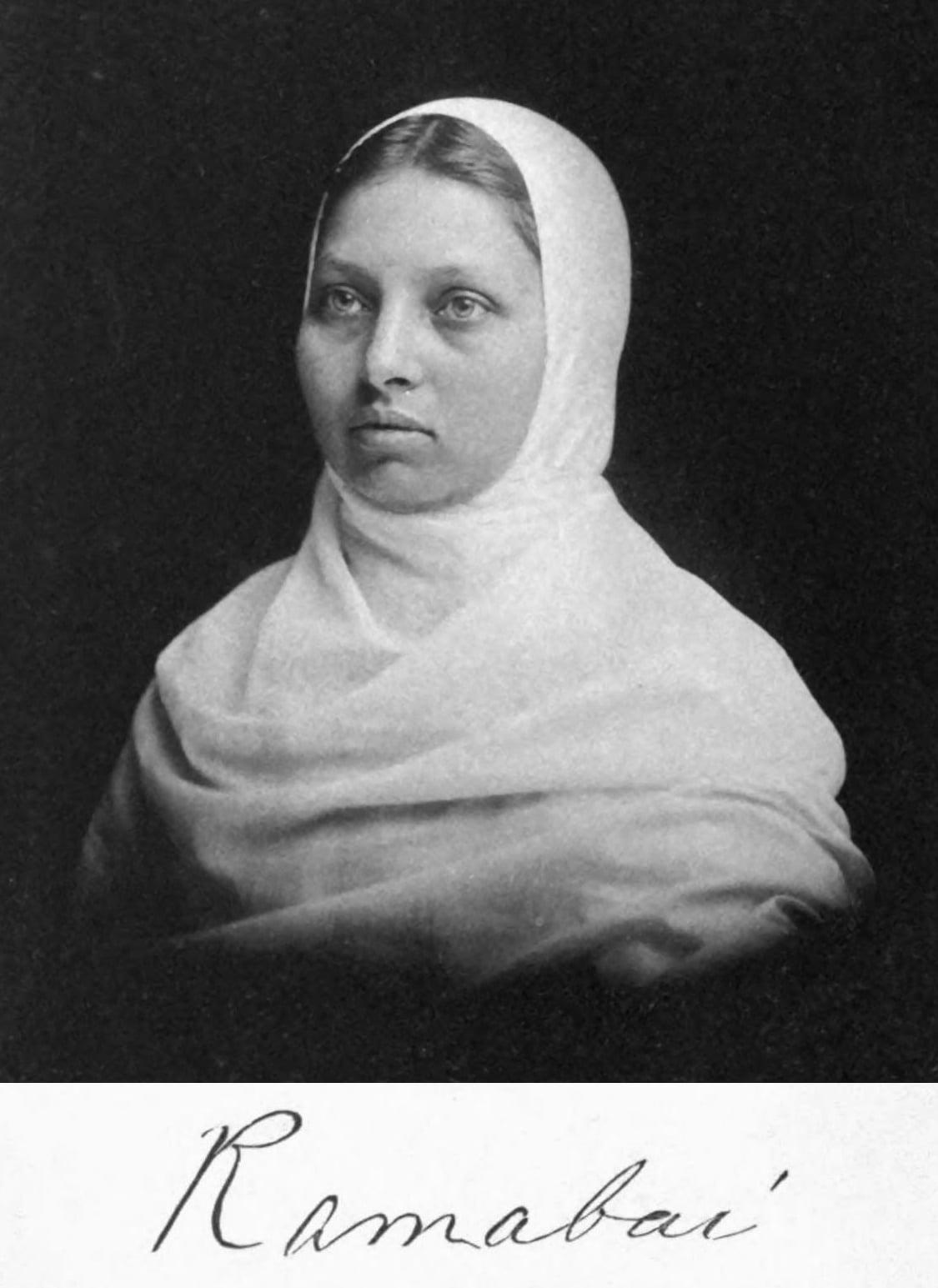
Ramabai, frontispiece of The High-Caste Hindu Woman, 1887. Public domain.
India, England and America, 1858 to 1922 · Person · Featured Study
Pandita Ramabai
She was an Indian scholar of Sanskrit who opened a home and school for high-caste widows in 1889.
The pundits of Calcutta named her Sarasvati for her learning, and she later found Christ in the Bible.
God is Spirit, and His worshipers must worship Him in spirit and in truth.”
God is Spirit, and His worshipers must worship Him in spirit and in truth.”
- Born
- 23 April 1858
- Died
- 5 April 1922
- Family
- husband: Bepin Bihari Medhavi; daughter: Manorama
- Places
- Calcutta, Wantage, Philadelphia, Bombay, Poona, Kedgaon
Summary
Ramabai was born in 1858, and her father taught her Sanskrit. Her husband died and left her with a small daughter. Then she went to England to study, and she was baptized there. In America she raised support for a school for Hindu widows.
- Her book The High-Caste Hindu Woman was printed in Philadelphia in 1887.
- Her Hindu advisers resigned when girls of the school became Christians.
- At Mukti she translated the Bible into the everyday Marathi of the villages.
The Chapter That Drew Her
A sister at Fulham read her John 4, and she wrote that the chapter showed her who Christ was.
The question of this life is how a learned Hindu widow came to Christ. It also asks what her faith did to the school she had promised to keep open to all. Her own Testimony, dated July 1907, Clementina Butler's life of 1922 and Nicol Macnicol's of 1926 are the witnesses.
But a time is coming and has now come when the true worshipers will worship the Father in spirit and in truth, for the Father is seeking such as these to worship Him.The sister who taught her read the meeting with the Samaritan woman and Christ's words on true worship.
The Life in Order
Her Testimony dates her baptism and her faith, and Butler and Macnicol date the school.
Eight years passed between her baptism and the faith she dated from 1891.
- 23 April 1858She was bornButler, from her casket
- At twenty-twoThe pundits of Calcutta gave her the title SarasvatiButler
- Early in 1883She went to England to study and stayed with the Sisters of WantageA Testimony
- Late in 1883She was baptized at WantageA Testimony
- 6 March 1886She met her kinswoman Anandibai Joshee in PhiladelphiaRachel Bodley, 1887
- March 1889She opened the Sharada Sadan in BombayButler
- November 1890The school moved to Poona with eighteen widowsMacnicol
- 1891Her faith in Christ, as she dates itA Testimony
- August 1893Ranade, Bhandarkar and others of the advisory committee resignedMacnicol
- 5 April 1922She died at MuktiButler, from her casket
Each step of the life stands with its witness.
November 1890, 1891, August 1893, 5 April 1922
From Calcutta to Kedgaon
Butler tells the outward life, and Ramabai's own Testimony tells the inward one.
Her father refused the offers of marriage made for her from the time she was nine, saying she was to be a student. After his death she and her brother carried on the work he had begun, and her lectures took her to Calcutta.
Her brother died a few months before she married Bepin Bihari Medhavi, a graduate of Calcutta University, by the civil rite. He died nineteen months later and left her with a daughter, Manorama. She formed the Arya Mahila Somaj for the education of women and against child-marriage.
She went to England early in 1883 and was taught by the Sisters of Wantage. At their home in Fulham she met women who had once been in the sisters' rescue home and now nursed the sick. She asked why Christians cared for such women. The sister answered by reading John 4, and Ramabai was baptized at Wantage late in 1883.
She went to Philadelphia in 1886 for the graduation of her kinswoman Anandibai Joshee in medicine. American friends formed an association to support her, and in March 1889 she opened the Sharada Sadan, the Home of Wisdom, in Bombay. In November 1890 the school moved to Poona.
When plague struck Poona she moved the work to land near the village of Kedgaon and called it Mukti, Salvation. There she took in widows and orphans of the famine, and the revival of 1905 began among them.
The girls of the Mukti press printed her Marathi translation, setting Roman, Marathi, Greek and Hebrew type. She died on 5 April 1922, and the young women of Mukti carried her coffin to the village cemetery.
In Their Own Words
Two lines from her Testimony of 1907 and the close of her book of 1887.
Pandita Ramabai (1858 to 1922)
A Testimony (signed July 1907), in Helen S. Dyer, Pandita Ramabai: Her Vision, Her Mission and Triumph of Faith, chapter 4
Hungry for something better
“I was hungry for something better than what the Hindu Shastras gave. I found it in the Christian's Bible and was satisfied.”
Indian Christian
About this saying1 paragraph
In her Testimony of 1907 she looked back on her baptism at Wantage in 1883.
Pandita Ramabai
A Testimony (signed July 1907), in Helen S. Dyer, Pandita Ramabai: Her Vision, Her Mission and Triumph of Faith, chapter 5
I needed Christ
“One thing I knew by this time, that I needed Christ, and not merely His religion.”
Indian Christian
About this saying1 paragraph
In the same Testimony she described the years after her return to India, before she came to the faith she dated from 1891.
Pandita Ramabai
The High-Caste Hindu Woman, chapter 7, The Appeal, page 119
The cry of India's daughters
“I beg you, friends and benefactors, educators and philanthropists, all who have any interest in or compassion for your fellow-creatures, let the cry of India's daughters, feeble though it be, reach your ears and stir your hearts.”
Indian Christian
About this saying1 paragraph
She closed her book of 1887 with an appeal to American readers.
The People Around Her
The witnesses name her husband and daughter, her teachers and kinswoman, her advisers and an American friend.
Manorama carried the school so that her mother could translate.
| Person | Tie to Ramabai | The witness |
|---|---|---|
| Bepin Bihari Medhavi | Her husband | Butler |
| Manorama | Her daughter, who took charge of the school's teaching after her own degree | Butler |
| The Sisters of Wantage | They taught her in England, and one of them read her John 4 | A Testimony |
| Anandibai Joshee | Her kinswoman, the first Hindu woman to receive the degree of Doctor of Medicine, in Philadelphia in 1886 | Bodley's introduction |
| M. G. Ranade and Dr. Bhandarkar | Members of the Sadan's advisory committee, who resigned in 1893 | Macnicol; Butler |
| Clementina Butler | An American friend of the work, who visited Mukti in 1906 and wrote her life in 1922 | Butler |
The Places of Her Life
Her life runs from the cities of India to England and America and back to a village near Poona.
Her school moved three times in nine years.
| Place | What the witnesses say | The witness |
|---|---|---|
| Calcutta | Her lectures brought her there. | Butler |
| Wantage and Fulham | The Sisters of Wantage had their houses there. | A Testimony |
| Philadelphia | Her book was printed there. | Bodley |
| Bombay | The school began there. | Butler |
| Poona | The school stood there until plague came. | Macnicol |
| Kedgaon | She built Mukti near the village and died there in 1922. | Butler |
How the Key Verses Were Taught
Ambrose of Milan, Jan Amos Comenius and Richard Allen read Christ's words on worship in spirit and truth.
Ambrose of Milan (died 397)
On Isaac and the Soul 4.26
Ambrose read the Samaritan woman at the well as one who learned that God is worshipped in spirit and not in a place.
“In the mystical doctrine, we understand that this well is also referred to there, because there the Samaritan woman, that is, the guardian (the guardian, however, of heavenly precepts), drew divine mysteries from that well, knowing that God is spirit, and is not worshipped in a place but in spirit; and because he is the Messiah, Christ. And therefore, he who is still expected by the Jews has already come. Having heard these things, that woman who appears to be of the Church, recognized the sacraments of the law, and believed.”
on John 4:23Patristic
Jan Amos Comenius (1592 to 1670)
The Labyrinth of the World and the Paradise of the Heart, chapter XXXIX, section 8, page 287
Jan Amos Comenius applied the verse to the church's quarrels over ceremonies.
“Thou hast seen in the world how men imagine vain ceremonies and strife while performing their religious duties. Thy religion shall be to serve me in quiet, and not to bind thyself by any ceremonies, for I do not bind thee by them.”
Unity of the Brethren
Richard Allen (1760 to 1831)
The Life, Experience, and Gospel Labours of the Rt. Rev. Richard Allen, page 15
Allen, a bishop of the African Methodist Episcopal Church, drew from the verse that heaven is open to every true worshipper.
“We believe heaven is free for all who worship in spirit and truth.”
African Methodist Episcopal
What the Witnesses Leave Open
Readers differ on whether her school kept its promise to the Hindus, on the year of the break and on the date of her faith.
Did the Sadan keep its promise?The advisory committee, as Macnicol prints them; Ramabai, as Butler prints her
The school was opened as non-sectarian. The committee wrote to Boston that girls were "induced to attend her (Ramabai's) private prayers regularly and read the Bible", and that "Such a departure from the original understanding" would shake the institution.
Ramabai told a meeting in Boston on 16 March 1898 that no religious training was compulsory. She said she had put "the Bible and the Vedas together on the shelves of the library" and let the girls read for themselves. Macnicol records that she told one critic she could not promise that a Hindu girl entering the school would always remain a Hindu.
The year of the breakClementina Butler; Nicol Macnicol
Butler dates the opposition and the resignation of the advisory board to 1892. Macnicol dates the committee's letter of resignation to August 1893 and prints it.
Her baptism and her faithRamabai, A Testimony
Ramabai was baptized in 1883 and wrote that she was then intellectually convinced of the truth of Christianity. In the same Testimony she wrote that she had not yet found Christ, and she dates her witness for Him from 1891, after reading the Bible itself for about two years.
Books to Read Next
The High-Caste Hindu Woman
Pundita Ramabai Sarasvati, with an introduction by Rachel L. Bodley · 1887
It is her own book on the lot of Hindu women, with her appeal for the school.
Read her book free at the Internet ArchivePandita Ramabai: Her Vision, Her Mission and Triumph of Faith
Helen S. Dyer · about 1920
Dyer prints A Testimony and a chapter on her translation.
Read Dyer free at the Internet ArchivePandita Ramabai Sarasvati
Clementina Butler · 1922
Butler visited Mukti in 1906 and gives the school's history and the funeral.
Read Butler free at the Internet ArchiveWhat Ramabai Left
Ramabai left the mission at Mukti, her Marathi Bible and her Testimony. Over her coffin was written the promise of 1 Corinthians 15 that the dead shall be raised incorruptible.
Sources
Scripture is the Berean Standard Bible.
- The Holy Bible, Berean Standard Bible (read 2026)
- Pandita Ramabai, A Testimony (signed July 1907), printed in Helen S. Dyer, Pandita Ramabai: Her Vision, Her Mission and Triumph of Faith (about 1920)
- Clementina Butler, Pandita Ramabai Sarasvati: Pioneer in the Movement for the Education of the Child-Widow of India (New York: Revell, 1922)
- Nicol Macnicol, Pandita Ramabai, Builders of Modern India (1926)
- Pundita Ramabai Sarasvati, The High-Caste Hindu Woman, with an introduction by Rachel L. Bodley (Philadelphia, 1887)
- Ambrose of Milan, On Isaac and the Soul 4.26, on John 4:23.
- Jan Amos Comenius, The Labyrinth of the World and the Paradise of the Heart, chapter 39, section 8, on John 4:24.
- Richard Allen, The Life, Experience, and Gospel Labours of the Rt. Rev. Richard Allen, on John 4:24.
- The Mukti Revival of 1905, its account of Minnie Abrams.
Keep Studying
Read it1