
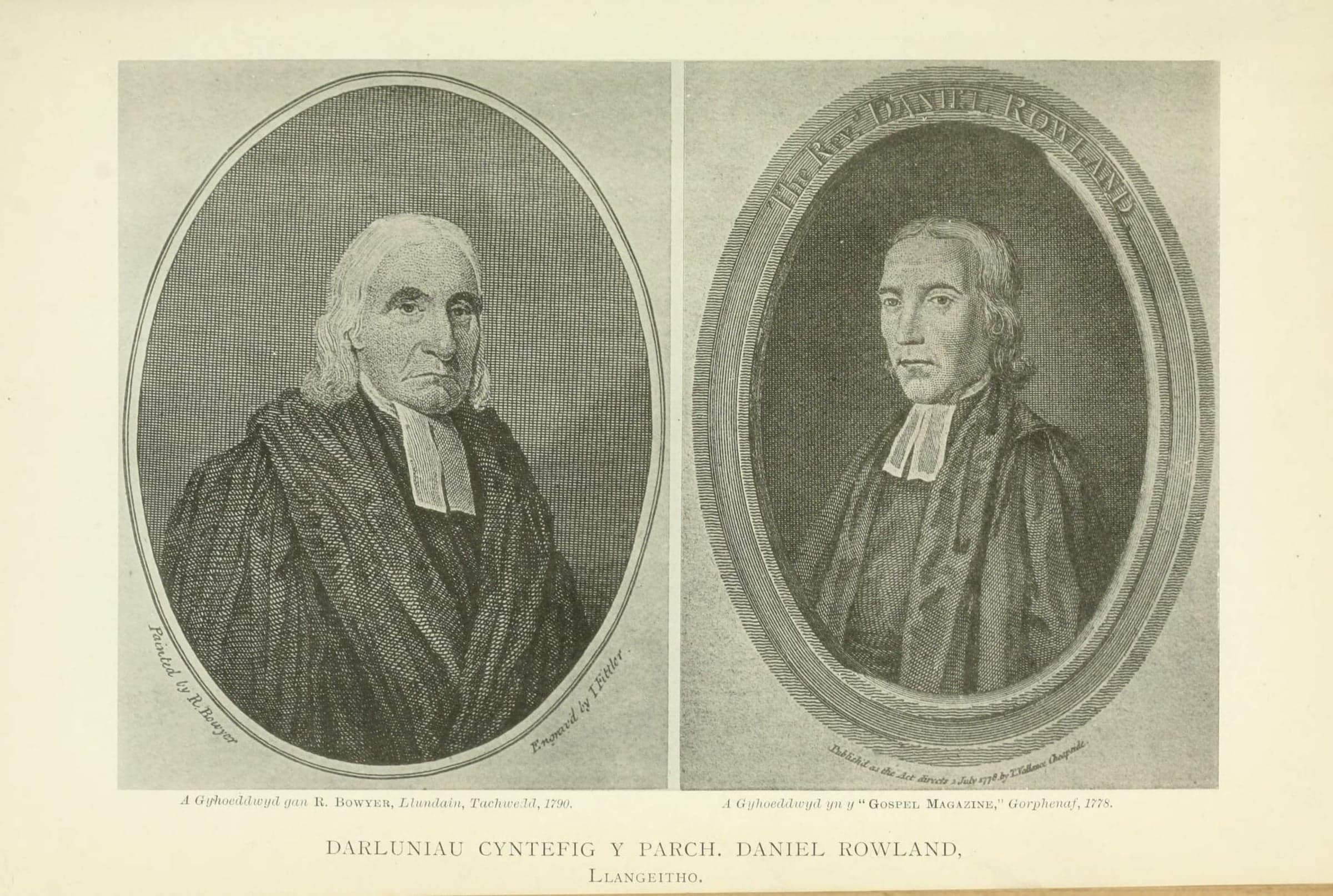
Two early portraits of Daniel Rowland of Llangeitho, 1778 to 1790. Public domain.
1735 to 1811 · Story · Featured Study
The Welsh Methodist Revival
The Welsh Methodist societies grew up inside the Church of England and became a church of their own.
- When
- 1735 to 1811
Howell Harris applied again and again for holy orders and was refused, he wrote, for no other reason than his preaching as a layman.
But whoever drinks the water I give him will never thirst. Indeed, the water I give him will become in him a fount of water springing up to eternal life.”
Summary
From 1735 two men led a revival of preaching in Wales. Howell Harris was a layman, and Daniel Rowland was a curate.
- By 1746 a visitor was told of fifty lay preachers and a hundred and forty societies.
- Rowland told him that three thousand took communion with him.
- Harris entered St Mary's Hall, Oxford, in November 1735.
The Texts of the Revival
The critics of the Welsh meetings were answered from the Gospels and Acts.
He sprang to his feet and began to walk. Then he went with them into the temple courts, walking and leaping and praising God.
The Welsh Methodists' Connexion named it as a precedent when its critics called its people Jumpers.
Acts 3:8BSB
Rejoice in that day and leap for joy, because great is your reward in heaven. For their fathers treated the prophets in the same way.
The Connexion set it in the same list, for joy shown in the body.
Luke 6:23BSB
The Dates in Dispute
The historians of the revival wrote between 1869 and 1959.
The first Association, Rowland's ordination and the division each have two or three dates in print.
| The event | The dates given | The sources |
|---|---|---|
| Rowland's ordination | 1733; or deacon in 1734 and priest in 1735 | Ryle (1869); the Dictionary of Welsh Biography |
| The first Association at Watford | 5 and 6 January 1743; or 1742 | Hughes (1892), from the Trevecca minutes; Williams (1872) |
| The parting of Harris and Rowland | 1750, Rowland's pamphlet; 1751, the rupture at Llanidloes; 1752, the complete split | The Dictionary of Welsh Biography; Williams (1872) |
The Story From Talgarth to Bala
It moves from a layman's assurance at the sacrament to the ordinations at Bala.
On 30 March 1735 the parish minister at Talgarth urged his people to the sacrament, and Harris resolved to go. At the Whitsunday sacrament on 25 May he knew his sins were forgiven, and he could not help telling it on the way home.
That summer he went on exhorting the poor, who flocked to hear him every Sunday evening.
And hope does not disappoint us, because God has poured out His love into our hearts through the Holy Spirit, whom He has given us.Harris wrote it beside the key verse in his diary on 18 June 1735.
Rowland was curate to his brother at Llangeitho. The Dictionary of Welsh Biography dates his conviction under Griffith Jones to about 1735, and Ryle wrote that its time and manner are involved in much obscurity.
Rowland met Harris in 1737, and the two joined forces in the work.
The societies' first Association met at Watford, near Caerphilly, with Whitefield as moderator and Rowland and William Williams among the clergy present.
A long quarrel between Harris and Rowland ended in separation at an Association at Llanidloes.
Their disagreement was so sharp that they parted company. Barnabas took Mark and sailed for Cyprus,Williams's history of 1872 sets this verse over the parting at Llanidloes.
In 1763 the bishop recalled Rowland's licence, and two clergymen handed him the order in church. He went out, and at his weeping people's entreaty he preached to them from outside the churchyard wall.
On 20 June 1811, at an Association at Bala, eight preachers of North Wales were ordained, and thirteen of the South were ordained at Llandeilo Fawr that August. Thomas Charles of Bala had at first opposed the step.
Who Tells the Story
Harris's own papers and the histories of his church tell the story.
A Brief Account of the Life of Howell Harris was printed at Trevecca in 1791, extracted from papers he wrote himself. Hugh J. Hughes's life of 1892 quotes his diaries.
Edward Morgan's records of 1840 and William Williams's history of 1872 were written from inside the church the revival became, and each defends its founders.
The People of the Story
Four men stood at the turns of the revival.
Each man's part stands beside the book that records it.
| Person | His part | The record |
|---|---|---|
| Howell Harris | He kept the diaries from which his biographers date his assurance. | Hughes (1892) |
| Daniel Rowland | He led the followers known as Rowland's people after the split with Harris. | The Dictionary of Welsh Biography |
| William Williams of Pantycelyn | He heard Harris preach in Talgarth churchyard and was converted. | The Dictionary of Welsh Biography |
| Thomas Charles of Bala | He chaired the Association that agreed to the ordinations. | Williams (1872) |
The Hymn of the Revival
Williams of Pantycelyn wrote the hymn in Welsh, and Peter Williams put it into English.
"Arglwydd, arwain trwy'r anialwch" was first printed in five stanzas in Williams's Alleluia, at Bristol, in 1745.
Peter Williams printed the English as the fifth hymn of his Hymns on Various Subjects, at Carmarthen, in 1771. Its first stanza reads:
“Guide me, O Thou great Jehovah, Pilgrim thro' this barren land, I am weak, but Thou art mighty, Hold me with Thy powerful hand: Bread of heaven, Feed me 'till I want no more.”
William Williams of Pantycelyn · "Guide me, O Thou great Jehovah", translated by Peter Williams, Hymns on Various Subjects (Carmarthen, 1771), hymn 5, in John Julian, A Dictionary of Hymnology (1907)Welsh Calvinistic
How the Key Verse Was Taught
Four writers from the third century to the eighteenth taught John 4:14.
Clement of Alexandria (died 215)
The Instructor Book 1
Clement gives the earliest of the four readings, in The Instructor.
“Sick, we truly stand in need of the Saviour; having wandered, of one to guide us; blind, of one to lead us to the light; thirsty, ‘of the fountain of life, of which whosoever partakes, shall no longer thirst;’ dead, we need life; sheep, we need a shepherd; we who are children need a tutor, while universal humanity stands in need of Jesus; so that we may not continue intractable and sinners to the end, and thus fall into condemnation, but may be separated from the chaff, and stored up in the paternal garner.”
on John 4:14Patristic
Cyril of Alexandria (died 444)
Commentary on the Gospel of John, Book 2
Cyril, two centuries after Clement, takes the water for the grace of the Spirit.
“We must know again that the Savior here calls the grace of the Holy Spirit water. If anyone drinks of this water, he will have the gift of the divine teaching constantly welling up from within him. He needs no admonition from others. Rather, it is enough to exhort those who thirst after the divine and heavenly Word that they are yet living in this present life and on earth along with the holy prophets and apostles. They are heirs of their ministrations of whom it was written, ‘And you shall draw water with joy out of the wells of salvation.’”
on John 4:14Patristic
Theophylact of Ohrid (died 1107)
Catena Aurea by Aquinas
Theophylact's reading stands in Aquinas's chain of the Fathers.
“For the water which I give him is ever multiplying. The saints receive through grace the seed and principle of good; but they themselves make it grow by their own cultivation.”
on John 4:14Patristic
Matthew Henry (1662 to 1714)
An Exposition of the Old and New Testament
Henry's commentary of 1710 gives a Puritan reading from before Harris's time.
“He that has at hand only a bucket of water needs not thirst as long as this lasts, but it will soon be exhausted; but believers have in them a well of water, overflowing, ever flowing. The principles and affections which Christ's holy religion forms in the souls of those that are brought under the power of it are this well of water.”
Puritan
Theophylact of Ohrid, Matthew Henry
In Their Own Words
Harris wrote in his diary, Rowland spoke as his biographers remember, and Williams wrote in his own English.
Howell Harris (1714 to 1773)
His diary for 18 June 1735, in Hugh J. Hughes, Life of Howell Harris, the Welsh Reformer, chapter 3
Like wax before the fire
“Being in secret prayer, I felt suddenly my heart melting within me, like wax before the fire, with love to God my Saviour”
Calvinistic Methodist
About this saying1 paragraph
Harris wrote this in June 1735, three weeks after the Whitsunday sacrament at Talgarth.
Daniel Rowland (1713 to 1790)
His answer to Thornton, as reported in Edward Morgan, Ministerial Records, the life of Rowland
We jump in Wales
“We jump in Wales, it is true, but you sleep, sleep, sleep, in England.”
Calvinistic Methodist
About this saying1 paragraph
Rowland gave this answer to Thornton, who had written twice to ask about the leaping, as Morgan reports it in 1840.
Daniel Rowland
His words to the portrait painter, as reported in J. C. Ryle, The Christian Leaders of the Last Century, the chapter on Daniel Rowland
A bit of clay
“I am only a bit of clay like thyself.”
Calvinistic Methodist
About this saying1 paragraph
Rowland said this to the artist sent to take his portrait near the end of his life, which ended in 1790, as Ryle tells it from Morgan.
William Williams of Pantycelyn (1717 to 1791)
Gloria in Excelsis, the hymn "There my Saviour reigns in Glory"
The Lamb upon the throne
“There my Saviour reigns in Glory, With ten thousand Saints around, Mixt with Cherubims and Angels, Their eternal Anthems sound; Be the Might, the Pow'r and Glory, Wisdom, Blessing, all in one, To the Lamb, our God, Jehovah, Now that sits upon the Throne.”
Welsh Calvinistic
About this saying1 paragraph
Williams printed these lines in Gloria in Excelsis in 1772.
Daniel Rowland, William Williams of Pantycelyn
Where Historians Disagree
Two questions divide the historians of the revival.
A renewal of the Church of England, or a new church?2 paragraphs
Williams wrote in 1872 that the men who began the movement had no idea it would become a new denomination, and had no wish to leave the Church of England.
Against that reading stand the meeting-house Rowland built near the parish church at Llangeitho, and the ordinations, which made the societies a church in fact.
Was the leaping fanaticism?2 paragraphs
Dr Evans's Sketch of the Denominations named a sect of "Jumpers" and called them victims of fanaticism. Williams answered in 1872 that the account was an absurd caricature, and that Williams of Pantycelyn had defended, or rather apologized for, the leaping.
The Connexion's own account called jumping the effect of great joy and said its preachers did not encourage it.
Books to Read Next
Four free books were printed between 1791 and 1872.
A Brief Account of the Life of Howell Harris
Howell Harris · 1791
It tells his first exhorting in 1735 in his own words.
Read it free onlineLife of Howell Harris, the Welsh Reformer
Hugh J. Hughes · 1892
It prints the minutes of the first Association at Watford.
Read it free onlineThe Christian Leaders of the Last Century
J. C. Ryle · 1869
Its chapters on Rowland weigh what is known of his preaching and his life.
Read it free onlineWelsh Calvinistic Methodism
William Williams · 1872
It follows the revival from its beginning to the ordinations of 1811.
Read it free onlineWhat the Revival Left
The revival left Wales its own Connexion and the hymns of Williams of Pantycelyn.
Sources
Scripture is the Berean Standard Bible.
- The Holy Bible, Berean Standard Bible (read 2026)
- Hugh J. Hughes, Life of Howell Harris, the Welsh Reformer (London: James Nisbet and Co., 1892), chapter 3 and the Watford minutes.
- Edward Morgan, Ministerial Records (London: H. Hughes, 1840), the life of Daniel Rowland.
- J. C. Ryle, The Christian Leaders of the Last Century (London: T. Nelson and Sons, 1869), chapters on Daniel Rowland.
- William Williams, Welsh Calvinistic Methodism: A Historical Sketch (London, 1872)
- John Julian, A Dictionary of Hymnology, revised edition (London: John Murray, 1907), volume 1, the article Arglwydd, arwain trwy'r anialwch.
- William Williams, Gloria in Excelsis (1772), his hymns of praise in English.
- The Dictionary of Welsh Biography (1959), Williams, William (1717 to 1791)
- Gomer Morgan Roberts, Rowland, Daniel, in the Dictionary of Welsh Biography (1959)
Keep Studying
Read it1
People and groups10
Church history3