
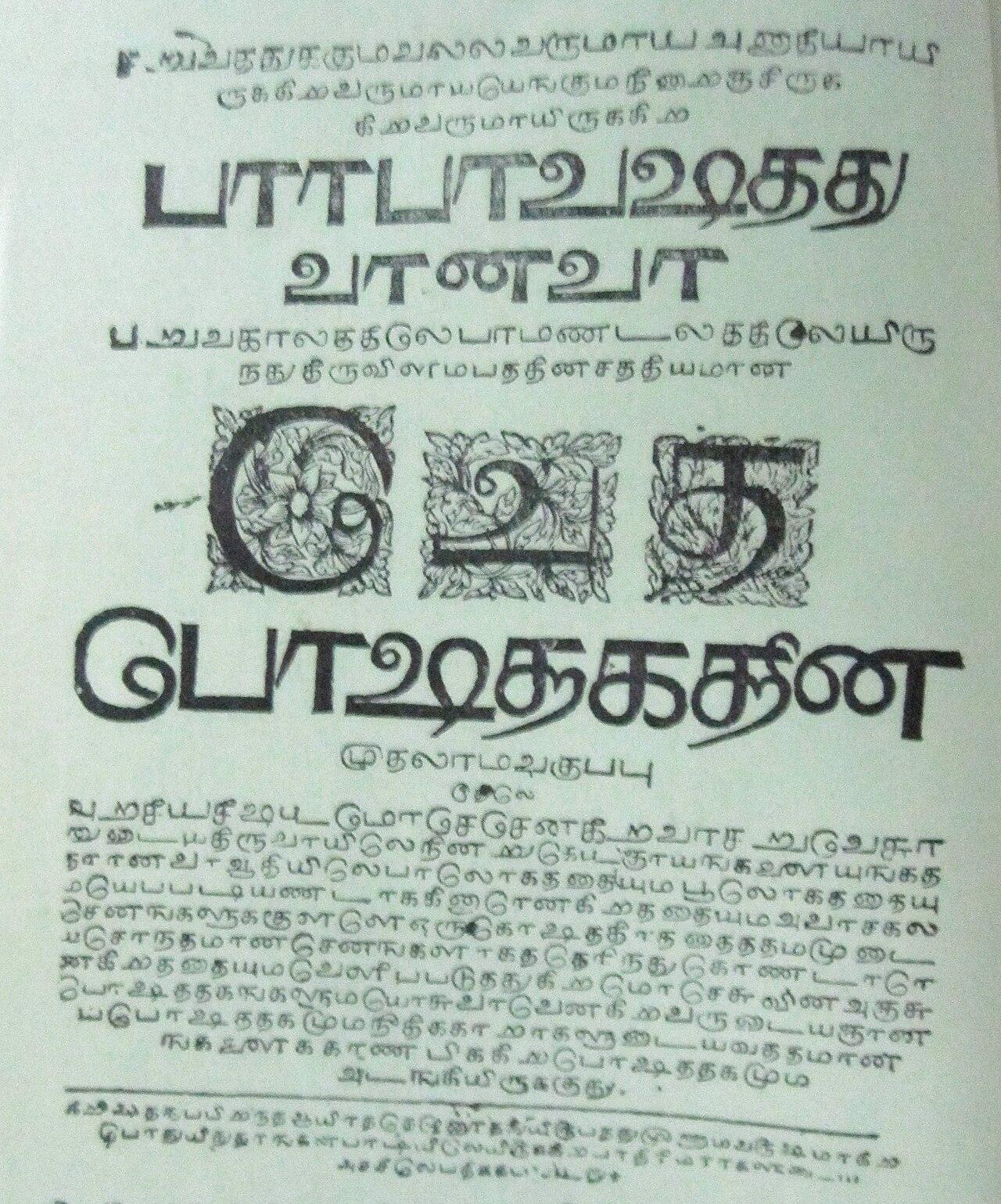
Unknown printer, the first page of the Tamil New Testament printed at Tranquebar, 1713. Public domain.
The ninth century to 1834 · Subject · Featured Study
The Scripture in the People's Tongue
What the translators of the Bible, from Cyril and Methodius to Judson, wrote about giving a people the Scripture in its own language.
Judson finished the Burmese Bible in January 1834 and wrote that he knelt with the last leaf in his hand.
both Jews and converts to Judaism; Cretans and Arabs—we hear them declaring the wonders of God in our own tongues!”
- Books
- Acts, John, Psalms
- Hold in memory
- Acts 2:11, Psalm 119:130
Summary
From the ninth century to the nineteenth, translators put the Bible into the speech of the people who would read it. Their prefaces and letters tell what the work meant to them.
- Nestor's chronicle says the Slavs rejoiced to hear the greatness of God in their own language.
- Tyndale wrote in 1530 that the lay people needed the Scripture in their mother tongue.
- Ziegenbalg and Grundler printed the Gospels and Acts in Tamil at Tranquebar in 1714.
- Carey saw the whole New Testament printed in Bengali by November 1801.
The Verses the Translators Echo
The day of Pentecost, the woman at the well and the psalm of the Word stand behind what the translators wrote.
The chronicle of the Slavs and the King James preface both reach for words of Scripture to say why a translation matters.
The King James preface
“Sir,” the woman replied, “You have nothing to draw with and the well is deep. Where then will You get this living water?
The King James preface draws on this well for its picture of a reader without a translation.
John 4:11BSB
The unfolding of Your words gives light; it informs the simple.
The psalm says the unfolding of God's words gives light, the image the preface takes for translation.
The Translations in Order
The dated steps run from the Slavonic Gospels to the last leaf of the Burmese Bible.
Eight translations over about a thousand years each gave a people the Scripture in its own speech.
- Cyril and Methodius, the Slavonic Gospels and ActsThe middle of the ninth centuryMaclear, Conversion of the West: The Slavs, page 69
- The first Wycliffite Bible in EnglishAbout 1382 or 1383Forshall and Madden, edition of 1879, page vi
- Luther's New Testament in GermanSeptember 1522Preserved Smith, The Life and Letters of Martin Luther, page 263
- Tyndale's English New TestamentBefore August 1526Spalatin's diary, in Tyndale, Doctrinal Treatises, pages xxx to xxxi
- The King James Bible1611The Translators to the Reader, reprint of 1852
- Ziegenbalg's Gospels and Acts in TamilSeptember 1714Ziegenbalg and Grundler, Propagation of the Gospel in the East, page 120
- Carey's New Testament in Bengali1801Eustace Carey, Memoir of William Carey, page 306
- Judson's Bible in Burmese31 January 1834Wayland, A Memoir of the Life and Labors of the Rev. Adoniram Judson, volume 2, page 75
A timeline of dated steps, each row naming the record that fixes its date.
Carey's New Testament in Bengali, Judson's Bible in Burmese
The page on how we got the Bible tells the making of the text these translators worked from.
From the Slavs to Tyndale
Cyril and Methodius, the Wycliffites, Luther and Tyndale gave the Slavs, the English and the Germans the Scripture in their own speech.
G. F. Maclear quotes the chronicle of Nestor, which says Cyril and Methodius came to the Slavonic princes, made a Slavonic alphabet, and translated the Gospels and the Acts of the Apostles, and after them the Psalter.
The Oxford editors of the Wycliffite New Testament date its earlier version to about 1382 or 1383, and record that Wycliffe died on the last day of 1384.
Preserved Smith writes that Luther began his New Testament at the Wartburg late in 1521 and had finished it by his return to Wittenberg in March. It came out the following September in a quarto with woodcuts from Cranach's workshop.
The Parker Society's editor of Tyndale quotes the diary of Spalatin, in August 1526, that six thousand copies of the New Testament in English had been printed at Worms.
From the King James Bible to the Mission Field
The King James preface named the reason, and missionaries carried it into Tamil, Bengali and Burmese.
The translators of 1611 likened the unlearned without a translation to children at Jacob's well, which was deep, without a bucket or anything to draw with.
At Tranquebar, Ziegenbalg and Grundler wrote on 3 January 1714 that the New Testament in Tamil was printed as far as the fourteenth chapter of Matthew. By 27 September they had printed the four Gospels and the Acts, and sent copies to England.
Eustace Carey's memoir of William Carey records that the Bengali New Testament was printed and circulated in 1801.
Francis Wayland prints the note Judson added to a letter from Maulmain when he had finished the whole Bible in Burmese.
In Their Own Words
William Tyndale (1494 to 1536)
A Prologue to the Five Books of Moses (1530), in Doctrinal Treatises, page 394
Tyndale wanted the Scripture before the eyes of the lay people.
“Which thing only moved me to translate the new Testament. Because I had perceived by experience, how that it was impossible to establish the lay-people in any truth, except the scripture were plainly laid before their eyes in their mother-tongue, that they might see the process, order, and meaning of the text”
Reformation translator
About this saying1 paragraph
Tyndale gave this reason in 1530, as he turned from the New Testament to the Old.
Martin Luther (1483 to 1546)
Letter on Translating (1530), as quoted in Preserved Smith, The Life and Letters of Martin Luther, page 267
Luther answered the critics of his translation.
“It is my testament and my translation [he bursts out] and if I have made any mistakes (though I never falsified intentionally) I will not let the papists judge me.”
Other
About this saying1 paragraph
Luther wrote this in his Letter on Translating of 1530, in Preserved Smith's English with Smith's bracket.
William Carey (1761 to 1834)
Letter to his sisters, Serampore, November 1801, in Eustace Carey, Memoir of William Carey, page 306
Carey lived to see the New Testament printed in Bengali.
“Hitherto the Lord has helped me. I have lived to see the Bible translated into Bengali, and the whole New Testament printed.”
Particular Baptist
About this saying1 paragraph
Carey wrote this in 1801, after years of work on the Bengali text.
Adoniram Judson (1788 to 1850)
Postscript of 31 January 1834, in Francis Wayland, A Memoir of the Life and Labors of the Rev. Adoniram Judson, volume 2, pages 75 to 76
Judson gave thanks to God that the work was done.
“Thanks be to God, I can now say I have attained. I have knelt down before him, with the last leaf in my hand, and imploring his forgiveness for all the sins which have polluted my labors in this department, and his aid in future efforts to remove the errors and imperfections which necessarily cleave to the work, I have commended it to his mercy and grace; I have dedicated it to his glory. May he make his own inspired word, now complete in the Burman tongue, the grand instrument of filling all Burmah with songs of praise to our great God and Saviour Jesus Christ. Amen.”
Baptist
About this saying1 paragraph
Judson wrote these words in 1834, on the day the translation was done.
Nestor the Chronicler
The Russian Primary Chronicle, as quoted in G. F. Maclear, Conversion of the West: The Slavs, page 69
The Slavs heard the greatness of God in their own language.
“they went into the Slavonic land, to Rostislav, to Sviatopolk, and to Kotzel; and, having arrived, they began to compose a Slavonic alphabet, and translated the Gospels and the Acts of the Apostles; and the Slavonians rejoiced, hearing the greatness of God in their own language: after which they translated the Psalter and other books.”
Eastern Orthodox
About this saying1 paragraph
Maclear gives Nestor's account in English in his book of 1879.
Books to Read Next
Doctrinal Treatises
William Tyndale · 1848
The Parker Society gathers Tyndale's prefaces to the books he translated.
Free scan of the 1848 editionThe Translators to the Reader
The translators of 1611 · 1611
The preface sets out why the translators worked and how.
Free scan of the reprint of 1852Propagation of the Gospel in the East
Bartholomaeus Ziegenbalg and J. E. Grundler · 1718
Their letters from Tranquebar tell the printing of the Tamil New Testament.
Free at the Internet ArchiveA Memoir of the Life and Labors of the Rev. Adoniram Judson, volume 2
Francis Wayland · 1853
Wayland prints Judson's letters on the Burmese Bible.
Free scan of volume 2What the Translators Handed On
Over about a thousand years, translators among the Slavs and in England, Germany, India and Burma put the Bible into the speech of its readers. Tyndale's reason in 1530 was that the lay people should see the text in their mother tongue.
Sources
Scripture is the Berean Standard Bible.
- The Holy Bible, Berean Standard Bible (read 2026)
- G. F. Maclear, Conversion of the West: The Slavs (London: SPCK, 1879), page 69.
- The New Testament in English according to the Version by John Wycliffe, ed. Josiah Forshall and Frederic Madden (Oxford: Clarendon Press, 1879), introduction, pages v and vi.
- Preserved Smith, The Life and Letters of Martin Luther (Boston and New York: Houghton Mifflin, 1914 printing), chapter XXIII, pages 263 and 267.
- William Tyndale, Doctrinal Treatises, Parker Society (Cambridge: University Press, 1848), the editor's notice, pages xxx to xxxi, and the prologue to the five books of Moses, page 394.
- The Preface of The Translators to the Reader of the Holy Bible First Published in 1611 (London: Prayer-Book and Homily Society, 1852), page 9.
- B. Ziegenbalg and J. E. Grundler, Propagation of the Gospel in the East, part III (London: Joseph Downing, 1718), letters XIV and XV, pages 110, 113, 116 and 120.
- Eustace Carey, Memoir of William Carey (Boston: Gould, Kendall and Lincoln, 1836), pages 306 and 406.
- Francis Wayland, A Memoir of the Life and Labors of the Rev. Adoniram Judson, volume 2 (Boston: Phillips, Sampson, and Company, 1853), pages 75 to 76.
Keep Studying
Studies1
People and groups2