
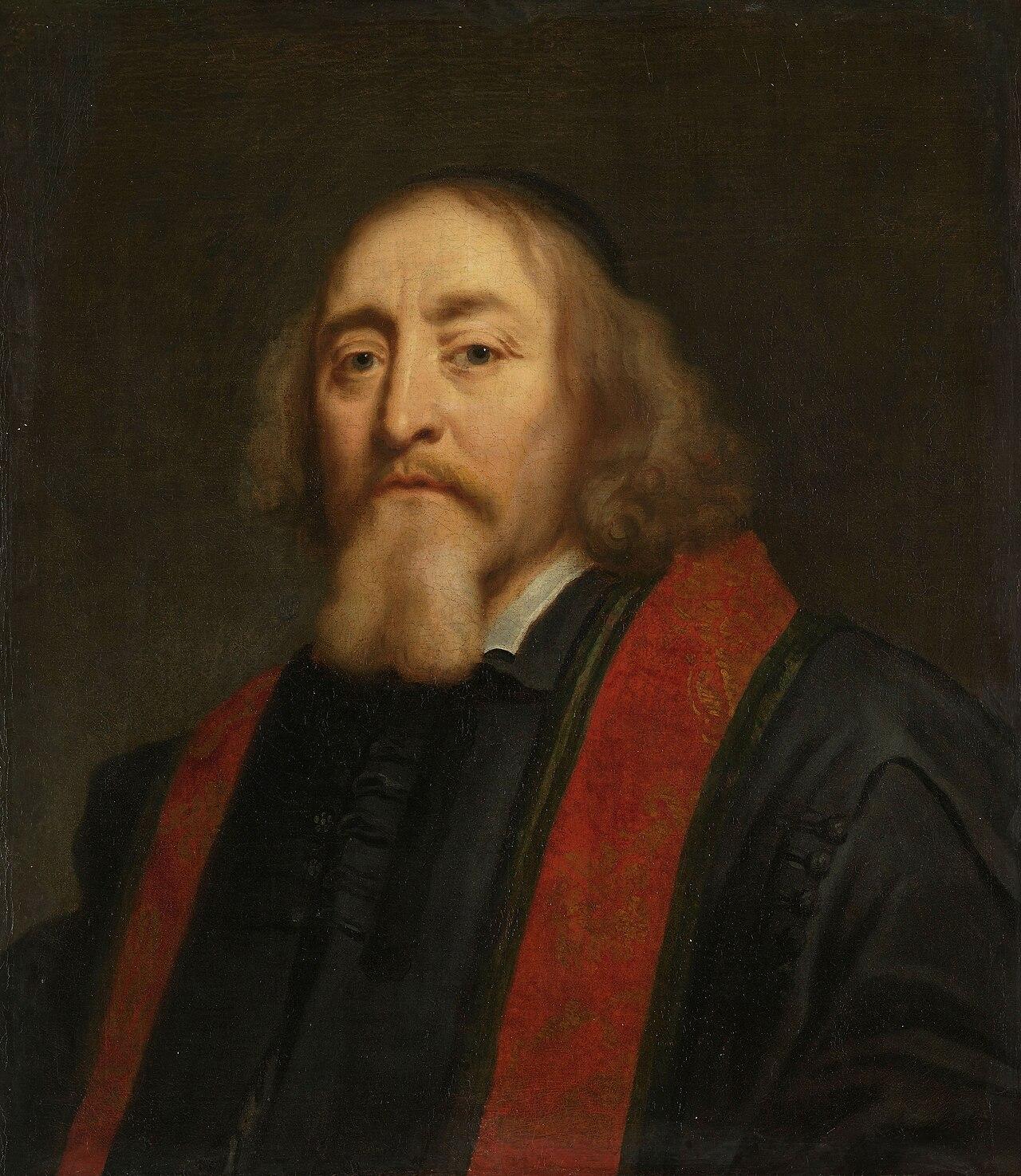
Jürgen Ovens, Portrait of Jan Amos Comenius, 1650 to 1670. CC0.
Moravia to Amsterdam, 1592 to 1670 · Person · Featured Study
Jan Amos Comenius
He was the last bishop of the old Unity of the Brethren, and he planned a schooling for every child.
Leading the last band of exiles out of Bohemia, a minister of the Brethren prayed that God would keep a hidden seed in the land.
Although it is the smallest of all seeds, yet it grows into the largest of garden plants and becomes a tree, so that the birds of the air come and nest in its branches.”
- Born
- 28 March 1592, by Keatinge and Laurie; Hutton gives 18 March (probable)
- Died
- 15 November 1670, by Keatinge; Laurie gives 1671 and Hutton 1672 (probable)
- Places
- Fulneck, Lissa, Amsterdam
Summary
Comenius was a minister and teacher of the Unity of the Brethren, the church that came from Jan Hus. He had to leave Moravia in the war. In 1628 he led its last ministers to Lissa in Poland. There he wrote schoolbooks that were read across Europe. He became the bishop of a scattered church.
- He handed on the Brethren's bishops, their book of discipline and a catechism for the villages where the first Herrnhut settlers lived.
- Hutton calls him the pioneer of modern education and the last bishop of the Bohemian Brethren.
- Keatinge, Laurie and Hutton give three different years for his death.
The Seed and the Tree
Matthew 13 speaks of a seed that becomes a tree, and John 4 of worship in spirit and in truth.
No verse of Scripture names Comenius. Hutton reports his prayer on the border for a "Hidden Seed" in the old home, "which would one day grow to a tree". The parable of the mustard seed, in which the smallest of seeds grows into a tree, carries the same picture.
The question of this life is what one exiled bishop kept alive for a church that seemed to have ended. His witnesses are his own books in English translation, the Moravian historian Hutton, and the lives by Keatinge and Laurie.
God is Spirit, and His worshipers must worship Him in spirit and in truth.”In the Labyrinth, Christ tells the pilgrim to serve Him in the spirit and in the truth.
The Life in Order
The dates come from Hutton (1909) and Keatinge (1896), and the two differ at the start and the end.
War moved him three times, and each move fixed a part of his work.
- 1592Born in MoraviaKeatinge
- When he was sixOrphaned by plagueHutton
- 1614 to 1616Master of the school at PrerauHutton
- After 1616Pastor at FulneckHutton
- After the sack of FulneckRefuge at BrandeisHutton
- 1628Exile to PolandHutton
- 1641A visit to EnglandHutton
- 1648The Peace of WestphaliaHutton
- 1656The fall of LissaHutton
- 1670Death at AmsterdamKeatinge
Each step of the life stands with its witness.
1641, 1648, 1656, 1670
From Fulneck to Naarden
He was driven from Fulneck and from Lissa, and he died at Amsterdam.
Comenius was born in 1592 in Moravia, and the plague took his parents when he was six. The Brethren paid for his schooling and his study of theology in Germany. He taught at their school at Prerau and then became minister and schoolmaster at Fulneck.
The Thirty Years' War reached Fulneck after the Bohemian revolt failed. The village was sacked, and his books and manuscripts were burned. He lost his wife and one of his children on the way to the estate of Charles von Zerotin at Brandeis. There, in a cottage that tradition gave to Gregory the Patriarch, he wrote The Labyrinth of the World and the Paradise of the Heart.
In 1628 the ministers sheltered at Brandeis were ordered away, and Comenius led the last band of them to Poland. On a spur of the Giant Mountains he prayed for the believers left behind, and the band sang as it went. The exiles made Lissa their centre.
At Lissa he taught in the Brethren's school and wrote the books that made him famous. His Janua Linguarum taught Latin through sentences about everyday things, and Hutton says it was translated into fifteen languages. His Great Didactic set out a plan of schooling for every child, from the mother's knee to the university.
He went to England in 1641 at Samuel Hartlib's invitation, and he left when the Irish rebellion and the Civil War broke out. He spent six years writing schoolbooks for the Swedish government, and he complained that Oxenstierna never helped the Brethren. When the old bishop Justinius died at Ostrorog, the Brethren chose Comenius to take his place.
The peace that ended the war in 1648 left the exiles no way home. Then war reached Lissa too, and his library and the school burned. He spent his last years in Amsterdam with the help of the De Geer family, who paid for his collected works. He died there and was buried at Naarden.
Read The Moravian Church, the church that came from the Unity
The Books and the Schools
The Labyrinth was a book of faith, and the Janua and the Didactic were books for schools.
The Labyrinth is an allegory. A pilgrim goes through the trades and ranks of a ruined Bohemia, finds nothing to trust, and returns to his own heart, where Christ meets him. Hutton calls it a picture both of the horrors of the time and of the religious life of the Brethren.
Comenius divided schooling into four stages: the mother school, the school of the mother tongue, the Latin school and the university. Hutton reports his rule that a child should learn nothing by heart that he did not understand, and that four hours of study a day were enough. He wanted religion taught in the day school, with prayer, psalms and Scripture learned by heart.
Comenius meant schooling to renew the Brethren's church and to lift the whole human race.
In Their Own Words
Two passages of his books and two of his letters as Hutton gives them.
Jan Amos Comenius (1592 to 1670)
The Labyrinth of the World and the Paradise of the Heart, chapter XXXIX, section 8, page 287
To serve me in quiet
“Thou hast seen in the world how men imagine vain ceremonies and strife while performing their religious duties. Thy religion shall be to serve me in quiet, and not to bind thyself by any ceremonies, for I do not bind thee by them.”
Unity of the Brethren
About this saying1 paragraph
In the Labyrinth, written at Brandeis after 1620, Christ speaks to the pilgrim in chapter 39, in Count Lützow's English of 1901.
Jan Amos Comenius
The Great Didactic, chapter IX, section 5, pages 219 to 220
They also are formed in the image of God
“Nor can any sufficient reason be given why the weaker sex (to give a word of advice on this point in particular) should be altogether excluded from the pursuit of knowledge (whether in Latin or in their mother-tongue). They also are formed in the image of God, and share in His grace and in the kingdom of the world to come.”
Unity of the Brethren
About this saying1 paragraph
He argued in chapter 9 of the Great Didactic that girls should be taught, in M. W. Keatinge's English of 1896.
Jan Amos Comenius
A letter to Axel Oxenstierna, as J. E. Hutton gives it in A History of the Moravian Church, Book One, chapter XVI
There will be from God
“If there is no help from man, there will be from God, whose aid is wont to commence when that of man ceases.”
Unity of the Brethren
About this saying1 paragraph
He wrote this to Oxenstierna after 1648, when the peace left the Brethren out, as Hutton gives it in 1909.
Jan Amos Comenius
His commendation of the Brethren to the Church of England, as J. E. Hutton gives it in A History of the Moravian Church, Book One, chapter XVI
We commit our dear mother
“Even in her death, which seems approaching, you ought to love her, because in her life she has gone before you for more than two centuries with examples of faith and patience.”
Unity of the Brethren
About this saying1 paragraph
In his last years he commended the Brethren to the Church of England, as Hutton gives the words in 1909.
The People Around Him
Patrons sheltered him, friends brought him to England, and his own family carried on his office.
His office passed through his own family to the renewed church.
| Person | Tie to Comenius | The witness |
|---|---|---|
| Charles von Zerotin | A nobleman who gave him refuge on his estate. | Hutton |
| Samuel Hartlib | A friend in London who brought him over. | Hutton |
| Axel Oxenstierna | The Swedish chancellor he appealed to. | Hutton |
| The De Geer family | His patrons in his last years. | Laurie |
| Nicholas Drabik | A seer whose visions he trusted. | Hutton |
| Peter Jablonsky | His daughter's husband, who carried on his office. | Hutton |
| Daniel Ernest Jablonsky | His grandson, a court preacher at Berlin. | Hutton |
His patrons sheltered him, but none of them won the exiles a way home.
The Places of His Life
His life runs from Moravia to Poland to Amsterdam, with a stay in London.
He lived his last forty-two years outside his own land.
| Place | What the witnesses say | The witness |
|---|---|---|
| Nivnitz, Moravia | His birthplace, a village near Ungarisch-Brod. | Laurie |
| Herborn and Heidelberg | Two Reformed universities in Germany. | Hutton |
| Fulneck | His first parish. | Hutton |
| Brandeis | A refuge on a friendly estate. | Hutton |
| Lissa, Poland | Home of the exiles for most of three decades. | Hutton |
| London | His one stay in England. | Hutton |
| Amsterdam and Naarden | The city that housed him at the end, and the town of his grave. | Keatinge |
What He Handed On
Hutton traces three links from the old church to the new.
The first was the office of bishop. He consecrated his son-in-law Peter Jablonsky, and Peter's son Daniel Ernest consecrated David Nitschmann, the first bishop of the renewed church. He published an edition of the Ratio Disciplinae, and Hutton says this book fired Zinzendorf's love for the Brethren.
He also wrote a catechism for those who still worshipped in secret. Its preface named the villages by their first letters. Hutton reads them as Fulneck, Kunewalde, Zauchtenthal and five more, the places from which the first exiles came to Herrnhut. Hutton writes that fifty years before his prayers were answered, Comenius "lay silent in the grave".
How the Key Verse Was Taught
Chrysostom, Jerome and Theophylact of Ohrid read the mustard seed.
John Chrysostom (died 407)
Homily on the Gospel of Matthew 46
Chrysostom read the parable as a promise that the gospel would spread.
“Another parable put He forth unto them, saying, The Kingdom of Heaven is like to a grain of mustard seed.”
on Matthew 13:31 to 32Patristic
The rest3 more paragraphs
That is, since He had said, that of the crop three parts are lost, and but one saved, and in the very part again which is saved so great damage ensues; lest they should say, "And who, and how many will be the faithful?" this fear again He removes, by the parable of the mustard seed leading them on to belief, and signifying that in any case the gospel shall be spread abroad.
Therefore He brought forward the similitude of this herb, which has a very strong resemblance to the subject in hand; "Which indeed is the least," He saith, "of all seeds, but when it is grown, it is the greatest among herbs, and becometh a tree, so that the birds of the air come and lodge in the branches thereof."
Thus He meant to set forth the most decisive sign of its greatness. "Even so then shall it be with respect to the gospel too," saith He. Yea, for His disciples were weakest of all, and least of all; but nevertheless, because of the great power that was in them, it hath been unfolded in every part of the world.
Jerome (died 420)
Catena Aurea by Aquinas
Jerome read the kingdom of heaven here as the preaching of the gospel.
“The kingdom of heaven is the preaching of the Gospel, and the knowledge of the Scriptures which leads to life, concerning which it is said to the Jews, The kingdom of God shall be taken from you. (Mat. 21:43.) It is the kingdom of heaven thus understood which is likened to a grain of mustard seed.”
on Matthew 13:31 to 32Patristic
The rest2 more paragraphs
The man who sows is by most understood to be the Saviour, who sows the seed in the minds of believers; by others the man himself, who sows in his field, that is, in his own heart. Who indeed is he that soweth, but our own mind and understanding, which receiving the grain of preaching, and nurturing it by the dew of faith, makes it to spring up in the field of our own breast? Which is the least of all seeds. The Gospel preaching is the least of all the systems of the schools; at first view it has not even the appearance of truth, announcing a man as God, God put to death, and proclaiming the offence of the cross. Compare this teaching with the dogmas of the Philosophers, with their books, the splendour of their eloquence, the polish of their style, and you will see how the seed of the Gospel is the least of all seeds.
For the dogmas of Philosophers when they have grown up, show nothing of life or strength, but watery and insipid they grow into grasses and other greens, which quickly dry up and wither away. Brit the Gospel preaching; though it seem small in its beginning, when sown in the mind of the hearer, or upon the world, comes up not a garden herb, but a tree, so that the birds of the air (which we must suppose to be either the souls of believers or the Powers of God set free from slavery) come and abide in its branches. The branches of the Gospel tree which have grown of the grain of mustard seed, I suppose to signify the various dogmas in which each of the birds (as explained above) takes his rest. […]
What the Witnesses Leave Open
His writers differ on his dates, on his trust in prophets and on how to read his two callings.
The dates of his birth and deathKeatinge; Laurie; Hutton
Keatinge in 1896 and Laurie in 1881 give his birth as 28 March 1592 at Nivnitz. Hutton in 1909 gives 18 March 1592 at Trivnitz.
Keatinge gives his death as 15 November 1670 and his burial at Naarden on 22 November. Laurie gives 15 November 1671, and Hutton prints 1672. Keatinge's 1670 is the only one of the three that comes with a day of burial.
His trust in the prophetsHutton; Keatinge
Comenius believed the visions of Christopher Kotter, Christina Poniatowski and Nicholas Drabik, who foretold the fall of the House of Austria. Hutton calls him in this "an unpractical dreamer" and Drabik a "vile impostor", and he says Comenius turned down Cromwell's offer of a home for the Brethren in Ireland. Keatinge speaks of "the fuel of fanaticism" in his last years. The prophecies did not come to pass.
One work or twoHutton; the scholars he answers
Hutton reports that many scholars divide his life into the bishop and the educational reformer. He answers that the division is false: "His whole life was of a piece." Comenius, he writes, drew no line between the secular and the sacred.
Books to Read Next
The Labyrinth of the World and the Paradise of the Heart
Jan Amos Comenius, translated by Count Lützow · 1901
This is his allegory of the war years in an English translation of 1901.
Read the Labyrinth free at the Internet ArchiveThe Great Didactic of John Amos Comenius
M. W. Keatinge, translator and editor · 1896
Keatinge's introduction gives the life, and the treatise gives his plan of schooling.
Read Keatinge free at the Internet ArchiveA History of the Moravian Church
J. E. Hutton · 1909
Hutton tells the life as part of the story of the Brethren.
Read Hutton free at Project GutenbergWhat Comenius Left
Comenius left schoolbooks read across Europe, a line of bishops and a catechism for the hidden believers of Moravia. Hutton judged that of all the links between the old church of the Brethren and the new, "Comenius was the strongest".
Sources
Scripture is the Berean Standard Bible.
- The Holy Bible, Berean Standard Bible (read 2026)
- J. E. Hutton, A History of the Moravian Church (London, 1909), Book One, chapter XVI, and Book Two, chapter III.
- M. W. Keatinge, The Great Didactic of John Amos Comenius (London, 1896), the biographical introduction and chapter IX.
- S. S. Laurie, John Amos Comenius, Bishop of the Moravians: His Life and Educational Works (1881)
- Jan Amos Comenius, The Labyrinth of the World and the Paradise of the Heart, translated by Count Lützow (London: Swan Sonnenschein, 1901)
- John Chrysostom, Homily 46 on the Gospel of Matthew, on Matthew 13:31 to 32.
- Jerome, on Matthew 13:31 to 32, as the Catena Aurea of Thomas Aquinas gives him.
- Theophylact of Ohrid, Commentary on Matthew, on Matthew 13:31 to 32.