
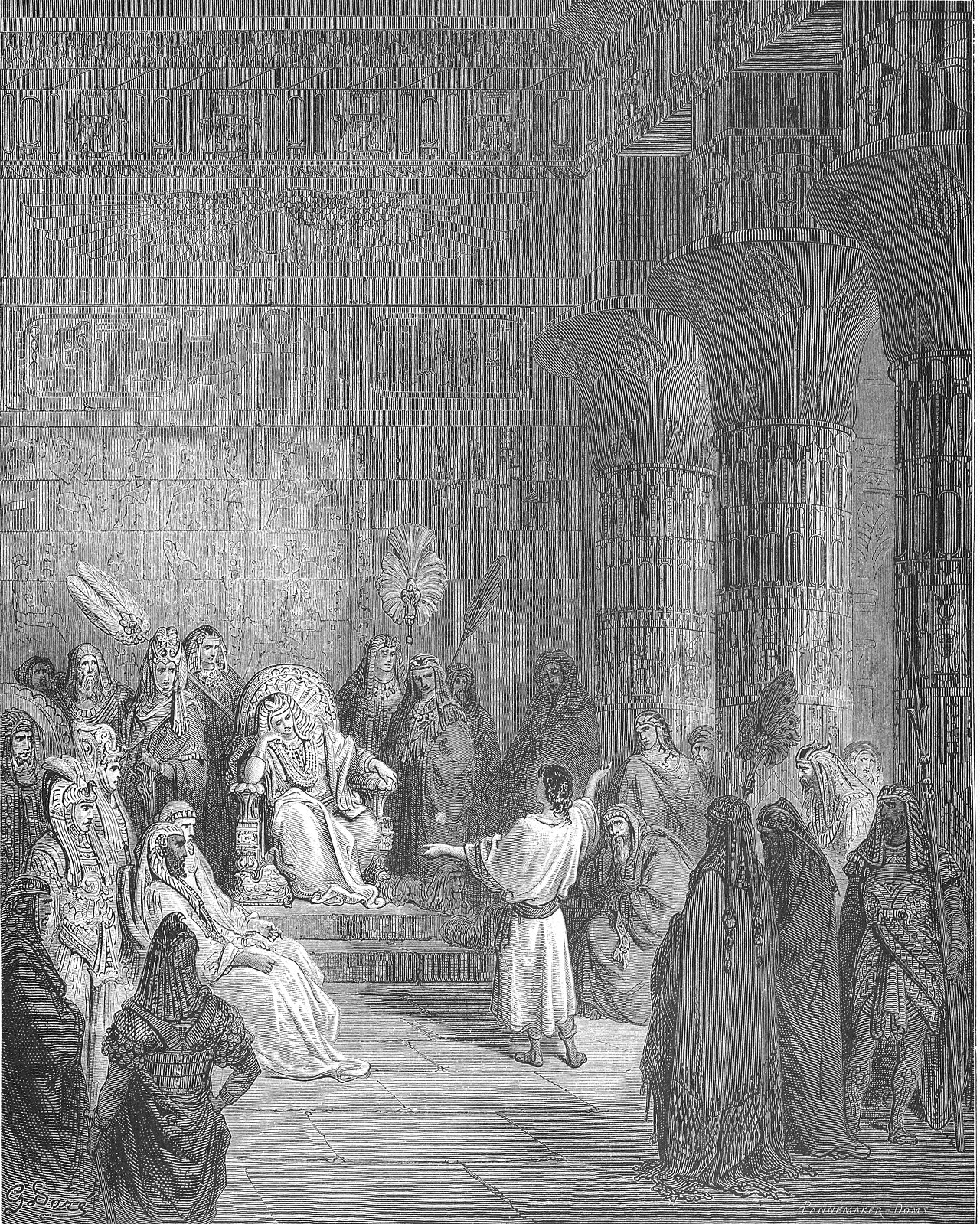
Genesischapter 41
57 verses · Moses, by tradition · 15th to 13th century BC · The Law
when seven cows, sleek and well-fed, came up from the river and began to graze among the reeds.
Introduction
Moses, by tradition, The Law, Genesis Overview.
This chapter stands at the hinge of the Joseph account, and Genesis gives it more room than any chapter around it. Israel heard it as the account of how their fathers came to be fed in Egypt. It moves between a prison and a throne room, with the whole court of Egypt watching. Listen for how often the name of God is spoken in a pagan king's hearing, and by whom. Notice the clothes, since clothing has marked every turn in Joseph's life so far. Read it asking what two years of silence had been preparing.
Context
- Who
- Israel in the wilderness, whose ancestors were fed by a Hebrew who ran Egypt
- What
- A court narrative in which Joseph reads Pharaoh's two dreams and is raised to govern Egypt.
- Where
- Pharaoh's court, and then the storage cities of the whole land of Egypt.
- When
- Joseph's thirtieth year, about 1885 BC on the traditional chronology.
- Why
- To show God ruling the harvests of Egypt and raising Joseph at the hour He had set, so that many would be kept alive.
Historical context
The chapter is Pharaoh's as much as Joseph's, since a king dreams twice in one night, his own specialists fail him, and a prisoner is brought up to read the dreams. The time is Joseph's thirtieth year, which 41:46 gives, and the place is the court and then every storage city in Egypt.
Show the rest of the historical context, 3 more paragraphs
The occasion is a famine warning delivered fourteen years ahead of its last year. Dream interpretation in Egypt was a trained profession, and surviving dream manuals list images in columns with their standard readings worked out in advance. A first hearer needed no explanation of the imagery, since cattle in the Nile and grain in the field are what the inundation controlled.
The investiture is Egyptian ceremony reported item by item, and James K. Hoffmeier and John D. Currid find each item in tomb art and inscriptions. The signet ring let Joseph seal documents in the king's name, the gold collar chain was the standard royal reward for service, and the second chariot went out with heralds before it. An Egyptian name and a marriage into the family of the priest of On complete the naturalisation.
The administration that follows is recognisable Egyptian practice, a fifth of the harvest taken in the good years and stored city by city in state granaries. Famine relief was part of what a competent vizier was for.
Significance
A slave came out of a dungeon, was shaved and dressed as an Egyptian, and was made second in the land inside a single day.
Show the rest of the significance, 1 more paragraph
Israel heard why they had ever been in Egypt at all. The bread that kept their family alive was stored years before the family knew it was hungry.
This chapter in Jewish lifeWhat this chapter is in Jewish life and reading.
How it is read
Rashi reads Pharaoh's dream as a picture whose every detail carries its meaning. The well-favoured cattle stand for the years of plenty, and he gives the sign a social sense: "This was an indication of a period of plenty, when people show themselves well-disposed one to another, for no-one then envies another person's prosperity" (Rashi on Genesis 41:2:1, the Pentateuch with Rashi's commentary by M. Rosenbaum and A. M. Silbermann, 1929 to 1934, public domain). The eating of the fat cattle by the lean he reads the same way, "indicating that all the joy occasioned by the years of plenty would be forgotten in the days of famine" (Rashi on Genesis 41:4:1). He notices how the butler speaks of Joseph and judges him for it: "Cursed be the wicked for the favours they do are never really complete!", because he named him as a lad, a Hebrew and a slave (Rashi on Genesis 41:12:1). Joseph's disclaimer before Pharaoh he takes at its word, that the skill is not Joseph's own and that God will put an answer in his mouth for Pharaoh's welfare (Rashi on Genesis 41:16:1). On the doubled dream he rules plainly, "all together they are only seven years", and explains the repetition as a sign that the thing is ready to happen (Rashi on Genesis 41:26:1). Much of the rest of his commentary here is translation work, and several times he gives the old French word he used himself for a thing the Hebrew names. Sforno reads the failure of the Egyptian wise men as a failure of method: "He noted that all his professional wise men proceeded from the premise that they had to interpret two separate dreams", where Pharaoh himself held it to be one dream, "and this is why all your interpreters have failed to come up with the correct answer" (Sforno on Genesis 41:24:1 and 41:25:1, translated by Eliyahu Munk, HaChut Hameshulash, CC-BY). Radak notes the ordinary fact that a man repeating his own account adds and drops details, and reads Pharaoh's second telling by that rule (Radak on Genesis 41:17:1 and 41:20:1, Munk translation, CC-BY). Ibn Ezra comments here at 41:9:1, 41:10:1 and 41:21:1, and the corpus holds no English of him under a licence permitting quotation, so he stands as a citation.
What the rabbis say
The corpus records forty rabbinic locators on this chapter, thirty-nine of them Midrash and one Talmud. Bereshit Rabbati is the densest work here and follows the dream closely, at Parashat Miketz 3, 4, 5, 6, 7, 29, 30, 31, 32 and 33. Midrash Sekhel Tov is cited eleven times, at Bereshit 41:19:1, 41:20:1, 41:22:1, 41:23:1, 41:26:1, 41:28:1, 41:29:1, 41:31:1, 41:35:1 and 41:37:1, and Midrash Lekach Tov at Genesis 41:11:1, 41:15:1 and 41:17:1 and at Genesis 22:18:2 and Exodus 2:24:1. Bereshit Rabbah stands at 88:3, 89:5, 90:1 and 90:6, the last two at Pharaoh's search for a man in whom the spirit of God is and at the appointment over the land. Midrash Aggadah is cited at Genesis 41:8:1 and at Genesis 21:22:1 and 49:22:5, Bamidbar Rabbah at 10:10 and 14:6, Aggadat Bereshit at 67:1, 70:5 and 83:1, Eikhah Rabbah at 1:18, and Mekhilta DeRabbi Yishmael at Tractate Pischa 13:17. The single Talmud locator is Berakhot 55b:20, at the thirty-second verse, which is the verse about the doubling of the dream. Rashi hands on further sayings with their locators, among them Genesis Rabbah on the well-favoured cattle and Chullin 92a as he cited it in the chapter before.
Sources: Rashi, Rashi on Genesis 41:1:1, 41:2:1, 41:3:1, 41:4:1, 41:5:1, 41:6:1, 41:7:1, 41:8:1, 41:11:1, 41:12:1, 41:13:1, 41:14:1, 41:15:1, 41:16:1, 41:19:1, 41:23:1 and 41:26:1, the Pentateuch with Rashi's commentary by M. Rosenbaum and A. M. Silbermann, 1929 to 1934, public domain; Sforno, Sforno on Genesis 41:24:1 and 41:25:1, translated by Eliyahu Munk, HaChut Hameshulash, CC-BY; Radak, Radak on Genesis 41:17:1 and 41:20:1, translated by Eliyahu Munk, HaChut Hameshulash, CC-BY; Ibn Ezra, Ibn Ezra on Genesis 41:9:1, 41:10:1 and 41:21:1, cited only, no English version in the corpus under a licence permitting quotation; Midrash, Bereshit Rabbati, Parashat Miketz 3, 4, 5, 6, 7, 29, 30, 31, 32 and 33; Midrash Sekhel Tov, Bereshit 41:19:1, 41:20:1, 41:22:1, 41:23:1, 41:26:1, 41:28:1, 41:29:1, 41:31:1, 41:35:1 and 41:37:1; Midrash Lekach Tov, Genesis 41:11:1, 41:15:1, 41:17:1 and 22:18:2 and Exodus 2:24:1; Bereshit Rabbah 88:3, 89:5, 90:1 and 90:6; Midrash Aggadah, Genesis 41:8:1, 21:22:1 and 49:22:5; Bamidbar Rabbah 10:10 and 14:6; Aggadat Bereshit 67:1, 70:5 and 83:1; Eikhah Rabbah 1:18; Mekhilta DeRabbi Yishmael, Tractate Pischa 13:17; Babylonian Talmud, Berakhot 55b:20.
The heads below are this chapter's scenes. The numbered points under each are its verses.
Pharaoh's Cows and Ears of Grain
Genesis 41:1-4
After two full years had passed: Two full years pass after the cupbearer forgets, and then Pharaoh dreams. He stands beside the Nile, which carried the whole food supply of the country. Jamieson notes that the ox stood in Egyptian picture writing for the earth and its food, so the dream strikes at the nation's life where it starts. Seven thin cows eat the seven well-fed ones and Pharaoh wakes.
Genesis 41:1
“It was certainly a singular honor to be instructed concerning an event yet fourteen years future: for truly the will of God was manifested to Pharaoh, just as if he had been taught by the word, except that the interpretation of it was to be sought elsewhere.”
John Calvin · Commentaries (1554)reformed
1 more voice on this verseWhat preachers and commentators have said about this verse, in their own words.
Genesis 41:1
“Pharaoh dreamed--"Pharaoh," from an Egyptian word Phre, signifying the "sun," was the official title of the kings of that country. The prince, who occupied the throne of Egypt, was Aphophis, one of the Memphite kings, whose capital was On or Heliopolis, and who is universally acknowledged to have been a patriot king.”
Jamieson, Fausset & Brown · Commentary Critical and Explanatory on the Whole Bible (1871)reformed
began to graze among the reeds: The cows rise out of the Nile itself, the river that watered every field in Egypt. Reeds translates an Egyptian loanword for the marsh grass along its banks. Job 8:11 uses the same word.
Genesis 41:2
“There came up out of the river seven well-favored kine - This must certainly refer to the hippopotamus or river horse, as the circumstances of coming up out of the river and feeding in the field characterize that animal alone. The hippopotamus is the well-known inhabitant of the Nile, and frequently by night comes out of the river to feed in the fields, or in the sedge by the river side.”
Adam Clarke · Commentary on the Bible (1810-1826)evangelical
seven other cows, sickly and thin: The thin cows stand on the same bank beside the fat ones, and at verse 30 the famine follows the abundance with no gap between. Sickly renders a Hebrew phrase meaning bad to look at. The fat cows carry the opposite phrase, used of Joseph himself at 39:6.
devoured the seven sleek, well-fed cows: Cows graze on grass and never eat flesh, so the picture is impossible on its face. An impossible sight marked the dream as a message. At verse 36 the lean years threaten to consume everything the good years produce, unless the grain is set aside.
Genesis 41:4
“And the ill favoured and leanfleshed kine did eat up the seven well favoured and fat kine,.... So it seemed in the dream as if this was done, was very strange and surprising that animals should devour one another; and especially that tame ones, cows or heifers, should eat those of their own species, which was never known to be done: so Pharaoh awoke; through surprise at the strange sight he had in his dream.”
Genesis 41:5-7
dreamed a second time: He falls asleep again and dreams a second time, seven plump heads of grain on one stalk swallowed by seven thin ones. Clarke observes that the east wind is the blighting wind through Scripture, blamed for ruined grain and fruit from Exodus to Jonah, and that in Egypt it comes off the Arabian desert. Pharaoh wakes and knows it was a dream.
thin and scorched by the east wind: The second dream moves from the herd to the field, the two things every Egyptian household lived on. Scorched comes from a root meaning blasted or blighted. 2 Kings 19:26 uses it for grass on a roof, dried out before it can grow.
Genesis 41:6
“Blasted with the east wind - It has been very properly observed that all the mischief done to corn or fruit, by blasting, smutting, mildews, locusts, etc., is attributed to the east wind. See Exo 10:13; Exo 14:21; Psa 78:26; Eze 17:10; Jon 4:8. In Egypt it is peculiarly destructive, because it comes through the parched deserts of Arabia, often destroying vast numbers of men and women. The destructive nature of the simoom or smoom is mentioned by almost all travelers. Mr. Bruce speaks of it in his Travels in Egypt.”
Adam Clarke · Commentary on the Bible (1810-1826)evangelical
swallowed up the seven plump, ripe ones: Swallowed translates bala, the verb for a mouth taking something whole. Exodus 7:12 uses it when Aaron's staff swallows the staffs of Egypt's magicians. Both times the sign sets the power of God over the wisdom of Egypt.
Genesis 41:7
“And the seven thin ears devoured the seven rank and full ears,.... So it appeared to Pharaoh in his dream, which must be very amazing to behold, and unaccountable how it should be: and Pharaoh awoke, and, behold, it was a dream; not a real fact, but a dream; yet not a common dream, but had some important signification in it; it not vanishing from his mind, but abode upon it, which made him conclude there was something more than common in it, and made him very desirous to have the interpretation of it.”
his spirit was troubled: His spirit is troubled in the morning, and he summons every magician and wise man in Egypt. Egypt kept a trained profession for reading dreams, and the profession fails in front of the king. The same thing happens in Babylon at Daniel 2, where the wise men cannot read the king's dream and a Hebrew captive can. Pharaoh is left with two dreams and no meaning.
Genesis 41:8
“His spirit was troubled - It cannot but put us into a concern to receive any extraordinary message from heaven. And his magicians were puzzled; the rules of their art failed them; these dreams of Pharaoh did not fall within the compass of them. This was to make Joseph's performance by the Spirit of God the more admirable.”
John Wesley · Explanatory Notes upon the Old Testament (1765)evangelical
1 more voice on this verse
Genesis 41:8
“Called for all the magicians - חרטמים chartummim. The word here used may probably mean no more than interpreters of abstruse and difficult subjects; and especially of the Egyptian hieroglyphics, an art which is now entirely lost. It is most likely that the term is Egyptian, and consequently its etymology must remain unknown to us.”
Adam Clarke · Commentary on the Bible (1810-1826)evangelical
The Butler Finally Remembers
Genesis 41:9-13
The cupbearer speaks at last, and his first words are about himself. He describes Joseph as a young Hebrew, a servant under the captain of the guard, three descriptions that put him at the bottom of every ladder in Egypt. Two years of silence end on the day Joseph becomes useful. He tells the king that everything Joseph said came true.
Genesis 41:9
“Therefore, being warned in a dream by the king, he said: I remember my sin. Indeed, it is late, but I wish it were a true confession! After the sin, you confess what you should have guarded against before the sin. How quickly you had forgotten: Remember me. You certainly know that at that time this was the discourse: but you had deaf ears due to the pride of power, and being drunk with wine, you did not hear the words of sobriety. Even now, remember me, as you confess your sin late.”
Ambrose of Milan · written before 397 · On Joseph the Patriarchpatristic
1 more voice on this verse
Genesis 41:9
“I do remember my faults - It is not possible he could have forgotten the circumstance to which he here alludes; it was too intimately connected with all that was dear to him, to permit him ever to forget it. But it was not convenient for him to remember this before; and probably he would not have remembered it now, had he not seen, that giving this information in such a case was likely to serve his own interest.”
Adam Clarke · Commentary on the Bible (1810-1826)evangelical
Pharaoh was once angry with his servants: The cupbearer has to recall his own disgrace to make the recommendation, and he mentions Pharaoh's anger without naming his offence. The captain of the guard is Potiphar of 39:1. Joseph's prison lay in the house of the man who had bought him, as 40:3 records.
Genesis 41:10
“Pharaoh was wroth with his servants,.... Not with all of them, but with the butler and the baker.”
each dream had its own meaning: The cupbearer repeats the wording of 40:5, where the two prisoners dream on the same night. Their dreams carried separate meanings for separate men. Pharaoh's two dreams run the other way, one meaning told twice, as Joseph says at verse 25.
Genesis 41:11
“And we dreamed a dream in one night, I and he,.... In one and the same night: we dreamed each man according to the interpretation of his dream; they both dreamed exactly what should befall them, as it was interpreted to them; the dreams, the interpretation of them, and the events, answered to each other.”
he interpreted them for us individually: Joseph had asked the two men for their dreams at 40:8, after they complained that no one could interpret them. He gave each man a different reading, one of life and one of death. Readings that specific could be tested within three days.
it happened to us just as he had interpreted: Moses later gives Israel a test for anyone who speaks in the LORD's name at Deuteronomy 18:22, whether the word comes to pass. Joseph had passed it twice in one prison. The cupbearer's evidence is a man restored and a man hanged.
Genesis 41:13
“And it came to pass, as he interpreted to us, so it was,.... The event answered to the interpretation, and showed it to be right; this is frequently hinted and repeated, to show the exactness and certainty of the interpretation given, in order to recommend Joseph to Pharaoh the more: me he restored unto my office, and him he hanged: that is, Joseph interpreted the butler's dream to such a sense, that he should be restored to his butlership, and accordingly he was; and the baker's dream, that he should be hanged, and so he was.”
quickly brought out of the dungeon: He is brought out of the dungeon in a hurry. He shaves and changes his clothes before he can stand in front of Pharaoh. Jamieson notes that the Egyptians wanted a smooth chin where their neighbours wore beards, so even the shaving is Egypt's custom laid on a Hebrew. Three garments have come off Joseph now, the robe at Genesis 37:23, the cloak at 39:12, and the prison clothes here.
Genesis 41:14
“It is done with all possible expedition, and Joseph is brought in, perhaps almost as much surprised as Peter was, Acts xii. So suddenly is his captivity brought back that he is as one that dreams, Ps. cxxvi.”
Matthew Henry · Commentary on the Whole Bible (1707-1721)puritan
1 more voice on this verse
Genesis 41:14
“During his protracted confinement, he might have often been distressed with perplexing doubts; but the mystery of Providence was about to be cleared up, and all his sorrows forgotten in the course of honor and public usefulness in which his services were to be employed. shaved himself--The Egyptians were the only Oriental nation that liked a smooth chin.”
Jamieson, Fausset & Brown · Commentary Critical and Explanatory on the Whole Bible (1871)reformed
Genesis 41:15-16
no one can interpret it: Pharaoh credits Joseph with the skill, and Joseph gives it away in his first sentence. He cannot do it, and God will give the answer. He had said the same to two prisoners at Genesis 40:8, and thirteen years in slavery and prison have left him saying it the same way. Clarke reads the Hebrew behind the answer as peace, the king's comfort coming from God.
Genesis 41:15
“And Pharaoh said unto Joseph,...., Immediately, upon his being introduced to him: I have dreamed a dream, and there is none that can interpret it; that he could yet meet with; none of his magicians or wise men, who made great pretensions to skill in such matters: and I have heard say of thee, that thou canst understand a dream to interpret it; it had been reported to him, particularly by the chief butler, that when he heard a dream told him, he had such knowledge and understanding, that he could interpret it, tell the meaning of it, what it…”
1 more voice on this verse
Genesis 41:15
Notice how Pharaoh was ashamed to say openly, "None of my sages can interpret the dream." Instead, what? "I had a dream, and there is no one to interpret it; but I have heard them say of you that once you hear of a dream you interpret it." Consider in this case too, I ask you, Joseph's good sense and discretion in the way he replies to Pharaoh: "Don't suspect," he says, "that I utter anything of myself or interpret them by human wisdom.
John Chrysostom · written before 407 · HOMILIES ON GENESIS 63.14-15patristic
Daniel answers Nebuchadnezzar the same way at Daniel 2:27 and 28, saying that no wise man can reveal the mystery and that a God in heaven can. Both men stand before a king who holds their lives and give the credit away first. Joseph's humility comes before his answer.
Genesis 41:16
“It is not in me, etc. - בלעדי biladai, without or independently of me - I am not essential to thy comfort, God himself has thee under his care. And he will send thee, or answer thee, peace; thou shalt have prosperity (שלום shelom) howsoever ominous thy dreams may appear. By this answer he not only conciliated the mind of the king, but led him to expect his help from that God from whom alone all comfort, protection, and prosperity, must proceed.”
Adam Clarke · Commentary on the Bible (1810-1826)evangelical
Genesis 41:17-21
I was standing on the bank of the Nile: Pharaoh tells the first dream again, and the retelling runs longer than the telling. He adds that he never saw cows so ugly in all the land of Egypt, and that after the thin ones had devoured the well-fed ones no one could tell they had. Genesis prints both accounts in full. The detail the king adds is the one that makes the famine terrible, that the abundance will leave no mark behind.
Genesis 41:17
“The fertility of Egypt being wholly dependent on the Nile, the scene is laid on the banks of that river; and oxen being in the ancient hieroglyphics symbolical of the earth and of food, animals of that species were introduced in the first dream.”
Jamieson, Fausset & Brown · Commentary Critical and Explanatory on the Whole Bible (1871)reformed
well-fed and sleek: Pharaoh's first words match the narrator's account at verse 2, with the two descriptions of the cows in reverse order. A full river meant a full harvest in Egypt. The fat cows grazing at the water's edge picture the Nile at its height.
Genesis 41:18
“Seven kine, fat-fleshed - See Clarke on Gen 41:2 (note). And observe farther, that the seven fat and the seven lean kine coming out of the same river plainly show, at once, the cause both of the plenty and the dearth. It is well known that there is scarcely any rain in Egypt; and that the country depends for its fertility on the overflowing of the Nile; and that the fertility is in proportion to the duration and quantity of the overflow.”
Adam Clarke · Commentary on the Bible (1810-1826)evangelical
I have never seen such ugly cows: Pharaoh kept royal herds, and at 47:6 he puts capable men of Joseph's family in charge of his livestock. A king who knew cattle calls these the worst he had seen in Egypt. His added word ugly carries the dread the famine brings.
Genesis 41:19
“And, behold, seven other kine,.... Here some addition is made: these are said not only to be very ill favoured, and leanfleshed; see Gill on Gen 41:3, but poor, thin, meagre, exhausted of their flesh and strength through some disease upon them, or want of food: and it follows, what was not before expressed: such as I never saw in all the land of Egypt, for badness; so poor, so lean, and so ill favoured; for whatever might be seen in other countries, never were such seen in Egypt, which was famous for good cattle.”
that were there first: The king adds that the fat cows were there first. The order of the dream is the order of the years, which gives Egypt seven harvests to prepare before the hunger begins. Joseph builds his counsel at verses 34 to 36 on that head start.
Genesis 41:20
“And the lean and the ill favoured kine,.... The same as previously described; See Gill on Gen 41:4.”
no one could tell that they had done so: The Hebrew says the fat cows went into their bellies, and the thin ones stayed as ugly as before. Eating without being filled is the covenant curse of Leviticus 26:26 and the complaint of Haggai 1:6. Hunger on that scale swallows whatever it is fed.
Genesis 41:21
“And when they had eaten them up, etc. - Nothing can more powerfully mark the excess and severity of the famine than creatures of the beeve or of the hippopotamus kind eating each other, and yet without any effect; remaining as lean and as wretched as they were before.”
Adam Clarke · Commentary on the Bible (1810-1826)evangelical
Genesis 41:22-24
I also saw seven heads of grain: The second dream comes back with one word added, that the thin heads were withered as well as scorched. Pharaoh ends where the chapter began, with no one to explain it to him. The man who can read it has been standing in the room since Pharaoh sent for him. Joseph waits through the whole retelling.
Genesis 41:22
“I saw in my dream, and, behold, seven ears--that is, of Egyptian wheat, which, when "full and good," is remarkable in size (a single seed sprouting into seven, ten, or fourteen stalks) and each stalk bearing an ear.”
Jamieson, Fausset & Brown · Commentary Critical and Explanatory on the Whole Bible (1871)reformed
Withered translates tsenumot, a word found nowhere else in the Hebrew Bible, usually taken to mean hard and shrunken grain. Verse 6 describes the seven thin heads without it. Pharaoh adds his own word to the dream as he tells it.
I told this dream to the magicians: The magicians are the hartummim, Egypt's learned scribes of sacred writing. The same order of men faces Moses at Exodus 7:11 and gives up at Exodus 8:19, saying the finger of God is at work. Egypt's wisdom fails twice before the God of Israel.
Genesis 41:24
“And the thin ears devoured the seven good ears,.... See Gill on Gen 41:7, and I told this unto the magicians; just in the same manner as he had to Joseph: but there was none that could declare it unto me; the meaning of it; what all this should signify or portend.”
Seven Years of Plenty, Seven of Famine
Genesis 41:25-27
Joseph says first that the two dreams are one, and second that God has told Pharaoh what He is about to do. Seven good cows and seven ripe heads are seven years, and the thin ugly ones are seven years of famine. He says that to a pagan king's face. Clarke notes that Egypt credited the Nile with the abundance and the famine, and Joseph puts the river under God's hand.
Genesis 41:25
“God hath showed Pharaoh what he is about to do - Joseph thus shows the Egyptian king that though the ordinary cause of plenty or want is the river Nile, yet its inundations are under the direction of God: the dreams are sent by him, not only to signify beforehand the plenty and want, but to show also that all these circumstances, however fortuitous they may appear to man, are under the direction of an overruling Providence.”
Adam Clarke · Commentary on the Bible (1810-1826)evangelical
The seven good cows are seven years: Seven marks a full measure, and Genesis has already counted two spans of seven years in Jacob's service for Leah and Rachel at 29:20 and 27. Here each cow and each head of grain stands for one year. Joseph turns a picture into a calendar.
Genesis 41:26
“However, I do not think that this dream is demonstrated to one or two, but to all; because the seven fat years of this world, rich with secular abundance, are absorbed by those ages which are yet to come, in which there will be perpetual rest and observance of the spiritual law, which Ephraem holds dear to God and fruitful for the three patriarchs. A good cow, not one with a distended body but abundant in spiritual milk and grace, on whose beauty God says He will sit, as it is written: Ephraem, the learned cow, loves victory.”
Ambrose of Milan · written before 397 · On Joseph the Patriarchpatristic
1 more voice on this verse
Genesis 41:26
“The seven good kine are seven years,.... Signify seven years, and these years of plenty, as appears from the antithesis in Gen 41:26, and the seven good ears are seven years; signify the same: the dream is one; for though the seven good kine were seen in one dream, the seven good ears in another, yet both dreams were one as to signification.”
the seven worthless heads of grain: Worthless translates reqot, meaning empty. Genesis 37:24 uses the same word for the pit, empty of water, into which the brothers threw Joseph. The empty years will bring those brothers to Egypt and to him.
Genesis 41:28-31
It is just as I said to Pharaoh: The famine will be heavy enough to wipe out the memory of the good years. Gill notes that abundance on this scale rested on the Nile rising high year after year, and seven such years running are credited here to God. The language of forgetting comes back at verse 51, over Manasseh.
Genesis 41:28
“This is the thing which I have spoken unto Pharaoh,.... As an interpretation of his dreams: what God is about to do, he sheweth unto Pharaoh: the events of fourteen years with respect to plenty and sterility.”
seven years of great abundance are coming: Joseph gives the good news first. The abundance is promised to the land of Egypt, and by verse 57 the famine reaches every country around it. Egypt's surplus becomes the store that feeds the nations, Jacob's family among them.
Genesis 41:29
“Behold, there come seven years of great plenty throughout all the land of Egypt. Not only a sufficiency but an abundance, even to luxury, as when the Nile rose to sixteen cubits, as Pliny observes (m); which, though a natural cause, was owing to God, and that it should thus overflow for seven years successively, and cause such a continued plenty, can be ascribed to no other. (m) Nat. Hist. l. 5. c. 9.”
the famine will devastate the land: Genesis has told of famines before, in Abram's day at 12:10 and Isaac's at 26:1. This one will devastate, a verb meaning to use up. Abram and Isaac escaped hunger by moving, and this time the whole region will share it.
Genesis 41:30
“The great increase of the years of plenty was quite lost and swallowed up in the years of famine; and the overplus of it, which seemed very much, yet did but just serve to keep men alive.”
John Wesley · Explanatory Notes upon the Old Testament (1765)evangelical
the famine that follows it will be so severe: Severe translates kaved, heavy. The same root gives the Hebrew word for glory and calls the famine of 12:10 heavy in the land. In Exodus it names the heavy heart of a later Pharaoh.
Genesis 41:31
“The plenty shall not be known in the land by reason of that famine following - As Egypt depends for its fertility on the flowing of the Nile, and this flowing is not always equal, there must be a point to which it must rise to saturate the land sufficiently, in order to produce grain sufficient for the support of its inhabitants. Pliny, Hist.”
Adam Clarke · Commentary on the Bible (1810-1826)evangelical
1 more voice on this verse
Genesis 41:31
“And the plenty shall not be known in the land, by reason of that famine following,.... That is, before it would be over; otherwise the former plenty was in some measure known by the stores of provisions laid up in the seven years of it, and which were brought forth when the famine became very pressing; but by that time, and before the seven years of it were ended, there were no traces of the foregoing plenty to be observed: for it shall be very grievous; as it was both in Egypt and in all the countries round about.”
the dream was given to Pharaoh in two versions: Genesis states its own rule here. The dream came to Pharaoh in two versions, and that settles the matter as decreed by God, to be carried out shortly. Repetition in this book is confirmation. Joseph had two dreams of his own as a boy, the sheaves and the stars, and by the rule he is reciting to a king, those two were settled too.
Genesis 41:32
“Thus God has often shown the immutability of his counsel by two immutable things, Heb. vi. The covenant is sealed with two sacraments; and in the one of them there are both bread and wine, wherein the dream is one, and yet it is doubled, for the thing is certain.”
Matthew Henry · Commentary on the Whole Bible (1707-1721)puritan
Genesis 41:33-36
a discerning and wise man: Joseph was asked for a meaning and hands back a policy, a fifth of the harvest stored in the cities against the famine, since the interpretation alone would have saved nobody. He names no man, and the older writers read that silence two ways. Ephrem the Syrian took him to speak of himself out of modesty, and Clarke held that he gave no thought to his own advancement.
Genesis 41:33
“A man discreet and wise - As it is impossible that Joseph could have foreseen his own elevation, consequently he gave this advice without any reference to himself. The counsel therefore was either immediately inspired by God, or was dictated by policy, prudence, and sound sense.”
Adam Clarke · Commentary on the Bible (1810-1826)evangelical
take a fifth of the harvest of Egypt: The fifth is one Hebrew verb, to take a fifth part. Twice the tithe, it could be spared easily in years of great harvests. Genesis 47:26 records the same fifth becoming a standing law of Egypt, paid to Pharaoh long after the famine.
Genesis 41:34
“Let him appoint officers - פקדים pekidim, visitors, overseers: translated by Ainsworth, bishops; see Gen 39:1. Take up the fifth part of the land - What is still called the meery, or that part of the produce which is claimed by the king by way of tax.”
Adam Clarke · Commentary on the Bible (1810-1826)evangelical
Under the authority of Pharaoh: The grain is stored under Pharaoh's hand, so it belongs to the crown. That ownership explains the sales of chapter 47, where the people pay for bread with silver, then livestock, then land. Joseph's plan saves lives and enlarges the king.
Genesis 41:35
“Under the hand of Pharaoh - To be completely at the disposal of the king.”
Adam Clarke · Commentary on the Bible (1810-1826)evangelical
This food will be a reserve for the land: Reserve translates pikkadon, food deposited for safekeeping. Its root is the verb Joseph uses at 50:24 when he promises that God will surely attend to his brothers. The grain stored in the cities of Egypt is kept so that the land will live through the famine.
Joseph Raised Over All Egypt
Genesis 41:37-40
This proposal pleased Pharaoh: The plan pleases Pharaoh and all his officials, and the king asks whether anyone can be found in whom the Spirit of God abides. Clarke notes that the Hebrew behind that phrase is the pair of words used at Genesis 1:2, now in an Egyptian king's mouth. Pharaoh hands over his house and the rule of his people and keeps the throne. The man came out of a dungeon that morning.
Genesis 41:37
“The thing was good - Pharaoh and his courtiers saw that the counsel was prudent, and should be carefully followed.”
Adam Clarke · Commentary on the Bible (1810-1826)evangelical
2 more voices on this verse
Genesis 41:37
“And the thing was good in the eyes of Pharaoh,.... He approved of the advice Joseph gave, and of the scheme and plan which he proposed: and in the eyes of all his servants; his nobles, ministers of state and courtiers, all highly commended and applauded it; and it was with the general and unanimous consent of all agreed that it should be put into execution: but then the next question, and the thing to be considered, was, who was a person fit to be engaged in such an affair?”
Genesis 41:37
“He is gatherer, keeper, and disposer, of all the stores of divine grace, and chief ruler of the kingdom of God among men. The work of ministers is to cry before him, " Bow the knee; kiss the Son. " The Famine in Egypt and Canaan. 46 And Joseph was thirty years old when he stood before Pharaoh king of Egypt.”
Matthew Henry · Commentary on the Whole Bible (1707-1721)puritan
Pharaoh puts the question to his officials, and the answer is in the question. Babylon's king speaks of Daniel in similar terms at Daniel 4:8, and Numbers 27:18 describes Joshua in nearly the same words. Egypt's king sees the Spirit of God in a Hebrew servant.
Genesis 41:38
“In whom the Spirit of God is? - רוח אלהים ruach Elohim, the identical words used Gen 1:2; and certainly to be understood here as in the preceding place. If the Egyptians were idolaters, they acknowledged Joseph’s God; and it is not to be supposed that they only became acquainted with him on this occasion.”
Adam Clarke · Commentary on the Bible (1810-1826)evangelical
there is no one as discerning and wise as you: Pharaoh hands Joseph's own words back to him. At verse 33 Joseph advised looking for a discerning and wise man, and the king finds that man standing before him. Pharaoh rests his choice on the revelation from God.
Genesis 41:39
“Do you see how even Pharaoh realized that these things became clear to Joseph through a revelation from on high? I mean, whom would we find, he is saying, so imbued with grace as to have the spirit of God in him? "He said to Joseph, 'Since God has revealed all this to you, there is no person more discerning than you.' " Consider in this instance how, when the resourceful God wishes to put his decisions into effect, no difficulty can arise from events that occur in the meantime.”
John Chrysostom · written before 407 · HOMILIES ON GENESIS 63.16patristic
1 more voice on this verse
Genesis 41:39
“Now he is abundantly recompensed for the disgrace that had been done him; and his righteousness is as the morning-light, Ps. xxxvii.”
Matthew Henry · Commentary on the Whole Bible (1707-1721)puritan
You shall be in charge of my house: The Hebrew behind obey your commands says the people will kiss at his word, a gesture of homage. Joseph has now been set over three houses, Potiphar's at 39:4, the prison at 39:22, and the king's. Each rise followed a fall.
Genesis 41:40
“According unto thy word shall all my people be ruled - Literally, At thy mouth shall all my people kiss. In the eastern countries it is customary to kiss any thing that comes from a superior, and this is done by way of testifying respect and submission. In this sense the words in the text are to be understood: All the people shall pay the profoundest respect and obedience to all thy orders and commands. Only in the throne will I be greater than thou - This, in one word, is a perfect description of a prime minister.”
Adam Clarke · Commentary on the Bible (1810-1826)evangelical
Genesis 41:41-43
The investiture takes three verses: the signet ring off Pharaoh's finger, garments of fine linen, a gold chain, the second chariot, and a cry going before him. Clarke takes the ring to make Joseph keeper of the royal seal. The word behind Bow the knee is abrech, whose meaning Clarke calls unknown, and Jerome records that Aquila and Symmachus read it differently. A king clothes the man his brothers stripped.
Genesis 41:41
“And Pharaoh said unto Joseph,.... He continued speaking to him for the greater confirmation of what he had said, and for further explanation of it: see, I have set thee over all the land of Egypt; not merely as the corn master general, to take care of a provision of corn in time of plenty, against a time of scarcity, but as a viceroy or deputy governor over the whole land, as appears by the ensigns of honour and dignity bestowed on him; of which in the following verses.”
put it on Joseph’s finger: At 38:18 Judah handed his seal and cord to Tamar as a pledge. Here a seal is put on Joseph's finger. The fine linen is shesh, an Egyptian word Exodus uses again for the curtains of the tabernacle at 26:1.
Genesis 41:42
“And Pharaoh took off his ring - and put it upon Joseph’s hand - In this ring was probably set the king’s signet, by which the royal instruments were sealed; and thus Joseph was constituted what we would call Lord Chancellor, or Lord Keeper of the Privy Seal. Vestures of fine linen - שש shesh. Whether this means linen or cotton is not known. It seems to have been a term by which both were denominated; or it may be some other substance or cloth with which we are unacquainted.”
Adam Clarke · Commentary on the Bible (1810-1826)evangelical
1 more voice on this verse
Genesis 41:42
“Therefore, I believe that Joseph deserved the more mystical rewards because he spoke of mysteries. For what does the ring inserted on his finger mean, if not that the priesthood of faith was bestowed upon him, so that he might mark others himself? What does the stole, which is the garment of wisdom, mean, if not the tribute given to him by the heavenly king, the principality of prudence? The golden torque also seems to express good understanding. The chariot, likewise, signifies the lofty peak of merits.”
Ambrose of Milan · written before 397 · On Joseph the Patriarchpatristic
ride in his second chariot: This is the first chariot in the Bible. Joseph harnesses one to meet his father in Goshen at 46:29. A later Pharaoh sends his chariots after Israel at Exodus 14:7, and the sea covers them.
Genesis 41:43
“He made him to ride in the second chariot - That which usually followed the king’s chariot in public ceremonies. Bow the knee - אברך abrech, which we translate bow the knee, and which we might as well translate any thing else, is probably an Egyptian word, the signification of which is utterly unknown.”
Adam Clarke · Commentary on the Bible (1810-1826)evangelical
Genesis 41:44-45
without your permission: Pharaoh gives him an Egyptian throne name and an Egyptian wife, Asenath daughter of Potiphera, priest of On, which is Heliopolis and the centre of Egypt's sun worship. Jamieson reads the marriage as finishing his naturalisation by tying him to a family of high rank. Gill records that the Jewish writers took the new name to mean a revealer of secrets. Two tribes of Israel come from this Egyptian priest's daughter.
Genesis 41:44
“The brightest glories of the upper world are upon him, the highest trusts lodged in his hand, and all power given him both in heaven and earth. He is gatherer, keeper, and disposer of all the stores of divine grace, and chief ruler of the kingdom of God among men.”
John Wesley · Explanatory Notes upon the Old Testament (1765)evangelical
Asenath daughter of Potiphera: Potiphera is the longer form of the name Potiphar, the master of 39:1, and both are usually read as the one whom Ra gave. Ra was the sun god worshipped at On. Joseph names both his sons in this house to the praise of God, at verses 51 and 52.
Genesis 41:45
“Zaphnath-paaneah--variously interpreted, "revealer of secrets"; "saviour of the land"; and from the hieroglyphics, "a wise man fleeing from pollution"--that is, adultery. gave him to wife Asenath, the daughter of--His naturalization was completed by this alliance with a family of high distinction.”
Jamieson, Fausset & Brown · Commentary Critical and Explanatory on the Whole Bible (1871)reformed
2 more voices on this verse
Genesis 41:45
“And Pharaoh called Joseph's name Zaphnathpaaneah,.... Which, according to the paraphrase of Onkelos, signifies one to whom hidden things are revealed; or, as Jonathan, a revealer of secrets; and so most of the Jewish writers explain it; and which seems to be given him from his interpreting Pharaoh's dreams, and revealing what was hereafter to come to pass.”
Genesis 41:45
“Zaphnath-paaneah - The meaning of this title is as little known as that of abrech in the preceding verse. Some translate it, The revealer of secrets; others, The treasury of glorious comfort. St. Jerome translates the whole verse in the most arbitrary manner. Vertitque nomen ejus, et vocavit eum, lingua Aegyptiaca, Salvatorem mundi. “And he changed his name, and called him in the Egyptian language, The savior of the world.” None of the Asiatic versions acknowledge this extraordinary gloss, and it is certainly worthy of no regard.”
Adam Clarke · Commentary on the Bible (1810-1826)evangelical
Grain Stored Like Sand of the Sea
Genesis 41:46-49
when he entered the service of Pharaoh: He is thirty, and Genesis 37:2 had him at seventeen when his brothers sold him, so thirteen years stand between the pit and the palace. He stores grain like the sand of the sea, until he stops counting it. Genesis has used that measure for the offspring promised to Abraham at 22:17. Here the same words count grain.
Genesis 41:46
“Joseph was thirty years old - As he was seventeen years old when he was sold into Egypt, Gen 37:2, and was now thirty, he must have been thirteen years in slavery. Stood before Pharaoh - This phrase always means admission to the immediate presence of the sovereign, and having the honor of his most unlimited confidence. Among the Asiatic princes, the privilege of coming even to their seat, of standing before them, etc., was granted only to the highest favorites.”
Adam Clarke · Commentary on the Bible (1810-1826)evangelical
the land brought forth bountifully: Bountifully translates a Hebrew phrase meaning by handfuls, every stalk yielding a fistful of grain. Leviticus 2:2 uses the same word for the handful of flour a priest burns on the altar. God keeps His word to the year.
Genesis 41:47
“And in the seven plenteous years the earth brought forth by handfuls.”
1 more voice on this verse
Genesis 41:47
“The earth brought forth by handfuls - This probably refers principally to rice, as it grows in tufts, a great number of stalks proceeding from the same seed. In those years the Nile probably rose sixteen cubits; See Clarke on Gen 41:31 (note).”
Adam Clarke · Commentary on the Bible (1810-1826)evangelical
In every city he laid up the food: Each city stored the grain of its own fields, so the food stayed near the people who would need it. Egyptian tombs held models of granaries. Proverbs 6:8 praises the ant for the same wisdom, storing its food in summer.
he stopped keeping track of it: The Hebrew says the grain was without number. Abram was told at 15:5 to count the stars if he could, and here Joseph gives up counting grain. Genesis sets both the promise and the provision past counting.
Genesis 41:50-52
Before the years of famine arrived: Two sons are born before the famine, and the names carry the story. Manasseh is named for the God who made him forget his hardship and his father's household, and that household is about to walk into Egypt for bread. Ephraim carries the second name, God made him fruitful in the land of his affliction, and he governs that land. Genesis gives them here in birth order.
Genesis 41:50
“Two sons - Whom he called by names expressive of God’s particular and bountiful providence towards him. Manasseh, מנשה menashsheh, signifies forgetfulness, from נשה nashah, to forget; and Ephraim, אפרים ephrayim, fruitfulness, from פרה parah, to be fruitful; and he called his sons by these names, because God had enabled him to forget all his toil, disgrace, and affliction, and had made him fruitful in the very land in which he had suffered the greatest misfortune and indignities.”
Adam Clarke · Commentary on the Bible (1810-1826)evangelical
1 more voice on this verse
Genesis 41:50
“It had been the land of his affliction, and in some sense it was still so, for it was not Canaan, the land of promise. His distance from his father was still his affliction. Note, Light is sometimes sown for the righteous in a barren and unlikely soil; and yet if God sow it, and water it, it will come up again.”
Matthew Henry · Commentary on the Whole Bible (1707-1721)puritan
Joseph sends no message to Canaan through the years of abundance. His weeping at 45:2 answers any idea that his father's house had left his heart. The name thanks God for healing the pain of the memory.
Genesis 41:51
“Consider the man's God-fearing attitude. By recording the memory of everything by the name of his son, Joseph purposely expressed his constant thankfulness. He did so that the one born to him might be in a position to know from his own name the trials and endurance that characterized the good man and so brought Joseph to such prominence. "Because he made me forget all my hardships and all those of my father." What is the meaning of "all those of my father"?”
John Chrysostom · written before 407 · HOMILIES ON GENESIS 64.2patristic
Ephraim comes from the verb for being fruitful, the word of God's charge at 1:28 and His promise to Jacob at 35:11. Affliction is the word Leah used at 29:32. Exodus 3:7 uses it for Israel's misery in this same land.
Genesis 41:52
Notice that this child's name too is suggestive of gratitude. "Not only did he grant me forgetfulness of my distress," he is saying, "but he also made me prosper in the land where I suffered such awful humiliation as to be reduced to the limit and run a risk to life itself."
John Chrysostom · written before 407 · HOMILIES ON GENESIS 64.2patristic
Genesis 41:53-55
the seven years of abundance in the land of Egypt came to an end: The abundance ends on schedule and the famine begins, just as Joseph had said. There is famine in every country and food in Egypt alone. When the people cry to Pharaoh for food, he sends them to a Hebrew who came out of his own dungeon. His instruction is one line, go to Joseph.
Genesis 41:53
“And the seven years of plenteousness that was in the land of Egypt were ended. Perhaps quickly after the birth of Ephraim, Joseph's second son; since the account follows upon that, and it is certain that he was born before the years of famine began, Gen 41:50; some connect the words, "moreover when" the seven years of plenty were ended, then began, as follows, seven years of famine; these events were fulfilled just as Joseph had predicted.”
1 more voice on this verse
Genesis 41:53
“But improvident as men commonly are in the time of prosperity, they found themselves in want, and would have starved by thousands had not Joseph anticipated and provided for the protracted calamity.”
Jamieson, Fausset & Brown · Commentary Critical and Explanatory on the Whole Bible (1871)reformed
the seven years of famine began: Stephen retells this famine at Acts 7:11, saying it struck Egypt and Canaan and the patriarchs found no food. The good years had run their full seven, and the bad years arrived on time. Joseph's word stands confirmed twice over.
Genesis 41:54
“The seven years of dearth began to come - Owing in Egypt to the Nile not rising more than twelve or thirteen cubits; (See Clarke on Gen 41:31 (note)); but there must have been other causes which affected other countries, not immediately dependent on the Nile, though remotely connected with Egypt and Canaan. The dearth was in all lands - All the countries dependent on the Nile.”
Adam Clarke · Commentary on the Bible (1810-1826)evangelical
1 more voice on this verse
Genesis 41:54
“It is here said that in the land of Egypt there was bread, meaning probably, not only that which Joseph had bought up for the king, but that which private persons, by his example, and upon the public notice of this prediction, as well as by the rules of common prudence, had laid up. The performance of Joseph's trust. He was found faithful to it, as a steward ought to be.”
Matthew Henry · Commentary on the Whole Bible (1707-1721)puritan
The line returns at the wedding in Cana, where Mary tells the servants at John 2:5 to do whatever Jesus tells them. Both sayings send the needy to the one who holds the supply. Egypt's own people must come and ask.
Genesis 41:55
“Finally, whoever was suffering from hunger, was sent to Joseph. Who are these people, if not those of whom it is said: They will turn back at evening, and suffer hunger like dogs? However, the hunger was not limited to one place, but was all over the land; because there was no one who would do good. Therefore, the Lord Jesus, having mercy on earthly fasts, opened His storehouses and revealed the hidden treasures of celestial mysteries and knowledge, so that no one would lack sustenance. For Wisdom says: Come, eat my bread.”
Ambrose of Milan · written before 397 · On Joseph the Patriarchpatristic
2 more voices on this verse
Genesis 41:55
“When all the land of Egypt was famished - As Pharaoh, by the advice of Joseph, had exacted a fifth part of all the grain during the seven years of plenty, it is very likely that no more was left than what was merely necessary to supply the ordinary demand both in the way of home consumption, and for the purpose of barter or sale to neighboring countries.”
Adam Clarke · Commentary on the Bible (1810-1826)evangelical
Genesis 41:55
“The people in distress cried to Pharaoh, as that woman to the king of Israel ( 2 Kings vi. 26 ), Help, my lord, O king: he sent them to his treasurer, Go to Joseph. Thus God in the gospel directs those that apply to him for mercy and grace to go to the Lord Jesus, in whom all fulness dwells; and, What he saith to you, do.”
Matthew Henry · Commentary on the Whole Bible (1707-1721)puritan
Genesis 41:56-57
Joseph opened up all the storehouses: Joseph opens the storehouses and sells grain, and every nation comes into Egypt to buy. Clarke reads the phrase over all the earth as that whole land, and the verse closes on Egypt. That last sentence starts ten brothers down a road they do not know they are walking. Abram went down the same road in the famine of Genesis 12:10.
Genesis 41:56
“Over all the face of the earth - The original, כל פני הארץ col peney haarets, should be translated, all the face of that land, viz., Egypt, as it is explained at the end of the verse.”
Adam Clarke · Commentary on the Bible (1810-1826)evangelical
every nation came to Joseph in Egypt: God promised at 12:3 that all the families of the earth would be blessed through Abram. Here the nations come to his great-grandson for bread. Joseph sells the grain, and the whole region stays alive.
Genesis 41:57
“And all the regions came into Egypt to Joseph to buy; for famine had obtained. For all hunger, whom Christ did not feed. Therefore, let us buy food, with which we can repel hunger. Let no one be discouraged by contemplating his poverty, let no one be afraid who does not have money. Christ does not seek silver, but faith, which is more precious than silver. Finally, Peter bought it, who did not have money. Silver and gold, I do not have, but what I have, I give to you. In the name of Jesus Christ, rise up and walk.”
Ambrose of Milan · written before 397 · On Joseph the Patriarchpatristic
How this psalm is built
The form: Narrative, a court scene where a doubled royal dream is read and a policy is handed back with it, as Jamieson, Fausset & Brown classes it.
The patterns in this chapter
| Device | What it does | Where to see it |
|---|---|---|
| The dream told, and then told again at greater length | Verses 1 to 7 give the two dreams as Pharaoh dreamt them and verses 17 to 24 give them again in his own mouth, and Genesis prints both accounts in full. John Gill marks what the second telling adds, that the cows were poor and exhausted and that the thin heads were withered as well as scorched, and Jamieson notes the point the retelling serves, that the doubling shows the certainty and the speed of what is coming.John Gill, Exposition of the Old Testament, 1748 to 1763, on Genesis 41:19 and 41:22. | Genesis 41:1, Genesis 41:7, Genesis 41:17, Genesis 41:24 |
| Seven and seven, and seven and seven | Seven fat cows, seven lean cows, seven full heads and seven thin heads stand in the two dreams, and Joseph reads all four sevens as one count of fourteen years at verses 26 to 30. Adam Clarke observes that the fat and the lean cows come up out of the same river, so the one Nile is the cause of the plenty and of the dearth alike.Adam Clarke, Commentary on the Bible, 1832, on Genesis 41:18. | Genesis 41:2, Genesis 41:3, Genesis 41:5, Genesis 41:6, Genesis 41:26, Genesis 41:27 |
| It is not in me | Pharaoh credits Joseph with the skill at verse 15 and Joseph gives it away in his first sentence at verse 16, that he cannot do it and God will give Pharaoh a sound answer. Adam Clarke reads the Hebrew behind the answer as peace, so the king is promised prosperity whatever the dreams portend. Joseph had said the same thing to two prisoners at 40:8.Adam Clarke, Commentary on the Bible, 1832, on Genesis 41:16. | Genesis 41:16, Genesis 40:8 |
| Forgetting, in the dream and in a son's name | The famine of verses 30 and 31 is heavy enough that the plenty will not be known in the land, and at verse 51 Joseph names his firstborn Manasseh because God has made him forget his hardship and his father's household. Adam Clarke gives the root of the name as nashah, to forget, and of Ephraim as parah, to be fruitful. The household Joseph has been made to forget walks into Egypt for bread two chapters later.Adam Clarke, Commentary on the Bible, 1832, on Genesis 41:50. | Genesis 41:31, Genesis 41:51, Genesis 41:52 |
The historical value
11 more paragraphs on the patterns
A seven-year famine is a thing Egypt itself recorded. The Famine Stela, cut into rock on Sehel Island near Aswan, tells of seven years of low Nile and hunger in the reign of Djoser of the Third Dynasty. Miriam Lichtheim prints the text in Ancient Egyptian Literature and dates the carving to the Ptolemaic period, tentatively to the reign of Ptolemy V, and she and Werner Vycichl read it as the work of the priests of Khnum written long after the reign it describes. It shows that a famine of seven years was a known and recorded thing in Egypt. It stands many centuries later than the events of this chapter and is evidence of the theme rather than of this famine.
The chapter's Egyptian detail is dense. Jamieson, Fausset and Brown note that the whole fertility of the country depended on the Nile, which is why the dream is set on its bank, and that the ox stood in the hieroglyphic writing for the earth and its food. Adam Clarke traces the blighting east wind of verse 6 through Exodus 10:13, Psalm 78:26, Ezekiel 17:10 and Jonah 4:8, and notes that in Egypt it comes off the Arabian desert. Verse 45 marries Joseph to the daughter of the priest of On, which is Heliopolis, the centre of the sun cult, and Jamieson reads the marriage as a naturalisation that tied him to a family of high rank.
The debated concept
Which animals the seven cows are is disputed. Adam Clarke argues that coming up out of the river and feeding in the field describe the hippopotamus rather than cattle. Jamieson, Fausset and Brown keep them as oxen and read them as the hieroglyphic sign for the earth and its food. The text itself says only that they came up out of the river and grazed among the reeds.
The two Egyptian words of verses 43 and 45 are the chapter's standing puzzle. Adam Clarke says plainly that the meaning of abrech, which the older English renders bow the knee, is unknown, and that the meaning of Zaphnath-paaneah is as little known. John Gill reports the Targums of Onkelos and Jonathan and the Jewish writers, who take the name as a revealer of secrets. Jamieson lists three renderings that have been offered, a revealer of secrets, a saviour of the land, and from the hieroglyphics a wise man fleeing from pollution.
Which Pharaoh sat on the throne Genesis does not say. Jamieson, Fausset and Brown name Aphophis of the Memphite kings and note that Pharaoh was a title rather than a name, from an Egyptian word for the sun. The site's own historical layer places the chapter at about 1885 BC on the traditional dating, and the book of Genesis names no king of Egypt in the whole Joseph account. Anyone who reads the chapter for a date is reading it for something it does not carry.
The divine connection
Verse 32 states the rule of the chapter, that the dream came in two versions because the matter is decreed by God and He will carry it out shortly. Matthew Henry sets that beside Hebrews 6:17 and 18, where God confirms an unchanging purpose by two unchangeable things, and reads the doubling as the same kind of confirmation. By that rule the two dreams Joseph himself had as a boy in chapter 37 were settled too, which the chapter does not say and the reader is left to notice.
Pharaoh's own question at verse 38 puts the matter in an Egyptian mouth. Adam Clarke points out that the Hebrew behind the Spirit of God there is ruach Elohim, the pair of words that stands at Genesis 1:2, and holds that the phrase means in the king's mouth what it means in the first chapter of the book.
How the rest of Scripture reads this chapter
Stephen gives the chapter one sentence at Acts 7:10, that God granted Joseph favor and wisdom in the sight of Pharaoh king of Egypt, who appointed him ruler over Egypt and all his household. Psalm 105:20 to 22 tells it as a release, the king sending and setting him free, making him master of his household and ruler over all his substance, to instruct his princes and teach his elders wisdom.
Keep studying
Sources for this chapter
The summary
Jamieson, Fausset & Brown, Commentary Critical and Explanatory; John Calvin, Commentaries; John Wesley, Notes on the Old Testament and Matthew Henry, Complete Commentary.
The form and classifications
Jamieson, Fausset & Brown, Commentary Critical and Explanatory on the Whole Bible, 1871, on Genesis 41:25; John Calvin, Commentaries, 1554, on Genesis 41:1; John Wesley, Explanatory Notes upon the Old Testament, 1765, on Genesis 41:2 and 41:29 and Matthew Henry, Commentary on the Whole Bible, 1710, on Genesis 41:8.
The exposition
Adam Clarke, Commentary on the Bible; Ambrose of Milan, On Joseph the Patriarch; Chuck Missler; Ephrem the Syrian, Commentary on Genesis; Jamieson, Fausset & Brown, Commentary Critical and Explanatory on the Whole Bible; Jerome, Hebrew Questions on Genesis; John Gill, Exposition of the Old Testament and Matthew Henry, Commentary on the Whole Bible.