
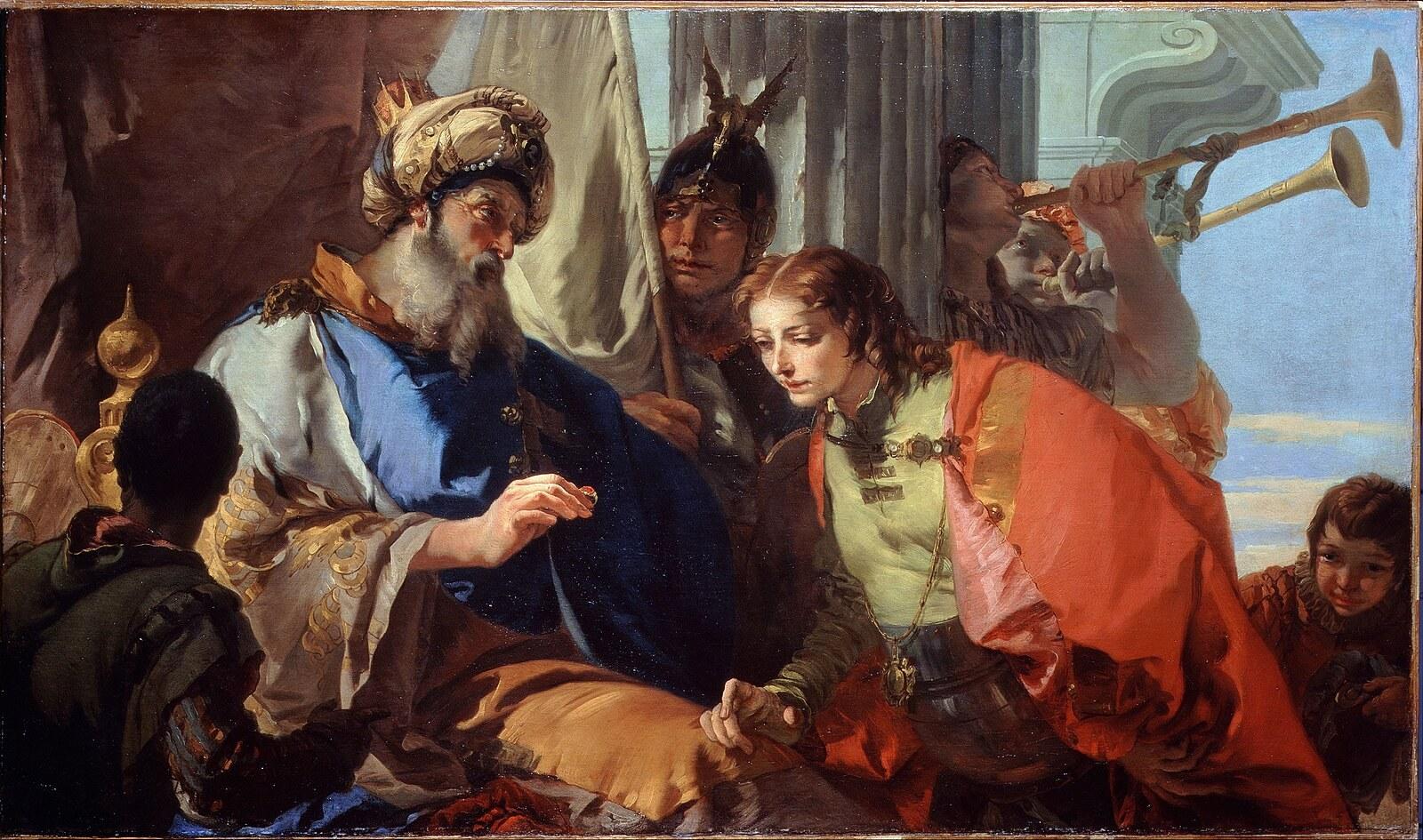
Giovanni Battista Tiepolo, Joseph Receiving Pharaoh's Ring, 1733 to 1735. Public domain.
Haggai 2:23 and Jeremiah 22:24 · Symbol · Featured Study
The Signet Ring
Jeremiah and Haggai made the signet ring a picture of the LORD's judgment on one king and His choice of a governor.
On that day, declares the LORD of Hosts, I will take you, My servant, Zerubbabel son of Shealtiel, declares the LORD, and I will make you like My signet ring, for I have chosen you, declares the LORD of Hosts.”
- The word
- חוֹתָם (chôwthâm), H2368
- First appears
- Genesis 38:18 “What pledge should I give you?” he asked.…”
The last word of Haggai's book is a promise about a ring.
Summary
A signet ring gave a king's orders their force, and whoever held it acted in his name. The ring appears in the stories of Joseph and Esther as well as in the prophets.
- Pharaoh made Joseph ruler of Egypt by giving him the ring from his finger.
- No one could revoke a decree sealed with the Persian king's ring.
- Readers differ on whether Haggai's promise of the ring reaches past Zerubbabel to Christ.
The Ring Pulled Off and Given Back
Jeremiah and Haggai call the LORD's signet ring by one Hebrew word.
“As surely as I live,” declares the LORD, “even if you, Coniah son of Jehoiakim king of Judah, were a signet ring on My right hand, I would pull you off.The sentence on Coniah is the first half of the picture, the ring taken off.
Coniah, also called Jeconiah, was Zerubbabel's grandfather. Jeremiah 22:30 says that none of Coniah's descendants would prosper to sit on the throne of David.
The Parts of a Signet Ring
A signet ring of Egypt shows how a ring could carry a name and press it into clay.
A signet ring carries its owner's mark cut into its face, so that what it presses bears his name.
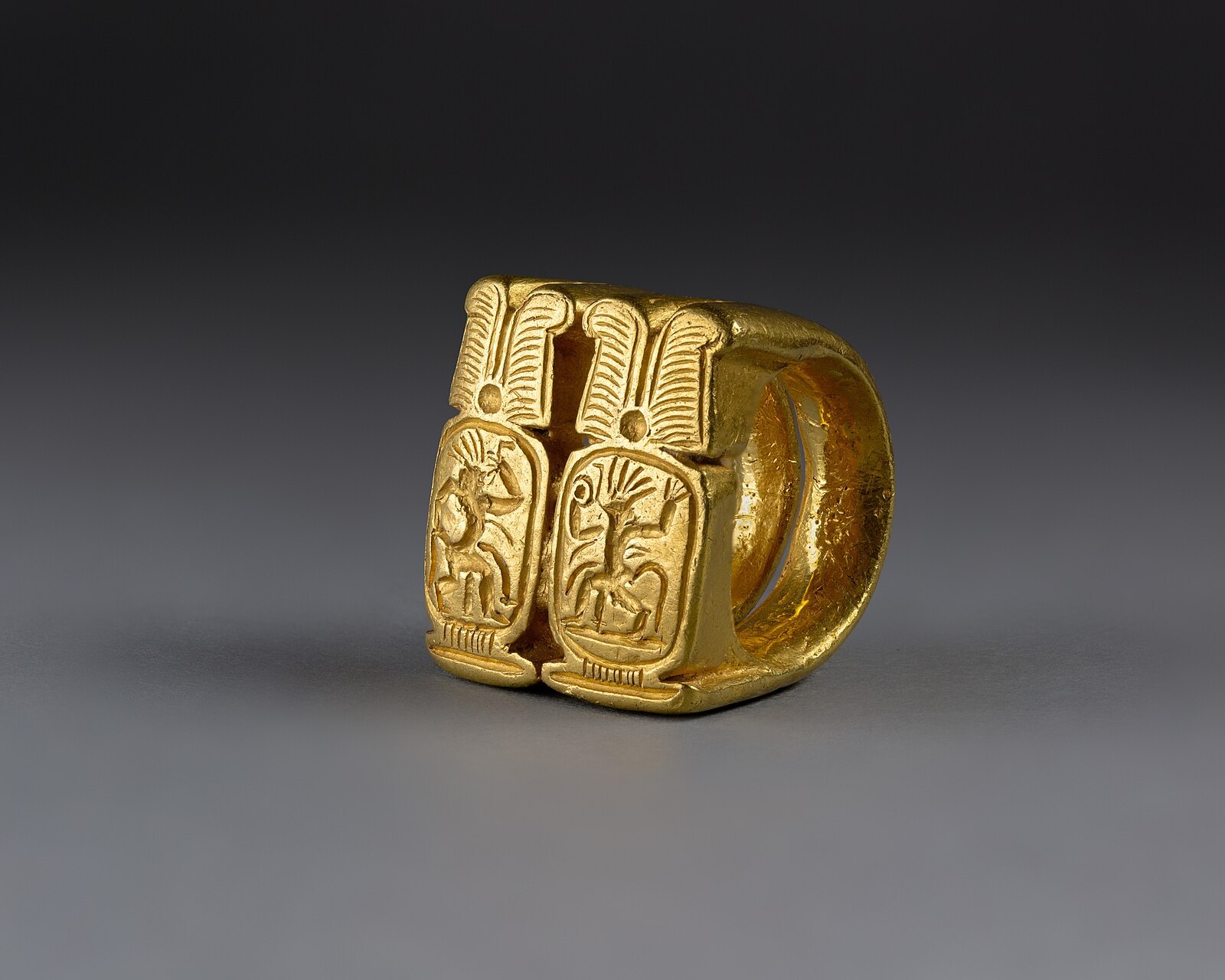
- The face, cut with signs in two oval framesExodus 28:11
- The signs that leave their mark in clayJob 38:14
- The hoop, worn on the fingerEsther 3:10
Signet ring, Egypt, about 1353 to 1323 BC. The Metropolitan Museum of Art, CC0, public domain; Wikimedia Commons, File:Signet ring MET LC-24 2 8 EGDP030813.jpg.
Three parts of a signet ring of Egypt, each with a verse that names its use.
What a Signet Did
Four stories of Scripture show a signet leaving its owner's hand.
Then Pharaoh removed the signet ring from his finger, put it on Joseph’s finger, clothed him in garments of fine linen, and placed a gold chain around his neck.Joseph receives the ring with the linen and the chain, so the ring stands among the marks of his new office.
Now you may write in the king’s name as you please regarding the Jews, and seal it with the royal signet ring. For a decree that is written in the name of the king and sealed with the royal signet ring cannot be revoked.”Mordecai now held the ring Haman had used, so the Jews could seal a second decree to defend themselves.
Adam Clarke, in his Commentary on the Bible, wrote that Pharaoh's ring probably held the king's signet, with which the royal orders were sealed. Jamieson, Fausset and Brown said the giving of the king's ring to Haman was the same as signing a royal decree.
Judah gave his seal and cord to Tamar as a pledge in Genesis 38:18. Jezebel sealed her letters with Ahab's seal in First Kings 21:8.
Zerubbabel in Three Lists
First Chronicles, Matthew and Luke each name Zerubbabel with Shealtiel.
After the exile to Babylon: Jeconiah was the father of Shealtiel, Shealtiel the father of Zerubbabel,Matthew carries the line from Jeconiah through Zerubbabel to Joseph.
the son of Joanan, the son of Rhesa, the son of Zerubbabel, the son of Shealtiel, the son of Neri,Luke also names a Zerubbabel son of Shealtiel, in a list that runs through Nathan.
First Chronicles 3:19 names Pedaiah, a brother of Shealtiel, as Zerubbabel's father. Albert Barnes, in his Notes, read Zerubbabel as Shealtiel's heir and legal son and Pedaiah's natural son.
Jamieson, Fausset and Brown held that the Shealtiel and Zerubbabel of Luke 3:27 are probably other men than those of Matthew 1:12.
Seal, Ring and Choice in Hebrew
Hebrew has two words for a signet, and Haggai 2:23 adds the word for choosing.
חוֹתָם chotham
14 uses in the canon
Chotham is a signature ring, and Exodus 28:11 uses it for the names cut on two onyx stones.
טַבַּעַת tabbaat
49 uses in the canon
Tabbaat is a ring, properly a seal sunk into wax, the word of Pharaoh's ring and the king's ring in Esther.
בָּחַר bachar
171 uses in the canon
Bachar means to choose, the verb of the LORD's choice of Zerubbabel.
The lexicon in full1 paragraph
Exodus 28:36 uses chotham for the engraving on the high priest's gold plate. The plate bore the words HOLY TO THE LORD, cut as on a seal.
Voices on the Right Hand
Two commentators explain why Jeremiah's picture names the right hand.
Adam Clarke (1762 to 1832)
Adam Clarke read the signet on the LORD's right hand as His most precious seal, and Coniah as dearer to Him than the finest gem to its owner.
Jamieson
Jamieson, Fausset and Brown, in their Commentary of 1871, called the right hand the hand most valued.
How Haggai 2:23 Has Been Read
Readers have tied the promise to the fall of Persia, to Zerubbabel's line, and to Christ.
The thrones that fell with PersiaJohn Gill
I will overturn royal thrones and destroy the power of the kingdoms of the nations. I will overturn chariots and their riders; horses and their riders will fall, each by the sword of his brother.The promise to Zerubbabel in the next verse is set on the day these thrones fall.
John Gill, in his Exposition of the Old Testament, read the thrones of Haggai 2:22 as the Persian empire. Alexander overthrew it when he overcame Darius Codomannus.
Zerubbabel's line, and chiefly ChristAlbert Barnes; Adam Clarke
Albert Barnes read the promise as given to Zerubbabel and his descendants, and chiefly to Christ. His reason, in his note on Haggai 2:21, was that no shaking of the heaven or of the nations came in Zerubbabel's time.
Adam Clarke took the signet as dignity, power and trust given to Zerubbabel himself, and he also held that the kingdom of Christ is designed in the prophecy.
Christ, the signet on God's right handMatthew Henry; John Wesley
Matthew Henry, in his Commentary of 1710, gave the promise a reference beyond the governor.
“But this promise has special reference to Christ, who lineally descended from Zerubbabel, and is the sole builder of the gospel-temple. Zerubbabel is here owned as God's servant, and it is an honourable mention that is hereby made of him, as Moses and David my servants.”
Matthew Henry · Commentary on the Whole Bible · on Haggai 2:23Puritan
John Wesley, in his Explanatory Notes, wrote that all power is given to Christ and that in Him the promises of God are yes.
The Hands of Zerubbabel
Zechariah tells what work the chosen governor was given.
“The hands of Zerubbabel have laid the foundation of this house, and his hands will complete it. Then you will know that the LORD of Hosts has sent me to you.The governor named in the promise of the ring is the man whose hands laid the foundation of the house.
Ezra 6:15 records that the house was finished in the sixth year of Darius.
Sources
Scripture is the Berean Standard Bible.
- The Hebrew Bible with Strong's numbers, at Haggai 2:23, Jeremiah 22:24 and Genesis 41:42.
- Henry, Clarke, Barnes, Gill, Wesley, Jamieson, Fausset and Brown and others on Haggai 2:20 to 23, Jeremiah 22:24 to 30, Genesis 41:42, Esther 3:10 and 8:8, Matthew 1:12, Luke 3:27 and First Chronicles 3.
- Matthew Henry, Commentary on the Whole Bible (1710), on Haggai 2:23.
- Albert Barnes, Notes, Explanatory and Practical, on Haggai 2:21 and First Chronicles 3:19.
- Adam Clarke, Commentary on the Bible (1832), on Genesis 41:42, Jeremiah 22:24 and Haggai 2:23.
- Jamieson, Fausset and Brown, Commentary Critical and Explanatory on the Whole Bible (1871), on Jeremiah 22:24, Esther 3:10 and Luke 3:24 to 30.
- John Gill, Exposition of the Old Testament (1748 to 1763), on Haggai 2:22.
- John Wesley, Explanatory Notes upon the Old Testament (1765), on Haggai 2:23.
Keep Studying
Studies5
People and groups5