
Genesis 41:9
in Genesis 41Then the chief cupbearer said to Pharaoh, “Today I recall my failures.
BSB
The same verse in ASV and KJV ▾
ASV
Then spake the chief butler unto Pharaoh, saying, I do remember my faults this day:
KJV
Then spake the chief butler unto Pharaoh, saying, I do remember my faults this day:
⋯
This verse in Genesis 41
Commentary
10 notes on this verseTherefore, being warned in a dream by the king, he said: I remember my sin. Indeed, it is late, but I wish it were a true confession! After the sin, you confess what you should have guarded against before the sin. How quickly you had forgotten: Remember me. You certainly know that at that time this was the discourse: but you had deaf ears due to the pride of power, and being drunk with wine, you did not hear the words of sobriety. Even now, remember me, as you confess your sin late.
This site's exposition
Today I recall my failures
on Genesis 41:9-13
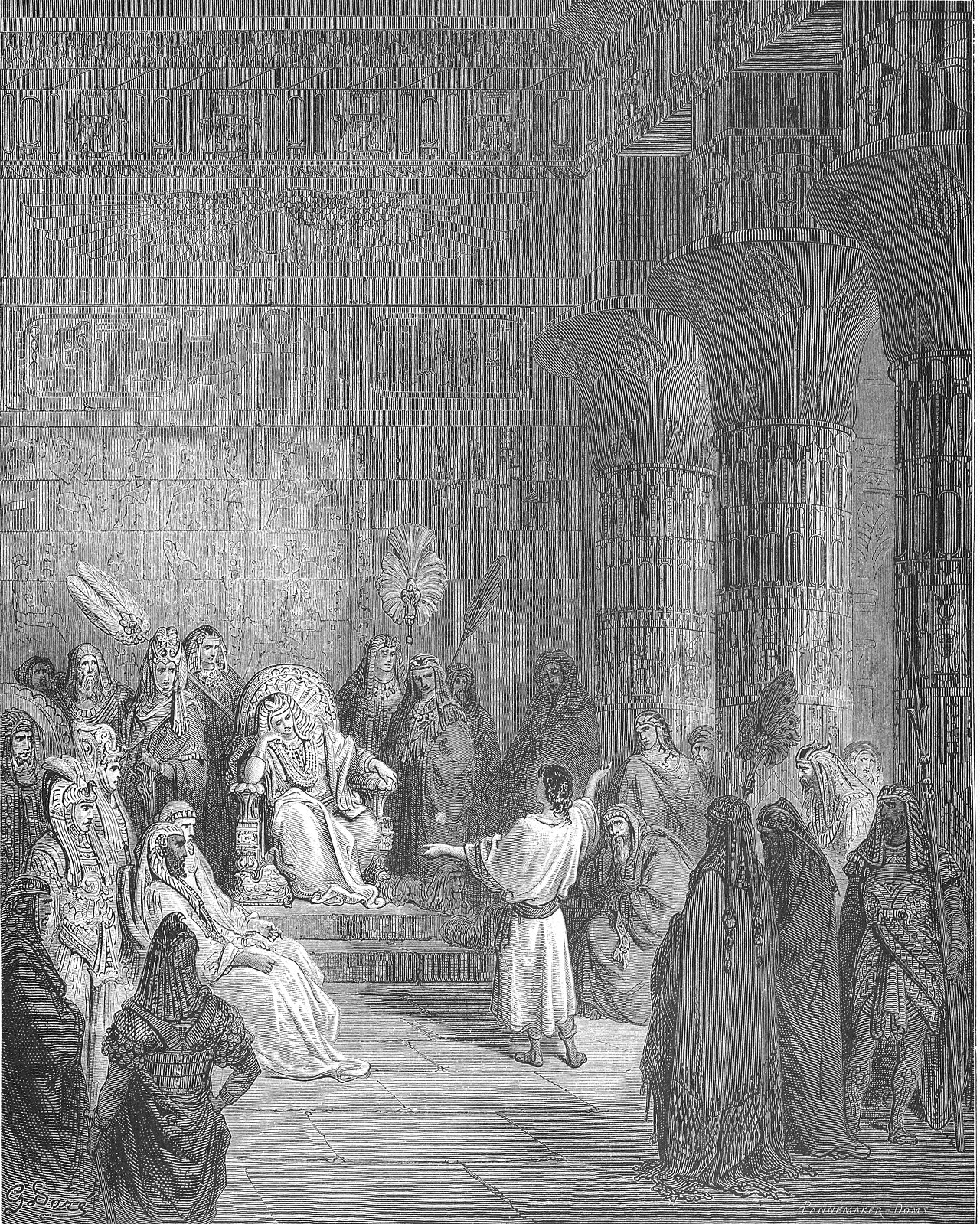
The cupbearer speaks at last, and his first words are about his own failures. He describes Joseph as a young Hebrew serving the captain of the guard, words that put him at the bottom of every ladder in Egypt. Two years of silence end on the day Joseph becomes useful.
The record, by era
The Church Fathers1 voice
See God's wonderful design. First he let him have recourse to all those considered wise in those parts so that, when their ignorance was demonstrated, then this prisoner, this captive, this slave, this Hebrew, might be brought forward and unravel what was a mystery to so many, and thus Joseph might make clear to everyone the grace that had descended on him from above. So when all the wise men arrived and were unable to say anything or even open their mouths, then the chief cupbearer's memory returned, and he informed Pharaoh of what had happened to him, saying, "Today I'm going to bring to light my fault."
The Puritans and the Awakening3 voices
): " I remember my faults this day, in forgetting Joseph." Note, It is best to remember our duty, and to do it in its time; but, if we have neglected that, it is next best to remember our faults, and repent of them, and do our duty at last; better late than never.
quarantine:debris (2026-07-29) — leading-punctuation+unbalanced-parens
The king can scarce allow him time, but that decency required it, to shave himself, and to change his raiment, chap. xli, 14. It is done with all possible expedition, and Joseph is brought in perhaps almost as much surprised as Peter was, Acts xii, 9, so suddenly is his captivity brought back, that he is as one that dreams, Psalm lxxvi, 1.
Then spake the chief butler unto Pharaoh,....
The Nineteenth Century1 voice
I do remember my faults - It is not possible he could have forgotten the circumstance to which he here alludes; it was too intimately connected with all that was dear to him, to permit him ever to forget it. But it was not convenient for him to remember this before; and probably he would not have remembered it now, had he not seen, that giving this information in such a case was likely to serve his own interest.
3 more voices on this verse
The Nineteenth Century3 voices
A commentator
Jamieson, Fausset & Brown1802–1910
Commentary Critical and Explanatory on the Whole Bible (1871)
proposed
then spake the chief butler unto Pharaoh, saying, I do remember my faults--This public acknowledgment of the merits of the young Hebrew would, tardy though it was, have reflected credit on the butler had it not been obviously made to ingratiate himself with his royal master.
quarantine:debris (2026-07-29) — starts-lowercase
No single power or faculty of man escaped damage at the Fall—while the affections were polluted, the will was made perverse, the judgment was shifted from its proper balance, and the memory lost much of its power and more of its integrity. Every observing mind will have noticed that naturally we have a greater power for remembering evil than good. Very plain is this in your children. If you mention anything good in their hearing you had need to say it many times and very plainly before they are likely to remember it.
No single power or faculty of man escaped damage at the Fall—while the affections were polluted, the will was made perverse, the judgment was shifted from its proper balance, and the memory lost much of its power and more of its integrity. Every observing mind will have noticed that naturally we have a greater power for remembering evil than good. Very plain is this in your children. If you mention anything good in their hearing you had need to say it many times and very plainly before they are likely to remember it. But if one ill word shall casually meet their ear in the street, it will not be long before you have the pain of hearing them repeat it. Our memory is like theirs, only in proportion as it is developed this peculiarity is more manifest. We have a most convenient warehouse for storing the merchandise of evil, but the priceless jewels of goodness are readily stolen from their case. We have a fireproof safe for worthless matters, and enclose the rarest gems in mere pasteboard cases. Our memory, like a strainer, often suffers the good wine to pass through but retains all the dregs. It holds the bad in an iron grasp and plays with good till it slips through the fingers. Our memories, like ourselves, have done the things which they ought not to have done, and have left undone the things which they ought to have done—and there is no health in them. Among other things, it is not always easy to remember our faults. We have special and particular reasons for not wishing to be too often reminded of them. Few men care to keep their faults in the front room of the house. Underground, in the darkest cellar, and, if possible with the door locked and the key lost—it is there we would like to conceal our faults from ourselves.
How the passage was read
What the Jewish commentators add
On the verses either side of this one
I believe that Pharaoh is an adjective. What I.E. means by “adjective” is an adjectival noun, a descriptive term like melekh (king). Cf.
This section is reception history: how the passage was read and kept in the Jewish tradition. Where a reading parts from an essential of the Christian faith, the section says so at that point.
Texts and citation data: Sefaria; each excerpt follows its version’s licence. 4 further sources are cited on this chapter that carry no English text this site may quote or only restate the verse.
The words behind it
11 Hebrew wordsEvery Hebrew word of this verse in the order it stands, with what it means and the door to its own study. The last column counts the times a word stands in the whole Bible: the rarer the word, the more the places it appears belong together.
| Hebrew | Sound | Meaning | Word study | In the Bible |
|---|---|---|---|---|
| וַיְדַבֵּר֙ | vaydaber | and he spoke | H1696 → | 1141 times |
| שַׂ֣ר | sar | [the] chief of | H8269 → | 421 times |
| הַמַּשְׁקִ֔ים | hamashkim | the cup bearers | H4945 → | 19 times |
| אֶת־ | ʾet- | with | H854 → | 929 times |
| פַּרְעֹ֖ה | paroh | Pharaoh | H6547 → | 274 times |
| לֵאמֹ֑ר | lemor | <to> saying | H559 → | 5305 times |
| אֶת־ | ʾet- | <obj.> | H853 → | 10935 times |
| חֲטָאַ֕י | chataai | sins my | H2399 → | |
| אֲנִ֖י | ʾani | I | H589 → | 874 times |
| מַזְכִּ֥יר | mazkir | [am] bringing to remembrance | H2142 → | 230 times |
| הַיּֽוֹם׃ | haiyom | this day | H3117 → | 2304 times |
וַיְדַבֵּר֙and he spoke
vaydaberH1696 →1141 times
שַׂ֣ר[the] chief of
sarH8269 →421 times
הַמַּשְׁקִ֔יםthe cup bearers
hamashkimH4945 →19 times
אֶת־with
ʾet-H854 →929 times
פַּרְעֹ֖הPharaoh
parohH6547 →274 times
לֵאמֹ֑ר<to> saying
lemorH559 →5305 times
אֶת־<obj.>
ʾet-H853 →10935 times
חֲטָאַ֕יsins my
chataaiH2399 →
אֲנִ֖יI
ʾaniH589 →874 times
מַזְכִּ֥יר[am] bringing to remembrance
mazkirH2142 →230 times
הַיּֽוֹם׃this day
haiyomH3117 →2304 times
A shaded row is a word that stands 400 times or fewer in the Bible.
The walk
8 stopsEach card is a verse this one points to, and under it the verses that one points to in turn. Where several paths arrive at the same place, that place is listed first: the text keeps returning to it.
Through
Genesis 40:14But when it goes well for you, please remember me and show me kindness by mentioning me to Pharaoh, that he might bring me out of this prison.
it leads to
- Joshua 2:12
Now therefore, please swear to me by the LORD that you will indeed show kindness to my family, because I showed kindness to you. Give me a sure sign
- Luke 23:42
Then he said, “Jesus, remember me when You come into Your kingdom!”
- 1 Samuel 20:14–15
And as long as I live, treat me with the LORD’s loving devotion, that I may not die,
- 1 Kings 2:7
But show loving devotion to the sons of Barzillai the Gileadite, and let them be among those who eat at your table, because they stood by me when I fled from your brother Absalom.
- 1 Samuel 25:31
then my lord will have no remorse or guilt of conscience over needless bloodshed and revenge. And when the LORD has dealt well with my lord, may you remember your maidservant.”
- Joshua 2:12
Through
Genesis 40:23The chief cupbearer, however, did not remember Joseph; he forgot all about him.
it leads to
- Psalms 31:12
I am forgotten like a dead man, out of mind. I am like a broken vessel.
- Job 19:14
My kinsmen have failed me, and my friends have forgotten me.
- Psalms 105:19
until his prediction came true and the word of the LORD proved him right.
- Psalms 31:12
Where this verse is studied
On this page
Studies1
About Genesis
This page draws on Adam Clarke, Commentary on the Bible; Ambrose of Milan, On Joseph the Patriarch; Charles Spurgeon, The Metropolitan Tabernacle Pulpit, Sermon No. 680: “Have You Forgotten Him?” (lightly modernized text, CCEL edition); Jamieson, Fausset & Brown, Commentary Critical and Explanatory on the Whole Bible; John Chrysostom, HOMILIES ON GENESIS 63.13; John Gill, Exposition of the Old Testament (1748-1763); John Wesley, Explanatory Notes upon the Old Testament and Matthew Henry, Commentary on the Whole Bible.