
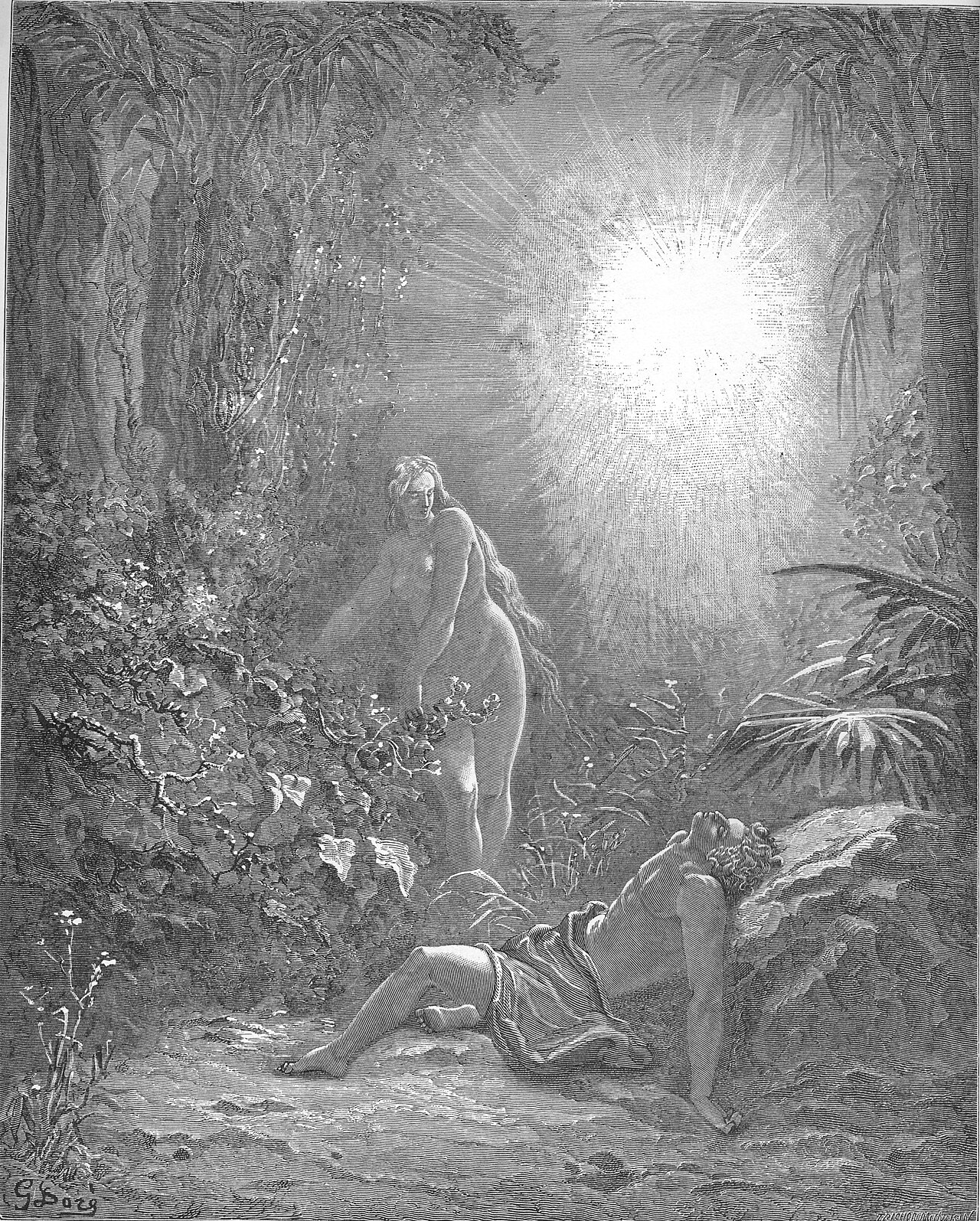
Genesischapter 2
25 verses · Moses, by tradition · 15th to 13th century BC · The Law
Out of the ground the LORD God gave growth to every tree that is pleasing to the eye and good for food. And in the middle of the garden were the tree of life and the tree of the knowledge of good and evil.
The first three verses of this chapter close the account that began at Genesis 1:1; a new account opens at verse 4. Read Genesis 1→
Introduction
Moses, by tradition, The Law, Genesis Overview.
This chapter was written for Israel in the wilderness, a people about to receive laws on work, rest and marriage, and tradition gives it to Moses. It opens a new section of the book and returns to the making of mankind at close range. The wide view of the chapter before narrows to one place and one man. Later Scripture reaches back to it on marriage and on the first man. Listen for what the man is given to do, what he is told to leave alone, and what he lacks. Read it as a close view of the sixth day.
Context
- Who
- Israel in the wilderness, learning what work, rest and marriage were made to be
- What
- A close account of the making of the man and the woman and of the garden God planted for them in Eden.
- Where
- A garden planted in Eden, in the east, watered by a river that divides into four, two of them the Tigris and the Euphrates.
- When
- Before any dated history; the chapter stands inside the account that opens at Genesis 2:4 and gives no date.
- Why
- To show Israel the purpose God gave to work, rest and marriage before anything went wrong.
Historical context
This is the first chapter of the section headed by the account of the heavens and the earth at Genesis 2:4, and it goes back over the sixth day at close range. The man is the figure the chapter follows, and God is the one who plants, forms, commands and brings.
Show the rest of the historical context, 4 more paragraphs
The chapter sets real geography into the story. The Tigris and the Euphrates are the great rivers of Mesopotamia and run today, while the Pishon and the Gihon cannot now be traced with confidence. The land around the Pishon is described the way a trader would describe it, with good gold, bdellium and onyx.
A garden here is a walled and irrigated park of fruit trees, watered from a river and worked by gardeners, which is what a royal garden was in the ancient Near East. The two words used for the man's work in it, to work it and to keep it, are the pair later used for the service the priests give at the tabernacle.
Naming the animals was an act of authority. In that world a ruler's first act over a new territory was to name it, and to name a thing was to hold it.
The chapter closes on a man leaving his father and his mother, which cut against the practice of the region, where a bride left her family and entered her husband's household.
Significance
A generation of former slaves heard that work stood in the garden before anything went wrong, and that rest was set into the week by God himself.
Show the rest of the significance, 1 more paragraph
They also heard that the woman was formed from the man's own side, which in their world was the plainest way of saying that she stood beside him as his equal and his partner.
This chapter in Jewish lifeWhat this chapter is in Jewish life and reading.
What is done
The portion that opens the annual cycle runs from the first verse of Genesis into Genesis 6, and a congregation hears the whole of it in one sitting (src/lib/hebraic/readings.ts). This chapter is therefore heard on the same Sabbath as the creation account, as the second half of one reading. The card above carries the portion and the prophetic reading set beside it.
How it is read
The corpus holds twenty four comments on this chapter and the text of none of them, because the licence Sefaria reports for the English versions keeps them out. Every reference below is cited and linked, and the comment itself is read at the source.
Rashi comments on twenty of the twenty five verses, from the rest of the seventh day to the man leaving his father and his mother. The corpus prints them as Rashi on Genesis 2:2:1 through Rashi on Genesis 2:24:1, one for each verse from 2 to 9, from 11 to 15 and from 18 to 24. Ibn Ezra comments on five, at Ibn Ezra on Genesis 2:1:1, 2:10:1, 2:12:1, 2:16:1 and 2:17:1. Those five verses are the heavens finished, the river of Eden, the gold of Havilah, the leave to eat and the one tree withheld.
The weight of the classical comment on this chapter falls on the garden and its rivers, on the making of the woman, and on the word about the two becoming one flesh. This site names the comments and links them, and it states plainly that it holds no English text of them to quote.
What the rabbis say
The corpus records forty places where the Midrash and the Talmud cite this chapter, twenty one under Midrash and nineteen under Talmud. It carries the locator for each one with no text, so the references stand here and the sayings are read at the source.
Bereshit Rabbah reads the fifth verse at 13:1 and 13:10, the eighth at 15:1 and 15:3, the eleventh at 16:2, the thirteenth at 16:3, the twenty third at 31:8 and the twenty fifth at 18:6. Bamidbar Rabbah reads the first verse at 10:1 and 12:13, the third at 3:8, the sixth at 9:24, the tenth at 21:18 and the twelfth at 12:4. Aggadat Bereshit reads the eighteenth verse at 62:2 and the twentieth at 79:1, and Midrash Lekach Tov reads the thirteenth at Genesis 2:13:1.
The Talmud is cited at Berakhot 61a:3 on the forming of the man, at Berakhot 34b:26 on the river, and at Berakhot 61a:15 on the deep sleep and the making of the woman. It is cited at Bekhorot 55a:22 on the four rivers and at Bekhorot 55b:2 on the Euphrates. The word about a man leaving his father and his mother is cited at Bava Batra 113a:4.
Avot DeRabbi Natan carries twelve of the nineteen Talmud locators on this chapter, more than on any other chapter of the first twenty five. The rest of the seventh day is cited in its second recension at 21:2 and 21:10, and the generations of the heavens at 31:3 and 37:11. The tree of life is cited at 34:11 and 43:24, the man set in the garden at 11:1 and the leave to eat at 1:5. The one tree withheld is cited at 1:13 and the woman built from the rib at 4:3.
Sources: Rashi and Ibn Ezra, their twenty four comments on Genesis 2, cited by reference; the licence Sefaria reports for the English versions keeps the text out of the corpus; The Midrash and the Talmud, the forty locators on Genesis 2 in scripts/data/sources/sefaria/genesis/2.json; MannaFest, the annual cycle table at src/lib/hebraic/readings.ts, 2026.
The heads below are this chapter's scenes. The numbered points under each are its verses.
The sixth day closes here, at Genesis 1:31
1:31And God looked upon all that He had made, and indeed, it was very good. And there was evening, and there was morning—the sixth day.
These verses are numbered in Genesis 1.
God Rests on the Seventh Day
Genesis 2:1-3
the heavens and the earth were completed: , and God finished His work by the seventh day and rested. The seventh day alone is left open at its end, and Hebrews 4:9 reads that as a rest still held out to God's people. God blessed and sanctified the day, so the first thing set apart in Scripture is a piece of time. Exodus 20:11 grounds the Sabbath on these verses.
Genesis 2:1
“The creatures made both in heaven and earth are the hosts or armies of them, which denotes them to be numerous, but marshalled, disciplined, and under command. How great is the sum of them!”
Matthew Henry · Commentary on the Whole Bible (1707-1721)puritan
1 more voice on this verseWhat preachers and commentators have said about this verse, in their own words.
Genesis 2:1
“No permanent change has ever since been made in the course of the world, no new species of animals been formed, no law of nature repealed or added to. They could have been finished in a moment as well as in six days, but the work of creation was gradual for the instruction of man, as well, perhaps, as of higher creatures (Job 38:7).”
Jamieson, Fausset & Brown · Commentary Critical and Explanatory on the Whole Bible (1871)reformed
by the seventh day: The Septuagint, the Samaritan and the Syriac read the sixth day here, and Adam Clarke took that as the original reading. John Gill kept the seventh and denied that any work was done on that day. The Hebrew verb for rested, shabat, means to cease.
Genesis 2:2
“And on the seventh day God ended his work, which he had made,.... Not that God wrought anything on the seventh day, or finished any part of his work on that day, because he could not then be said to rest from all his work, as be is afterwards twice said to do; and because of this seeming difficulty the Septuagint, Samaritan, and Syriac versions, read, "on the sixth day".”
1 more voice on this verse
Genesis 2:2
“On the Seventh day God ended, etc. - It is the general voice of Scripture that God finished the whole of the creation in six days, and rested the seventh! giving us an example that we might labor six days, and rest the seventh from all manual exercises. It is worthy of notice that the Septuagint, the Syriac, and the Samaritan, read the sixth day instead of the seventh; and this should be considered the genuine reading, which appears from these versions to have been originally that of the Hebrew text.”
Adam Clarke · Commentary on the Bible (1810-1826)evangelical
Cross references
Genesis 2:2
- Quoted inHebrews 4:4For somewhere He has spoken about the seventh day in this manner: “And on the seventh day God rested from all His works.”
'God did rest the seventh day from all his works' (Sabbath-rest argument via gezerah shavah w/ Ps 95:11)
blessed the seventh day: Adam Clarke noted that barach, the Hebrew verb for blessed, often means to speak good of, and the Septuagint rendered it that way. God blessed the seventh day and spoke well of it. To sanctify the day was to set it apart for Himself, for on that day He rested.
Genesis 2:3
“And God blessed the seventh day - The original word ברך barach, which is generally rendered to bless, has a very extensive meaning. It is frequently used in Scripture in the sense of speaking good of or to a person; and hence literally and properly rendered by the Septuagint ευλογησεν, from ευ, good or well, and λεγω, I speak. So God has spoken well of the Sabbath, and good to them who conscientiously observe it.”
Adam Clarke · Commentary on the Bible (1810-1826)evangelical
A Garden Planted in Eden
This is the account of the heavens and the earth: The heading gives a title to what follows, the account of the heavens and earth. This is the first of eleven such headings in Genesis, and each one opens what comes after it. The name LORD God stands here for the first time in Scripture, the covenant name YHWH joined to Elohim. The God of chapter 1 is the LORD.
Genesis 2:4
“In the day that the Lord God made, etc. - The word יהוה Yehovah is for the first time mentioned here. What it signifies see the note on Exo 34:5, Exo 34:6. Wherever this word occurs in the sacred writings we translate it Lord, which word is, through respect and reverence, always printed in capitals. Though our English term Lord does not give the particular meaning of the original word, yet it conveys a strong and noble sense.”
Adam Clarke · Commentary on the Bible (1810-1826)evangelical
1 more voice on this verse
Genesis 2:4
“Not from any human source, for man was not in existence to witness it; not from the light of nature or reason, for though they proclaim the eternal power and Godhead by the things which are made, they cannot tell how they were made. None but the Creator Himself could give this information, and therefore it is through faith we understand that the worlds were framed by the word of God (Heb 11:3).”
Jamieson, Fausset & Brown · Commentary Critical and Explanatory on the Whole Bible (1871)reformed
Genesis 2:5-6
no shrub of the field had yet appeared: No rain has fallen yet, and springs well up from the earth and water the whole surface of the ground. Some read this as a different atmosphere before the flood, and others take it as the ordinary ground fog of a dry season. Genesis records no rainfall until chapter 7. The field waits for a man to cultivate it.
Genesis 2:5
“Every plant of the field before it was in the earth - It appears that God created every thing, not only perfect as it respects its nature, but also in a state of maturity, so that every vegetable production appeared at once in full growth; and this was necessary that man, when he came into being, might find every thing ready for his use.”
Adam Clarke · Commentary on the Bible (1810-1826)evangelical
springs welled up from the earth: The Hebrew word is ed, used again only at Job 36:27. It waters the ground, adamah, and in verse 7 the man, adam, is formed from the dust of that ground. Adam Clarke held that God made everything ready and full grown before the man came to use it.
Genesis 2:6
For it says, "The trees were not in existence and the vegetation had not yet sprouted, seeing that the Lord had not caused rain to fall on the earth. A fountain went up from the earth to irrigate the surface of the earth."
Ephrem the Syrian · written before 373 · Commentary (church-history corpus)patristic
4 more voices on this verse
Genesis 2:6
“The saying that man and animals have a like beginning in generation is true of the body; for all animals alike are made of earth. But it is not true of the soul.”
Thomas Aquinas · written before 1274 · Commentary (church-history corpus)patristic
Genesis 2:6
“There went up a mist - This passage appears to have greatly embarrassed many commentators.”
Adam Clarke · Commentary on the Bible (1810-1826)evangelical
Genesis 2:6
“The gentle face of the earth, that is, the dignity of the earth, may be correctly viewed as the mother of the Lord, the Virgin Mary, who was watered by the Holy Spirit, who is signified in the Gospel by the term water.”
Augustine of Hippo · written before 430 · TWO BOOKS ON GENESIS AGAINST THE MANICHAEANS 2.24.37patristic
Genesis 2:6
“By means of diffusion, as of brightness out of light, of heat out of fire, of a river out of its headspring, of rain out of a full or humid cloud.”
Bonaventure · written before 1257 · Collations on the Hexaemeron, Collation 11patristic
breathed the breath of life into his nostrils: Man is made of two things at once, dust from the ground and the breath of God. The Hebrew verb for formed is the potter's word, and the picture is hands working clay. Paul quotes the verse at 1 Corinthians 15:45, the first man Adam became a living being, and sets the last Adam beside him as a life-giving spirit. God breathed, and the man lived.
Genesis 2:7
“God formed man of the dust - In the most distinct manner God shows us that man is a compound being, having a body and soul distinctly, and separately created; the body out of the dust of the earth, the soul immediately breathed from God himself. Does not this strongly mark that the soul and body are not the same thing? The body derives its origin from the earth, or as עפר aphar implies, the dust; hence because it is earthly it is decomposable and perishable.”
Adam Clarke · Commentary on the Bible (1810-1826)evangelical
3 more voices on this verse
Genesis 2:7
“Therefore the soul is not blood, because blood is of the flesh; nor is the soul a harmony, because harmony of this sort is also of the flesh; neither is the soul air, because blown breath is one thing and the soul something else. The soul is not fire, nor is the soul actuality, but the soul is living, for Adam "became a living soul," since the soul rules and gives life to the body, which is without life or feeling.”
Ambrose of Milan · written before 397 · On Isaac and the Soulpatristic
Genesis 2:7
“Man is a little world, consisting of heaven and earth, soul and body. Now here we have an account of the origin of both and the putting of both together: let us seriously consider it, and say, to our Creator's praise, We are fearfully and wonderfully made, Ps. cxxxix.”
Matthew Henry · Commentary on the Whole Bible (1707-1721)puritan
Genesis 2:7
“Here the sacred writer supplies a few more particulars about the first pair. formed--had FORMED MAN OUT OF THE DUST OF THE GROUND. Science has proved that the substance of his flesh, sinews, and bones, consists of the very same elements as the soil which forms the crust of the earth and the limestone that lies embedded in its bowels.”
Jamieson, Fausset & Brown · Commentary Critical and Explanatory on the Whole Bible (1871)reformed
Cross references
Genesis 2:7
- Quoted in1 Corinthians 15:45“So it is written: “The first man Adam became a living being;” the last Adam a life-giving spirit.”
'The first man Adam was made a living soul' ('it is written')
planted a garden in Eden: The LORD God planted the garden in Eden and put the man there. Being placed is the first move in his story. He is sent out of the same garden at the end of chapter 3. The east, a river and four named lands set Eden on the map.
Genesis 2:8
“And the Lord God planted a garden eastward in Eden,.... Or "had planted" (m), for this was not now done after the formation of man, but before; and so the word translated "eastward" may be rendered, as it is by some, "before" (n): for the plain meaning is, that God had planted a garden before he made man, even on the third day, when all herbs, and plants, and trees were produced out of the earth.”
3 more voices on this verse
Genesis 2:8
“A garden eastward in Eden - Though the word עדן Eden signifies pleasure or delight, it is certainly the name of a place. See Gen 4:16; 2Ki 19:12; Isa 37:12; Eze 27:23; Amo 1:5. And such places probably received their name from their fertility, pleasant situation, etc. In this light the Septuagint have viewed it, as they render the passage thus: Εφυτευσεν ὁ Θεος παραδεισον εν Εδεν, God planted a paradise in Eden. Hence the word paradise has been introduced into the New Testament, and is generally used to signify a place of exquisite pleasure and delight.”
Adam Clarke · Commentary on the Bible (1810-1826)evangelical
Genesis 2:8
“If paradise, then, is of such a nature that Paul alone, or one like Paul, could scarcely see it while alive and still was unable to remember whether he saw it in the body or out of the body, and moreover heard words that he was forbidden to reveal—if this be true, how will it be possible for us to declare the position of paradise which we have not been able to see and, even if we had succeeded in seeing it, we would be forbidden to share with others?”
Ambrose of Milan · written before 397 · On Paradisepatristic
Genesis 2:8
“Eden--was probably a very extensive region in Mesopotamia, distinguished for its natural beauty and the richness and variety of its produce. Hence its name, signifying "pleasantness." God planted a garden eastward, an extensive park, a paradise, in which the man was put to be trained under the paternal care of his Maker to piety and usefulness.”
Jamieson, Fausset & Brown · Commentary Critical and Explanatory on the Whole Bible (1871)reformed
the tree of life: Every tree in the garden is good for food and pleasing to the eye, and two of them are named. Only one of the two is put off limits, so the tree of life stands open to Adam through this chapter. It is barred to him at the end of chapter 3. Revelation 22:2 has it growing again, with leaves for the healing of the nations.
Genesis 2:9
“Its prominent position where it must have been an object of daily observation and interest, was admirably fitted to keep man habitually in mind of God and futurity. tree of the knowledge of good and evil--so called because it was a test of obedience by which our first parents were to be tried, whether they would be good or bad, obey God or break His commands.”
Jamieson, Fausset & Brown · Commentary Critical and Explanatory on the Whole Bible (1871)reformed
ConnectionsProverbs 3:18, Revelation 22:1, Revelation 22:2, tree of life
Genesis 2:10-14
a river flowed out of Eden: Four rivers are named, and two of them, the Hiddekel and the Euphrates, are still on the map. The other two have never been identified. The passage reads as geography, and the writer troubles to say where the gold is pure. Revelation 22:1 sets a river and the tree of life together again, flowing from the throne.
Genesis 2:10
“Moses turned to write about the river that flowed out from paradise and that, once outside of it, divided into four distinct sources, saying, "A river flowed out of Eden to water paradise." Here too Moses calls the delightful land of paradise Eden.”
Ephrem the Syrian · written before 373 · COMMENTARY ON GENESIS 2.6patristic
4 more voices on this verse
Genesis 2:10
“And a river went out of Eden to water the garden,.... Before man was created, as Aben Ezra observes, this river went out of Eden and watered it on every side; but what river is here meant, is hard to say.”
Genesis 2:10
“Then there is the ocean that encircles the entire earth like a sort of river and to which it seems to me that Scripture referred when it said that "a river flowed out of paradise." It has sweet potable water and supplies the seas, but because the water remains stagnant in the seas for a long time it becomes brackish. The sun and the waterspouts are constantly drawing up the less dense water, and from this the clouds are formed and the rain comes, the water becoming sweet by filtration. This ocean is divided into four heads, of four rivers.”
John Damascene · written before 749 · ORTHODOX FAITH 2.9patristic
Genesis 2:10
“A river went out of Eden, etc. - It would astonish an ordinary reader, who should be obliged to consult different commentators and critics on the situation of the terrestrial Paradise, to see the vast variety of opinions by which they are divided.”
Adam Clarke · Commentary on the Bible (1810-1826)evangelical
Genesis 2:10
“Now is manifested the reason of the truth why the fourth day is called the Tetras, why we fast even to the ninth hour, or even to the evening, or why there should be a passing over even to the next day. Therefore this world of ours is composed of four elements-fire, water, heaven, earth. These four elements, therefore, form the quaternion of times or seasons. The sun, also, and the moon constitute throughout the space of the year four seasons-of spring, summer, autumn, winter; and these seasons make a quaternion.”
Victorinus of Pettau · written before 304 · Victorinus On the Creation of the Worldpatristic
the first river is Pishon: Pishon has never been fixed on a map. Ambrose of Milan followed an old reading that made it the Ganges, flowing toward India. The land of Havilah, where there is gold, shares its name with a son of Cush and a son of Joktan in Genesis 10.
Genesis 2:11
"The river," we are told, "is separated into four branches." The name of one is Pishon, which encircles all the land of Hevila, where there is gold. And the gold of that land is good; bdellium and onyx are there. The name of the second river is Gihon. This river encircles all the land of Ethiopia. The name of the third river is Tigris, which river flows by the Assyrians. And the fourth river is the Euphrates. There are, therefore, four rivers. Pishon—so called by the Hebrews but named Ganges by the Greeks—flows in the direction of India.
Ambrose of Milan · written before 397 · On Paradisepatristic
ConnectionsStrong's H2091
bdellium and onyx: The pure gold of that land is joined by two stones. Bdellium is named again only at Numbers 11:7, where manna looks like it, and onyx stones bore the names of the tribes of Israel on the high priest's shoulders at Exodus 28:9. Adam Clarke granted that the exact meaning of both Hebrew names cannot be fixed.
Genesis 2:12
“There is bdellium (בדלח bedolach) and the onyx stone, אבן השהם eben hashshoham - Bochart thinks that the bedolach or bdellium means the pearl-oyster; and shoham is generally understood to mean the onyx, or species of agate, a precious stone which has its name from ονυξ a man’s nail, to the color of which it nearly approaches. It is impossible to say what is the precise meaning of the original words; and at this distance of time and place it is of little consequence.”
Adam Clarke · Commentary on the Bible (1810-1826)evangelical
ConnectionsExodus 25:7
the second river is Gihon: A spring called Gihon flowed outside Jerusalem, and Solomon was anointed there at 1 Kings 1:33. John Gill cited Aben Ezra, who took that spring as the river meant here. Cush usually names the land south of Egypt.
Genesis 2:13
“And the name of the second river is Gihon,.... There was one of this name in the land of Israel, which, or a branch of it, flowed near Jerusalem, 1Ki 1:33 this Aben Ezra suggests is here meant, and which favours the notion of the above learned man, that the garden of Eden was in the land of Israel.”
the fourth river is the Euphrates: Hiddekel is the Hebrew name of the Tigris, and John Gill noted it still bore that name in Daniel's day. It runs on the east side of Assyria, and the Euphrates is named with no word of description. The Euphrates is later the border promised to Abraham at Genesis 15:18.
Genesis 2:14
“The name of the third river is Hiddekel,.... A river which ran by Shushan in Persia, and retained its name in the times of Daniel, Dan 10:4 where it is called the great river; and it seems it bears the same name now among the Persians; at least it did an hundred and fifty years ago, when Rauwolff (m) travelled in those parts.”
1 more voice on this verse
Genesis 2:14
“The fourth river is the Euphrates, which means in Latin "fecundity and abundance of fruits." It presents a symbol of justice, the nourishment of every soul. No virtue produces more abundant benefits than equity or justice, which is more concerned with others than with itself, neglecting its own advantages and preferring the common good. Many derive Euphrates from the Greek apo tou euphrainesthai, that is, from a "feeling of gladness," because the human race rejoices in nothing more than it does in justice and equity.”
Ambrose of Milan · written before 397 · On Paradisepatristic
The Tree He Must Not Touch
to cultivate and keep it: Work is given to the man before the fall. The two verbs, abad and shamar, are the ones used later of serving and guarding in the tabernacle, which sets Adam in the garden as a priest stands in a sanctuary. Adam is put there to cultivate and keep the garden. The same verb guards the way to the tree of life at Genesis 3:24, and Adam is on the outside of it.
Genesis 2:15
“Note, now, the person who was taken and the land where he was formed. The virtue of God, therefore, took man and breathed into him, so that man's virtue will advance and increase. God set him apart in Paradise that you may know that man was taken up, that is to say, was breathed upon by the power of God. Note the fact that man was created outside Paradise, whereas woman was made within it. This teaches us that each person acquires grace by reason of virtue, not because of locality or of race.”
Ambrose of Milan · written before 397 · On Paradisepatristic
Genesis 2:16-17
Every tree of the garden is open to the man, and the tree of the knowledge of good and evil is closed. This is the first time the Bible uses the word die, and it comes as a warning before anything has happened. The Hebrew doubles the verb, dying you will die, and the older commentators read a death that begins on the day and is completed in the grave.
Genesis 2:16
“Knowing once more how the will of man could sway to either side, in anticipation God secured the grace given them by a command and by the place where he put them. For he brought them into his own garden and gave them a law so that, if they kept the grace and remained good, they might still keep the life in paradise without sorrow or pain or care, besides having the promise of incorruption in heaven.”
Athanasius of Alexandria · written before 373 · On the Incarnation of the Word 3.4patristic
Adam Clarke called this the first command God gave man, a test of obedience for one set over the earth as His deputy. Of all the trees of the garden, one is closed. The serpent answers these words at Genesis 3:4 by setting a not before them.
Genesis 2:17
“Of the tree of the knowledge - thou shalt not eat - This is the first positive precept God gave to man; and it was given as a test of obedience, and a proof of his being in a dependent, probationary state. It was necessary that, while constituted lord of this lower world, he should know that he was only God’s vicegerent, and must be accountable to him for the use of his mental and corporeal powers, and for the use he made of the different creatures put under his care.”
Adam Clarke · Commentary on the Bible (1810-1826)evangelical
1 more voice on this verse
Genesis 2:17
“What is the difference between saying 'ye shall die' and 'ye shall die the death'? We ought to point out that there is nothing superfluous in the command of God. Here is my solution. Since life and death are contradictory ideas, in unaffected language we say 'we live in life' and 'die in death.'”
Ambrose of Milan · written before 397 · On Paradisepatristic
A Helper Fit for Adam
This is the first thing in the account God calls not good, the man being alone. The Hebrew is ezer kenegdo, a helper answering to him, and ezer is the word used most often in the Old Testament of God coming to the aid of His people. Clarke reads the phrase as one standing opposite him. Henry read the woman made from the man's side as her standing beside him.
Genesis 2:18
“Still another question arises, that concerning the saying of the Lord: 'It is not good for man to be alone.' [ Gen 2:18 ] Recognize the fact, first of all, that, when God created man from the slime of the earth, He did not add: 'God saw that it was good,' [ Gen 1:14 ] as He did in the case of each of His works.”
Ambrose of Milan · written before 397 · On Paradisepatristic
1 more voice on this verse
Genesis 2:18
“It is not good that the man should be alone - לבדו lebaddo; only himself. I will make him a help meet for him; עזר כנגדו ezer kenegdo, a help, a counterpart of himself, one formed from him, and a perfect resemblance of his person. If the word be rendered scrupulously literally, it signifies one like, or as himself, standing opposite to or before him. And this implies that the woman was to be a perfect resemblance of the man, possessing neither inferiority nor superiority, but being in all things like and equal to himself.”
Adam Clarke · Commentary on the Bible (1810-1826)evangelical
Genesis 2:19-20
formed every beast of the field: To name a thing was an act of authority, and Adam does it over every creature brought to him. It also shows him something: among the beasts and the birds no suitable helper was found. He names the woman four verses on. He receives her already knowing what she is.
Genesis 2:19
“God brought unto Adam--not all the animals in existence, but those chiefly in his immediate neighborhood to be subservient to his use. whatsoever Adam called every living creature, that was the name thereof--His powers of perception and intelligence were supernaturally enlarged to know the characters, habits, and uses of each species that was brought to him.”
Jamieson, Fausset & Brown · Commentary Critical and Explanatory on the Whole Bible (1871)reformed
1 more voice on this verse
Genesis 2:19
“Here, as in several previous instances Gen 1:5; Gen 2:4, Gen 2:8-9, the narrative reverts to the earlier part of the sixth day. This is, therefore, another example of the connection according to thought overruling that according to time. The order of time, however, is restored, when we take in a sufficient portion of the narrative. We refer, therefore, to the fifth verse, which is the regulative sentence of the present passage.”
no suitable helper was found: Here the Berean first gives the man's name, Adam, and the Hebrew adam is also the common word for man. Adam Clarke saw two purposes in the naming: to show the powers of mind God gave him, and to show that no creature yet formed could be his companion. The lack comes to light before God supplies it.
Genesis 2:20
“And Adam gave names to all cattle - Two things God appears to have had in view by causing man to name all the cattle, etc. 1. To show him with what comprehensive powers of mind his Maker had endued him; and 2. To show him that no creature yet formed could make him a suitable companion. And that this twofold purpose was answered we shall shortly see; for, 1. Adam gave names; but how? From an intimate knowledge of the nature and properties of each creature.”
Adam Clarke · Commentary on the Bible (1810-1826)evangelical
Genesis 2:21-22
a deep sleep: The LORD God takes a rib from the man's side while he sleeps. The Hebrew verb in verse 22 is banah, the word for building, and Jerome read the church built out of the side of the second Adam. Genesis itself says none of that. She was made while the man slept.
Genesis 2:21
“The Lord God caused a deep sleep to fall upon Adam, etc. - This was neither swoon nor ecstasy, but what our translation very properly terms a deep sleep. And he took one of his ribs - It is immaterial whether we render צלע tsela a rib, or a part of his side, for it may mean either: some part of man was to be used on the occasion, whether bone or flesh it matters not; though it is likely, from verse Gen 2:23, that a part of both was taken; for Adam, knowing how the woman was formed, said,…”
Adam Clarke · Commentary on the Bible (1810-1826)evangelical
4 more voices on this verse
Genesis 2:21
“So, now that all the animals were created and had received their names from the first man, the loving Lord made it his concern to create a helpmate for him of his kind; having arranged everything with this creature of his in mind and for his sake brought forth all this visible creation, after all the other beings he creates also woman. Notice how he teaches us precisely the process of her creation too.”
John Chrysostom · written before 407 · Commentary (church-history corpus)patristic
Genesis 2:21
“In Genesis: "The Lord cast a deep sleep upon Adam, and when he had fallen asleep, he took one of his ribs" and made a woman "and brought her to Adam." And why, while he slept, did He take one of his ribs?”
Bonaventure · written before 1257 · Collationes de Septem Donis, Collation 6patristic
Genesis 2:21
“It is certain that, from the very beginning of his nature, man was impressed with these instincts (of sleep). (Genesis 2:21). If you receive your instruction from God, (you will find) that the fountain of the human race, Adam, had a taste of drowsiness before having a draught of repose; slept before he laboured, or even before he ate, nay, even before he spoke; in order that men may see that sleep is a natural feature and function, and one which has actually precedence over all the natural faculties.”
Tertullian · written before 220 · A Treatise on the Soulpatristic
Genesis 2:21
“What does the phrase 'deep sleep' signify? Does it not mean that when we contemplate a conjugal union we seem to be turning our eyes gradually in the direction of God's kingdom? Do we not seem, as we enter into a vision of this world, to partake a little of things divine, while we find our repose in the midst of what is secular and mundane?”
Ambrose of Milan · written before 397 · On Paradisepatristic
He made a woman: The LORD God brought the woman to the man, as He had brought the beasts and birds in verse 19, and here the search for a suitable helper ends. Albert Barnes left open whether Adam knew what was done while he slept. His next words show he saw what she was.
Genesis 2:22
"God took a rib from the side of Adam and made it into a woman." Here Scripture said aedificavit ("built"). The concept of building intends to denote the construction of a great house; consequently Adam's rib fashioned into a woman signifies, by apostolic authority, Christ and the church, and that is why Scripture said he formed (aedificavit) a woman from the rib. We have heard about the first Adam; let us come now to the second Adam and see how the church is made (aedificatur) from his side.
Jerome · written before 420 · HOMILIES 66patristic
bone of my bones: Adam's first recorded words are poetry. He calls her bone of my bones, and says that out of man she was taken. The name he gave, ishshah from ish, plays on his own name, and English keeps it as woman from man. Jerome noted that the play holds in Hebrew and is lost in Greek and Latin.
Genesis 2:23
“Whether the primeval man was conscious of the change in himself, and of the work of the Supreme Being while it was going on, or received supernatural information of the event when he awoke, does not appear. But he is perfectly aware of the nature of her who now for the first time appears before his eyes.”
be united to his wife: Marriage is set down here, before there is a nation, a law or a priesthood. The verse speaks of a man leaving his father and mother, though Adam had neither, so it is said over every reader. Leave, be united, become one flesh, in that order. Paul quotes the verse at Ephesians 5:31 and says he speaks of Christ and the church.
Genesis 2:24
“Therefore shall a man leave his father and his mother - There shall be, by the order of God, a more intimate connection formed between the man and woman, than can subsist even between parents and children. And they shall be one flesh - These words may be understood in a twofold sense. 1. These two shall be one flesh, shall be considered as one body, having no separate or independent rights, privileges, cares, concerns, etc., each being equally interested in all things that concern the marriage state.”
Adam Clarke · Commentary on the Bible (1810-1826)evangelical
2 more voices on this verse
Genesis 2:24
“It appears by Matt. xix, 4, 5, that it was God himself who said here, a man must leave all his relations to cleave to his wife; but whether he spake it by Moses or by Adam who spake, ver. 23 is uncertain: It should seem they are the words of Adam in God's name, laying down this law to all his posterity.”
John Wesley · Explanatory Notes upon the Old Testament (1765)evangelical
Genesis 2:24
“If the union of Adam and Eve is a great mystery in Christ and in the church, it is certain that as Eve was bone of the bones of her husband and flesh of his flesh, we also are members of Christ's body, bones of his bones and flesh of his flesh.”
Ambrose of Milan · written before 397 · Letterspatristic
Cross references
Genesis 2:24
- Quoted in1 Corinthians 6:16Or don’t you know that he who unites himself with a prostitute is one with her in body? For it is said, “The two will become one flesh.”
'The twain shall be one flesh' (against joining a harlot)
- Quoted inEphesians 5:31“For this reason a man will leave his father and mother and be united to his wife, and the two will become one flesh.”
'They two shall be one flesh' (marriage as Christ and the church)
- Quoted inMark 10:7“‘For this reason a man will leave his father and mother and be united to his wife,”
'they twain shall be one flesh'
- Quoted inMatthew 19:5“and said, ‘For this reason a man will leave his father and mother and be united to his wife, and the two will become one flesh’?”
'For this cause shall a man leave father and mother, and shall cleave to his wife'
ConnectionsEphesians 5:31–32, Revelation 22:17
were both naked: The man and his wife are naked, and they are not ashamed. This is the last line of the account before chapter 3. Shame arrives in the next chapter with the fig leaves, and what is named here is what gets lost.
Genesis 2:25
“Now the resurrection promises us nothing else than the restoration of the fallen to their ancient state; for the grace we look for is a certain return to the first life, bringing back again to Paradise him who was cast out from it. If then the life of those restored is closely related to that of the angels, it is clear that the life before the transgression was a kind of angelic life, and hence also our return to the ancient condition of our life is compared to the angels.”
Gregory of Nyssa · written before 395 · ON THE MAKING OF MAN 17patristic
1 more voice on this verse
Genesis 2:25
“They knew not what shame was, so the Chaldee reads it. Blushing is now the colour of virtue, but it was not then the colour of innocency. Those that had no sin in their conscience might well have no shame in their faces, though they had no clothes to their backs.”
Matthew Henry · Commentary on the Whole Bible (1707-1721)puritan
How this psalm is built
The form: A narrative whose connection follows thought rather than time, reverting to the earlier part of the sixth day, as Barnes classes it.
The patterns in this chapter
| Device | What it does | Where to see it |
|---|---|---|
| The four rivers and the lands they run through | Verses 10 to 14 name one river out of Eden and the four heads it branches into, and each is given its land and what that land holds, the gold and the bdellium and the onyx of Havilah, the land of Cush, the east side of Assyria. John Gill takes the Hiddekel as the river that ran by Shushan in Persia and kept its name into his own century, and this site's published exposition records that two of the four are still on the map and two have never been identified.John Gill, Exposition of the Old Testament (1748-1763), on Genesis 2:14. | Genesis 2:10, Genesis 2:11, Genesis 2:12, Genesis 2:13, Genesis 2:14 |
| The name of the woman taken from the name of the man | The name Adam gives at verse 23 is made from his own. This site's published exposition records the Hebrew pair, ishshah from ish, states that English keeps the play as woman from man, and reports Jerome's note that the play holds in Hebrew and is lost in Greek and Latin.This site's published exposition of Genesis 2:23, the note at Genesis 2:23, bone of my bones, sourced to Jerome, Hebrew Questions on Genesis, and Adam Clarke, Commentary on the Bible. | Genesis 2:23 |
| The man's first recorded words, said twice over | Verse 23 says one thing in two limbs, the bone and then the flesh, before it turns to the name. Albert Barnes reads the man as perfectly aware of the nature of the one who now stands before him for the first time, and Matthew Henry holds it probable that what she was had been shown him while he slept.Albert Barnes, Notes, Explanatory and Practical, on the Old and New Testaments (1832-1869), on Genesis 2:23. | Genesis 2:23 |
| The one command spoken to the man | Verses 16 and 17 are the LORD God speaking directly to the man, and they are the only law in the chapter. Adam Clarke calls this the first positive precept God gave to man, given as a test of obedience and a proof that the man held his place as a dependent under God rather than in his own right.Adam Clarke, Commentary on the Bible, 1832, on Genesis 2:17. | Genesis 2:16, Genesis 2:17 |
The debate over the seventh day in the versions
17 more paragraphs on the patterns
Verse 2 reads that God finished His work by the seventh day, and the ancient versions do not agree with the Hebrew here.
Adam Clarke holds that the Septuagint, the Syriac and the Samaritan read the sixth day, that this should be considered the genuine reading, and that it appears from those versions to have been the original reading of the Hebrew text (Commentary on the Bible, 1832, on Genesis 2:2). The strongest objection is that the reading removes a difficulty and that a reading which removes a difficulty is the one a copyist is most likely to have made.
John Gill holds the Hebrew and reads the difficulty as only apparent. He states that God wrought nothing on the seventh day and finished no part of the work on it, since He is twice afterwards said to have rested from all His work, and he records the three versions as a response to a seeming difficulty rather than as the older text. The objection is that his answer turns on how the Hebrew preposition is taken, which is the point in dispute.
The debate over the two accounts of the creation of man
This site's published dossier for Genesis carries the question under its own entry, and the pool's voices stand on one side of it.
Albert Barnes and Jamieson, Fausset and Brown read chapters 1 and 2 as one connected account. Barnes holds that the narrative reverts to the earlier part of the sixth day and that this is one of several places where the connection follows thought rather than time, with the order of time restored when a large enough portion is read together. Jamieson, Fausset and Brown hold that the writer is supplying a few more particulars about the first pair. The strongest objection is that the two chapters put the making of the plants, the animals and the man in different orders, and Barnes has to carry the whole of that difference on the grammar of verse 19.
The dossier records the other position, the documentary division that assigns chapter 1 to a Priestly source and chapter 2 to a Yahwist source and reads them as originally separate. The strongest objection to it is that the two chapters use different names of God for a reason the text itself supplies at verse 4, where the two names are joined in one heading.
The debate over the helper of verse 18
Adam Clarke reads the Hebrew ezer kenegdo as one like the man, standing opposite to or before him, and he presses the sense to the point of equality, a counterpart possessing neither inferiority nor superiority but in all things like and equal to himself (Commentary on the Bible, 1832, on Genesis 2:18). This site's published exposition records the same pair of words, adds that ezer is most often used of God Himself coming to the aid of His people, and gives Clarke's reading of a helper standing opposite the man. The strongest objection to pressing the phrase to equality is that the chapter gives the man the naming of the woman at verse 23, which Matthew Henry and Adam Clarke both read elsewhere as an act of authority.
The New Testament's use
Paul quotes verse 7 at 1 Corinthians 15:45, where the first Adam who became a living being is set against the last Adam who is a life-giving spirit. This site's published exposition of Genesis 2:7 states the connection and notes that the Hebrew verb for formed is the potter's word.
Jesus quotes verses 23 and 24 at Matthew 19:4 and 5 when He is asked about divorce. John Wesley draws the point out: it appears from Matthew 19 that it was God Himself who said a man must leave all his relations to cleave to his wife, though whether He spoke it through Moses or through Adam is uncertain, and Wesley judges these to be the words of Adam in God's name, laying down a law for all his posterity (Explanatory Notes upon the Old Testament, 1765, on Genesis 2:24). Matthew Henry reads the same verse as the second of the two ordinances instituted in innocency.
Paul quotes verse 24 again at Ephesians 5:31 and applies it to Christ and the church, which this site's published exposition records. The published exposition also sets Revelation 22:2 beside verse 9, where the tree of life grows again, and Revelation 22:1 beside verse 10, where a river flows from the throne.
What the chapter claims and what is confirmed
What the text says is that the man was formed from the dust of the ground and that the breath of life was breathed into him.
What is claimed as confirmed is Jamieson, Fausset and Brown's. They state that science has proved the substance of a man's flesh, sinews and bones to consist of the very same elements as the soil that forms the crust of the earth and the limestone embedded in it (Commentary Critical and Explanatory on the Whole Bible, 1871, on Genesis 2:7). The claim is theirs and it is stated as the chemistry of 1871. Adam Clarke reads the same verse for a different purpose, that the body and the soul are distinctly and separately created and so stand as two things, and he takes that as an argument drawn from the verse itself.
What is contested is the geography. Two of the four rivers are named on the map today and the other two remain unidentified, Clarke records a wide variety of opinions on where the garden stood, and Gill records a reading that would put it in the land of Israel. Nothing in the chapter's own text settles it.
Keep studying
Studies17
People1
Words12
Trails1
Sources for this chapter
The summary
Jamieson, Fausset & Brown, Commentary Critical and Explanatory; John Wesley, Notes on the Old Testament and Matthew Henry, Complete Commentary.
The context
Keil, The Books of the Kings and Matthew Henry, Commentary on the Whole Bible.
The form and classifications
Albert Barnes, Notes, Explanatory and Practical, on the Old and New Testaments (1832-1869), on Genesis 2:19; Jamieson, Fausset & Brown, Commentary Critical and Explanatory on the Whole Bible, 1871, on Genesis 2:7; Matthew Henry, Commentary on the Whole Bible, 1710, on Genesis 2:24 and This site's published dossier for Genesis, src/components/book/dossier-content/genesis.ts, the theology entry The Toledoth Structure, with the published exposition note at Genesis 2:4.
The exposition
Adam Clarke, Commentary on the Bible; Albert Barnes, Notes, Explanatory and Practical, on the Old and New Testaments (1832-1869); Ambrose of Milan, On Paradise; Chuck Missler, The Book of Genesis; Jamieson, Fausset & Brown, Commentary Critical and Explanatory on the Whole Bible; Jerome; John Calvin, Commentary on Genesis; John Gill; John Wesley, Explanatory Notes upon the Old Testament and Matthew Henry, Commentary on the Whole Bible.