
Genesis 2:25
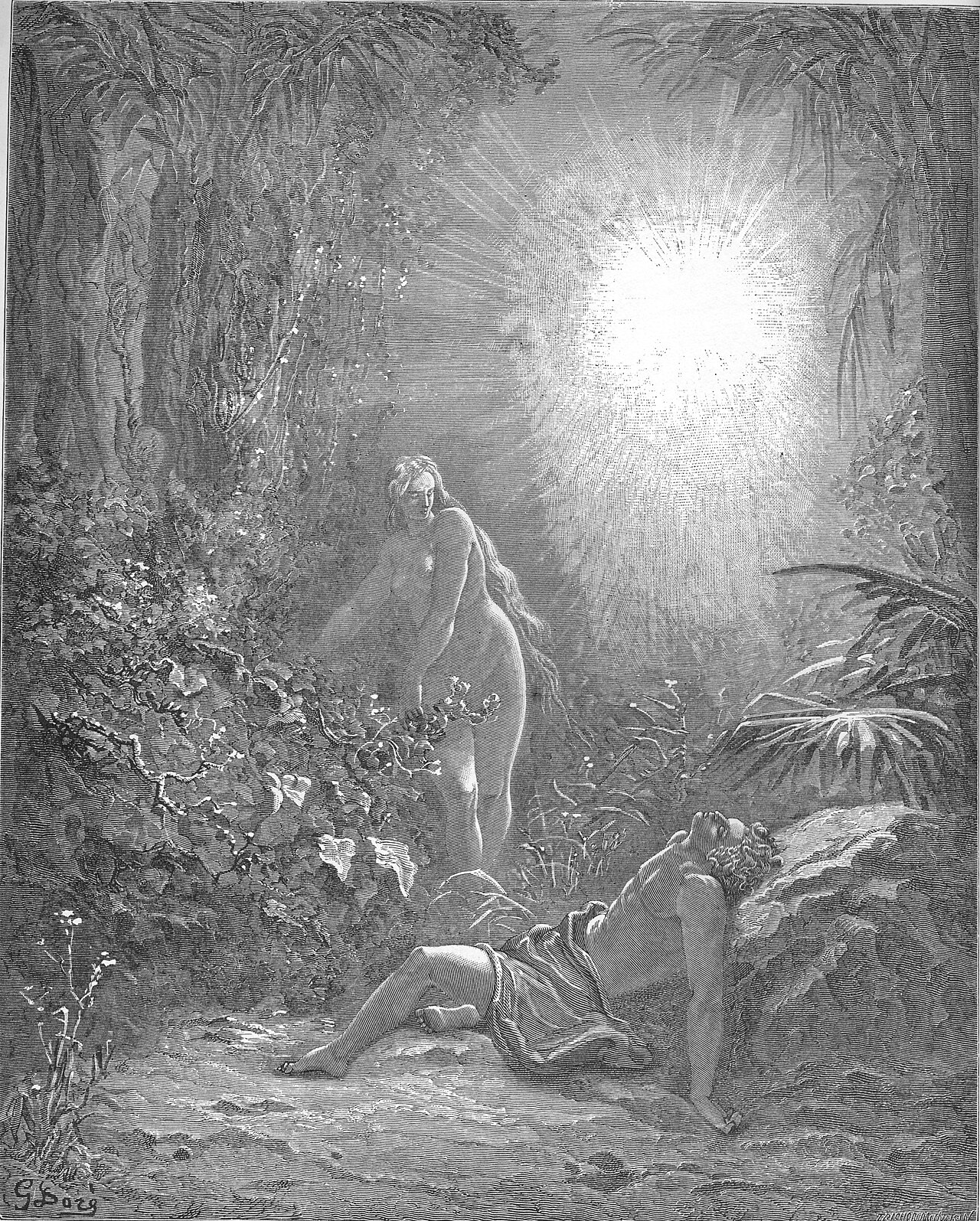
in Genesis 2And the man and his wife were both naked, and they were not ashamed.
BSB
The same verse in ASV and KJV ▾
ASV
And they were both naked, the man and his wife, and were not ashamed.
KJV
And they were both naked, the man and his wife, and were not ashamed.
⋯
This verse in Genesis 2
Commentary
16 notes on this verseNow the resurrection promises us nothing else than the restoration of the fallen to their ancient state; for the grace we look for is a certain return to the first life, bringing back again to Paradise him who was cast out from it. If then the life of those restored is closely related to that of the angels, it is clear that the life before the transgression was a kind of angelic life, and hence also our return to the ancient condition of our life is compared to the angels.
This site's exposition
were both naked
The man and his wife are naked, and they are not ashamed. This is the last line of the account before chapter 3. Shame arrives in the next chapter with the fig leaves, and what is named here is what gets lost.
The record, by era
The Church Fathers5 voices
Following this it says, "The two of them were naked, but they were not ashamed. " [ Gen. 2:25 ] It was not because they were ignorant of what shame was that they were not ashamed; for had they been infants, as the pagans say, …
They were not ashamed because of the glory with which they were clothed. It was when this glory was stripped from them after they had transgressed the commandment that they were ashamed because they were naked.
After stripping you of your robe, the priest himself leads you down into the flowing waters. But why naked? He reminds you of your former nakedness, when you were in paradise and you were not ashamed. For Holy Writ says, "Adam and Eve were naked and were not ashamed," until they took up the garment of sin, a garment heavy with abundant shame.
"They were both naked," the text says, remember, "and were not ashamed." You see, while sin and disobedience had not yet come on the scene, they were clad in that glory from above which caused them no shame. But after the breaking of the law, then entered the scene both shame and awareness of their nakedness.
In the beginning, when God created man, he set him in paradise (as the divine holy Scripture says) adorned with every virtue and gave him a command not to eat of the tree in the middle of paradise.
9 more voices on this verse
The Church Fathers2 voices
A commentator
John ChrysostomCommentary (church-history corpus) · Written in the 5th century.
proposed
I WOULD LIKE TODAY, dearly Beloved, to open up for you spiritual treasure, which though distributed is never fully exhausted, which though bringing riches to everyone is in no way diminished but even increased. You see, just as in the case of material treasure people able to collect even a tiny nugget acquire for themselves great wealth, so too in the case of Sacred Scripture you can find in even a brief phrase great power of thought and wealth beyond telling. Such, after all, is the nature of this treasure: it enriches those receiving it without itself ever failing, rising as it does from the source which is the Holy Spirit. It remains for you, however, to keep careful guard on what is entrusted to you and preserve the memory of it untarnished so that you may with ease follow what is said, provided we make our contribution zealously. Grace, you see, is ready at hand and looks only for people welcoming it with generosity. Let us listen today also to what is read so that we may come to know of God's unspeakable love for humanity and the extent of the considerateness he employs with our salvation in mind. "They were both naked, Adam and his wife, without feeling shame." Consider, I ask you, the transcendence of their blessed condition, how they were superior to all bodily concerns, how they lived on earth as if they were in heaven, and though in fact possessing a body they did not feel the limitations of their bodies. After all, they had no need of shelter or habitation, clothing or anything of that kind.
[Man and woman] were aware, of course, of their nakedness, but they felt no shame, because no desire stirred their organs in defiance of their deliberate decision. The time had not yet come when the rebellion of the flesh was a witness and reproach to the rebellion of man against his Maker.
The Medieval Church1 voice
And they were both naked. Adam and his wife, and were not ashamed. "And rightly so, for why would they feel shame when they perceived no law in their members opposing the law of their mind?
The Puritans and the Awakening4 voices
They knew not what shame was, so the Chaldee reads it. Blushing is now the colour of virtue, but it was not then the colour of innocency. Those that had no sin in their conscience might well have no shame in their faces, though they had no clothes to their backs.
(2.) The commencement of the kingdom of grace, in the sanctification of the sabbath day, ver. 3. He rested on that day, and took a complacency in his creatures, and then sanctified it, and appointed us on that day to rest and take a complacency in the Creator; and his rest is in the fourth commandment made a reason for ours after six days labour.
quarantine:anchor (2026-07-29) — cites-ver-3-anchored-18-25
Solomon in all his glory was not arrayed like one of these. Nay, they needed none for decency, they were naked, and had no reason to be ashamed. They knew not what shame was, so the Chaldee reads it.
And they were both naked, the man and his wife,....
The Nineteenth Century2 voices
They were both naked, etc. - The weather was perfectly temperate, and therefore they had no need of clothing, the circumambient air being of the same temperature with their bodies. And as sin had not yet entered into the world, and no part of the human body had been put to any improper use, therefore there was no shame, for shame can only arise from a consciousness of sinful or irregular conduct. Even in a state of innocence, when all was perfection and excellence, when God was clearly discovered in all his works, every place being his temple, every moment a time of worship, and every object an incitement to religious reverence and adoration - even then, God chose to consecrate a seventh part of time to his more especial worship, and to hallow it unto his own service by a perpetual decree. Who then shall dare to reverse this order of God? Had the religious observance of the Sabbath been never proclaimed till the proclamation of the law on Mount Sinai, then it might have been conjectured that this, like several other ordinances, was a shadow which must pass away with that dispensation; neither extending to future ages, nor binding on any other people. But this was not so. God gave the Sabbath, his first ordinance, to man, (see the first precept, Gen 2:17), while all the nations of the world were seminally included in him, and while he stood the father and representative of the whole human race; therefore the Sabbath is not for one nation, for one time, or for one place. It is the fair type of heaven’s eternal day - of the state of endless blessedness and glory, where human souls, having fully regained the Divine image, and become united to the Centre and Source of all perfection and excellence, shall rest in God, unutterably happy through the immeasurable progress of duration!
A commentator
Albert Barnes1798–1870
Notes, Explanatory and Practical, on the Old and New Testaments (1832-1869)
proposed
This is corroborated by the statement contained in Gen 2:25. “They were both naked, and were not ashamed.” Of nakedness in our sense of the term they had as yet no conception.
The words behind it
7 Hebrew wordsEvery Hebrew word of this verse in the order it stands, with what it means and the door to its own study. The last column counts the times a word stands in the whole Bible: the rarer the word, the more the places it appears belong together.
| Hebrew | Sound | Meaning | Word study | In the Bible |
|---|---|---|---|---|
| וַיִּֽהְי֤וּ | vaiyihyu | and they were | H1961 → | 3559 times |
| שְׁנֵיהֶם֙ | sheneihem | both of them | H8147 → | 768 times |
| עֲרוּמִּ֔ים | ʾarumim | naked | H6174 → | |
| הָֽאָדָ֖ם | haadam | the man | H120 → | 551 times |
| וְאִשְׁתּ֑וֹ | veishto | and wife his | H802 → | 781 times |
| וְלֹ֖א | velo' | and not | H3808 → | 5168 times |
| יִתְבֹּשָֽׁשׁוּ׃ | yitboshashu | they were ashamed | H954 → |
וַיִּֽהְי֤וּand they were
vaiyihyuH1961 →3559 times
שְׁנֵיהֶם֙both of them
sheneihemH8147 →768 times
עֲרוּמִּ֔יםnaked
ʾarumimH6174 →
הָֽאָדָ֖םthe man
haadamH120 →551 times
וְאִשְׁתּ֑וֹand wife his
veishtoH802 →781 times
וְלֹ֖אand not
velo'H3808 →5168 times
יִתְבֹּשָֽׁשׁוּ׃they were ashamed
yitboshashuH954 →
A shaded row is a word that stands 400 times or fewer in the Bible.
The walk
8 stopsEach card is a verse this one points to, and under it the verses that one points to in turn. Where several paths arrive at the same place, that place is listed first: the text keeps returning to it.
Through
Romans 10:11It is just as the Scripture says: “Anyone who believes in Him will never be put to shame.”
it leads to
- Isaiah 49:23
Kings will be your foster fathers, and their queens your nursing mothers. They will bow to you facedown and lick the dust at your feet. Then you will know that I am the LORD;…
Reached by 2 separate paths from here.
- Isaiah 28:16
So this is what the Lord GOD says: “See, I lay a stone in Zion, a tested stone, a precious cornerstone, a sure foundation; the one who believes will never be shaken.
- Romans 9:33
as it is written: “See, I lay in Zion a stone of stumbling and a rock of offense; and the one who believes in Him will never be put to shame.”
- Isaiah 49:23
Through
Jeremiah 17:13O LORD, the hope of Israel, all who abandon You will be put to shame. All who turn away will be written in the dust, for they have abandoned the LORD, the fountain of…
it leads to
- Revelation 7:17
For the Lamb in the center of the throne will be their shepherd. ‘He will lead them to springs of living water,’ and ‘God will wipe away every tear from their eyes.’”
- John 4:14
But whoever drinks the water I give him will never thirst. Indeed, the water I give him will become in him a fount of water springing up to eternal life.”
- John 7:37–38
On the last and greatest day of the feast, Jesus stood up and called out in a loud voice, “If anyone is thirsty, let him come to Me and drink.
- John 4:10
Jesus answered, “If you knew the gift of God and who is asking you for a drink, you would have asked Him, and He would have given you living water.”
- Revelation 22:1
Then the angel showed me a river of the water of life, as clear as crystal, flowing from the throne of God and of the Lamb
- Revelation 7:17
Where this verse is studied
On this page
Studies16
On this chapter
About Genesis
This page draws on 16 works. Open the list of works
This page draws on Adam Clarke, Commentary on the Bible; Albert Barnes, Notes, Explanatory and Practical, on the Old and New Testaments (1832-1869); Augustine of Hippo, City of God 14.17; Bede, Commentary on Genesis (Hexaemeron); Dorotheos of Gaza, SPIRITUAL INSTRUCTIONS 1; Ephrem the Syrian, Commentary (church-history corpus); Ephrem the Syrian, COMMENTARY ON GENESIS 2.14.2; Gregory of Nyssa, ON THE MAKING OF MAN 17; Jamieson, Fausset & Brown, Commentary Critical and Explanatory on the Whole Bible; John Calvin, Commentary on Genesis; John Chrysostom, BAPTISMAL INSTRUCTION 11.28; John Chrysostom, HOMILIES ON GENESIS 15.14; John Chrysostom, Commentary (church-history corpus); John Gill, Exposition of the Old Testament (1748-1763); John Wesley, Explanatory Notes upon the Old Testament and Matthew Henry, Commentary on the Whole Bible.