
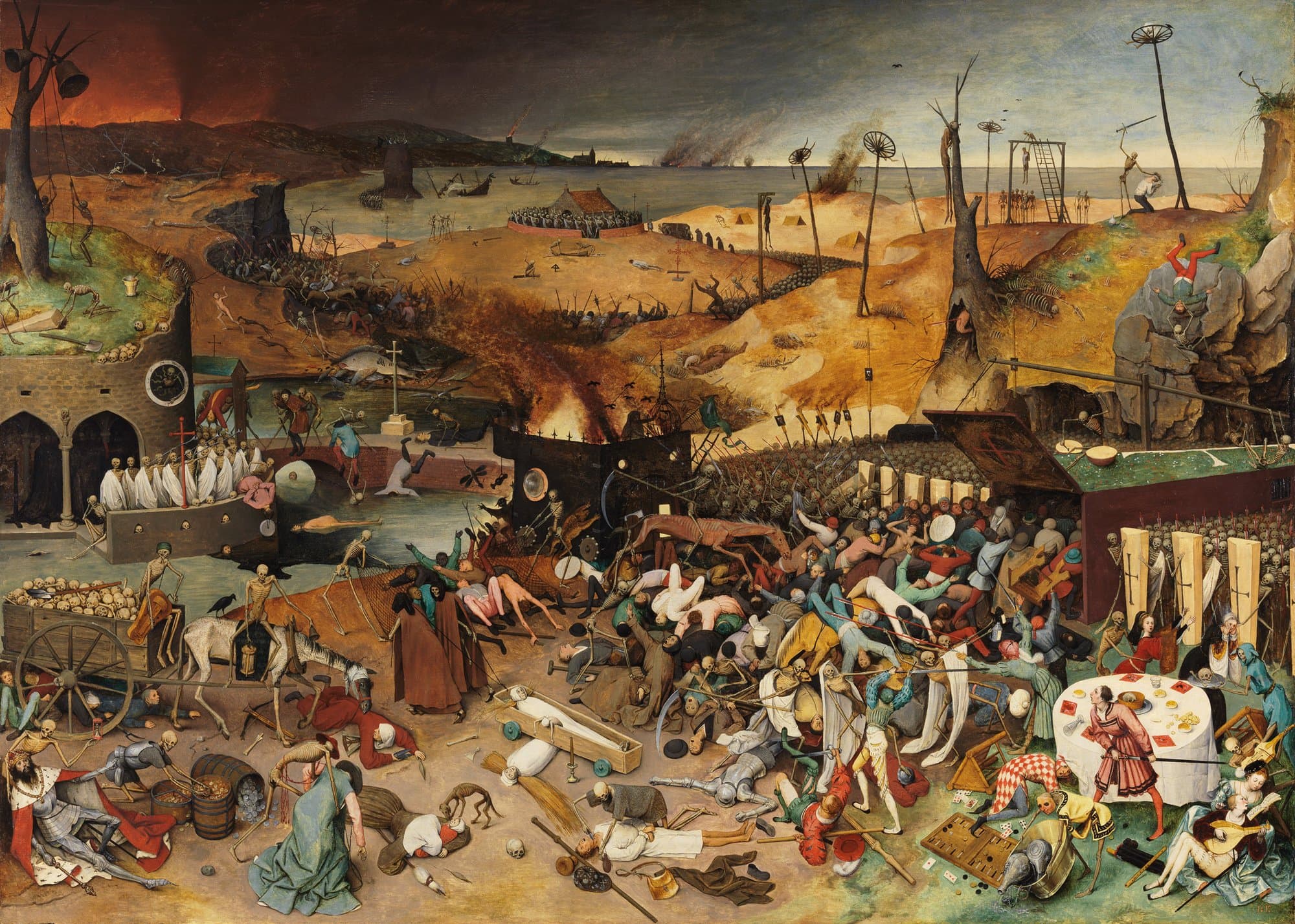
Hosea 13 · Symbol · Death and Dying
The Words Maveth and Thanatos
The Hebrew noun maveth and the Greek noun thanatos are the Bible's words for death.
Hagar's cry in the wilderness, when she could not bear to watch her son die, holds the first use of maveth (Genesis 21:16).
I will ransom them from the power of Sheol; I will redeem them from Death. Where, O Death, are your plagues? Where, O Sheol, is your sting? Compassion is hidden from My eyes.
- The word
- מָוֶת (maveth), H4194
- First appears
- Genesis 21:16 “Then she went off and sat down nearby,…”
Summary
The Hebrew verb muth and the Greek verb apothnesko, both meaning to die, stand beside the nouns maveth and thanatos. Scripture uses all four of these words for the end of bodily life, for the penalty of sin and for a power that Christ defeats. Hebrew and Greek add a noun for the shade of death and an adjective for the dead.
- The noun maveth stands for the death of the faithful in Psalm 116:15 and for Death as a power in Hosea 13:14.
- Jesus, Luke and Paul each use koimao, the verb to sleep, for a death (John 11:11, Acts 7:60, 1 Thessalonians 4:14).
- Paul answers death in the words of two prophets, Isaiah and Hosea (1 Corinthians 15:54 to 55).
Where the Words First Stand
The Berean text renders the noun maveth of Genesis 21:16 with the verb die.
The Words Maveth and Thanatos belongs to death and dying, the trial every person faces, because Scripture names that enemy in these words and in the verbs beside them.
The question it answers is what Scripture means when it speaks of death. It gives the counts of the words, a verse for each of their main senses, the New Testament's word sleep for the death of believers and the questions of Hosea that Paul took up. It also names teachers who read the words.
the people living in darkness have seen a great light; on those living in the land of the shadow of death, a light has dawned.”Thanatos first stands, in the order of the New Testament, in this line of Isaiah that Matthew quotes when Jesus begins to preach in Galilee.
The Death Words Counted
Counted in the tagged texts, the Hebrew verb to die stands more often than all the other words together.
The Hebrew verb muth stands more than five times as often as the noun maveth, while the Greek noun thanatos and verb apothnesko stand about equally.
| Word | Sense | Uses | Books with the most uses |
|---|---|---|---|
| Hebrew | |||
| maveth, מָוֶת, H4194, noun | death, natural or violent | 156 | Psalms 22, Proverbs 19, Jeremiah 11; 27 books in all |
| muth, מוּת, H4191, verb | to die | 839 | Genesis 72, 2 Samuel 62, Numbers 59; 28 books in all |
| tsalmaveth, צַלְמָוֶת, H6757, noun | shade of death, the grave | 18 | Job 9, Psalms 4; 5 books in all |
| Greek | |||
| thanatos, θάνατος, G2288, noun | death, in fact or in figure | 120 | Romans 20, Revelation 15; 15 books in all |
| apothnesko, ἀποθνήσκω, G599, verb | to die | 110 | John 24, Romans 18; 15 books in all |
| nekros, νεκρός, G3498, adjective | dead | 128 | Acts 17, Romans 15; 18 books in all |
| koimao, κοιμάω, G2837, verb | to put to sleep, to slumber | 18 | 1 Corinthians 6, Acts 3, 1 Thessalonians 3; 7 books in all |
apothnesko, ἀποθνήσκω, G599, verb, nekros, νεκρός, G3498, adjective, koimao, κοιμάω, G2837, verb
The counts are those of the STEP Bible tagging of the Hebrew and Greek texts, where a verse that holds a word twice is counted twice, and the books are counted by verses.
From the Garden to the Second Death
The words name a warning, a power that passed to all, a death God watches over, an enemy and a second death.
but you must not eat from the tree of the knowledge of good and evil; for in the day that you eat of it, you will surely die.”God's first word about death is a warning attached to the tree, and the Hebrew sets the verb muth twice to make the warning certain.
Therefore, just as sin entered the world through one man, and death through sin, so also death was passed on to all men, because all sinned.The verse stands here because Paul sets the noun thanatos in it twice.
Precious in the sight of the LORD is the death of His saints.The verse stands here because the psalmist uses the noun maveth in it.
The last enemy to be destroyed is death.The verse stands here because Paul uses the noun thanatos in his teaching on the resurrection.
Revelation speaks of a death beyond the first: "Then Death and Hades were thrown into the lake of fire. This is the second death" (Revelation 20:14).
Hosea sets Sheol beside Death, and Revelation sets Hades beside it, and Afterlife Vocabulary teaches these two names for the place of the dead with the others.
Psalm 116:15, 1 Corinthians 15:26
Sleep for the Death of Believers
The New Testament uses the verb for sleep both of ordinary rest and of believers who have died.
The Greek verb koimao means to put to sleep or to slumber. It names ordinary sleep when Jesus found the disciples asleep from sorrow (Luke 22:45) and when Peter slept between two soldiers (Acts 12:6).
Jesus used the same verb when He said, "Our friend Lazarus has fallen asleep", and when the disciples took Him to mean rest, He told them plainly, "Lazarus is dead" (John 11:11 to 14). Luke uses it again when Stephen died under the stones (Acts 7:60).
John Wesley, in his Explanatory Notes upon the New Testament (1755), wrote of Jesus' word in John 11:11, "Such is the death of good men in the language of heaven."
For since we believe that Jesus died and rose again, we also believe that God will bring with Jesus those who have fallen asleep in Him.Paul ties the sleep of believers to the death and rising of Jesus, so the figure looks to the day God brings them with Him.
A word takes its sense from the verses it stands in, and the root meaning of koimao cannot tell by itself what the dead experience. Albert Barnes, in his Notes, Explanatory and Practical (1832 to 1869), read the figure from its setting. He wrote that "in the Scriptures it is used to intimate that death will not be final: that there will be an awaking out of this sleep, or a resurrection."
The state of the believer between death and the resurrection is weighed on The Intermediate State.
Hosea's Questions in Paul's Mouth
Hosea's questions to Death and Sheol stand in a chapter of judgment on Ephraim and Samaria.
Matthew Henry, in his Commentary on the Whole Bible, read the promise of Hosea 13:14 as reaching "particularly to the blessed resurrection of believers at the great day".
He will swallow up death forever. The Lord GOD will wipe away the tears from every face and remove the disgrace of His people from the whole earth. For the LORD has spoken.Paul quotes this promise in 1 Corinthians 15:54, the verse before he takes up Hosea's questions.
In 1 Corinthians 15:55 Paul asks, "Where, O Death, is your victory? Where, O Death, is your sting?", where Hosea had asked about plagues.
Jamieson, Fausset and Brown, in their Commentary Critical and Explanatory (1871), wrote that Paul quoted Hosea "substantially; but freely used by the warrant of the Spirit by which Paul wrote".
Teachers on Death
Two fathers of the fourth and fifth centuries wrote of death as the common lot and the last enemy.
died 397 · Ambrose of Milan
On the Decease of His Brother Satyrus, Book 2
Ambrose found the resurrection in the death that came through one man
The quotation1 quotation
“For death is alike to all, without difference for the poor, without exception for the rich. And so although through the sin of one alone, yet it passed upon all; that we may not refuse to acknowledge Him to be also the Author of death, Whom we do not refuse to acknowledge as the Author of our race; and that, as through one death is ours, so should be also the resurrection; and that we should not refuse the misery, that we may attain to the gift.”
Ambrose of Milan · On the Decease of His Brother Satyrus, Book 2 · on Romans 5:12Patristic
died 430 · Augustine of Hippo
On Continence 3.6
Augustine set the present fight beside the end of the last enemy
The quotation1 quotation
“It is one thing to fight well, which is the case now when the struggle of death is resisted. It is something else not to have an adversary, which will be the case when death ‘our last enemy’ is destroyed.”
Augustine of Hippo · On Continence 3.6 · on 1 Corinthians 15:26Patristic
Death Abolished
The noun thanatos stands again in 2 Timothy 1:10, where Paul writes to Timothy of the gospel.
The words for death run from the warning in the garden to the second death in Revelation.
And now He has revealed this grace through the appearing of our Savior, Christ Jesus, who has abolished death and illuminated the way to life and immortality through the gospel,The believer may face dying without despair because of this word of the gospel.
Sources
Scripture is the Berean Standard Bible.
- STEP Bible TAHOT, TAGNT and TBESG, Tyndale House, CC BY 4.0, the Brief lexicon based on Abbott-Smith (1922)
- John Wesley, Explanatory Notes upon the New Testament (1755)
- Albert Barnes, Notes, Explanatory and Practical, on the Old and New Testaments (1832 to 1869)
- Matthew Henry, Commentary on the Whole Bible.
- Jamieson, Fausset and Brown, Commentary Critical and Explanatory on the Whole Bible (1871)
- Ambrose of Milan, On the Decease of His Brother Satyrus, book 2.
- Augustine of Hippo, On Continence 3.6.
Keep Studying
In this trial6
People and groups11