
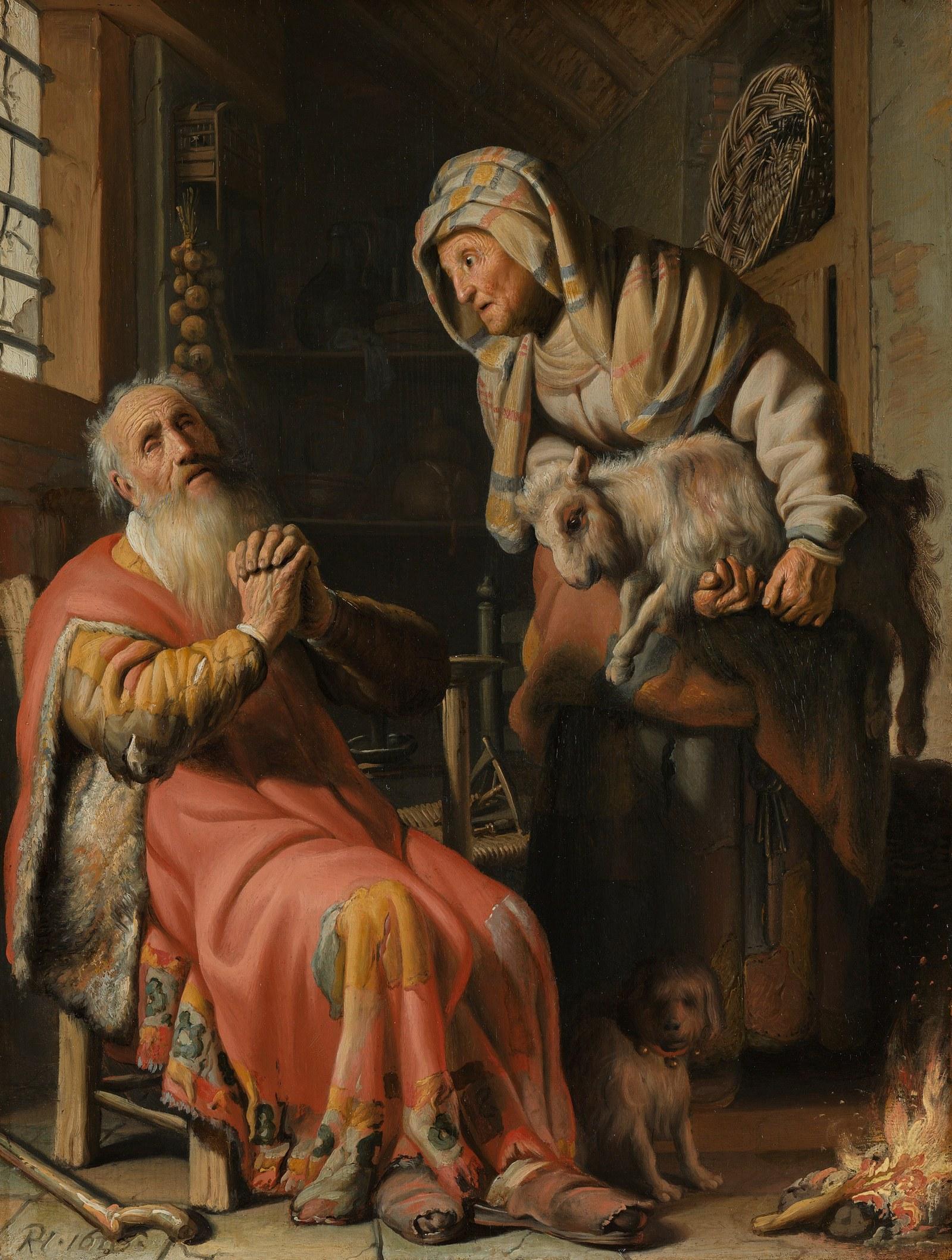
Rembrandt, Tobit and Anna with the Kid, 1626. CC0.
Tobit 1 to 14 · Book · Apocrypha, a study resource beside the canon
Tobit
Tobit is a book of the Apocrypha in fourteen chapters, set among the exiles of Israel at Nineveh in the Assyrian age.
Tobit dies at a hundred and fifty-eight, by the count of Tobit 14:11.
In everything, then, do to others as you would have them do to you. For this is the essence of the Law and the Prophets.
In everything, then, do to others as you would have them do to you. For this is the essence of the Law and the Prophets.
- Date
- about 350 to 170 BC, by Simpson's dating (probable)
- Edition
- Tobit in the King James Version Apocrypha, 1769 text (eBible.org); the Berean Standard Bible for the canon
Summary
Tobit is a book of fourteen chapters. The Council of Trent received it among the books of the Old Testament, and the Hebrew canon leaves it out. Its hero is an exile at Nineveh. Its scenes move between his house and the cities of Media.
- Tobit loses his goods and flees when a man of Nineveh tells the king he buries the dead, Tobit 1:19 to 20.
- Tobias dies at Ecbatane at a hundred and twenty-seven, after hearing of the fall of Nineveh, Tobit 14:14 to 15.
- Tobit is fifty-eight when he loses his sight and has it back after eight years, Tobit 14:2.
The Book of Tobit
Fourteen chapters stand in the Greek Old Testament and in the Apocrypha of the King James Bible.
Tobit opens as a man's own record: "I Tobit have walked all the days of my life in the ways of truth and justice, and I did many almsdeeds to my brethren" (Tobit 1:3). He is of the tribe of Naphtali, carried captive to Nineveh in the days of Enemessar king of the Assyrians (Tobit 1:1 to 2).
The site holds the sixty-six books of the Bible as Scripture and reads Tobit beside them.
The Book at a Glance
Two prayers rise on one day in chapter 3, and the rest of the book answers them.
Tobit moves from a blind man's prayer and a bride's prayer to one answer, a road, a healing and a hymn.
- The exileChapter 1: Tobit keeps the law at Nineveh, gives alms and buries the dead.
- The blindnessChapter 2: sparrows' dung whitens his eyes, and he quarrels with Anna over a kid.
- Two prayersChapter 3: Tobit at Nineveh and Sara at Ecbatana each pray to die, and Raphael is sent to both.
- The counselChapter 4: Tobit gives his son his rules for life.
- The roadChapters 5 to 11: the son's road to Media and home.
- The angel namedChapter 12: the guide names himself and goes up to God.
- The hymn and the last wordsChapters 13 and 14: Tobit praises God for Jerusalem, and dies after warning his son to leave Nineveh.
A sequence of seven acts in the book's order, each with its chapters in the King James numbering.
Tobit Beside the Canon
Tobit quotes Amos and Genesis, and its rule of conduct stands beside the words of Jesus.
At the feast of Pentecost Tobit finds a man of his nation strangled in the marketplace. He remembers "that prophecy of Amos": "Your feasts shall be turned into mourning" (Tobit 2:6).
I will turn your feasts into mourning and all your songs into lamentation. I will cause everyone to wear sackcloth and every head to be shaved. I will make it like a time of mourning for an only son, and its outcome like a bitter day.On the wedding night Tobias prays from the creation of the first marriage (Tobit 8:6).
The LORD God also said, “It is not good for the man to be alone. I will make for him a suitable helper.”Tobit's counsel to his son gives a rule in the negative form: do to no man what you hate (Tobit 4:15). Jesus gives the rule in the positive form in Matthew 7:12.
Tobit's dying counsel trusts what the prophet Jonah said of Nineveh, that it would be overthrown (Tobit 14:4).
On the first day of his journey, Jonah set out into the city and proclaimed, “Forty more days and Nineveh will be overturned!”Where the Book Came From
Simpson dated the book before the Maccabees and found two forms of its Greek.
D. C. Simpson introduced Tobit in R. H. Charles's Apocrypha and Pseudepigrapha of the Old Testament in 1913. He dated the book between about 350 BC and about 170 BC. He put it "probably much nearer the latter than the former date". He placed it in the last quarter of the third century BC, possibly in Aramaic, and probably among orthodox Jews in Egypt.
The Greek survives in two forms. Simpson called the text of Codex Sinaiticus "the longest and clearest text" and translated it. He set the shorter text of Codex Vaticanus and Codex Alexandrinus beside it.
Five fragmentary copies of Tobit were found among the Dead Sea Scrolls at Qumran, four in Aramaic and one in Hebrew. They stand closer to the longer Sinaitic form.
Simpson held that the book is not an autobiography of the seventh century BC, because of its historical inaccuracies and its knowledge of later events. Simpson names Tobit 1:15 among them, where Sennacherib succeeds his father Enemessar; Simpson's own translation gives the father's name as Shalmaneser.
The book also borrows from the older tale of Ahikar. It makes Achiacharus the nephew of Tobit and the cupbearer of Sarchedonus (Tobit 1:21 to 22). Tobit's last words recall how Aman handled him (Tobit 14:10). Simpson thought the author made Ahikar a Jew and Tobit's nephew to add to Tobit's fame.
Who Receives the Book
Five witnesses from the second century to the sixteenth set the book's standing.
Polycarp cites Tobit, Origen reports the Church's use of it, Jerome keeps it outside the canon, Trent counts it in, and Article VI names it among the other books.
| Who | What they do with the book |
|---|---|
| Polycarp, Letter to the Philippians 10 | urges almsgiving and cites Tobit 4:10 and Tobit 12:9, as the Catholic Encyclopedia records |
| Origen, Letter to Africanus | writes that the Hebrews do not use Tobit, yet the Church does, as the Catholic Encyclopedia reports him |
| Jerome, preface to the books of Solomon | says the Church reads Tobit but does not admit it among the canonical Scriptures |
| The Council of Trent, session 4, 1546 | lists Tobias among the books of the Old Testament |
| The Church of England, Article VI | names The Book of Tobias among the other books the Church reads |
Article VI follows Jerome: the Church reads such books "for example of life and instruction of manners". It does not apply them "to establish any doctrine".
The Voices
Jerome put the book into Latin at the request of two bishops.
Jerome (died 420)
Jerome wrote to the bishops Cromatius and Heliodorus about the book they had asked of him. It was "the book of Tobias, which the Hebrews exclude from the catalogue of Divine Scriptures", written in Chaldean words. A speaker skilled in both Chaldean and Hebrew gave him the words in Hebrew. A scribe set them down in Latin as the work of one day.
Books to Read Next
Three works give the book, its critical notes and its place in the church.
Tobit, King James Version Apocrypha
The King James translators · 1611
It gives the whole book in the King James English.
Read it free at eBible.orgThe Apocrypha and Pseudepigrapha of the Old Testament, vol. I
R. H. Charles, ed.; Tobit by D. C. Simpson · 1913
Simpson sets out the book's date, its two Greek forms and its sources, and translates the long Sinaitic text.
Read it free at archive.orgTobias, in The Catholic Encyclopedia
Walter Drum · 1912
It gives the book's text forms and its reception among the fathers and at Trent.
Read it free at New AdventThe City of Precious Stones
An exile's song and John's vision both look ahead to God's renewed dwelling place.
Tobit's hymn ends on a rebuilt city: "Jerusalem shall be built up with sapphires and emeralds, and precious stone" (Tobit 13:16). John's vision gives the canon's own picture of the holy city.
The foundations of the city walls were adorned with every kind of precious stone: The first foundation was jasper, the second sapphire, the third chalcedony, the fourth emerald,Sources
Scripture is the Berean Standard Bible.
- Tobit, King James Version Apocrypha, 1769 text (eBible.org USFX edition), public domain.
- D. C. Simpson, The Book of Tobit, in R. H. Charles (ed.), The Apocrypha and Pseudepigrapha of the Old Testament, vol. I, Oxford, 1913; public domain.
- Wikipedia, Book of Tobit, citing J. Klawans, The Jewish Annotated Apocrypha (2020), pp. 149 to 151.
- Jerome, Prologue to Tobit, tr. Kevin P. Edgecomb, 2006, released by the translator into the public domain.
- Jerome, Preface to the Books of Solomon, Nicene and Post-Nicene Fathers, series 2, vol. 6; public domain.
- Walter Drum, Tobias, The Catholic Encyclopedia, 1912; public domain.
- The Council of Trent, session 4, 8 April 1546, the decree on the canonical Scriptures.
- The Church of England, Articles of Religion, Article VI, in the Book of Common Prayer of 1863.
Keep Studying
Studies8
People and groups2
Places1