
Genesis 2:21
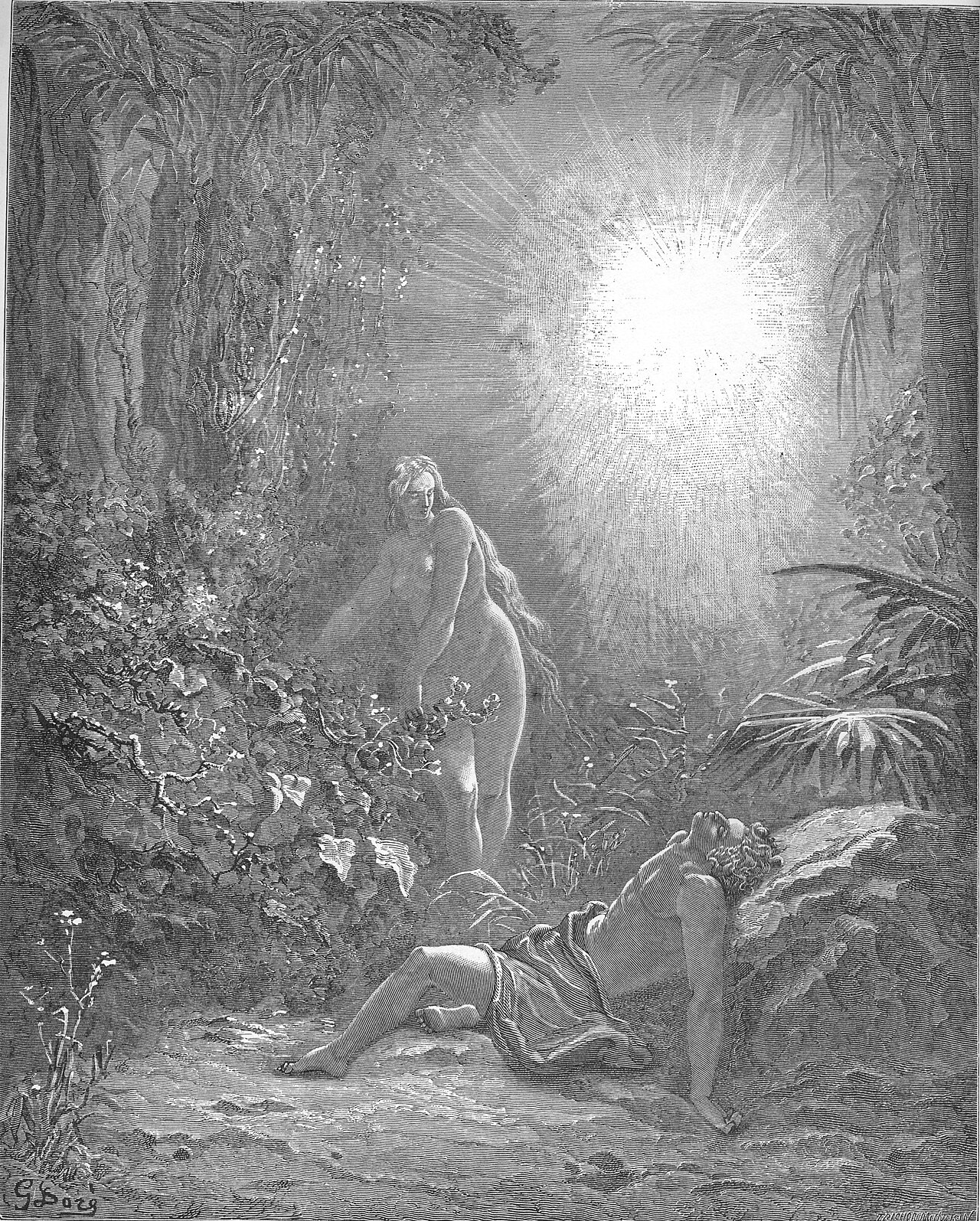
in Genesis 2So the LORD God caused the man to fall into a deep sleep, and while he slept, He took one of the man’s ribs and closed up the area with flesh.
BSB
The same verse in ASV and KJV ▾
ASV
And Jehovah God caused a deep sleep to fall upon the man, and he slept; and he took one of his ribs, and closed up the flesh instead thereof:
KJV
And the Lord God caused a deep sleep to fall upon Adam, and he slept: and he took one of his ribs, and closed up the flesh instead thereof;
⋯
This verse in Genesis 2
Commentary
17 notes on this verseThis site's exposition
a deep sleep
on Genesis 2:21-22
The LORD God takes a rib from the man's side while he sleeps. The Hebrew verb in verse 22 is banah, the word for building, and Jerome read the church built out of the side of the second Adam. Genesis itself says none of that. She was made while the man slept.
The record, by era
The Church Fathers5 voices
A commentator
Philo of Alexandria-20–50
QUESTIONS AND ANSWERS ON GENESIS, I · Written before 50.
proposed
(25) What the rib is which God took from the man whom he had formed out of the earth, and which he made into a woman? [Gen 2:21-22] The letter of this statement is plain enough; for it is expressed according to a symbol of …
We hold the soul to be perennially active because of its continual movement, which is a sign both of its divinity and its immortality. So, then, when rest comes—rest, that special comfort of bodies—the soul disdains an idleness that is alien to its nature and, deprived of the faculties of the body, makes use of its own. This power we call ecstasy. This occurs when we are deprived of the activity of the senses. Lacking sensory input the soul reflects conditions akin to delirium. Thus, in the beginning, sleep was preceded by ecstasy, as we read: "God sent an ecstasy upon Adam, and he slept." Sleep brought rest to the body, but ecstasy came over the soul and prevented it from resting, and from that time this combination constitutes the natural and normal form of the dream.
(Ver. 21.) And the Lord God sent a trance upon Adam. For trance, that is, the departure of the mind, is called Thardema in Hebrew, which Aquila interprets as descent, and Symmachus as heavy and deep sleep. Finally, it follows: And he slept. The same word is used in Jonah (1:5) for a deep sleep.
"God caused drowsiness to come upon Adam," the text says, "and he slept." It wasn't simply drowsiness that came upon him nor normal sleep; instead the wise and skillful creator of our nature was about to remove one of Adam's ribs. Lest the experience cause Adam afterward to be badly disposed toward the creature formed from his rib and through memory of the pain bear a grudge against this being at its formation, God induced in him this kind of sleep. God caused a drowsiness to come upon him and bid him be weighed down as though by some heavy weight.
Of whom in the beginning was Eve begotten? What mother conceived her, the motherless? But the Scripture says that she was born out of Adam's side. Is Eve then born out of man's side without a mother, and is a child not to be born without a father, of a virgin's womb? This debt of gratitude was due to men from womankind: for Eve was begotten of Adam and not conceived of a mother, but as it were brought forth of man alone.
11 more voices on this verse
The Church Fathers5 voices
The apostle Paul testifies that this passage has both a plain and an allegorical meaning. Discussing it in his letter to the Ephesians, he asserts, "This is a great mystery, but I speak concerning Christ and the church."
A commentator
John ChrysostomCommentary (church-history corpus) · Written in the 5th century.
proposed
So, now that all the animals were created and had received their names from the first man, the loving Lord made it his concern to create a helpmate for him of his kind; having arranged everything with this creature of his in mind and for his sake brought forth all this visible creation, after all the other beings he creates also woman. Notice how he teaches us precisely the process of her creation too. I mean, after teaching us that he wanted to produce for man a helpmate like him by saying previously, "Let us make him a helpmate like him self," and then adding, "There proved to be no help mate of his own kind," accordingly he set about the formation of this creature of similar properties to him, and the text says, "God caused drowsiness to come upon Adam, and he slept. God took one of Adam's ribs and closed up the flesh in its place. The Lord God fashioned the rib he had taken from Adam into a woman and brought her to Adam." [ Gen 2:21, Gen 2:22 ] There is great force in these words, surpassing all human reasoning. I mean, it is not possible to comprehend their grandeur in any other way than by viewing everything with the eyes of faith. "God caused drowsiness to come upon Adam," the text says, "and he slept." Notice the precision of the teaching. This blessed author has stipulated both things, or rather the Holy Spirit through his tongue, teaching us the sequence of what happened. "God caused drowsiness to come upon Adam," the text says, "and he slept." It wasn't simply drowsiness that came upon him nor normal sleep; instead, the wise and skillful creator of our nature was about to remove one of Adam's ribs.
It is certain that, from the very beginning of his nature, man was impressed with these instincts (of sleep). (Genesis 2:21). If you receive your instruction from God, (you will find) that the fountain of the human race, Adam, had a taste of drowsiness before having a draught of repose; slept before he laboured, or even before he ate, nay, even before he spoke; in order that men may see that sleep is a natural feature and function, and one which has actually precedence over all the natural faculties. From this primary instance also we are led to trace even then the image of death in sleep. For as Adam was a figure of Christ, Adam's sleep shadowed out the death of Christ, who was to sleep a mortal slumber, that from the wound inflicted on His side might, in like manner (as Eve was formed), be typified the church, the true mother of the living. This is why sleep is so salutary, so rational, and is actually formed into the model of that death which is general and common to the race of man. God, indeed, has willed (and it may be said in passing that He has, generally, in His dispensations brought nothing to pass without such types and shadows) to set before us, in a manner more fully and completely than Plato's example, by daily recurrence the outlines of man's state, especially concerning the beginning and the termination thereof; thus stretching out the hand to help our faith more readily by types and parables, not in words only, but also in things.
Did Adam not suffer pain? Did he not experience agony? A single hair is plucked from the body and we feel pain. Even if one is deeply asleep, he will awake from the pain.
What does the phrase 'deep sleep' signify? Does it not mean that when we contemplate a conjugal union we seem to be turning our eyes gradually in the direction of God's kingdom? Do we not seem, as we enter into a vision of this world, to partake a little of things divine, while we find our repose in the midst of what is secular and mundane?
The Medieval Church2 voices
A commentator
BonaventureCollationes de Septem Donis, Collation 6 · Written in the 13th century.
proposed
In Genesis: "The Lord cast a deep sleep upon Adam, and when he had fallen asleep, he took one of his ribs" and made a woman "and brought her to Adam." And why, while he slept, did He take one of his ribs?
A commentator
BonaventureCollations on the Hexaemeron, Collation 16 · Written in the 13th century.
proposed
In the New Testament, after the universal scripture and the course of time, Christ was formed, as was man on the sixth day, that He may "have dominion over the fish of the sea," and "the birds of the air."
The Puritans and the Awakening2 voices
(2.) The commencement of the kingdom of grace, in the sanctification of the sabbath day, ver. 3. He rested on that day, and took a complacency in his creatures, and then sanctified it, and appointed us on that day to rest and take a complacency in the Creator; and his rest is in the fourth commandment made a reason for ours after six days labour.
quarantine:anchor (2026-07-29) — cites-ver-3-anchored-18-25
And the Lord God caused a deep sleep to fall upon Adam, and he slept,....
The Nineteenth Century2 voices
The Lord God caused a deep sleep to fall upon Adam, etc. - This was neither swoon nor ecstasy, but what our translation very properly terms a deep sleep. And he took one of his ribs - It is immaterial whether we render צלע tsela a rib, or a part of his side, for it may mean either: some part of man was to be used on the occasion, whether bone or flesh it matters not; though it is likely, from verse Gen 2:23, that a part of both was taken; for Adam, knowing how the woman was formed, said, This is flesh of my flesh, and bone of my bone. God could have formed the woman out of the dust of the earth, as he had formed the man; but had he done so, she must have appeared in his eyes as a distinct being, to whom he had no natural relation. But as God formed her out of a part of the man himself, he saw she was of the same nature, the same identical flesh and blood, and of the same constitution in all respects, and consequently having equal powers, faculties, and rights. This at once ensured his affection, and excited his esteem.
A commentator
Albert Barnes1798–1870
Notes, Explanatory and Practical, on the Old and New Testaments (1832-1869)
proposed
- XIV. The Woman 21. תרדמה tardēmâh, “deep sleep,” ἔκστασις ekstasis, Septuagint. צלע tsēlā‛, “rib, side, wing of a building.” 23. פעם pa‛am, “beat, stroke, tread, anvil.” אישׁ 'ı̂ysh, “man,” vir. אשׁה 'āshah, “be firm, as a foundation;” ישׁה yāshah, “be firm as a substance;” אנש 'ānash, “be strong;” אושׁ 'ûsh, “to give help: hence, the strong, the brave, the defender, the nourisher.” אשׂה 'ı̂śâh, “woman,” feminine of the above; “wife.” The second creative step in the constitution of man as the natural head of a race is now described.
The words behind it
13 Hebrew wordsEvery Hebrew word of this verse in the order it stands, with what it means and the door to its own study. The last column counts the times a word stands in the whole Bible: the rarer the word, the more the places it appears belong together.
| Hebrew | Sound | Meaning | Word study | In the Bible |
|---|---|---|---|---|
| וַיַּפֵּל֩ | vaiyapel | and he made fall | H5307 → | 435 times |
| יְהוָ֨ה | yahweh | Yahweh | H3068 → | 6520 times |
| אֱלֹהִ֧ים׀ | ʾelohim | God | H430 → | 2601 times |
| תַּרְדֵּמָ֛ה | tardemah | a deep sleep | H8639 → | |
| עַל־ | ʾal- | on | H5921 → | 5755 times |
| הָאָדָ֖ם | haadam | the man | H120 → | 551 times |
| וַיִּישָׁ֑ן | vaiyishan | and he fell asleep | H3462 → | |
| וַיִּקַּ֗ח | vaiyikach | and he took | H3947 → | 966 times |
| אַחַת֙ | ʾachat | one | H259 → | 971 times |
| מִצַּלְעֹתָ֔יו | mitzalotav | of ribs his | H6763 → | |
| וַיִּסְגֹּ֥ר | vaiyisgor | and he closed up | H5462 → | 91 times |
| בָּשָׂ֖ר | basar | flesh | H1320 → | 270 times |
| תַּחְתֶּֽנָּה׃ | tachtenah | in place of it | H8478 → | 505 times |
וַיַּפֵּל֩and he made fall
vaiyapelH5307 →435 times
יְהוָ֨הYahweh
yahwehH3068 →6520 times
אֱלֹהִ֧ים׀God
ʾelohimH430 →2601 times
תַּרְדֵּמָ֛הa deep sleep
tardemahH8639 →
עַל־on
ʾal-H5921 →5755 times
הָאָדָ֖םthe man
haadamH120 →551 times
וַיִּישָׁ֑ןand he fell asleep
vaiyishanH3462 →
וַיִּקַּ֗חand he took
vaiyikachH3947 →966 times
אַחַת֙one
ʾachatH259 →971 times
מִצַּלְעֹתָ֔יוof ribs his
mitzalotavH6763 →
וַיִּסְגֹּ֥רand he closed up
vaiyisgorH5462 →91 times
בָּשָׂ֖רflesh
basarH1320 →270 times
תַּחְתֶּֽנָּה׃in place of it
tachtenahH8478 →505 times
A shaded row is a word that stands 400 times or fewer in the Bible.
The walk
8 stopsEach card is a verse this one points to, and under it the verses that one points to in turn. Where several paths arrive at the same place, that place is listed first: the text keeps returning to it.
Through
Job 33:15In a dream, in a vision in the night, when deep sleep falls upon men as they slumber on their beds,
it leads to
- Numbers 12:6
He said, “Hear now My words: If there is a prophet among you, I, the LORD, will reveal Myself to him in a vision; I will speak to him in a dream.
- Job 4:13
In disquieting visions in the night, when deep sleep falls on men,
- Genesis 20:3
One night, however, God came to Abimelech in a dream and told him, “You are as good as dead because of the woman you have taken, for she is a married woman.”
- Genesis 31:24
But that night God came to Laban the Aramean in a dream and warned him, “Be careful not to say anything to Jacob, either good or bad.”
- Daniel 4:5
I had a dream, and it frightened me; while in my bed, the images and visions in my mind alarmed me.
- Numbers 12:6
Through
Daniel 8:18While he was speaking with me, I fell into a deep sleep, with my face to the ground. Then he touched me, helped me to my feet,
it leads to
- Daniel 10:18
Again the one with the likeness of a man touched me and strengthened me.
- Daniel 10:18
Through
1 Samuel 26:12So David took the spear and water jug by Saul’s head, and they departed. No one saw them or knew about it, nor did anyone wake up; they all remained asleep, because a deep…
it leads to
- Genesis 15:12
As the sun was setting, Abram fell into a deep sleep, and suddenly great terror and darkness overwhelmed him.
- Genesis 15:12
Through
Genesis 15:12As the sun was setting, Abram fell into a deep sleep, and suddenly great terror and darkness overwhelmed him.
it leads to
- Job 33:15
In a dream, in a vision in the night, when deep sleep falls upon men as they slumber on their beds,
- Job 33:15
Where this verse is studied
On this page
Studies16
On this chapter
About Genesis
This page draws on 18 works. Open the list of works
This page draws on Adam Clarke, Commentary on the Bible; Albert Barnes, Notes, Explanatory and Practical, on the Old and New Testaments (1832-1869); Ambrose of Milan, On Paradise; Bonaventure, Collationes de Septem Donis, Collation 6; Bonaventure, Collations on the Hexaemeron, Collation 16; Cyril of Jerusalem, Catechetical Lecture 12:29; Jerome, Homilies 66; Jerome, Hebrew Questions on Genesis; John Chrysostom, HOMILIES ON GENESIS 15.7; John Chrysostom, Commentary (church-history corpus); John Gill, Exposition of the Old Testament; John Gill, Exposition of the Old Testament (1748-1763); John Wesley, Explanatory Notes upon the Old Testament; Philo of Alexandria, QUESTIONS AND ANSWERS ON GENESIS, I; Quodvultdeus, BOOK OF PROMISES AND PREDICTIONS OF GOD 1.3; Severian of Gabala, ON THE CREATION OF THE WORLD 5.8; Tertullian, ON THE SOUL 45.1-3 and Tertullian, A Treatise on the Soul.