
Concept
AnthropologyThe Tree of Life
Standing in the middle of Eden and in the middle of the city at the end: guarded in Genesis, given freely in Revelation.
#eden#eschatology
- 13passages
- 111original words
- 1approved connection
- 240cross-references
- 1thread through it
The words behind it
Hebrew and Greek standing in the 13 passages listed below, not a lexicon of "the tree of life" itself. The number on each word is how often it occurs in those passages; the connecting words the languages use everywhere are set aside so the words that carry meaning can be seen.
Hebrew53
43 more hebrew words ▾
Greek58
48 more greek words ▾
The passages
Every passage this site attaches to the concept, in canon order. Each row says where it came from.
Old Testament7
- Genesis 2:9listed key text
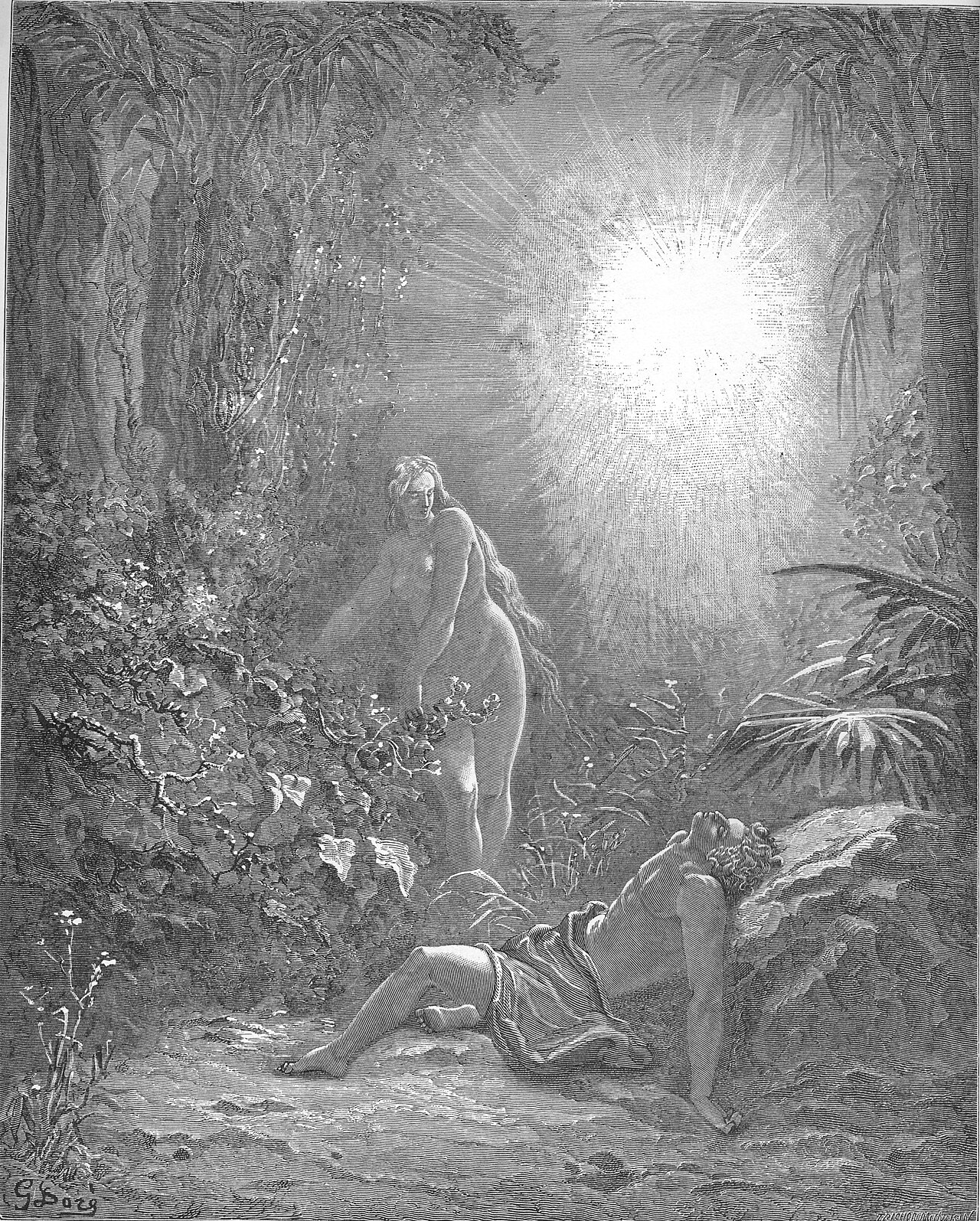
Out of the ground the LORD God gave growth to every tree that is pleasing to the eye and good for food. And in the middle of the garden were the tree of life and the tree of the knowledge of good and evil.(opening verse of the passage)
- Genesis 3:6thread stop
When the woman saw that the tree was good for food and pleasing to the eyes, and that it was desirable for obtaining wisdom, she took the fruit and ate it. She also gave some to her husband who was with her, and he ate it.
Commentary on Genesis 3:61 voice
“That the Lord then was manifestly coming to His own things, and was sustaining them by means of that creation which is supported by Himself, and was making a recapitulation of that disobedience which had occurred in connection with a tree, through the obedience which was [exhibited by Himself when He hung] upon a tree, [the effects] also of that deception being done away with, by which that virgin Eve, who was already espoused to a man, was unhappily misled,-was happily announced, through means of the truth [spoken] by the angel to the Virgin Mary, who was [also espoused] to a man.”
Irenaeus · Against Heresies 5.19.1Patristic
- Genesis 3:22listed key text
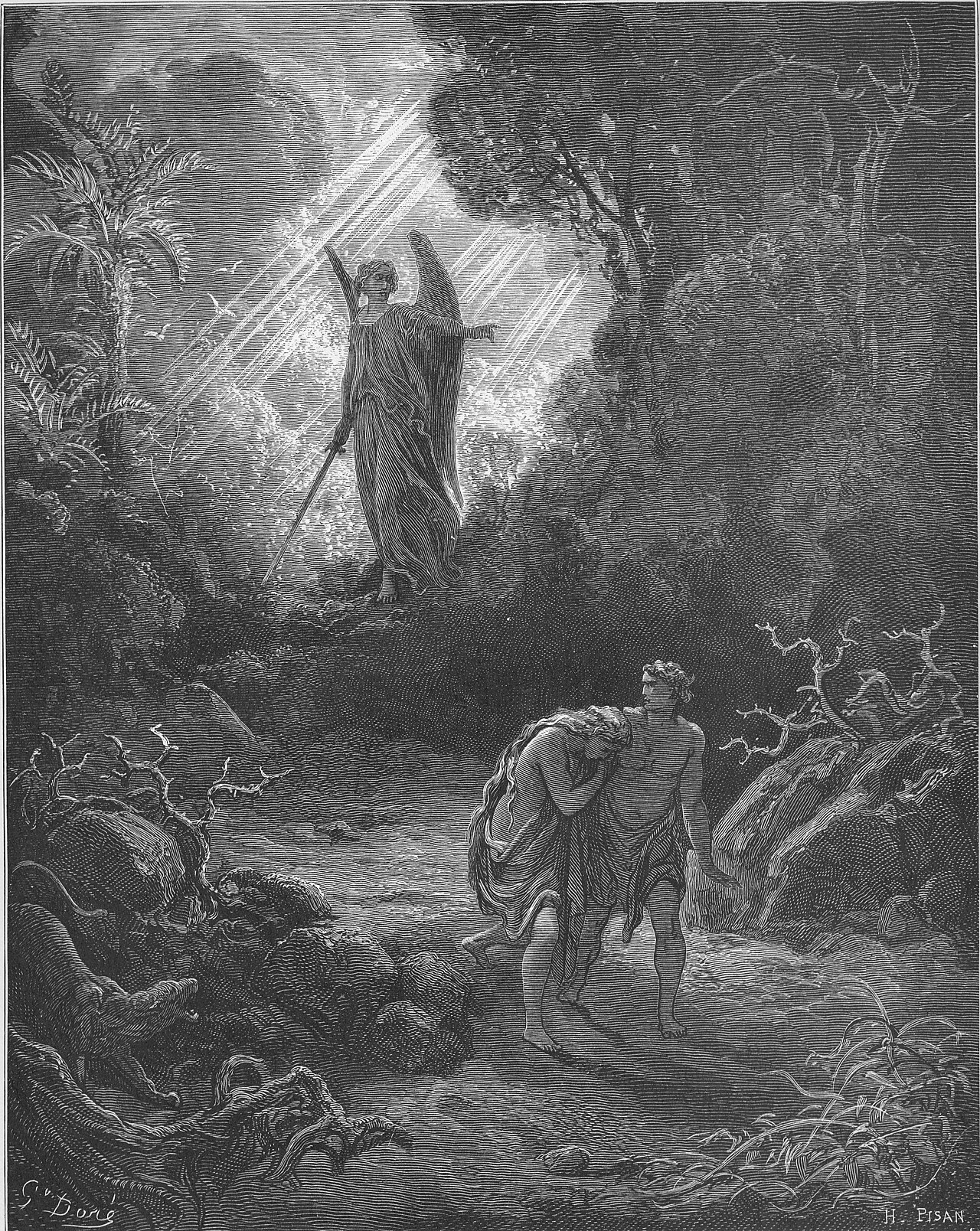
Then the LORD God said, “Behold, the man has become like one of Us, knowing good and evil. And now, lest he reach out his hand and take also from the tree of life, and eat, and live forever...”(opening verse of the passage)
Commentary on Genesis 3:222 voices
“Behold, the man is become as one of us, to know good and evil - See what he has got, what advantages, by eating forbidden fruit! This is said to humble them, and to bring them to a sense of their sin and folly, that seeing themselves thus wretchedly deceived by following the devil's counsel, they might henceforth pursue the happiness God offers, in the way he prescribes.”
John Wesley · Explanatory Notes upon the Old Testament, 1765Evangelical
“And how will that statement of the Lord stand, after the sin of the first man: ‘Behold, Adam is become like one of us, knowing good and evil?’ For he must not to be thought to have been such before the sin that he was wholly ignorant of good. Otherwise, it must be admitted that he was created like an irrational and senseless animal; and this is quite absurd and foreign to the Catholic faith. No, rather, according to the pronouncement of the most wise Solomon, ‘God made man right,’ that is, to enjoy continually the knowledge of good alone.”
John Cassian · CONFERENCES 13.12.1-2Patristic
- Deuteronomy 21:22thread stop
If a man has committed a sin worthy of death, and he is executed, and you hang his body on a tree,(opening verse of the passage)
Commentary on Deuteronomy 21:221 voice
“There were four methods of execution in use among the ancient Jews; stoning (Exo 17:4; Deu 13:10, etc.), burning Lev 20:14; Lev 21:9, the sword Exo 32:27, and strangulation. The latter, though not named in Scripture, is regarded by the rabbis as the most common, and the proper one to be adopted when no other is expressly enjoined by the Law. Suspension, whether from cross, stake, or gallows, was not used as a mode of taking life, but was sometimes added after death as an enhancement of punishment.”
Albert Barnes · Notes, Explanatory and Practical, on the Old and New Testaments (1832-1869)Evangelical
- Psalms 1:3thread stop
He is like a tree planted by streams of water, yielding its fruit in season, whose leaf does not wither, and who prospers in all he does.
Commentary on Psalms 1:32 voices
“(Verse 3.) And it shall be like a tree that is planted by the courses of water, which will yield its fruit in its season. And its leaf shall not wither, and whatever it does, it shall prosper. What is this blessedness that is compared to the tree, unless we understand it to be in paradise, that blessed place, the tree of life produced from the earth in the midst of other trees?”
Ambrose of Milan · Commentaries on the Twelve Davidic PsalmsPatristic
“And he shall be like a tree planted by the rivers of water,.... Or, ‘for then shall he be’, &c. as Alshech renders the words; and the Hebrew ‘vau’ is often used for ‘then’ (q).”
John Gill · Exposition of the Old Testament (1748-1763)Reformed
- Proverbs 3:18listed key text
She is a tree of life to those who embrace her, and those who lay hold of her are blessed.(opening verse of the passage)
Commentary on Proverbs 3:182 voices
“I turn to the most wise Solomon as a witness when he said about wisdom, ‘The tree of life is for all who embrace it.’ Therefore, if ‘wisdom is the tree of life,’ without a doubt, there is another tree of prudence, another of knowledge and another of justice. For logically it is not said that only wisdom, of all the virtues, was worthy to be called ‘the tree of life’ but that the other virtues by no means received names of a similar sort. Therefore, ‘the trees of the field will give their fruit.’”
Origen of Alexandria · Homilies on Leviticus 16:4.3Patristic
“She is a tree of life - עץ חיים ets chaiyim, ‘the tree of lives,’ alluding most manifestly to the tree so called which God in the beginning planted in the garden of Paradise, by eating the fruit of which all the wastes of nature might have been continually repaired, so as to prevent death for ever. This is an opinion which appears probable enough. The blessings which wisdom - true religion - gives to men, preserve them in life, comfort them through life, cause them to triumph in death, and ensure them a glorious immortality.”
Adam Clarke · Commentary on the BibleEvangelical
- Isaiah 11:1thread stop
Then a shoot will spring up from the stump of Jesse, and a Branch from his roots will bear fruit.
Commentary on Isaiah 11:11 voice
“And there shall come forth a rod - In the previous chapter, the prophet had represented the Assyrian monarch and his army under the image of a dense and flourishing forest, with all its glory and grandeur. In opposition to this, he describes the illustrious personage who is the subject of this chapter, under the image of a slender twig or shoot, sprouting up from the root of a decayed and fallen tree. Between the Assyrian, therefore, and the person who is the subject of this chapter, there is a most striking and beautiful contrast.”
Albert Barnes · Notes, Explanatory and Practical, on the Old and New Testaments (1832-1869)Evangelical
New Testament6
- Acts 5:30thread stop
The God of our fathers raised up Jesus, whom you had killed by hanging Him on a tree.
Commentary on Acts 5:301 voice
“The God of our fathers raised up Jesus - It was well to introduce this, that the council might at once see that they preached no strange God; and that he who so highly honored the patriarchs, Moses, and the prophets, had yet more highly honored Jesus Christ in raising him from the dead and seating him at his right hand, and proclaiming him as the only giver of salvation and the repentance which leads to it.”
Adam Clarke · Commentary on the BibleEvangelical
- Galatians 3:13thread stop
Christ redeemed us from the curse of the law by becoming a curse for us. For it is written: “Cursed is everyone who is hung on a tree.”
Commentary on Galatians 3:132 voices
“And everywhere, when [referring to] the passion of our Lord, and to His human nature, and His subjection to death, he employs the name of Christ, as in that passage: ‘Destroy not him with thy meat for whom Christ died.’ And again: ‘But now, in Christ, ye who sometimes were far off are made nigh by the blood of Christ.’ And again: ‘Christ has redeemed us from the curse of the law, being made a curse for us: for it is written, Cursed is every one that hangeth upon a tree.’”
Irenaeus · Against Heresies Book IIIPatristic
“Christ hath redeemed us from the curse of the law,.... The Redeemer is Christ, the Son of God; who was appointed and called to this work by his Father, and which he himself agreed to; he was spoken of in prophecy under this character; he came as such, and has obtained eternal redemption, for which he was abundantly qualified; as man, he was a near kinsman, to whom the right of redemption belonged; and as God, he was able to accomplish it.”
John Gill · Exposition of the New Testament (1746-1748)Reformed
- 1 Peter 2:24thread stop
He Himself bore our sins in His body on the tree, so that we might die to sin and live to righteousness. “By His stripes you are healed.”
Commentary on 1 Peter 2:242 voices
“Who his own self bare our sins,.... As was typified by the high priest bearing the sins of the holy things of the people of Israel, when he went into the most holy place, and by the scape goat bearing the iniquities of all the people unto a land not inhabited, and as was foretold by the Prophet Isaiah. The apostle here explains the nature and end of Christ's sufferings, which were to make atonement for sins, and which was done by bearing them.”
John Gill · Exposition of the New Testament (1746-1748)Reformed
“Who his own self - Not another in his place, as some anciently supposed, because they thought it impossible that the Christ should suffer. Bare our sins in his own body - Bore the punishment due to our sins. In no other sense could Christ bear them. To say that they were so imputed to him as if they had been his own, and that the Father beheld him as blackened with imputed sin, is monstrous, if not blasphemous.”
Adam Clarke · Commentary on the BibleEvangelical
- Revelation 2:7listed key text
He who has an ear, let him hear what the Spirit says to the churches. To the one who overcomes, I will grant the right to eat from the tree of life in the Paradise of God.(opening verse of the passage)
Commentary on Revelation 2:71 voice
“He that hath an ear, let him hear ... - This expression occurs at the close of each of the epistles addressed to the seven churches, and is substantially a mode of address often employed by the Saviour in his personal ministry, and quite characteristic of him. See Mat 11:15; Mar 4:23; Mar 7:16. It is a form of expression designed to arrest the attention, and to denote that what was said was of special importance.”
Albert Barnes · Notes, Explanatory and Practical, on the Old and New Testaments (1832-1869)Evangelical
- Revelation 22:2listed key text
down the middle of the main street of the city. On either side of the river stood a tree of life, bearing twelve kinds of fruit and yielding a fresh crop for each month. And the leaves of the tree are for the healing of the nations.(opening verse of the passage)
Commentary on Revelation 22:22 voices
“This river waters the saints who are planted alongside it. They are here figuratively called the ‘tree of life’ by virtue of their participation and imitation of him who is the Tree of Life. Moreover, they give forth ‘twelve fruits,’ that is, they unceasingly yield …”
Andreas of Caesarea · Commentary on the Apocalypse 22:2Patristic
“In the midst of the street of it - That is, of the city which was described in the preceding chapter. The tree of life - An allusion to Gen 2:9. As this tree of life is stated to be in the streets of the city, and on each side of the river, tree must here be an enallage of the singular for the plural number, trees of life, or trees which yielded fruit by which life was preserved.”
Adam Clarke · Commentary on the BibleEvangelical
- Revelation 22:14listed key text
Blessed are those who wash their robes, so that they may have the right to the tree of life and may enter the city by its gates.(opening verse of the passage)
Commentary on Revelation 22:142 voices
“Inserting thus the particle of present time, ‘And now,’ He shows that He had made for a time, and at present, a prolongation of man's life. Therefore He did not actually curse Adam and Eve, for they were candidates for restoration, and they had been relieved by confession.”
Tertullian · Against Marcion Book IIPatristic
“Blessed are they that do his commandments - They are happy who are obedient. That they may have right to the tree of life - The original is much more expressive, Ἱνα εσται ἡ εξουσια αυτων επι το ξυλον της ζωης· That they may have authority over the tree of life; an authority founded on right, this right founded on obedience to the commandments of God, and that obedience produced by the grace of God working in them.”
Adam Clarke · Commentary on the BibleEvangelical
Approved connections
1 link an editor approved, each with the reason it was kept.
- first mentionGenesis 2:9
First mention of the tree of life: planted center-garden, guarded at the fall, promised to the overcomer (Rev 2:7), restored in the city (Rev 22).
Matthew Henry, Commentary on the Whole Bible (public domain)Puritan
Voices on these passages
Commentary matched to the verses above, each named with its source: the full pool sits on each verse page.
“That the Lord then was manifestly coming to His own things, and was sustaining them by means of that creation which is supported by Himself, and was making a recapitulation of that disobedience which had occurred in connection with a tree, through the obedience which was [exhibited by Himself when He hung] upon a tree, [the effects] also of that deception being done away with, by which that virgin Eve, who was already espoused to a man, was unhappily misled,-was happily announced, through means of the truth [spoken] by the angel to the Virgin Mary, who was [also espoused] to a man.”
Irenaeus · Against Heresies 5.19.1Patristic
Genesis 3:6
“Behold, the man is become as one of us, to know good and evil - See what he has got, what advantages, by eating forbidden fruit! This is said to humble them, and to bring them to a sense of their sin and folly, that seeing themselves thus wretchedly deceived by following the devil's counsel, they might henceforth pursue the happiness God offers, in the way he prescribes.”
John Wesley · Explanatory Notes upon the Old TestamentEvangelical
Genesis 3:22
“There were four methods of execution in use among the ancient Jews; stoning (Exo 17:4; Deu 13:10, etc.), burning Lev 20:14; Lev 21:9, the sword Exo 32:27, and strangulation. The latter, though not named in Scripture, is regarded by the rabbis as the most common, and the proper one to be adopted when no other is expressly enjoined by the Law. Suspension, whether from cross, stake, or gallows, was not used as a mode of taking life, but was sometimes added after death as an enhancement of punishment.”
Albert Barnes · Notes, Explanatory and Practical, on the Old and New Testaments (1832-1869)Evangelical
Deuteronomy 21:22
Study it deeper
6 moves a student can make from here. Every one opens a tool on this site.
Trace one word to every place it stands
A word page lists every verse that word occurs in, with its definition and its range of meaning. Start with the roots that occur most under the passages above.
Walk out from the passages
The passages above carry 240 cross-references between them, links from the Treasury of Scripture Knowledge, the great 1830s reference work, together with the reader-voted index at OpenBible.info. The most-linked destinations:
Read it in both testaments
Set the earliest passage beside the New Testament one and ask what changed and what did not, the shape of the tree of life before Christ and after him.
Read the whole chapter around it
A verse quoted alone can mean almost anything. Open Genesis 2 in the reader, where the Hebrew or Greek sits under every line.
See everywhere else it appears
The search page is a doorway: it returns verses, word studies, people, places and studies for one term at once.
Walk it stop by stop
A thread takes the passages in order and stops at each one with commentary, so the idea unfolds instead of arriving all at once.
Where this comes from
In Genesis the way to it is barred by cherubim and a flaming sword, so that fallen man does not live forever in his fallen state (Genesis 3:22-24). It is mercy wearing the face of exclusion.
Proverbs uses it as a figure for wisdom and healed speech; Revelation restores the thing itself: twelve manner of fruits, leaves for the healing of the nations, and access granted to those who wash their robes (Revelation 22:14).