
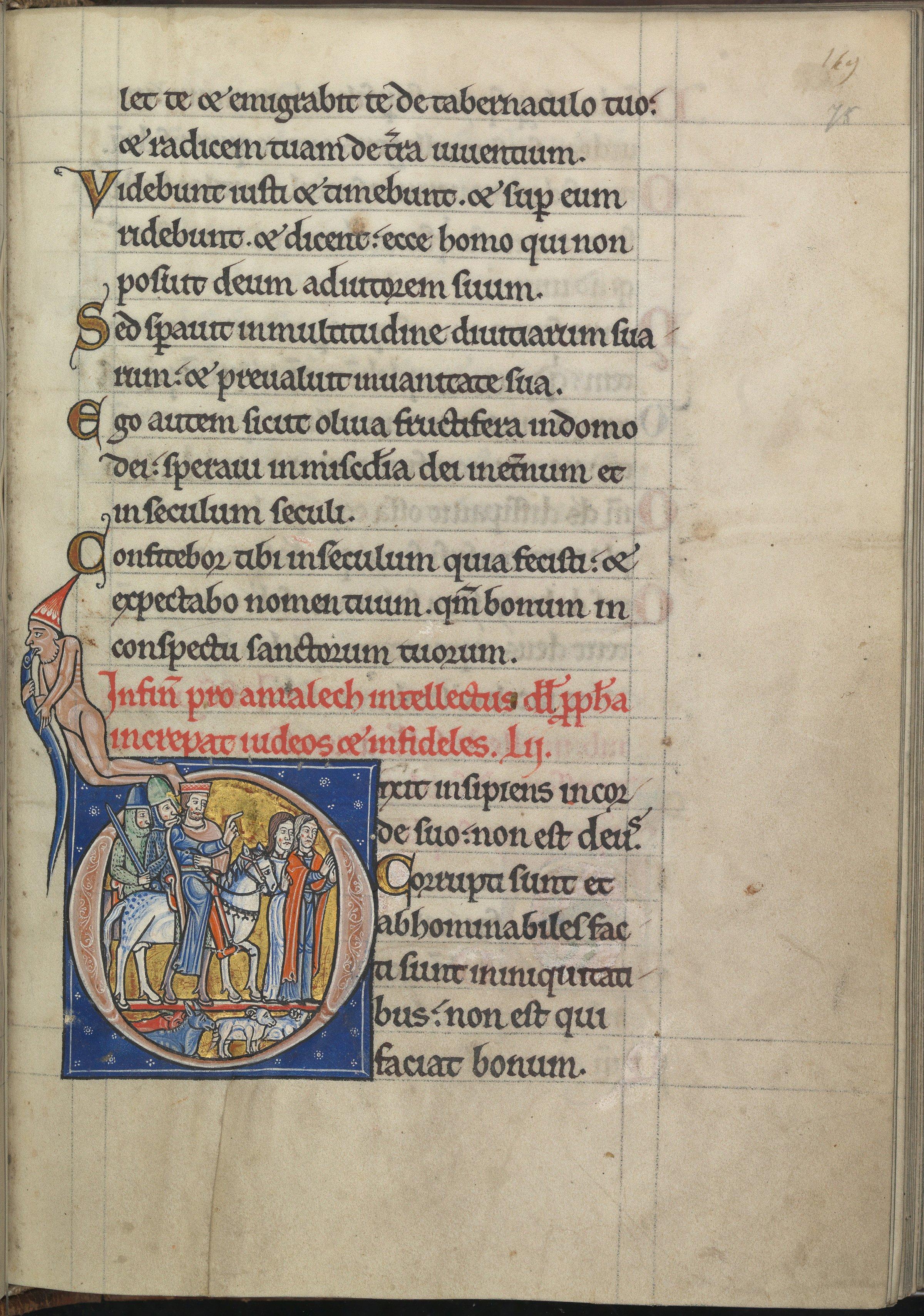
Psalter of Eleanor of Aquitaine, 1180 to 1185. Public domain.
Psalm 14 and Romans 3:9 to 23 · Passage · Featured Study
None Is Righteous: Psalm 14 and Romans 3
Paul quotes Psalm 14 in Romans 3, and some later copies of the psalm took in the rest of his chain.
Origen kept the added lines out of his text of the psalm.
As it is written: “There is no one righteous, not even one.
As it is written: “There is no one righteous, not even one.
- The passage
- Psalm 14:1 to 3, Psalm 14:7, Romans 3:9 to 12, Romans 3:13 to 18, Romans 3:19 to 23
- Books
- Psalms, Romans
- Hold in memory
- Romans 3:10, Psalm 14:2, Romans 3:23
Summary
Psalm 14 sees the LORD look down from heaven and find no one who seeks God. In Romans 3 Paul quotes its opening lines and adds more Scripture to them. Readers have long asked whether the psalm accuses all mankind or the wicked of one time.
- Perowne holds that Paul argues to the Jew from the Scriptures whose authority the Jew acknowledged.
- Perowne and Delitzsch judge that the long form of Psalm 14:3 came from Romans.
- Coverdale's psalter of 1535 carries the long form, by Perowne's account.
The Search from Heaven
The fool's denial stands first in the psalm, and the LORD's search of mankind follows it.
The fool says in his heart, “There is no God.” They are corrupt; their acts are vile. There is no one who does good.The psalm's charge begins in the heart.
J. J. Stewart Perowne reads the fool's words as a denial made in the way he lives. In his reading the fool denies that God governs the world, and his deeds show what his heart thinks.
The LORD looks down from heaven upon the sons of men to see if any understand, if any seek God. All have turned away, they have together become corrupt; there is no one who does good, not even one.Paul takes his first lines from these verses.
Perowne hears two echoes of Genesis here. The LORD looks down as He came down to see the tower of Babel in Genesis 11:5. The corruption recalls the flood, when all flesh had corrupted its way in Genesis 6:12.
The Long Form in the Copies
Perowne and Delitzsch name the copies of Psalm 14 that carry Paul's added lines.
The added lines stand in Greek, Latin, Syriac, Hebrew and English copies.
| Copy | What it holds | Who names it |
|---|---|---|
| Codex Alexandrinus | The lines inside the psalm | Delitzsch |
| The Greek and Latin Psalterium Veronense | The lines as part of the psalm | Delitzsch |
| The Syriac Psalterium Mediolanense | The lines as part of the psalm, in Syriac | Delitzsch |
| Codex Vaticanus | The lines in its margin | Delitzsch |
| Apollinaris' paraphrase of the Psalms | The lines as a later insertion | Delitzsch |
| Kennicott 649, a Hebrew codex | One of the lines, in Hebrew | Delitzsch |
| Some copies of the Septuagint, the Vulgate, the Arabic versions and the Syro-Hexaplar | The lines within the psalm's text | Perowne |
| The Prayer-Book psalter, Coverdale's of 1535 | The lines in English, made from the Latin and the German | Perowne |
Some copies of the Septuagint, the Vulgate, the Arabic versions and the Syro-Hexaplar, The Prayer-Book psalter, Coverdale's of 1535
“Their throats are open graves; their tongues practice deceit.” “The venom of vipers is on their lips.” “Their mouths are full of cursing and bitterness.” “Their feet are swift to shed blood; ruin and misery lie in their wake, and the way of peace they have not known.” “There is no fear of God before their eyes.”These are the lines the long form sets inside the psalm.
Perowne and Delitzsch both judge that the lines came into the psalm from the epistle. For the true account of the matter Delitzsch points to Jerome, in the preface to the sixteenth book of his commentary on Isaiah.
How Paul Quotes the Psalm
Paul's first line says no one is righteous where the psalm says no one does good.
There is no one who understands, no one who seeks God. All have turned away, they have together become worthless; there is no one who does good, not even one.”These lines keep closer to Psalm 14:2 to 3 than Paul's first line does.
Perowne writes that Paul quotes the three verses freely and does not keep even to the Septuagint, the old Greek translation.
The Charge and the Answer
Paul closes his case from the Scriptures and turns to a righteousness given through faith.
Now we know that whatever the law says, it says to those who are under the law, so that every mouth may be silenced and the whole world held accountable to God. Therefore no one will be justified in His sight by works of the law. For the law merely brings awareness of sin.This is the end of the case Paul built from the Psalms and Isaiah.
But now, apart from the law, the righteousness of God has been revealed, as attested by the Law and the Prophets. And this righteousness from God comes through faith in Jesus Christ to all who believe. There is no distinction,Paul's answer to the case begins here.
The psalm itself ends in hope.
Oh, that the salvation of Israel would come from Zion! When the LORD restores His captive people, let Jacob rejoice, let Israel be glad!Perowne judges that the verse may be a later addition made for worship.
Voices on Psalm 14
Eusebius of Caesarea and Matthew Henry wrote on Psalm 14:3.
Eusebius of Caesarea (died 339)
COMMENTARY ON PSALMS 14:3
Eusebius reads the verse beside Paul's words on grace in Romans 3:23 to 24.
“It was right to show openly the magnitude of the disease that lingered with sinister purpose for all people before the advent of the Savior: as it was manifested to all, his sojourn on earth became straightforwardly necessary. As all have sinned, all lacked the glory of God, and now they are all justified by his grace.”
on Psalm 14:3Patristic
Matthew Henry (1662 to 1714)
Commentary on the Whole Bible
Matthew Henry draws from the verse a lesson for those who sing it.
“They have gone aside from the right of their duty, the way that leads to happiness, and have turned into the paths of the destroyer. In singing this let us lament the corruption of our own nature, and see what need we have of the grace of God; and, since that which is born of the flesh is flesh, let us not marvel that we are told we must be born again.”
on Psalm 14:3Puritan
Whom the Psalm Accuses
Delitzsch reads the psalm of all mankind, and Perowne reads it of the wicked of the singer's own day.
What then? Are we any better? Not at all. For we have already made the charge that Jews and Greeks alike are all under sin.Paul's own reading takes in Jews and Greeks together.
All mankind, Israel with the nationsFranz Delitzsch
Delitzsch holds that the psalm laments the corruption of man everywhere, which prevails in Israel no less than among the nations.
Against this reading, Perowne points to my people in Psalm 14:4, a remnant whom the evildoers devour.
The wicked of the singer's own timeJ. J. Stewart Perowne
Perowne reads the psalm as the cry of a singer alive to the evils of his own time. The singer sees the apostasy spread so wide that all are caught in it except a small remnant. Perowne finds no note in the psalm that fixes its date or author.
Against this reading, Delitzsch finds that Psalm 14:3 states the corruption of all in the strongest terms possible.
Books to Read Next
Both works are in the public domain, and each has a free copy to read.
The Book of Psalms: A New Translation, with Introductions and Notes, Explanatory and Critical
J. J. Stewart Perowne · 1876
Perowne covers the fool, the remnant and the Prayer-Book psalter on pages 158 to 160.
Read at the Internet ArchiveBiblical Commentary on the Psalms, volume 1
Franz Delitzsch, translated by Francis Bolton · 1880
Delitzsch sets out the copies with the added lines on pages 205 to 206.
Read at the Internet ArchiveAll Have Sinned
Paul gathers the whole case into one sentence.
for all have sinned and fall short of the glory of God,The verse states in brief what the Psalms were quoted to prove.
Sources
Scripture is the Berean Standard Bible.
- J. J. Stewart Perowne, The Book of Psalms, from the third London edition, Warren F. Draper, 1876, vol. 1, pp. 158 to 160.
- Franz Delitzsch, Biblical Commentary on the Psalms, translated by Francis Bolton, T. and T. Clark, 1880, vol. 1, pp. 205 to 206.
- Matthew Henry, Commentary on the Whole Bible, 1710, on Psalm 14:3.
- Eusebius of Caesarea, Commentary on the Psalms, on Psalm 14:3.
Keep Studying
Studies5
Church history1
Places1
Go further2