
1 Samuel 17:4
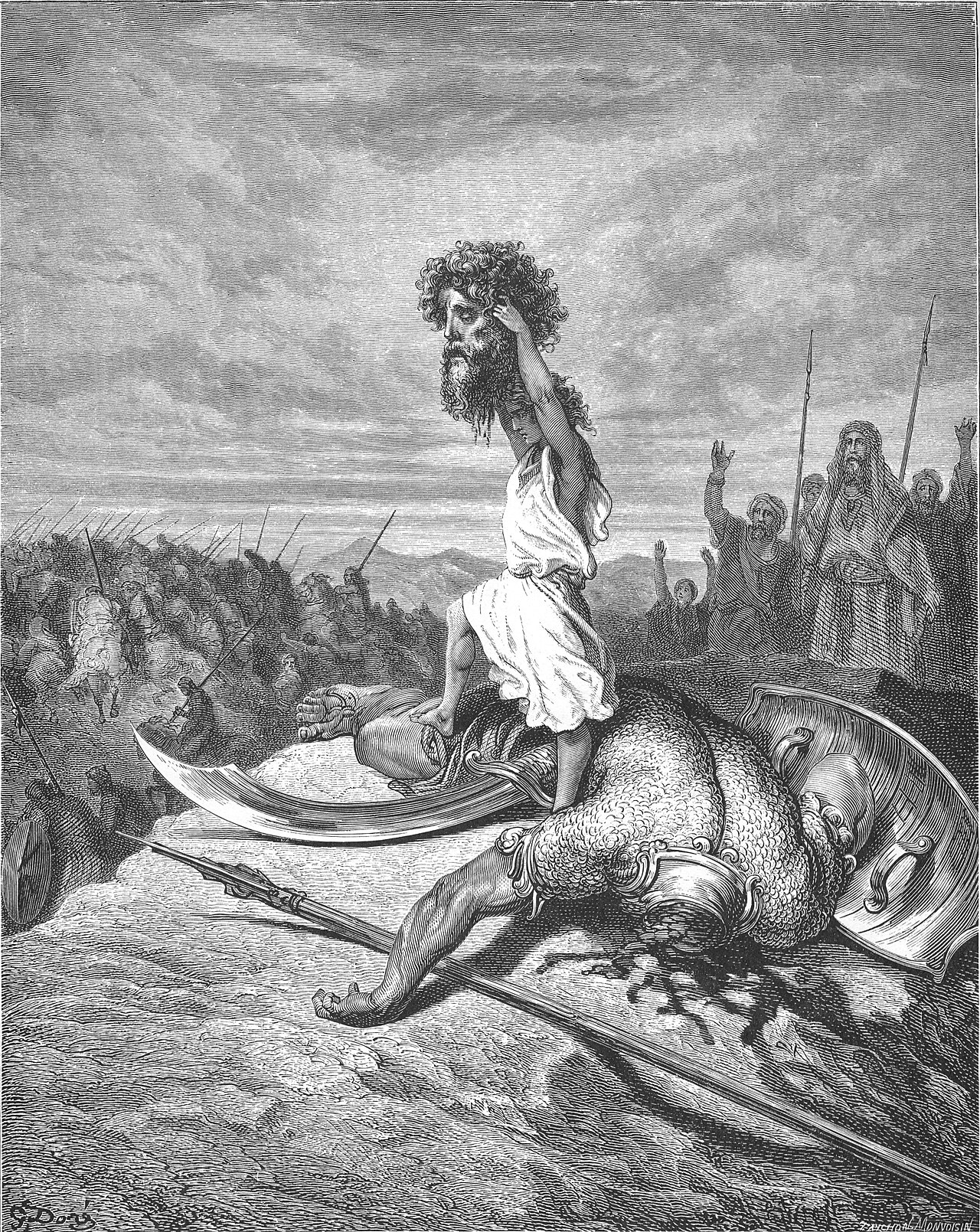
in 1 Samuel 17Then a champion named Goliath, who was from Gath, came out from the Philistine camp. He was six cubits and a span in height,
BSB
The same verse in ASV and KJV ▾
ASV
And there went out a champion out of the camp of the Philistines, named Goliath, of Gath, whose height was six cubits and a span.
KJV
And there went out a champion out of the camp of the Philistines, named Goliath, of Gath, whose height was six cubits and a span.
⋯
This verse in 1 Samuel 17
Commentary
8 notes on this verseAnd a man went out from above... named Goliath, etc. This notable man is the devil, who, daily going out from the camps of the Philistines, that is, from the hearts of the impious to rebel against God, does not cease to provoke the pious. …
This site's exposition
a champion named Goliath, who was from Gath
on 1 Samuel 17:4-5
Goliath comes from Gath, where Joshua left a remnant of the Anakim. The Hebrew text gives "six cubits and a span," while the Septuagint, a Qumran scroll and Josephus read four cubits and a span. Either way the coat of mail alone weighs "five thousand shekels."
The record, by era
The Church Fathers1 voice
Yet there stands Goliath, monstrous in his pride, swollen with his earthly power, confident that he can do everything by himself, with his head, hands and entire body clad in much bronze, having his own armor bearer behind him who, though he does not himself …
The Puritans and the Awakening2 voices
Six cubits - At least, nine feet, nine inches high. And this is not strange; for besides the giants mentioned in Scripture, Herodotus, Diodourus Siculus, and Pliny, make mention of persons seven cubits high.
And there went out a champion out of the camp of the Philistines,....
The Nineteenth Century2 voices
There went out a champion - Our word champion comes from campus, the field; Campio est enim ille qui pugnat in campo, hoc est, in castris, “Champion is he, properly, who fights in the field; i.e., in camps.” A man well skilled in arms, strong, brave, and patriotic. But is this the meaning of the original איש הבנים ish habbenayim, a middle man, the man between two; that is, as here, the man who undertakes to settle the disputes between two armies or nations.
A commentator
Jamieson, Fausset & Brown1802–1910
Commentary Critical and Explanatory on the Whole Bible (1871)
proposed
a champion--Hebrew, a "man between two"; that is, a person who, on the part of his own people, undertook to determine the national quarrel by engaging in single combat with a chosen warrior in the hostile army.
quarantine:debris (2026-07-29) — starts-lowercase
1 more voice on this verse
The Nineteenth Century1 voice
A commentator
Albert Barnes1798–1870
Notes, Explanatory and Practical, on the Old and New Testaments (1832-1869)
proposed
A champion - literally, “a man between the two camps:” i. e., one who did not fight in the ranks like an ordinary soldier, but came forth into the space between the hostile camps to challenge the mightiest man of his enemies to come and fight him. Goliath of Gath - One of the places mentioned in Jos 11:22 as still retaining a remnant of the sons of Anak; Gaza and Ashdod being the others. The race of giants (the Rephaim, from רפא râphâ' ) is mentioned again in the account of David’s Philistine wars 2Sa 21:15-22; 1Ch 20:4-8. It appears from these passages that Goliath had a brother Lahmi. Four are named as being “born to the giant in Gath.” See Deu 2:10-11, Deu 2:20-21; Deu 3:11-13. Six cubits ... - If the cubit, the length from the elbow to the tip of the middle finger, is about 1 12 feet; and the span, the distance from the thumb to the middle or little finger, when stretched apart to the full length, be half a cubit, six cubits and a span would equal about nine feet nine inches. The bed of Og king of Bashan was nine cubits long Deu 3:11.
The words behind it
12 Hebrew wordsEvery Hebrew word of this verse in the order it stands, with what it means and the door to its own study. The last column counts the times a word stands in the whole Bible: the rarer the word, the more the places it appears belong together.
| Hebrew | Sound | Meaning | Word study | In the Bible |
|---|---|---|---|---|
| וַיֵּצֵ֤א | vaiyetze' | and he came out | H3318 → | 1067 times |
| אִֽישׁ־ | ʾish- | [the] man of | H376 → | 1663 times |
| הַבֵּנַ֙יִם֙ | habenayim | the champions | H1143 → | |
| מִמַּחֲנ֣וֹת | mimachanot | from [the] camps of | H4264 → | 215 times |
| פְּלִשְׁתִּ֔ים | pelishtim | [the] Philistines | H6430 → | 287 times |
| גָּלְיָ֥ת | galyat | [was] Goliath | H1555 → | 6 times |
| שְׁמ֖וֹ | shemo | name his | H8034 → | 864 times |
| מִגַּ֑ת | migat | from Gath | H1661 → | 32 times |
| גָּבְה֕וֹ | gaveho | height his | H1363 → | |
| שֵׁ֥שׁ | shesh | [was] six | H8337 → | 216 times |
| אַמּ֖וֹת | ʾamot | cubits | H520 → | |
| וָזָֽרֶת׃ | vazaret | and a span | H2239 → |
וַיֵּצֵ֤אand he came out
vaiyetze'H3318 →1067 times
אִֽישׁ־[the] man of
ʾish-H376 →1663 times
הַבֵּנַ֙יִם֙the champions
habenayimH1143 →
מִמַּחֲנ֣וֹתfrom [the] camps of
mimachanotH4264 →215 times
פְּלִשְׁתִּ֔ים[the] Philistines
pelishtimH6430 →287 times
גָּלְיָ֥ת[was] Goliath
galyatH1555 →6 times
שְׁמ֖וֹname his
shemoH8034 →864 times
מִגַּ֑תfrom Gath
migatH1661 →32 times
גָּבְה֕וֹheight his
gavehoH1363 →
שֵׁ֥שׁ[was] six
sheshH8337 →216 times
אַמּ֖וֹתcubits
ʾamotH520 →
וָזָֽרֶת׃and a span
vazaretH2239 →
A shaded row is a word that stands 400 times or fewer in the Bible.
The walk
8 stopsEach card is a verse this one points to, and under it the verses that one points to in turn. Where several paths arrive at the same place, that place is listed first: the text keeps returning to it.
Through
Deuteronomy 3:11(For only Og king of Bashan had remained of the remnant of the Rephaim. His bed of iron, nine cubits long and four cubits wide, is still in Rabbah of the Ammonites.)
it leads to
- Genesis 14:5
In the fourteenth year, Chedorlaomer and the kings allied with him went out and defeated the Rephaites in Ashteroth-karnaim, the Zuzites in Ham, the Emites in Shaveh-kiriathaim,
- 2 Samuel 12:26
Meanwhile, Joab fought against Rabbah of the Ammonites and captured the royal fortress.
- Jeremiah 49:2
Therefore, behold, the days are coming, declares the LORD, when I will sound the battle cry against Rabbah of the Ammonites. It will become a heap of ruins, and its villages will be burned.…
- Amos 1:14
So I will kindle a fire in the walls of Rabbah to consume its citadels amid war cries on the day of battle and a violent wind on the day of tempest.
- Genesis 14:5
Through
Joshua 11:22No Anakim were left in the land of the Israelites; only in Gaza, Gath, and Ashdod did any survive.
it leads to
- Joshua 15:46
from Ekron to the sea, all the cities near Ashdod, along with their villages;
- 1 Chronicles 18:1
Some time later, David defeated the Philistines, subdued them, and took Gath and its villages from the hand of the Philistines.
- 1 Samuel 5:1
After the Philistines had captured the ark of God, they took it from Ebenezer to Ashdod,
- 1 Chronicles 29:4–8
three thousand talents of gold (the gold of Ophir) and seven thousand talents of refined silver, to overlay the walls of the buildings,
- Joshua 15:46
Where this verse is studied
On this page
Studies12
About 1 Samuel
Who and where
1 name in this verse with a page on the site.
This page draws on Adam Clarke, Commentary on the Bible; Albert Barnes, Notes, Explanatory and Practical, on the Old and New Testaments (1832-1869); Bede, Commentary on Samuel; Jamieson, Fausset & Brown, Commentary Critical and Explanatory on the Whole Bible; John Gill, Exposition of the Old Testament (1748-1763); John Wesley, Explanatory Notes upon the Old Testament; Keil and Delitzsch, Biblical Commentary on the Books of Samuel and Paulus Orosius, DEFENSE AGAINST THE PELAGIANS 2.