
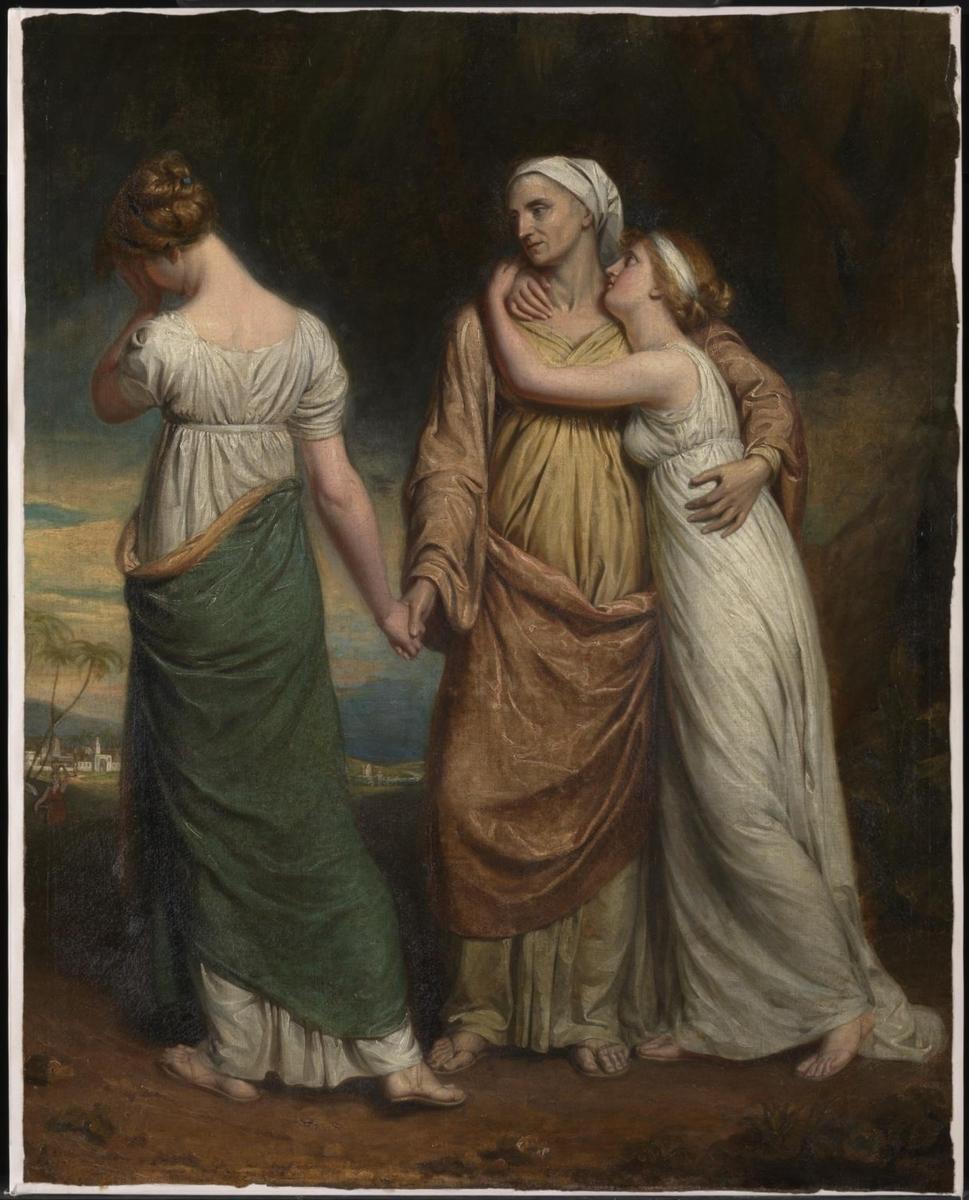
George Dawe, Naomi and her Daughters, 1804. Public domain.
Ruth 1 to 4 · Person · Featured Study
Naomi
Naomi, the wife of Elimelech and the mother-in-law of Ruth, is named in the book of Ruth and nowhere else in Scripture.
Naomi planned the night at the threshing floor and then told Ruth to wait, sure that Boaz would settle the matter that day.
And Naomi took the child, placed him on her lap, and became a nurse to him.
Summary
Naomi was the wife of Elimelech of Bethlehem in Judah. A famine took the family to Moab. Her husband and her two sons died there. She came home with Ruth, her Moabite daughter-in-law, and guided her through the harvest. When Ruth bore a son, Naomi took the child into her lap and cared for him.
- She urged both young widows to go back to their mothers' homes.
- She asked the LORD's blessing on the man who had noticed Ruth in the field.
- She held a share in Elimelech's land, and Boaz bought it from her.
Where Naomi Stands in Scripture
Her name stands from the opening verses of Ruth 1 to the women's words at Ruth 4:17.
Naomi is the first woman the book of Ruth names, before either of her daughters-in-law.
So Naomi and Ruth traveled until they came to Bethlehem. When they entered Bethlehem, the whole city was stirred because of them, and the women of the city exclaimed, “Can this be Naomi?”The whole town knew her, and the women's question draws out her answer at Ruth 1:20 to 21.
Her Words, Turn by Turn
Naomi speaks three times on the road from Moab and eight times in Bethlehem.
Her words move from sending the young widows away to planning a marriage for Ruth.
- Sends both daughters-in-law home with a blessingOrpah and RuthRuth 1:8 to 9
- Asks whether she has sons left to give themOrpah and RuthRuth 1:11 to 13
- Points Ruth after Orpah, back to her peopleRuthRuth 1:15
- Asks the women of the town to call her MaraThe women of Bethlehem
- Gives Ruth leave to gleanRuthRuth 2:2
- Asks where Ruth gleaned and blesses the manRuthRuth 2:19
- Names Boaz as one of the family's redeemersRuthRuth 2:20
- Tells Ruth to keep to the young women of BoazRuthRuth 2:22
- Sets out the plan for the threshing floorRuthRuth 3:1 to 4
- Asks Ruth how the night wentRuthRuth 3:16
- Tells Ruth to wait for Boaz to actRuthRuth 3:18
Names Boaz as one of the family's redeemers, Tells Ruth to keep to the young women of Boaz, Sets out the plan for the threshing floor, Asks Ruth how the night went, Tells Ruth to wait for Boaz to act
From Moab to Bethlehem
Two verses mark her road home, from the news of food in Judah to her arrival at the harvest.
Food in Judah againRuth 1:6 to 7
When Naomi heard in Moab that the LORD had attended to His people by providing them with food, she and her daughters-in-law prepared to leave the land of Moab.The famine that sent the family to Moab has ended, and the news turns Naomi toward home.
Home at the barley harvestRuth 1:19 to 22
So Naomi returned from the land of Moab with her daughter-in-law Ruth the Moabitess. And they arrived in Bethlehem at the beginning of the barley harvest.Her return falls at the start of the harvest in which Ruth will glean and meet Boaz.
What the Text Says Beside What Is Said
Two sayings about Naomi, each set against its verse
NAOMI TURNED FROM THE LORD IN HER GRIEF
She blessed her daughters-in-law by the LORD on the road. In Bethlehem she blessed Boaz by the LORD, whose kindness had not left the living or the dead.
NAOMI CAME HOME WITH NOTHING TO HER NAME
At the gate Boaz speaks of the piece of land that belonged to Elimelech as Naomi's to sell.
The Household of Naomi
Six of the house lived in Moab, and Boaz belonged to the same clan in Bethlehem.
The house of Elimelech lost its men in Moab and gained a son in Bethlehem.
- The house of ElimelechThe clan of Elimelech
Her generation
Her sons' generation
The child
- ObedRuth's son by Boaz, Ruth 4:13
The Places of Her Life
Three places, from her town to Moab and back
Naomi's road ran from Bethlehem in the hills of Judah to Moab, east of the Dead Sea, and back.
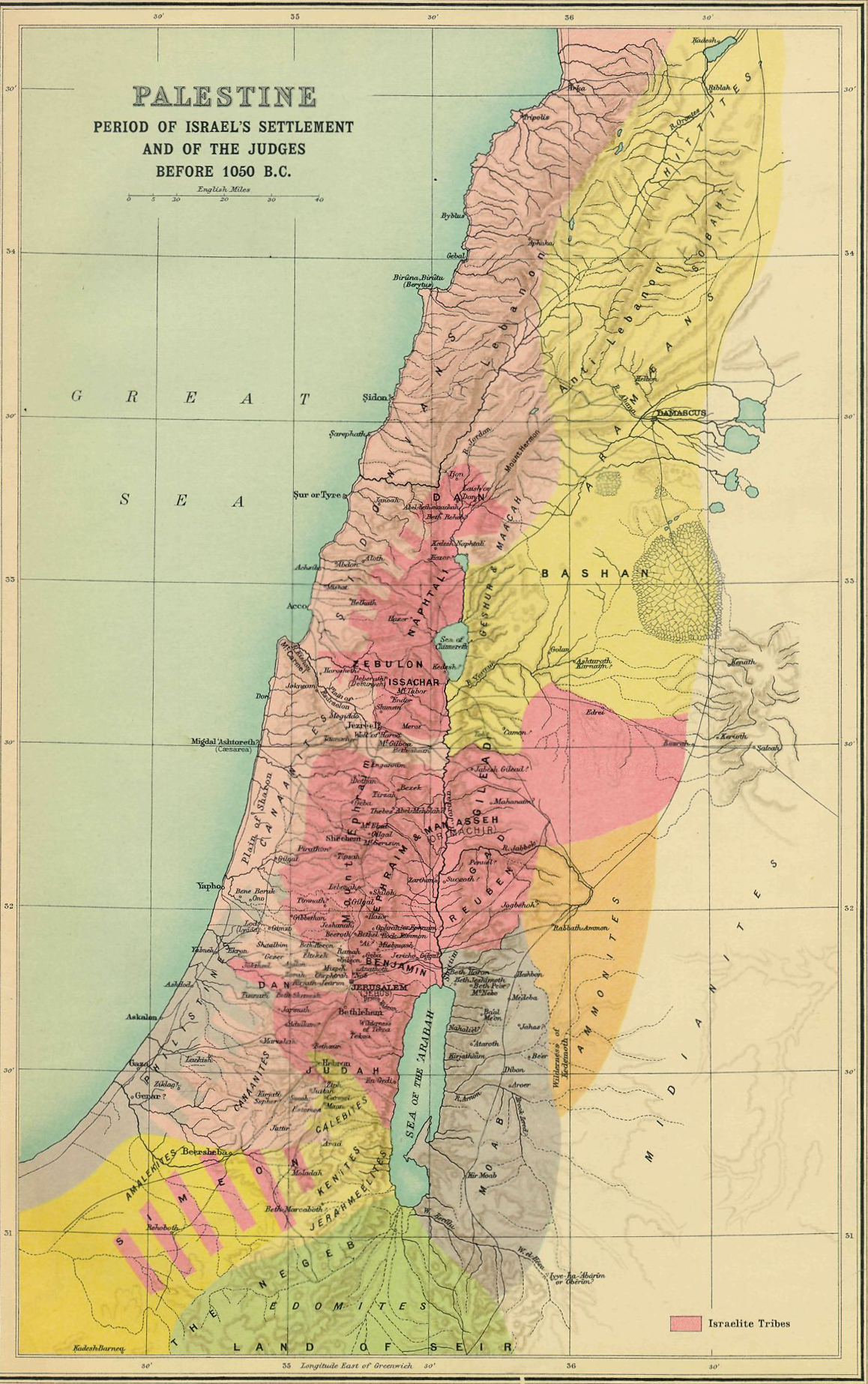
- Located: the site is known
- Identified: the point stands for an area, or is rounded
- 1Bethlehem, Her town, which she left in the famine and to which she came home. Ruth 1:1
- 2Moab, Where she was widowed and lost both her sons. Ruth 1:5
- 3The road to Judah, Where she sent her daughters-in-law home and Orpah left her. Ruth 1:7
Not placed: The road to Judah (3).
Base map: Israel's settlement and the period of the Judges, George Adam Smith, Atlas of the Historical Geography of the Holy Land (1915), public domain. Places with a place page stand at its coordinates and the others at the point cited for each, set on the plate by Jerusalem and Damascus, as the plate prints them.
Smith's plate shows the land in the period of the judges, when the book of Ruth is set.
Questions Her Life Raises
Two questions, each answered from the text and its readers
How could a widow sell her husband's land?Numbers 27:8 to 11; Ibn Ezra
Furthermore, you shall say to the Israelites, ‘If a man dies and leaves no son, you are to transfer his inheritance to his daughter. If he has no daughter, give his inheritance to his brothers. If he has no brothers, give his inheritance to his father’s brothers. And if his father has no brothers, give his inheritance to the next of kin from his clan, that he may take possession of it. This is to be a statutory ordinance for the Israelites, as the LORD has commanded Moses.’”Moses gives the order of heirs, and a widow has no place in it.
Ibn Ezra, on Ruth 4:5, says that a widow has her marriage contract and that a mother inherits what remains. On that reading the field came to Naomi when her husband and sons died.
What did Naomi's plan seek for Ruth?Ibn Ezra
Ibn Ezra, on Ruth 3:1, reads the resting place Naomi seeks for Ruth as marriage.
What the Text Leaves Unsaid
Five things the book of Ruth does not tell of her
The book names neither Naomi's father nor her mother. It gives no year for her age, only her own words that she is too old to marry again.
It says nothing of how she lived in Moab, and it records nothing of her death or burial.
What Her Life Means
The book's last act of Naomi is her care of the child, in a verb Scripture also uses of faith.
The word the Berean renders a nurse at Ruth 4:16 is a form of aman. The Tyndale House lexicon defines the verb first as to build up or support and to foster as a parent or nurse.
Ibn Ezra, on Ruth 4:16, reads it as to care for and sustain.
Abram believed the LORD, and it was credited to him as righteousness.In another stem aman means to believe, and Moses uses it here of Abram.
How Naomi Has Been Taught
Four readings by Matthew Henry and John Wesley, earliest first
Matthew Henry (1662 to 1714)
“This will help to allay the bitterness of parting; and, while we are together, we should labour so to conduct ourselves as that when we part we may not have cause to reflect with regret upon our miscarriages in the relation. It is very proper for friends, when they part, to part with prayer.”
Matthew Henry · Commentary on the Whole Bible · on Ruth 1:8 to 9Puritan
“So unlike is the rose when it is withered to what it was when it was blooming. What a poor figure does Naomi make now, compared with what she made in her prosperity!”
Matthew Henry · Commentary on the Whole Bible · on Ruth 1:19Puritan
“As Nabal and Absalom had feasts at their sheep-shearing, so Boaz at his winnowing. Naomi thought Ruth the most proper person to do it herself; and perhaps it was the usage in that country that in this case the woman should make the demand; so much is intimated by the law, Deut. xxv.”
Matthew Henry · Commentary on the Whole Bible · on Ruth 3:2Puritan
John Wesley (1703 to 1791)
“It is with me, that God has a controversy. This language becomes us, when we are under affliction; tho' many others share in the trouble, yet we are to hear the voice of the rod, as if it spake only to us. But did not she wish to bring them to the worship of the God of Israel?”
John Wesley · Explanatory Notes upon the Old Testament · on Ruth 1:13Evangelical
A Son Born to Naomi
Two readings of the women's words at Ruth 4:17, each with its holders
A way of speaking of the birthIbn Ezra, on Ruth 4:17
Ibn Ezra reads the women's words as a common way of saying that a son was born, like the phrase and she had a son.
The objection: the words follow Ruth 4:16, where Naomi takes the child into her care. They say more of Naomi than a birth notice would.
A son to serve her in her old ageMatthew Henry; Albert Barnes
“The good women would have it called Obed, a servant, either in remembrance of the meanness and poverty of the mother or in prospect of his being hereafter a servant, and very serviceable, to his grandmother. It is no dishonour to those that are ever so well born to be servants to God, their friends, and their generation. The motto of the princes of Wales is Ich dien--I serve.”
Matthew Henry · Commentary on the Whole Bible · on Ruth 4:17Puritan
Albert Barnes, on Ruth 4:17, reads the name Obed the same way, for the service the child would give his grandmother.
The objection: the women name the child without giving a reason for the name.
Books to Read Next
Three works from the eleventh century to the eighteenth, each free to read online
Commentary on Ruth
Rashi · eleventh century
Rashi gives the rabbis' readings of Naomi's words in short notes, verse by verse.
READ IT FREE AT SEFARIA →Commentary on Ruth
Abraham ibn Ezra · twelfth century
Ibn Ezra explains the Hebrew of Naomi's speeches and of the women's words over the child.
READ IT FREE AT SEFARIA →Commentary on the Whole Bible, Volume II (Joshua to Esther)
Matthew Henry · 1710
Henry draws a lesson for the household from Naomi's parting words on the road and from her counsel to Ruth.
READ IT FREE AT CCEL →The LORD Sustains the Widow
The LORD protects foreigners; He sustains the fatherless and the widow, but the ways of the wicked He frustrates.The psalm names the widow among those the LORD sustains, and Naomi was a widow in Bethlehem.
Sources
Scripture is the Berean Standard Bible.
- STEP Bible TBESH lexicon (Tyndale House, CC BY 4.0), with the tagged Hebrew of each verse.
- Strong's Exhaustive Concordance, Hebrew 5281.
- Ibn Ezra on Ruth, Sefaria Community Translation (CC0)
- Rashi on Ruth, The Metsudah Five Megillot (Lakewood, 2001), on Sefaria.
- Matthew Henry, Commentary on the Whole Bible, Volume II (Joshua to Esther), 1710.
- John Wesley, Explanatory Notes upon the Old Testament, 1765, on Ruth 1:13.
- Albert Barnes, Notes, Explanatory and Practical, on Ruth 4:17.
- George Adam Smith, Atlas of the Historical Geography of the Holy Land (1915), plate: Palestine, Period of Israel's Settlement and of the Judges, public domain.
- OpenBible.info, Bible-Geocoding-Data, ancient.jsonl.
Keep Studying
Read it5
Studies1
People and groups3
Doctrines5
Go further3