
Ruth 1 · Passage · Loyalty
Where You Go, I Will Go
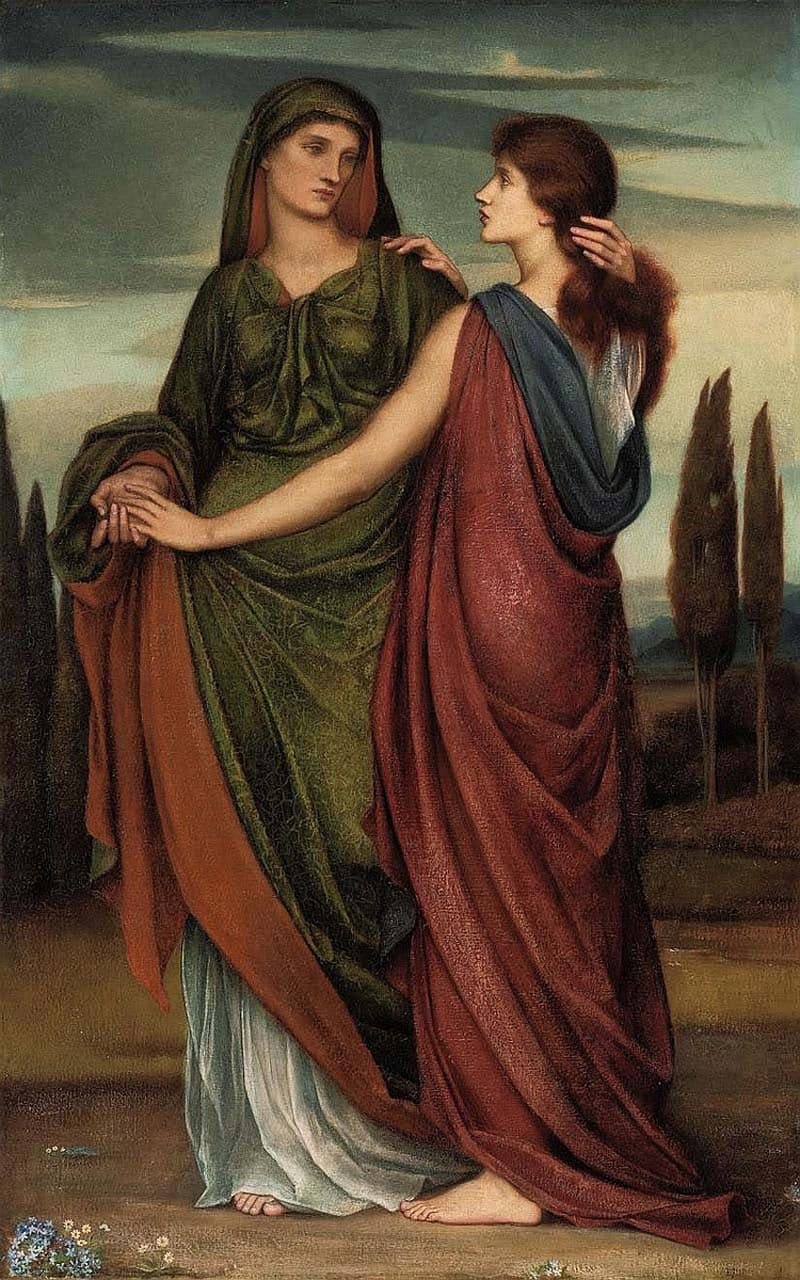
Ruth bound herself by oath to Naomi, to her people and to her God on the road from Moab to Bethlehem.
Ruth gave her loyalty for life to a widow who had nothing left to give her.
Again they wept aloud, and Orpah kissed her mother-in-law goodbye, but Ruth clung to her.
- The passage
- Ruth 1:1 to 22, Ruth 1:16 to 17
- Book
- Ruth
- When
- the days when the judges ruled, at the beginning of the barley harvest (Ruth 1:1; Ruth 1:22)
- Hold in memory
- Ruth 1:16
Summary
Ruth 1 sets two Moabite widows one choice on the road to Judah, and the chapter turns on their answers. Ruth refused every reason Naomi gave her to go back, and the words of her refusal reach past their life together to her death and her grave. Naomi, who had lost her husband and both her sons, was left with only the Moabite daughter-in-law who would not leave her.
- Ruth and Orpah were Moabite women married to Naomi's two sons, and all three husbands died in Moab (Ruth 1:4 to 5).
- Naomi urged both women three times to go back to their mothers' homes in Moab (Ruth 1:8 to 15).
- The chapter ends with Naomi and Ruth in Bethlehem at the start of the barley harvest, where the rest of the book takes place (Ruth 1:22).
The Road From Moab
A family of Bethlehem went down to Moab in a famine, and only its women came back.
Where You Go, I Will Go studies Ruth 1, the chapter of three widows on the road from Moab and of the vow one of them made. It belongs to the value of loyalty, because Ruth chose to stay with Naomi at the moment she was free to go.
The question the study answers is what Ruth bound herself to and why her word held. It reads Naomi's three appeals and sets out Ruth's answer clause by clause. It then gives two questions on which readers of the chapter have differed.
In the days when the judges ruled, a famine sent Elimelech of Bethlehem into Moab with his wife Naomi and their sons Mahlon and Chilion (Ruth 1:1 to 2). Elimelech died there, his sons married Orpah and Ruth, and about ten years later both sons died as well (Ruth 1:3 to 5). Then Naomi heard in Moab “that the LORD had attended to His people by providing them with food” (Ruth 1:6).
Accompanied by her two daughters-in-law, she left the place where she had been living and set out on the road leading back to the land of Judah.The verse puts the three widows on the road together, where the choice between Moab and Judah was made.
The Ladder of the Vow
Ruth answered Naomi's third appeal with a vow.
Ruth's vow climbs from the road to the grave and is sealed with an oath in the LORD's name.
| Verse | The Berean words | What it binds her to |
|---|---|---|
| Ruth 1:16 | “Do not urge me to leave you” | She turns down the release Naomi has offered her three times. |
| Ruth 1:16 | “or to turn from following you.” | She refuses to turn back, the verb of all three appeals. |
| Ruth 1:16 | “For wherever you go, I will go,” | Naomi's road becomes hers, wherever it leads. |
| Ruth 1:16 | “wherever you live, I will live;” | Naomi's home, however poor, becomes hers. |
| Ruth 1:16 | “your people will be my people,” | She takes Israel as her own people. |
| Ruth 1:16 | “and your God will be my God.” | She takes the God of Israel as her God. |
| Ruth 1:17 | “Where you die, I will die,” | She gives up any return to Moab for the rest of her life. |
| Ruth 1:17 | “and there I will be buried.” | Her body will lie in Naomi's land. |
| Ruth 1:17 | “May the LORD punish me, and ever so severely,” | She calls on the LORD to punish her if she breaks her word. |
| Ruth 1:17 | “if anything but death separates you and me.” | Only death may end the bond. |
Ruth 1:17, Ruth 1:17, Ruth 1:17, Ruth 1:17
Three Appeals to Turn Back
Naomi gave her daughters-in-law a blessing, a reason and an example for going home.
The first appeal was a blessing on both women. Naomi told them, “Go back, each of you to your mother’s home” (Ruth 1:8), and prayed that the LORD would let each of them find rest in the home of a new husband (Ruth 1:9).
The second appeal was a reason. Naomi had no more sons to give them as husbands, and in Ruth 1:13 she asked, “would you wait for them to grow up?”
In Ruth 1:14, the verse that parts the two widows, the Hebrew verb behind clung is dabaq, which the Tyndale House brief lexicon glosses as to cleave.
The third appeal was an example. “Look,” said Naomi, “your sister-in-law has gone back to her people and her gods; follow her back home” (Ruth 1:15).
One verb carries the three appeals and the refusal that answers them. The tagged Hebrew text of the chapter has shuv, to return, twelve times in ten verses. It runs from Naomi's setting out in Ruth 1:6 to her coming home in Ruth 1:22, and in Ruth 1:16 it is Ruth's own word for turning back.
Moab and Its Gods
The people Ruth left had gods of their own.
Moab's god was Chemosh, and Solomon later built a high place for him on a hill east of Jerusalem (1 Kings 11:7).
Naomi's Silence and Her New Name
Naomi's next recorded words are to the women of Bethlehem.
When Naomi saw that Ruth was determined to go with her, “she stopped trying to persuade her” (Ruth 1:18).
“Do not call me Naomi,” she replied. “Call me Mara, because the Almighty has dealt quite bitterly with me. I went away full, but the LORD has brought me back empty. Why call me Naomi? After all, the LORD has testified against me, and the Almighty has afflicted me.”Naomi speaks of coming home empty while the daughter-in-law sworn to her for life stands at her side.
The Oath in the LORD's Name
Ruth closed her vow with an oath that Israel's later leaders also swore.
The words “and ever so severely” stand in twelve verses of the Berean text, from Ruth 1:17 to 2 Kings 6:31, and Ruth's oath is the first of them in the order of the books.
Jonathan swore the same oath to David in 1 Samuel 20:13. He bound himself by it to warn David of Saul's intent “and send you on your way in safety.”
Why Naomi Pressed Them, and When Ruth Turned
Commentators have read Naomi's appeals in two ways and the start of Ruth's faith in two ways.
The first question is why Naomi urged both women to go back to Moab.
Naomi pressed them out of care for their goodJamieson, Fausset and Brown
Jamieson, Fausset and Brown, in their Commentary Critical and Explanatory (1871), read Naomi's words in Ruth 1:13 as care for the two women. They gave her meaning as “so reduced in circumstances that I cannot think of your being subjected to privations with me.”
The objection: the third appeal names the gods Orpah went back to, which sets a choice of God before Ruth (Ruth 1:15).
Naomi was testing Ruth's resolveJohn Wesley
John Wesley, in his Explanatory Notes upon the Old Testament (1765), read Naomi's words at Ruth 1:15 as spoken “to try Ruth's sincerity and constancy”. Naomi meant Ruth to understand “that if she went with her, she must embrace the true religion.”
The objection: Naomi gives her own reasons in Ruth 1:11 to 13, her age and her grief, and none of them is a test.
The second question is when Ruth turned to the God of Israel.
Ruth's turning began on the roadAdam Clarke
Adam Clarke, in his Commentary on the Bible (1832), held that the two widows “were probably both idolaters” and that “The conversion of Ruth probably commenced at this time.”
The objection: Naomi says both women had shown loving devotion to the dead and to her (Ruth 1:8) after about ten years in her household (Ruth 1:4).
Naomi's household had already won themMatthew Henry
Matthew Henry wrote in his Commentary on the Whole Bible (1710) on Ruth 1:10. He read the first answer of both women as “an evidence that they had, for her sake, conceived a good opinion of the people of Israel.”
The objection: Orpah gave the same first answer (Ruth 1:10) and still went home (Ruth 1:14).
Into Bethlehem at the Harvest
The vow held to the end of the road.
So Naomi returned from the land of Moab with her daughter-in-law Ruth the Moabitess. And they arrived in Bethlehem at the beginning of the barley harvest.The verse stands at the close because the narrator still calls her Ruth the Moabitess as she enters the land her vow had chosen.
Sources
Scripture is the Berean Standard Bible.
- STEP Bible, Translators Amalgamated Hebrew Old Testament, the tagged Hebrew text (Tyndale House, Cambridge), CC BY 4.0.
- STEP Bible, Translators Brief lexicon of Extended Strongs for Hebrew (Tyndale House, Cambridge), CC BY 4.0.
- Robert Jamieson, A. R. Fausset and David Brown, Commentary Critical and Explanatory on the Whole Bible (1871), on Ruth 1:13.
- Adam Clarke, Commentary on the Bible (1832), on Ruth 1:15.
- John Wesley, Explanatory Notes upon the Old Testament (1765), on Ruth 1:15.
- Matthew Henry, Commentary on the Whole Bible (1710), on Ruth 1:10.
Keep Studying
Read it1
Studies7
People and groups8