
John 19:2
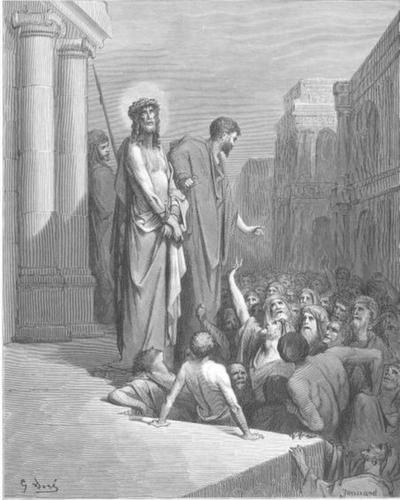
in John 19The soldiers twisted together a crown of thorns, set it on His head, and dressed Him in a purple robe.
BSB
The same verse in ASV and KJV ▾
ASV
And the soldiers platted a crown of thorns, and put it on his head, and arrayed him in a purple garment;
KJV
And the soldiers platted a crown of thorns, and put it on his head, and they put on him a purple robe,
⋯
This verse in John 19
Commentary
20 notes on this verseHe scourges Him unjustly, and suffers the crowd of soldiers to insult Him, and put a crown of thorns about His Head, and throw a purple robe upon Him, and buffet Him with the palms of their hands, and otherwise dishonour Him. For he thought he could easily put to shame the people of the Jews, if they saw the Man Who was altogether free from guilt suffering this punishment, only without a cause.
This site's exposition
twisted together a crown of thorns
on John 19:2-3
The soldiers stage a coronation: a crown of thorns, a purple robe, and the salute given to Caesar. Thorns came with the curse of the ground at Genesis 3:18. They are pressed onto the head of the man who carries that curse away.
The record, by era
The Church Fathers5 voices
(Tr. cxvi) When the Jews had cried out that they did not wish Jesus to be released on account of the passover, but Barabbas, Then Pilate therefore took Jesus, and scourged Him. Pilate seems to have done this for no reason but to satisfy the malice of the Jews with some punishment short of death. On which account he allowed his band to do what follows, or perhaps even commanded them. The Evangelist only says however that the soldiers did so, not that Pilate commanded them: And the soldiers platted a crown of thorns, and put it on His head, and they put on Him a purple robe, and said, Hail, King of the Jews! and they smote Him with their hands. (Tr. cxvi) Thus were fulfilled what Christ had prophesied of Himself; thus were martyrs taught to suffer all that the malice of persecutors could inflict; thus that kingdom which was not of this world conquered the proud world, not by fierce fighting, but by patient suffering.
On the Jews crying out that they did not wish Jesus to be released unto them at the passover, but Barabbas the robber; not the Saviour, but the murderer; not the Giver of life, but the destroyer, - "then Pilate took Jesus and scourged Him." We must believe that Pilate acted thus for no other reason than that the Jews, glutted with the injuries done to Him, might consider themselves satisfied, and desist from madly pursuing Him even unto death. With a similar intention was it that, as governor, he also permitted his cohort to do what follows, or even perhaps ordered them, although the evangelist is silent on the subject. For he tells us what the soldiers did thereafter, but not that Pilate ordered it. "And the soldiers," he says, "platted a crown of thorns, and put it on His head, and they clothed Him with a purple robe. And they came to Him and said, Hail, King of the Jews! And they smote Him with their hands." Thus were fulfilled the very things which Christ had foretold of Himself; thus were the martyrs moulded for the endurance of all that their persecutors should be pleased to inflict; thus, by concealing for a time the terror of His power, He commended to us the prior imitation of His patience; thus the kingdom which was not of this world overcame that proud world, not by the ferocity of fighting, but by the humility of suffering; and thus the grain of corn that was yet to be multiplied was sown amid the horrors of shame, that it might come to fruition amid the wonders of glory.
A commentator
Origen of AlexandriaCOMMENTARY ON THE GOSPEL OF JOHN 1.72-73 · Written before 253.
proposed
There are those who still have thorns with which they crown and dishonor Jesus, those, namely, who are choked by the cares and riches and pleasures of life and, though they have received the word of God, do not bring it to perfection. We must beware, therefore, lest we also, as crowning Jesus with thorns of our own, should be entered in the Gospel … and read how he is dishonored and mocked and beaten [by us].
You belong to Christ for you have been enrolled in the books of life. There the blood of the Lord serves for your purple robe, and your broad stripe is his own cross.
(Hom. lxxxiii) Pilate having called Him the King of the Jews, they put the royal dress upon Him, in mockery.
13 more voices on this verse
The Church Fathers2 voices
What patriarch, what prophet, what Levite, or priest or ruler, or at a later period what apostle, or preacher of the gospel or bishop do you ever find the wearer of a crown?… If, perhaps, you object that Christ himself was crowned, to that you will get the brief reply: Go ahead and be crowned like he was. You have my full permission.
The Lord's crown of thorns prophetically pointed to us who once were barren but are placed around him through the church of which he is the head. But it is also a type of faith, of life in respect to the substance of the wood, of joy in respect to the appellation of crown, of danger in respect to the thorn. For there is no approaching the Word without blood.… They crowned Jesus raised up high, testifying to their own ignorance.… This crown is the flower of those who have believed on the glorified One, but it covers with blood and chastises those who have not believed. It is a symbol, too, of the Lord's successful work, he having borne on his head (the princely part of his body) all our iniquities by which we were pierced. For he by his own passion rescued us from offenses and sins and other thorns. And having destroyed the devil, deservedly said in triumph, "O Death, where is your sting?"
The Medieval Church4 voices
Allow them to put a cloak on Him and place a crown on Him, also with the purpose of appeasing their anger.
To the affliction was added mockery: And the soldiers plaiting, etc. And because kings are accustomed to be honored by a sign, by dress, and by word or salutation and the showing of reverence, therefore they mock him in four ways: first in the sign …
2374 Now the Evangelist shows us Christ being ridiculed: first, the mock honors paid to him; secondly, the real dishonor showed him, and struck him. They pay him mock honors by calling him a king, thus adverting to the charge lodged by the Jews, who …
For instead of a diadem, they put upon Him a crown of thorns, and a purple robe to represent the purple robe which kings wear. Matthew says, a scarlet robe, (Mat. 27:28) but scarleta and purple are different names for the same colour. And though the soldiers did this in mockery, yet to us their acts have a meaning. For by the crown of thorns is signified the taking of our sins upon Him, the thorns which the earth of our body brings forth. And the purple robe signifies the flesh crucified. For our Lord is robed in purple, wherever He is glorified by the triumphs of holy martyrs.
The Reformation1 voice
And the soldiers, platting a crown of thorns. This was unquestionably done by the authority of Pilate, in order to affix a mark of infamy on the Son of God, for having made himself a king; and that in order to satisfy the rage of the Jews, as if he had been convinced that the accusations which they brought against Christ were well founded.
The Puritans and the Awakening2 voices
And the soldiers platted a crown of thorns,.... This was an emblem of his being surrounded by wicked men, sons of Belial, comparable to thorns, whilst he hung suffering on the cross; and of the sins of his people compassing him about, which were as thorns, very grievous to him; and of his various troubles in life, and of his being made a curse for us at death; thorns being the produce of the curse upon the earth.
But thus hath Christ's holy religion been basely misrepresented, dressed up by bad men at their pleasure, and so exposed to contempt and ridicule, as Christ was here. [1.] They clothe him with a mock-robe, as if it were a sham and a jest, and nothing but the product of a heated fancy and a crazed imagination.
The Nineteenth Century3 voices
A commentator
J.C. Ryle1816–1900
Expository Thoughts on the Gospels: John (lightly modernized text, Grace Gems edition) (1869)
proposed
Pilate said to the Jewish religious leaders, "Look, here is your king!" Then they shouted out, "Away with him! Away with him! Crucify him!" Pilate asked, "Shall I crucify your king?" The high priests replied, "We have no king except Caesar!" Then Pilate handed him over to them to be crucified. These verses exhibit to our eyes a wonderful picture, a picture which ought to be deeply interesting to all who profess and call themselves Christians. Like every great historical picture, it contains special points on which we should fix our special attention.
A commentator
J.C. Ryle1816–1900
Expository Thoughts on the Gospels: John (lightly modernized text, Grace Gems edition) (1869)
proposed
Pilate said to the Jewish religious leaders, "Look, here is your king!" Then they shouted out, "Away with him! Away with him! Crucify him!" Pilate asked, "Shall I crucify your king?" The high priests replied, "We have no king except Caesar!" Then Pilate handed him over to them to be crucified. These verses exhibit to our eyes a wonderful picture, a picture which ought to be deeply interesting to all who profess and call themselves Christians. Like every great historical picture, it contains special points on which we should fix our special attention. Above all, it contains three life-like portraits, which we shall find it useful to examine in order. The first portrait in the picture is that of our Lord JESUS CHRIST himself. We see the Savior of mankind scourged, crowned with thorns, mocked, smitten, rejected by His own people, unjustly condemned by a judge who saw no fault in Him, and finally delivered up to a most painful death. Yet this was He who was the eternal Son of God, whom the Father's countless angels delighted to honor. This was He who came into the world to save sinners, and after living a blameless life for thirty years, spent the last three years of His time on earth in going about doing good, and preaching the Gospel. Surely the sun never shone on a more wondrous sight since the day of its creation! Let us admire that love of Christ which Paul declares, "passes knowledge," and let us see an endless depth of meaning in the expression. There is no earthly love with which it can be compared, and no standard by which to measure it. It is a love that stands alone. Never let us forget when we ponder this tale of suffering, that Jesus suffered for our sins, the Just for the unjust, that He was wounded for our transgressions and bruised for our iniquities, and that with His stripes we are healed.
Platted a crown of thorns - See on Mat 27:29 (note).
Modern Voices1 voice
But it is essential to feel that he may have gone to Glastonbury: all songs, arts, and dedications branching and blossoming like the thorn, are rooted in some such sacred doubt. Taken thus, not heavily like a problem but lightly like an old tale, the …
The words behind it
16 Greek wordsEvery Greek word of this verse in the order it stands, with what it means and the door to its own study. The last column counts the times a word stands in the whole Bible: the rarer the word, the more the places it appears belong together.
| Greek | Sound | Meaning | Word study | In the Bible |
|---|---|---|---|---|
| καὶ | kai | And | G2532 → | 9120 times |
| οἱ | hoi | the | G3588 → | 19766 times |
| στρατιῶται | stratiotai | soldiers | G4757 → | 26 times |
| πλέξαντες | plexantes | having twisted together | G4120 → | |
| στέφανον | stephanon | a crown | G4735 → | |
| ἐξ | ex | of | G1537 → | 911 times |
| ἀκανθῶν | akanthon | thorns | G173 → | |
| ἐπέθηκαν | epethekan | put [it] | G2007 → | |
| αὐτοῦ | autou | of Him | G846 → | 5565 times |
| τῇ | tea | on the | G3588 → | 19766 times |
| κεφαλῇ | kephalea | head | G2776 → | 75 times |
| καὶ | kai | and | G2532 → | 9120 times |
| ἱμάτιον | himation | a robe | G2440 → | 60 times |
| πορφυροῦν | porphuroun | purple | G4210 → | |
| περιέβαλον | periebalon | cast around | G4016 → | |
| αὐτὸν | auton | Him | G846 → | 5565 times |
καὶAnd
kaiG2532 →9120 times
οἱthe
hoiG3588 →19766 times
στρατιῶταιsoldiers
stratiotaiG4757 →26 times
πλέξαντεςhaving twisted together
plexantesG4120 →
στέφανονa crown
stephanonG4735 →
ἐξof
exG1537 →911 times
ἀκανθῶνthorns
akanthonG173 →
ἐπέθηκανput [it]
epethekanG2007 →
αὐτοῦof Him
autouG846 →5565 times
τῇon the
teaG3588 →19766 times
κεφαλῇhead
kephaleaG2776 →75 times
καὶand
kaiG2532 →9120 times
ἱμάτιονa robe
himationG2440 →60 times
πορφυροῦνpurple
porphurounG4210 →
περιέβαλονcast around
periebalonG4016 →
αὐτὸνHim
autonG846 →5565 times
A shaded row is a word that stands 400 times or fewer in the Bible.
The walk
8 stopsEach card is a verse this one points to, and under it the verses that one points to in turn. Where several paths arrive at the same place, that place is listed first: the text keeps returning to it.
Through
Isaiah 53:3He was despised and rejected by men, a man of sorrows, acquainted with grief. Like one from whom men hide their faces, He was despised, and we esteemed Him not.
it leads to
- Isaiah 49:7
Thus says the LORD, the Redeemer and Holy One of Israel, to Him who was despised and abhorred by the nation, to the Servant of rulers: “Kings will see You and rise, and princes…
Reached by 2 separate paths from here.
- John 1:10–11
He was in the world, and though the world was made through Him, the world did not recognize Him.
- Matthew 26:67
Then they spit in His face and struck Him. Others slapped Him
- Isaiah 53:10
Yet it was the LORD’s will to crush Him and to cause Him to suffer; and when His soul is made a guilt offering, He will see His offspring, He will prolong His days,…
- Hebrews 12:2–3
Let us fix our eyes on Jesus, the author and perfecter of our faith, who for the joy set before Him endured the cross, scorning its shame, and sat down at the right hand…
- Isaiah 49:7
Through
Psalms 22:6But I am a worm and not a man, scorned by men and despised by the people.
it leads to
- Isaiah 53:3
He was despised and rejected by men, a man of sorrows, acquainted with grief. Like one from whom men hide their faces, He was despised, and we esteemed Him not.
Reached by 2 separate paths from here.
- Job 25:6
how much less man, who is but a maggot, and the son of man, who is but a worm!”
- Isaiah 41:14
Do not fear, O worm of Jacob, O few men of Israel. I will help you,” declares the LORD. “Your Redeemer is the Holy One of Israel.
- Isaiah 53:3
Where this verse is studied
On this page
Studies18
On this verse
On this chapter
About John
This page draws on 19 works. Open the list of works
This page draws on Adam Clarke, Commentary on the Bible; Augustine of Hippo, Catena Aurea by Aquinas; Augustine of Hippo, Tractates on John 116; Bede, Catena Aurea by Aquinas; Bonaventure, Commentary on John, Chapter 19; Clement of Alexandria, The Instructor Book 2; Cyril of Alexandria, Commentary on the Gospel of John, Book 12; GK Chesterton, Alarms and Discursions, The Gold of Glastonbury (1910); J.C. Ryle, Expository Thoughts on the Gospels: John (lightly modernized text, Grace Gems edition); John Calvin, Commentaries; John Chrysostom, Homilies on St. John; John Chrysostom, Catena Aurea by Aquinas; John Gill, Exposition of the New Testament (1746-1748); Matthew Henry, Commentary on the Whole Bible; Origen of Alexandria, COMMENTARY ON THE GOSPEL OF JOHN 1.72-73; Tertullian, THE CHAPLET 13; Tertullian, THE CHAPLET 9; Theophylact of Ohrid, Commentary on John and Thomas Aquinas, Commentary on John.