
Markchapter 6
56 verses · Mark · AD 55 to 65 · The Gospels
Isn’t this the carpenter, the son of Mary and the brother of James, Joses, Judas, and Simon? Aren’t His sisters here with us as well?” And they took offense at Him.
Introduction
Mark, The Gospels, Mark Overview.
Mark opens this chapter in Jesus' home town and closes it on the far side of the lake, and he fits the death of John the Baptist between the sending of the Twelve and their return. He wrote for believers in Rome who lived under rulers able to kill on a whim, and who knew rejection among their own neighbours. The chapter sets two kinds of kingship side by side. Listen for the two meals, one in a palace and one on a hillside. Listen also for what the disciples fail to understand on the water. Read it as a chapter about who truly feeds and rules God's people.
Context
- Who
- Roman readers who knew how rulers behaved at drinking parties
- What
- An account of Jesus' rejection at Nazareth, the mission of the Twelve, the death of John the Baptist, the feeding of the five thousand and the walk on the sea.
- Where
- Nazareth, the villages of Galilee, the court of Herod Antipas, a solitary place by the lake and the water itself.
- When
- The Galilean ministry under Herod Antipas, about AD 29.
- Why
- To show Jesus as the shepherd who feeds and guards His people, set against a ruler whose feast ended in the death of a prophet.
Historical context
The word Mark uses for Jesus' trade, tekton, means a builder who worked in wood and stone, a general craftsman rather than a fine cabinetmaker. Nazareth was a small village, and the city of Sepphoris, being rebuilt on a large scale a few miles away in these decades, would have offered such men steady work.
Show the rest of the historical context, 3 more paragraphs
The instructions for the mission are famously slightly different from Matthew's version: here they take a staff and wear sandals. The difference has been explained in various ways and is worth naming rather than smoothing over. Either way the point stands, travel light and depend on hospitality, which in that culture was an obligation a village owed a guest.
The banquet scene is thoroughly Greco-Roman: a ruler's birthday, his officers and the leading men of Galilee reclining, entertainment during the drinking, and a rash public oath the host cannot retract without losing face in front of everyone who matters. Josephus independently records that Antipas imprisoned and executed John, and places it at the fortress of Machaerus.
The feeding happens in spring, Mark notes the grass was green, which in that country it is only for a few weeks. He also says the people sat down in groups of hundreds and fifties, an orderly arrangement that would have reminded a Jewish observer of Israel camped in the wilderness.
Significance
Mark sets a king's feast that ends in a severed head beside a shepherd's feast that ends with twelve baskets over. Roman Christians, who lived under a court where a word at dinner could kill, would not have missed the comparison.
Show the rest of the significance, 1 more paragraph
The rejection at Nazareth also carried a quiet comfort. If the people who had watched him grow up took offence, then believers whose own neighbours in Rome thought them mad were in familiar company.
The heads below are this chapter's scenes. The numbered points under each are its verses.
A Prophet Without Honor at Home
Mark 6:1-2
came to His hometown: Their questions, Where did this man get these ideas and What is this wisdom, grant His wisdom and ask only its source. Wonder turns to offense within the space of two verses.
Mark 6:1
“And he went out from thence,.... From Capernaum; and came into his own country; or "city", as the Syriac, Arabic, Persic, and Ethiopic versions read, the city of Nazareth; so called because it was the place where Christ was conceived, and where he was educated; for which he had a regard, and was willing it should partake of the benefit of his doctrine and miracles: and his disciples follow him; as they did wherever he went; and which is a true characteristic of a disciple of Jesus.”
1 more voice on this verseWhat preachers and commentators have said about this verse, in their own words.
Mark 6:1
“This passage shows us our Lord Jesus Christ in "his hometown," at Nazareth. It is a melancholy illustration of the wickedness of man's heart, and deserves special attention. We see, in the first place, how apt men are to undervalue things with which they are familiar . The men of Nazareth "were offended" at our Lord. They could not think it possible that one who had lived so many years among themselves, and whose brethren and sisters they knew, could deserve to be followed as a public teacher. Never had any place on earth such privileges as Nazareth.”
When the Sabbath came: John Gill suggests that Jesus reached Nazareth on a weekday and waited for the Sabbath before he taught. In the synagogue he expounded the law and the prophets. Matthew Henry notes that even hearers who took offense had to admit what was honourable in him.
Mark 6:2
“And when the sabbath day was come,.... For it seems that it was on a weekday, or on one of the common days of the week, that he entered into the city, where he remained without making himself known, till the sabbath day came: and then he began to teach in the synagogue; that is, at Nazareth; where he expounded the law and the prophets, and preached the Gospel: and many hearing him were astonished. The Vulgate Latin adds, "at his doctrine"; and so it is read in Beza's most ancient copy: saying, from whence hath this man these things?”
1 more voice on this verse
Mark 6:2
“Were astonished - επι τῃ διδαχῃ αυτου, at his doctrine, or teaching. This is added by the Codex Bezae and eight others, later Syriac, Armenian, Vulgate, and all the Itala.”
Adam Clarke · Commentary on the Bible (1810-1826)evangelical
Isn’t this the carpenter: The townspeople ask, Isn’t this the carpenter, the son of Mary, naming Jesus by His trade and by His mother. A man was usually named by his father. The familiarity that should have commended Him becomes their reason to reject Him.
Mark 6:3
“Is not this the carpenter - Among the ancient Jews, every father was bound to do four things for his son. 1. To circumcise him. 2. To redeem him. 3. To teach him the law. 4. To teach him a trade. And this was founded on the following just maxim: “He who teaches not his son to do some work, is as if he taught him robbery!” It is therefore likely that Joseph brought up our Lord to his own trade. Joses - Several good MSS. read Ιωσητος, Joset, and one, with several versions, reads Joseph.”
Adam Clarke · Commentary on the Bible (1810-1826)evangelical
1 more voice on this verse
Mark 6:3
“How then, says Helvidius, do you make out that they were called the Lord's brethren who were not his brethren? I will show how that is. In Holy Scripture there are four kinds of brethren — by nature, race, kindred, love. Instances of brethren by nature are Esau and Jacob, the twelve patriarchs, Andrew and Peter, James and John.”
Jerome · written before 420 · Against Helvidiuspatristic
Mark 6:4-6
He could not perform any miracles there, except to lay His hands on a few of the sick and heal them. Mark ties the limit to their unbelief, at which He was amazed.
lay His hands on a few of the sick: Gregory of Nazianzus explains the limit: healing needs faith in the patient as well as power in the healer. Origen compares faith to a magnet drawing iron. Matthew Henry says that by unbelief people put a bar on their own door and stop the flow of Christ's favours.
Mark 6:5
“One meaning of "could not" is simply the limits of some human will. Take, for example, the point that Christ "could not" fulfill any signs in Nazareth was due to disbelief on their part. Something essential for healing is required on both sides—faith on the part of the patients, power on that of the healer. So one side without its counterpart "could not," so to speak, perform them. As this can be seen in medical care, it can also be seen in moral transformation.”
Gregory of Nazianzus · written before 390 · Oration 30, on the Son 10-11patristic
from village to village: Charles Spurgeon observes that the Gospels record no wonder from Jesus at nature, art or the stones of the Temple. Unbelief among his own did. Theophylact of Ohrid sees in the circuit of the villages a lesson to sow the word in small and neglected places.
Mark 6:6
“And he marvelled because of their unbelief,.... Which was the reason, as Matthew says, Mat 13:58, why he did not many mighty works there, because they continued their prejudices against him, and their unbelief in him, notwithstanding what he did do, which was matter of admiration to him; wherefore he took his leave of them, as an ungrateful and unworthy people; and it is never after observed, that he returned there any more.”
1 more voice on this verse
Mark 6:6
“We never find Christ wondering but at the faith of the Gentiles that were strangers, as the centurion ( Matt. viii. 10 ), and the woman of Samaria, and at the unbelief of Jews that were his own countrymen. Note, The unbelief of those that enjoy the means of grace, is a most amazing thing.”
Matthew Henry · Commentary on the Whole Bible (1707-1721)puritan
Sent Out Two by Two
began to send them out two by two: Jesus began to send them out two by two, which gives each a companion for the road and two witnesses for any testimony. The church later sends its workers out in pairs as well.
Mark 6:7
“And he called unto him the twelve - See the notes at Mat 10:1. And began to send them forth by two and two - In order that they might “support” and “encourage” each other in their work. Amid the trials and opposition with which they would meet, mutual counsel and aid would greatly lighten their burdens and alleviate their calamities. Mutual counsel might also contribute to their success, and lead to “united” plans to advance the kingdom of the Redeemer.”
1 more voice on this verse
Mark 6:7
“These verses describe the first sending forth of the apostles to preach. The great Head of the church made proof of His ministers, before He left them alone in the world. He taught them to try their own powers of teaching, and to find out their own weaknesses, while He was yet with them. Thus, on the one hand, He was enabled to correct their mistakes. Thus, on the other, they were trained for the work they were one day to do, and were not novices, when finally left to themselves.”
Mark 6:8-9
to take nothing but a staff: Jesus sends them with a staff and sandals and forbids bread, a bag, money in their belts, and a second tunic. The charge strips away every ordinary provision, so the mission depends on the hospitality of those who receive them.
Mark 6:8
“A staff only - It is likely he desired them to take only one with every two, merely for the purpose of carrying any part of their clothes on, when they should be obliged to strip them off by reason of the heat; for walking staves, or things of this kind, were forbidden, see Mat 10:10. But, probably, no more is designed than simply to state that they must not wait to make any provision for the journey, but go off just as they were, leaving the provision necessary in the present case to the care of Divine Providence.”
Adam Clarke · Commentary on the Bible (1810-1826)evangelical
1 more voice on this verse
Mark 6:8
Are all commanded not to have two coats, nor food in their possession, money in their purse, only a staff in the hand and shoes on the feet? Are all commanded to sell all they possess and give it to the poor, and follow Jesus? Of course not. This command is for those who earnestly desire to respond fully to grace.… The Lord says in the Gospel to him who had boasted of having kept the whole law: "If you will be perfect, go and sell all that you have, and give to the poor, and come, follow me."
Jerome · written before 420 · Against Jovinianus 2.6patristic
not a second tunic: Augustine reads the rule as forbidding two tunics worn at once, and hears in it a call to walk in simplicity. Adam Clarke describes the sandal as a sole strapped to the foot and ankle, like the Roman solea. John Gill calls it fit for travel.
Mark 6:9
“But be shod with sandals,.... Which were different from shoes, and more fit to travel with, and therefore allowed when shoes were forbidden; See Gill on Mat 10:10, though some think there was no difference between shoes and sandals, and that Christ, in Mat 10:10, does not forbid the taking of shoes, but two pair of shoes; as not two coats, nor two staves, but one of a sort only.”
1 more voice on this verse
Mark 6:9
“Shod with sandals - The sandal seems to have been similar to the Roman solea, which covered only the sole of the foot, and was fastened about the foot and ankle with straps. The sandal was originally a part of the woman’s dress; ancient authors represent them as worn only by women.”
Adam Clarke · Commentary on the Bible (1810-1826)evangelical
Mark 6:10-11
stay there until you leave that area: Jews shook the dust from their feet when leaving Gentile ground. The command to shake the dust off your feet at an Israelite town, as a testimony against them, treats it as outside the covenant's welcome.
shake the dust off your feet: Adam Clarke notes that the closing clause about Sodom and Gomorrah, found in older English Bibles, is missing from many early manuscripts. The Berean text follows them. Theophylact of Ohrid reads the shaken dust as a sign that the messengers had walked a long way for that town in vain.
Mark 6:11
“And whoever shall not receive you, &c. This the Lord commanded them, that they might show that they had walked a long way for their sakes, and to no purpose. Or, because they received nothing from them, not even dust, which they shake off, that it might be a testimony against them, that is, by way of convicting them.”
Theophylact of Ohrid · written before 1107 · Catena Aurea by Aquinaspatristic
1 more voice on this verse
Mark 6:11
“And whosoever shall not receive you - Ὁς αν τοπος μη δεξηται, whatsoever Place will not receive you: this is the reading of BL, four others, and the later Syriac in the margin. Verily, etc. - All this clause is omitted in BCDL, two others, one Arabic, one Persic, Coptic, Armenian, Vulgate, and all the Itala but three. Mill and Beza approve of the omission, and Griesbach leaves it out of the text. It has probably been transferred here from Mat 10:15. See this subject, from Mar 6:7-11, explained at large on Mat 10:1-15 (note).”
Adam Clarke · Commentary on the Bible (1810-1826)evangelical
Mark 6:12-13
preached that the people should repent: The Twelve drove out many demons and healed many of the sick, their works matching His. This is the New Testament's first mention of anointing with oil in healing, a practice James 5:14 takes up again.
Mark 6:12
“Preached that men should repent - See the nature of repentance explained in notes at Mat 3:2. They were now called upon to repent and reform their lives because sin was evil, because the Messiah had come to preach forgiveness to the penitent, and because at “his” presence it was fit that the nation should turn from its sins and prepare to receive him.”
anointing them with oil: Albert Barnes notes that anointing the sick with oil was common among the Jews, who thought it soothing to the body. John Wesley contrasts this anointing, used for recovery, with the later rite given only when life was despaired of. Its aim was healing.
Mark 6:13
“And they cast out many devils,.... Which they had power given them to do; and this they did, in confirmation of their mission and doctrine, and for the benefit of miserable creatures, who were possessed by them; and to show their power over the devils, and as a prelude of what they were to be the instruments of, in casting Satan out of the souls of men, both Jews and Gentiles; and especially, in the ejection of him out of the Gentile world: and anointed with oil many that were sick, and healed them.”
2 more voices on this verse
Mark 6:13
“Some think this oil was used medicinally, according to the custom of the Jews; but I rather think it was used as a sign of miraculous healing, by the appointment of Christ, though not mentioned; and it was afterward used by those elders of the church, to whom by the Spirit was given the gift of healing, Jam. v. 14 .”
Matthew Henry · Commentary on the Whole Bible (1707-1721)puritan
Mark 6:13
“And it seems this was the great standing means of healing, desperate diseases in the Christian Church, long before extreme unction was used or heard of, which bears scarce any resemblance to it; the former being used only as a means of health; the latter only when life is despaired of.”
John Wesley · Explanatory Notes upon the New Testament (1755)evangelical
Herod's Oath and the Death of John
Mark 6:14-16
The people guess Elijah or a prophet, and Herod's guilty conscience settles on one answer, John, whom I beheaded, has risen from the dead. Mark sets the account of John's death inside the mission of the Twelve.
Mark 6:14
“And King Herod--that is, Herod Antipas, one of the three sons of Herod the Great, and own brother of Archelaus (Mt 2:22), who ruled as ethnarch over Galilee and Perea. heard of him; (for his name was spread abroad); and he said--"unto his servants" (Mt 14:2), his councillors or court ministers.”
Jamieson, Fausset & Brown · Commentary Critical and Explanatory on the Whole Bible (1871)reformed
1 more voice on this verse
Mark 6:14
“And king Herod heard? - Την ακοην αοτου, his fame, is added by KM, fifteen others, and in the margin of several. It seems necessary to complete the sense.”
Adam Clarke · Commentary on the Bible (1810-1826)evangelical
Adam Clarke prefers the reading followed here, a prophet like one of the prophets of old, which he says mends the sense. Theophylact of Ohrid suggests some named Elijah because Jesus rebuked the people as Elijah had. Each guess placed him among the prophets.
Mark 6:15
“Or, as one of the prophets - η, or, is omitted by ABCEGHKLMS - BHV, and one hundred others, Syriac, all the Arabic, all the Persic, Coptic, Ethiopic, Gothic, Slavonic, Vulgate, two Itala, Origen, Victor, and Theophylact. Bengel, Wetstein, and Griesbach leave it out of the text: the omission of it mends the sense much.”
Adam Clarke · Commentary on the Bible (1810-1826)evangelical
Luke 9:9 shows Herod at first perplexed. Augustine reconciles the accounts: after that hesitation Herod settled on what others were saying, as Matthew 14:2 records. Matthew Henry comments that where there is an idle faith, there is commonly a working fancy.
Mark 6:16
“But when Herod heard thereof, he said, It is John, whom I beheaded; he is risen from the dead--"Himself has risen"; as if the innocence and sanctity of his faithful reprover had not suffered that he should lie long dead.”
Jamieson, Fausset & Brown · Commentary Critical and Explanatory on the Whole Bible (1871)reformed
Mark 6:17-18
ordered that John be arrested and bound and imprisoned: Herodias was the wife of Herod's brother Philip, and the law banned taking a brother's wife while he lived. John had been telling Herod, It is not lawful for you to have your brother’s wife, naming the sin to the king himself. Prison is the cost of that plain word.
Mark 6:17
“For Herod himself had sent forth,.... Some of his guard, a detachment of soldiers, and laid hold upon John; who seized upon him, and took him up: and bound him in prison; in the castle of Machaerus: for Herodias' sake, his brother Philip's wife, for he had married her; whilst his brother was living, and who had had children by her; See Gill on Mat 14:3.”
2 more voices on this verse
Mark 6:17
“This Philip, however, was not the tetrarch of that name mentioned in Lu 3:1 (see on Lu 3:1), but one whose distinctive name was "Herod Philip," another son of Herod the Great--who was disinherited by his father.”
Jamieson, Fausset & Brown · Commentary Critical and Explanatory on the Whole Bible (1871)reformed
Mark 6:17
“Though it was dangerous to offend Herod, and much more to offend Herodias, yet John would run the hazard rather than be wanting in his duty. Note, Those ministers that would be found faithful in the work of God, must not be afraid of the face of man. If we seek to please men, further than is for their spiritual good, we are not the servants of Christ.”
Matthew Henry · Commentary on the Whole Bible (1707-1721)puritan
Jamieson, Fausset and Brown note that Herod's own wife was still living as well as Herodias' husband, and that Leviticus 20:21 forbade the match. John Chrysostom draws a lesson for believers. They too must admonish a brother without shrinking from the duty.
Mark 6:19-20
Herodias held a grudge against John: Herodias wanted to kill John, but Herod feared John and protected him, knowing that he was a righteous and holy man. He was greatly perplexed, yet he listened to him gladly, guarding the prisoner whose word convicted him.
Mark 6:19
“Therefore Herodias had a quarrel against him,.... Was angry with him, conceived wrath, and laid up hatred against him, and was an adversary to him; which is the sense of the Oriental versions. She bore him an inward grudge, and lay in wait to take the first opportunity of dispatching him: and would have killed him, but she could not; being hindered by Herod, who as yet would not suffer it; partly through fear of the people, and partly through the respect he had for John.”
he listened to him gladly: Matthew Henry reads the pair righteous and holy as justice toward men and holiness toward God. Herod knew this by personal acquaintance. John Chrysostom marvels that Herod honored John even under rebuke, and concludes that virtue is a great thing.
Mark 6:20
“Observe, [1.] John was a just man, and a holy; to make a complete good man, both justice and holiness are necessary; holiness toward God, and justice toward men. John was mortified to this world, and so was a good friend both to justice and holiness. [2.] Herod knew this, not only by common fame, but by personal acquaintance with him.”
Matthew Henry · Commentary on the Whole Bible (1707-1721)puritan
Mark 6:21-23
On Herod’s birthday, her opportunity arose: The daughter of Herodias dances, and the king swears, Whatever you ask of me, I will give you, up to half my kingdom. The oath is made before an audience of nobles, with no thought yet given to what will be asked.
Mark 6:21
“And when a convenient day was come,.... For Herodias; who had long sought and watched for an opportunity of avenging herself on John, and such a time Herod's birthday proved; though some think, that this phrase is the same with יום טוב, "a good day"; often used by the Jews for a festival, any one of their feast days; there is a tract in their Misna which bears this name; and that such a day was this.”
1 more voice on this verse
Mark 6:21
“Lords - Μεγιστασιν, probably governors of particular districts. High captains - Χιλιαρχοις; literally, chiefs or captains over a thousand men, military chiefs. Chief estates - Πρωτοις; probably such as might be called nobles by title only, having no office civil or military; probably magistrates. See Kypke an the place.”
Adam Clarke · Commentary on the Bible (1810-1826)evangelical
the daughter of Herodias came and danced: Jamieson, Fausset and Brown identify her as Herodias' daughter by Herod Philip, named Salome by Josephus. Ambrose notes that a queen's daughter was brought from the private rooms to dance in the sight of all. He counts many sins woven into this one act.
Mark 6:22
“And when the daughter of the said Herodias--that is, her daughter by her proper husband, Herod Philip: Her name was Salome [JOSEPHUS, Antiquities, 18.5,4]. came in and danced, and pleased Herod and them that sat with him, the king said unto the damsel--"the girl" (See on Mr 5:42).”
Jamieson, Fausset & Brown · Commentary Critical and Explanatory on the Whole Bible (1871)reformed
1 more voice on this verse
Mark 6:22
“Note how varied sins are interwoven in this one vicious action! A banquet of death is set out with royal luxury, and when a larger gathering than usual has come together, the daughter of the queen, sent for from within the private apartments, is brought forth to dance in the sight of all. What could she have learned from an adulteress but the loss of modesty?”
Ambrose of Milan · written before 397 · Concerning Virginity 3.6.27patristic
Jamieson, Fausset and Brown note that Herod held the title of king only by courtesy. They add that passion and luxury destroy self-command. John Chrysostom asks what Herod would have done had she asked for his own head, and warns how easily swearing makes a man witless.
Mark 6:23
“And he--the king, so called, but only by courtesy (see on Mr 6:14). sware unto her Whatsoever thou shalt ask of me, unto the half of my kingdom--Those in whom passion and luxury have destroyed self-command will in a capricious moment say and do what in their cool moments they bitterly regret.”
Jamieson, Fausset & Brown · Commentary Critical and Explanatory on the Whole Bible (1871)reformed
1 more voice on this verse
Mark 6:23
“Unto the half of my kingdom - A noble price for a dance! This extravagance in favor of female dancers has the fullest scope in the east, even to the present day. M. Anquetil du Perron, in the preliminary discourse to his Zend Avesta, p. 344 and 345, gives a particular account of the dancers at Surat. This account cannot be transcribed in a comment on the Gospel of God, however illustrative it might be of the conduct of Herodias and her daughter Salome: it is too abominable for a place here.”
Adam Clarke · Commentary on the Bible (1810-1826)evangelical
Mark 6:24-25
Herodias answers at once, The head of John the Baptist, as one who had waited for this opening. The girl hurried back to the king and made it sharper than her mother's, adding on a platter immediately. Mark keeps her eagerness in the account without softening it.
Mark 6:24
“And she said, The head of John the Baptist--Abandoned women are more shameless and heartless than men. The Baptist's fidelity marred the pleasures of Herodias, and this was too good an opportunity of getting rid of him to let slip.”
Jamieson, Fausset & Brown · Commentary Critical and Explanatory on the Whole Bible (1871)reformed
2 more voices on this verse
Mark 6:24
“The malignant woman begs that the head of John be given to her immediately, that is, at once, in that very hour, for she feared lest Herod should repent.”
Theophylact of Ohrid · written before 1107 · Catena Aurea by Aquinaspatristic
Mark 6:24
“The promise was rashly made, and could not bind him to do an unrighteous thing. Sinful oaths must be repented of, and therefore not performed; for repentance is the undoing of what we have done amiss, as far as is in our power. When Theodosius the emperor was urged by a suitor with a promise, he answered, I said it, but did not promise it if it be unjust.”
Matthew Henry · Commentary on the Whole Bible (1707-1721)puritan
Theophylact of Ohrid explains the haste: she feared Herod would change his mind. Matthew Henry answers the plea of the oath. A rash promise cannot bind anyone to an unrighteous act, and sinful oaths must be repented of and left unperformed.
Mark 6:26-28
The king was consumed with sorrow: Mark names Herod's motive plainly: because of his oaths and his guests, he did not want to refuse her. His sorrow is real and too late.
Mark 6:26
“A Man's disposition ought to be undefiled and sound, so that he may utter words without dissimulation and possess his vessel in sanctification; that he may not delude his brother with false words nor promise aught dishonourable. If he has made such a promise it is far better for him not to fulfil it, rather than to fulfil what is shameful. Often people bind themselves by a solemn oath, and, though they come to know that they ought not to have made the promise, fulfil it in consideration of their oath. This is what Herod did, as we mentioned before.”
Ambrose of Milan · written before 397 · On the Duties of the Clergy, Book 3patristic
1 more voice on this verse
Mark 6:26
“Yet for his oath's sake, and for the sake of his guests - Herod's honour was like the conscience of the chief priests, Matt. xxvii, 6. To shed innocent blood wounded neither one nor the other.”
John Wesley · Explanatory Notes upon the New Testament (1755)evangelical
beheaded him in the prison: Gregory the Dialogist marvels that the greatest born of women was beheaded for a girl's dance. Jamieson, Fausset and Brown call the end dark and cheerless. Yet John, they add, found the life he gave away, as Matthew 10:39 promises.
Mark 6:27
“Dark and cheerless was the end reserved for thee: but now thou hast thy Master's benediction, "Blessed is he whosoever shall not be offended in Me" (Mt 11:6), and hast found the life thou gavest away (Mt 10:39). But where are they in whose skirts is found thy blood?”
Jamieson, Fausset & Brown · Commentary Critical and Explanatory on the Whole Bible (1871)reformed
who gave it to her mother: Ambrose says Herodias rejoiced as though she had escaped her crime by killing her judge. John Chrysostom sees the opposite result. By silencing one tongue Herod opened countless mouths, and the dead prophet filled him with fear.
Mark 6:28
“And brought his head in a charger, and gave it to the damsel: and the damsel gave it to her mother--Herodias did not shed the blood of the stern reprover; she only got it done, and then gloated over it, as it streamed from the trunkless head.”
Jamieson, Fausset & Brown · Commentary Critical and Explanatory on the Whole Bible (1871)reformed
1 more voice on this verse
Mark 6:28
“Look, most savage king, at the spectacle of your feast. Stretch out your right hand and see the streams of holy blood pouring down between your fingers. Nothing is lacking in your cruelty. The hunger for such unheard-of cruelty could not be satisfied by banquets, or the thirst by goblets. So as you drink the blood pouring from the still flowing veins of the cut-off head, behold those eyes. Even in death, those eyes are the witnesses of your crime, turning away from the sight of the delicacies.”
Ambrose of Milan · written before 397 · Concerning Virginity 3.6.30patristic
they came and took his body and placed it in a tomb: When John’s disciples heard about this, they came and took his body and placed it in a tomb. It is the last act this Gospel records for them, and the account of John's death closes here.
Mark 6:29
“How Jesus felt, or what He said, on receiving this intelligence, is not recorded; but He of whom it was said, as He stood by the grave of His friend Lazarus, "Jesus wept," was not likely to receive such intelligence without deep emotion.”
Jamieson, Fausset & Brown · Commentary Critical and Explanatory on the Whole Bible (1871)reformed
Sheep Without a Shepherd; Five Thousand Fed
Mark 6:30-31
brought Him news of all they had done and taught: The apostles brought Jesus news of all they had done and taught, and He answers with rest before any new task. Mark gives the reason, for many people were coming and going, and they did not even have time to eat.
Mark 6:30
“The apostles gathered themselves together - For they went different ways before, by two and two, Mar 6:7; and now they return and meet Christ at Capernaum.”
Adam Clarke · Commentary on the Bible (1810-1826)evangelical
The invitation follows the account of John's death. Matthew Henry says Christ provides rest for those who are tired and refuge for those who are frightened. Adam Clarke adds that a zealous preacher of the Gospel needs rest as often as a galley slave does.
Mark 6:31
“A desert place - A retired place, across the sea from Capernaum, where they would be free from interruption. There were many coming and going - Coming to be healed and retiring, or coming to hear him preach. It means that they were “thronged,” or that there was a vast multitude attending his preaching.”
Mark 6:32-34
they went away in a boat by themselves to a solitary place: The planned rest fails, for the crowd ran on foot from all the towns and arrived before them. He had compassion on them, because they were like sheep without a shepherd, the image the prophets use for a people with no leader.
Mark 6:32
“See this narrative explained in the notes at Mat 14:13-21. Mar 6:32 By ship - By a boat or a small vessel. Privately - Without making their plan known. They intended to go privately. It appears, however, that their intention became known, and multitudes followed them. Mar 6:33 Afoot thither - On foot to the place where they saw them going. Out of all cities - All cities or large towns in the neighborhood. Mar 6:34 Much people ...as sheep ... - They had no one to teach them and guide them.”
2 more voices on this verse
Mark 6:32
“And they departed into a desert place,.... Which belonged to the city of Bethsaida, Luk 9:10, by ship, privately; over some part of the sea of Tiberias, this place lying on a more remote side of it.”
Mark 6:32
“And they departed into a desert place by ship privately--"over the Sea of Galilee, which is the Sea of Tiberias," says John (Joh 6:1), the only one of the Evangelists who so fully describes it; the others having written when their readers were supposed to know something of it, while the last wrote for those at a greater distance of time and place.”
Jamieson, Fausset & Brown · Commentary Critical and Explanatory on the Whole Bible (1871)reformed
arrived before them: The crowd walked the shore while the boat crossed. Theophylact of Ohrid urges readers to do the same and come to Christ before he calls them. Adam Clarke notes that few verses in the New Testament have suffered so much from copyists as this one.
Mark 6:33
“The people - Or, οχλοι, the multitudes. This is wanting in many MSS., but it seems necessary to make the sense clear. There is scarcely a verse in the whole New Testament that has suffered so much from transcribers as this verse. Amidst the abundance of various readings, one can scarcely tell what its original state was. The various readings may be seen in Griesbach.”
Adam Clarke · Commentary on the Bible (1810-1826)evangelical
He had compassion on them: Jamieson, Fausset and Brown draw on John 6:4. The Passover was near, which accounts for the size of the crowd. Theophylact of Ohrid reads the shepherd image against the Pharisees, who devoured the people instead of feeding them.
Mark 6:34
“The Pharisees, being ravenous wolves, did not shepherd the people but devoured them. Therefore the people, bypassing them, gather to Christ, the true Shepherd. And Christ gives them food—first the more profitable and precious kind, in word, and then bodily food as well.”
Theophylact of Ohrid · written before 1107 · Commentary on Markpatristic
1 more voice on this verse
Mark 6:34
“Here we have an important piece of information from the Fourth Evangelist (Joh 6:4), "And the passover, a feast of the Jews, was nigh"--rather, "Now the passover, the feast of the Jews, was nigh." This accounts for the multitudes that now crowded around Him.”
Jamieson, Fausset & Brown · Commentary Critical and Explanatory on the Whole Bible (1871)reformed
The disciples state the problem accurately: This is a desolate place, and the hour is already late. Their plan to dismiss the crowd is sensible, and the next verse shows that Jesus intends something else.
Mark 6:35
“This the disciples suggested to Christ; but we do not find that the multitude themselves did. They did not say, Send us away (though they could not but be hungry), for they esteemed the words of Christ's mouth more than their necessary food, and forgot themselves when they were hearing him; but the disciples thought it would be a kindness to them to dismiss them.”
Matthew Henry · Commentary on the Whole Bible (1707-1721)puritan
1 more voice on this verse
Mark 6:35
“And when the day was now far spent--"began to wear away" or "decline," says Luke (Lu 9:12). Matthew (Mt 14:15) says, "when it was evening"; and yet he mentions a later evening of the same day (Mr 6:23).”
Jamieson, Fausset & Brown · Commentary Critical and Explanatory on the Whole Bible (1871)reformed
Mark 6:37-38
Jesus answers their plan with a command they cannot meet, You give them something to eat. They ask whether they should spend two hundred denarii, roughly eight months' wages for a laborer.
Mark 6:37
“He answered and said unto them, give ye them to eat,.... This he said to try their faith, and make way for the following miracle: and they say unto him, shall we go and buy two hundred pennyworth of bread, and give them to eat?”
2 more voices on this verse
Mark 6:37
“He answered and said unto them--"They need not depart" (Mt 14:10). Give ye them to eat--doubtless said to prepare them for what was to follow. And they say unto him, Shall we go and buy two hundred pennyworth of bread, and give them to eat?--"Philip answered Him, Two hundred pennyworth of bread is not sufficient for them, that every one of them may take a little" (Joh 6:7).”
Jamieson, Fausset & Brown · Commentary Critical and Explanatory on the Whole Bible (1871)reformed
Mark 6:37
“As man he was put to the test, but as God he came through victorious—yes, he bids us be of good cheer, because he has conquered the world. He hungered—yet he fed thousands. He is indeed "living, heavenly bread." He thirsted—yet he exclaimed: "Whoever thirsts, let him come to me and drink." Indeed he promised that believers would become fountains.”
Gregory of Nazianzus · written before 390 · Oration 29, on the Son 20patristic
Augustine notes that only Mark records this command to go and look. John 6:8 to 9 fills in the answer, with Andrew pointing to a boy who had five barley loaves and two small fish. Jamieson, Fausset and Brown call John's account the fuller one.
Mark 6:38
“He saith unto them, How many loaves have ye? go and see. And when they knew, they say, Five, and two fishes--John is more precise and full: "One of His disciples, Andrew, Simon Peter's brother, saith unto Him, There is a lad here which hath five barley loaves and two small fishes: but what are they among so many?" (Joh 6:8, 9).”
Jamieson, Fausset & Brown · Commentary Critical and Explanatory on the Whole Bible (1871)reformed
Mark 6:39-40
sit in groups on the green grass: The green grass is Mark's own detail, and it places the scene in springtime. The people sat down in groups of hundreds and fifties, which turns a hungry crowd into an ordered and countable assembly. The order eases the distribution and lets Mark count the men fed.
Mark 6:39
“I believe that he ordered the people to sit down upon the grass because of what is said in Isaiah: "all flesh is grass"; that is, to humble the flesh, to make subject the arrogance of the flesh; so that each one may become a partaker of the loaves to which Jesus gave his blessing.”
Origen of Alexandria · written before 253 · Commentary on Matthew 11.3patristic
1 more voice on this verse
Mark 6:39
And he commanded them to make all sit down by companies upon the green grass--or "green hay"; the rank grass of those bushy wastes. For, as John (Joh 6:10) notes, "there was much grass in the place."
Jamieson, Fausset & Brown · Commentary Critical and Explanatory on the Whole Bible (1871)reformed
groups of hundreds and fifties: John Wesley explains that the word for groups means garden beds, a picture of ranks laid out on the grass. Luke 9:14 mentions only fifties, and Augustine answers that one writer names a part and Mark the whole. The two accounts agree.
Mark 6:40
“And they sat down in ranks, by hundreds, and by fifties--Doubtless this was to show at a glance the number fed, and to enable all to witness in an orderly manner this glorious miracle.”
Jamieson, Fausset & Brown · Commentary Critical and Explanatory on the Whole Bible (1871)reformed
2 more voices on this verse
Mark 6:40
“And they sat down in ranks,.... Or "beds": in such form as little beds are placed in a garden, or as rows of vines in a vineyard, in which form the scholars of the wise men sat in their schools: it is said (g), "R.”
Mark 6:40
“By hundreds, and by fifties - “That is,” says Mr. Wesley, “fifty in a rank, and a hundred in file. So, a hundred multiplied by fifty, made just five thousand.” But if they sat fifty deep, how could the disciples conveniently serve them with the bread and fish?”
Adam Clarke · Commentary on the Bible (1810-1826)evangelical
Mark 6:41-42
looking up to heaven, Jesus spoke a blessing and broke the loaves: Jesus spoke a blessing and broke the loaves, actions He repeats at the Last Supper. Then He gave them to His disciples to set before the people, so the disciples hand out what His hands multiply.
Mark 6:41
“And when he had taken the five loaves and two fishes,.... Out of the hands of those that brought them into his own: he looked up to heaven, and blessed, and brake the loaves: See Gill on Mat 14:19, and gave them to his disciples to set before them; the multitude, in order to eat of them: and the two fishes divided he among them all; that every one might have a part. The Syriac and Persic versions read, they divided; that is, the apostles.”
2 more voices on this verse
Mark 6:41
“And when he had taken the five loaves and the two fishes, he looked up to heaven--Thus would the most distant of them see distinctly what He was doing. and blessed--John (Joh 6:11) says, "And when he had given thanks." The sense is the same.”
Jamieson, Fausset & Brown · Commentary Critical and Explanatory on the Whole Bible (1871)reformed
Mark 6:41
“And blessed - I think the word God should be inserted here, as in Mat 14:19. See the note there. The food we receive from God is already blessed, and does not stand in need of being blessed by man; but God, who gives it, deserves our warmest thanksgivings, as frequently as we are called to partake of his bounty.”
Adam Clarke · Commentary on the Bible (1810-1826)evangelical
They all ate and were satisfied: Jamieson, Fausset and Brown note that all four Gospels record this. John 6:11 adds that the fish too were given as much as the people wanted. Matthew Henry reads the sign as Christ the great feeder, who nourishes life as well as restoring it.
Mark 6:42
“It goes on: And they did all eat, and were filled: and they took up twelve baskets full of the fragments. Twelve baskets of fragments remained over and above, that each of the Apostles, carrying a basket on his shoulder, might recognise the unspeakable wonder of the miracle. For it was a proof of overflowing power not only to feed so many men, but also to leave such a superabundance of fragments. Even though Moses gave manna, yet what was given to each was measured by his necessity, and what was over and above was overrun with worms.”
Theophylact of Ohrid · written before 1107 · Catena Aurea by Aquinaspatristic
2 more voices on this verse
Mark 6:42
“And they did all eat, and were filled--All the four Evangelists mention this: and John (Joh 6:11) adds, "and likewise of the fishes, as much as they would"--to show that vast as was the multitude, and scanty the provisions, the meal to each and all of them was a plentiful one.”
Jamieson, Fausset & Brown · Commentary Critical and Explanatory on the Whole Bible (1871)reformed
Mark 6:42
“This miracle was significant, and shows that Christ came into the world, to be the great feeder as well as the great healer; not only to restore, but to preserve and nourish, spiritual life; and in him there is enough for all that come to him, enough to fill the soul, to fill the treasures; none are sent empty away from Christ, but those that come to him full of themselves.”
Matthew Henry · Commentary on the Whole Bible (1707-1721)puritan
Mark 6:43-44
twelve basketfuls of broken pieces of bread and fish: The disciples picked up twelve basketfuls of broken pieces of bread and fish, abundance where they had assumed scarcity. Mark counts five thousand men who had eaten the loaves. By the custom of the day the women and children went uncounted, so the number fed was larger still.
Mark 6:43
“And they took up twelve baskets full of the fragments,.... Of the broken pieces of bread, after all had eaten, and were satisfied: and of the fishes; what remained of them:, for though there was but one loaf for a thousand persons and more, and two small fishes to be divided among five thousand and more: yet, through the wonderful power of Christ increasing both, as they were distributing and eating, there was enough of both for them all, and such a quantity of each left as filled twelve baskets.”
1 more voice on this verse
Mark 6:43
“Twelve baskets - These were either the baskets used by the disciples, see Mat 14:20, or baskets belonging to some of the multitude, who might have brought some with them to carry provisions, or other things necessary for the sick, whom they brought to Christ to be healed.”
Adam Clarke · Commentary on the Bible (1810-1826)evangelical
five thousand men: Older English Bibles read about five thousand. Adam Clarke notes that the word about is missing from most of the best manuscripts, and the Berean text follows them. John Gill adds that all of them ate of the fish as well as the loaves.
Mark 6:44
“And they that did eat of the loaves,.... And also of the fishes; for they all ate of both; were about five thousand men; the word ωσει, "about", is omitted in the Vulgate Latin, Syriac, Arabic, Persic and Ethiopic versions, reading five thousand men certain. The Evangelist Matthew adds, "beside children and women", Mat 14:21.”
Walking on the Sea; Healing at Gennesaret
Mark 6:45-46
Immediately Jesus made His disciples get into the boat: , a word stronger than a request. A parallel account gives the reason Mark leaves out, the crowd's intent to make Him king by force.
Mark 6:45
“The Savior thus compelled the disciples to enter into the boat of testing and to go before him to the other side, so to learn victoriously to pass through difficulties. But when they got in the middle of the sea, and of the waves in the temptation, and of the contrary winds which prevented them from going away to the other side, they were not able, struggling as they were, to overcome the waves and the contrary wind and reach the other side without Jesus.”
Origen of Alexandria · written before 253 · Commentary on Matthew 11.5patristic
3 more voices on this verse
Mark 6:45
“John (Joh 6:17) says they "went over the sea towards Capernaum"--the wind, probably, occasioning this slight deviation from the direction of Bethsaida. while he sent away the people--"the multitude." His object in this was to put an end to the misdirected excitement in His favor (Joh 6:15), into which the disciples themselves may have been somewhat drawn.”
Jamieson, Fausset & Brown · Commentary Critical and Explanatory on the Whole Bible (1871)reformed
Mark 6:45
“He constrained his disciples - Who did not care to go without him. And he saw them - For the darkness could veil nothing from him. And would have passed by them - That is, walked, as if he was passing by.”
John Wesley · Explanatory Notes upon the New Testament (1755)evangelical
Mark 6:45
“WE have here a word of comfort given to a shipload of Believers who were where their Lord had sent them. They had been unwilling to put out to sea, though it was probably calm enough at the time, but they did not wish to leave the Lord Jesus. He constrained them to go and thus their sailing was not merely under His sanction, but by His express command. They were in their right place and yet they met with a terrible storm.”
Charles Spurgeon · written before 1892 · The Metropolitan Tabernacle Pulpit, Sermon No. 3128: “Good Cheer From Christ's Real Presence” (lightly modernized text, CCEL edition)Particular Baptist
He went up on the mountain to pray: John Gill notes that Jesus sent the crowd away and went up to a retired place for private prayer. Charles Spurgeon adds that the disciples had gone unwillingly, because they did not want to leave him. They sailed where he had sent them.
Mark 6:46
“And when he had sent them away,.... Either his disciples, or rather the multitude: he departed into a mountain to pray: after his disciples were gone, and he had dismissed the people, he went from the desert where he had been, up into a mountain; being a retired place, to spend some time in private prayer to God; See Gill on Mat 14:23.”
1 more voice on this verse
Mark 6:46
“And He, having dismissed the crowd, goes up to the mountain to pray alone, since prayer requires solitude and an undisturbed state.”
Theophylact of Ohrid · written before 1107 · Commentary on Markpatristic
Mark 6:47-48
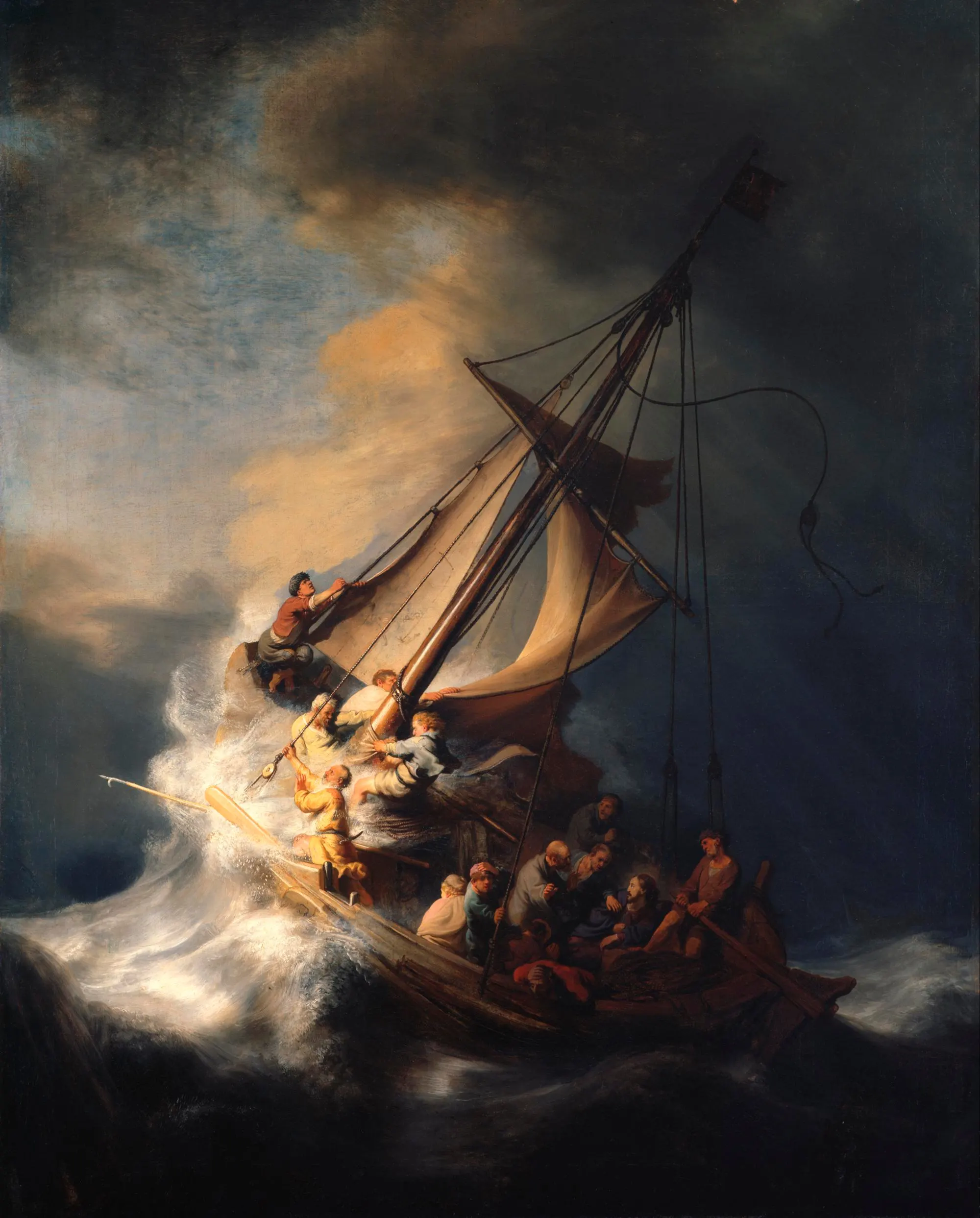
the boat was in the middle of the sea: About the fourth watch of the night, the hour before dawn, He came walking on the sea, though He intended to pass by them. Walking on the water shows the same authority that had stilled the sea in the earlier storm.
Mark 6:47
“And when even was come,.... The second evening, and it was properly night: the ship was in the midst of the sea; of Galilee, about twenty five or thirty furlongs from the shore; see Joh 6:19; and he alone on the land; upon the mountain.”
3 more voices on this verse
Mark 6:47
“It had come even when the disciples embarked (Mt 14:23; Joh 6:16). the ship was in the midst of the sea, and he alone on the land--John says (Joh 6:17), "It was now dark, and Jesus was not come to them." Perhaps they made no great effort to push across at first, having a lingering hope that their Master would yet join them, and so allowed the darkness to come on.”
Jamieson, Fausset & Brown · Commentary Critical and Explanatory on the Whole Bible (1871)reformed
Mark 6:47
“Now the Lord permitted His disciples to be in danger, that they might learn patience; wherefore He did not immediately come to their aid, but allowed them to remain in danger all night, that He might teach them to wait patiently, and not to hope at once for help in tribulations. For there follows, And he saw them toiling in rowing, for the wind was contrary unto them: and about the fourth watch of the night, he cometh unto them walking upon the sea.”
Theophylact of Ohrid · written before 1107 · Catena Aurea by Aquinaspatristic
Mark 6:47
“The event first recorded in these verses, is a beautiful emblem of the position of all believers, between the first and second advents of Jesus Christ. Like the disciples, we are now tossed to and fro by storms, and do not enjoy the visible presence of our Lord. Like the disciples, we shall see our Lord face to face again, though it may be a time of great extremity, when He returns. Like the disciples, we shall see all things changed for the better, when our Master comes to us. We shall no longer be buffeted by storms.”
About the fourth watch of the night: Jamieson, Fausset and Brown explain that the Jews once divided the night into three watches and later took up the Roman four. Jesus saw the struggle from the mountain, they add, yet waited for his own time. Augustine says he walked a different course, like a stranger.
Mark 6:48
“He "saw" this from His mountain top, and through the darkness of the night, for His heart was all with them: yet would He not go to their relief till His own time came. and about the fourth watch of the night--The Jews, who used to divide the night into three watches, latterly adopted the Roman division into four watches, as here.”
Jamieson, Fausset & Brown · Commentary Critical and Explanatory on the Whole Bible (1871)reformed
2 more voices on this verse
Mark 6:48
“The church is often like a ship at sea, tossed with tempests, and not comforted we may have Christ for us, and yet wind and tide against us; but it is a comfort to Christ's disciples in a storm, that their Master is in the heavenly mount, interceding for them. Christ made them a kind visit upon the water.”
Matthew Henry · Commentary on the Whole Bible (1707-1721)puritan
Mark 6:48
“But what is the spiritual nuance of the boat into which Jesus constrained the disciples to enter? Is it perhaps the conflict of temptations and difficulties into which any one is constrained by the Word, and goes unwillingly? The Savior wishes to train by exercise the disciples in this boat which is distressed by the waves and the contrary wind.”
Origen of Alexandria · written before 253 · Commentary on Matthew 11.5patristic
Mark 6:49-50
thinking He was a ghost—: When they saw Him walking on the sea, they cried out, thinking He was a ghost. Jesus spoke up at once, and His phrase It is I is in the Greek I am, the form used for the divine name.
Mark 6:49
“But when they saw him walking upon the sea, they supposed it had been a spirit, and cried out--"for fear" (Mt 14:26). He would appear to them at first like a dark moving speck upon the waters; then as a human figure; but in the dark tempestuous sky, and not dreaming that it could be their Lord, they take it for a spirit.”
Jamieson, Fausset & Brown · Commentary Critical and Explanatory on the Whole Bible (1871)reformed
John Chrysostom notes that the disciples knew him by his voice, and their fear left them. Matthew Henry hears in these words the voice of their Master, friend and Redeemer. Christ near, he says, is cheer enough in a storm.
Mark 6:51-52
the wind died down: Mark gives the reason without flattery to the Twelve: they had not understood about the loaves, but their hearts had been hardened. Their slowness is set down as hardening, more than forgetfulness.
Mark 6:51
"And immediately," adds the beloved disciple, "they were at the land whither they went," or "were bound." This additional miracle, for as such it is manifestly related, is recorded by the fourth Evangelist alone.
Jamieson, Fausset & Brown · Commentary Critical and Explanatory on the Whole Bible (1871)reformed
they had not understood about the loaves: Jamieson, Fausset and Brown explain the link. Had the disciples reflected on the loaves, multiplied a few hours before, nothing he did afterward would have astonished them. John Gill calls the feeding as much an act of almighty power as the walking on the water.
Mark 6:52
“For they considered not the miracle of the loaves,.... Which they had seen but the day before; they did not attend to it, nor learn from it, as they might, the wonderful glory of Christ, and the greatness of his power; which was as much an act of omnipotence, as either his walking upon the water, or causing the wind to cease, or more so. For their heart was hardened; or "blinded"; not by sin, or against Christ, much less in a judicial way: but there was a great deal of dulness and stupidity, and want of attention in them.”
3 more voices on this verse
Mark 6:52
“See this passage explained in the notes at Mat 14:22-36. Mar 6:52 They considered not the miracle of the loaves - They did not remember or call to mind the “power” which Jesus had shown in feeding the five thousand by a miracle, and that, having done that, he had power also to save them from the storm. Their heart was hardened - Their “mind” was dull to perceive it. This does not mean that they were “opposed” to Jesus, or that they had what we denominate “hardness of heart,” but simply that they were slow to perceive his power.”
Mark 6:52
“Let us, with deep attention, consider the miracle of the loaves lest we fall into the same evil as that which happened to the disciples in the text. When they saw Jesus walking on the sea, "they were sore amazed in themselves and wondered: for they considered not the miracle of the loaves, for their heart was hardened." Hard hearts and painful unbeliefs spring up in the waste places where we bury our forgotten mercies. The miracles of our Lord Jesus Christ ought to be considered.”
Mark 6:52
“For they considered not the miracle of the loaves; for their heart was hardened--What a singular statement! The meaning seems to be that if they had but "considered [reflected upon] the miracle of the loaves," wrought but a few hours before, they would have wondered at nothing which He might do within the whole circle of power and grace.”
Jamieson, Fausset & Brown · Commentary Critical and Explanatory on the Whole Bible (1871)reformed
Mark 6:53-54
they landed at Gennesaret and moored the boat: The crossing lands them at Gennesaret, though Jesus had sent them on ahead to Bethsaida, a night that went differently than planned. As soon as they got out of the boat, the people recognized Jesus in a district that knew Him well by now.
Mark 6:53
“And when they had passed over,.... The lake of Gennesaret, or sea of "Galilee", they came into the land of Gennesaret; See Gill on Mat 14:34; to Capernaum, as appears from Joh 6:17 for Capernaum was in the land of Gennesaret; to which agrees what Josephus says, that the land of Gennesaret was watered with a very excellent spring, which the inhabitants of that place called Capernaum (h): and drew to the shore: this is omitted in the Syriac and Persic versions: and the Arabic reads, "and they cast anchors". (h) De Bello Jud. l. 3. c. 35.”
2 more voices on this verse
Mark 6:53
“The land of Gennesaret - This country lay on the coast of the sea of Galilee: it is described by Josephus as being exceedingly pleasant and fertile. It had its name of Gennesaret from גן, gen, a garden, and סר sar, a prince, either because the king had a garden there, or because of its great fertility.”
Adam Clarke · Commentary on the Bible (1810-1826)evangelical
Mark 6:53
“And when they had passed over, they came into the land of Gennesaret--from which the lake sometimes takes its name, stretching along its western shore. Capernaum was their landing-place (Joh 6:24, 25). and drew to the shore--a nautical phrase, nowhere else used in the New Testament.”
Jamieson, Fausset & Brown · Commentary Critical and Explanatory on the Whole Bible (1871)reformed
the people recognized Jesus: Adam Clarke takes the verb to mean that they recollected him. He had already preached and worked miracles in this district. John Gill notes that several ancient versions name the people here as the inhabitants of that country.
Mark 6:54
“They knew him - Επιγνοντες, They recollected him; for he had before preached and wrought miracles in different places of the same country.”
Adam Clarke · Commentary on the Bible (1810-1826)evangelical
Mark 6:55-56
carrying the sick on mats to wherever they heard He was: They laid the sick in the marketplaces and begged Him to let them touch the fringe of His cloak, as the woman had done earlier. The chapter closes on a summary of a season of healing: all who touched Him were healed.
Mark 6:55
“And ran through that whole region round about,.... That is, the inhabitants of that part of the country where Christ landed, ran many of them themselves, and others sent messengers into all parts of it, on every side: and began to carry about in beds those that were sick; or lame, or so disordered that they could not walk, or bear any other way of being carried: these they brought to him, where they heard he was: in whatsoever part of the country they could learn he was in; for he went about from place to place doing good.”
the fringe of His cloak: Jamieson, Fausset and Brown place this season beside John 7:1, when Jesus stayed in Galilee because the rulers sought his life. The people meanwhile sought to make him king. Adam Clarke notes that he did good wherever he went, since everywhere people needed his help.
Mark 6:56
“Villages - Probably small towns near cities. Country - Villages at a distance from cities and large public towns. See the notes on Mat 14:34-36 (note). Christ went about doing good - he confined his ministry and miracles to no place - wherever he went, they stood in need of his help; and whenever they required his assistance, they had it granted immediately. Our Lord’s conduct, in these respects, is a perfect pattern for every preacher of his Gospel.”
Adam Clarke · Commentary on the Bible (1810-1826)evangelical
2 more voices on this verse
Mark 6:56
“The Lord of hosts was not signaling weakness as he gave sight to the blind, made the crooked to stand upright, raised the dead to life, anticipated the effects of medicine at our prayers, and cured those who sought after him. Those who merely touched the fringe of his robe were healed. Surely you did not think it was some divine weakness, you speculators, when you saw him wounded. Indeed there were wounds that pierced his body, but they did not demonstrate weakness but strength.”
Ambrose of Milan · written before 397 · Exposition of the Christian Faith 4.5.54-55patristic
Mark 6:56
“The time corresponds to that mentioned (Joh 7:1), when He "walked in Galilee," instead of appearing in Jerusalem at the passover, "because the Jews," that is, the rulers, "sought to kill Him"--while the people sought to enthrone Him!”
Jamieson, Fausset & Brown · Commentary Critical and Explanatory on the Whole Bible (1871)reformed
Keep studying
Studies11
People and groups1
Sources for this chapter
The summary
Jamieson, Fausset & Brown, Commentary Critical and Explanatory; John Calvin, Commentaries; John Wesley, Explanatory Notes Upon the New Testament and Matthew Henry, Complete Commentary.
The exposition
Adam Clarke, Commentary on the Bible; Albert Barnes; Alexander Maclaren, Expositions of Holy Scripture, Mark; Ambrose of Milan; Augustine of Hippo; Charles Spurgeon; Gregory of Nazianzus, ORATION 30, ON THE SON 10-11; Gregory the Dialogist, Catena Aurea by Aquinas; J. C. Ryle, Expository Thoughts on the Gospels, Mark; Jamieson, Fausset & Brown, Commentary Critical and Explanatory on the Whole Bible; John Chrysostom; John Gill; John Lightfoot, Horae Hebraicae et Talmudicae; John Wesley, Explanatory Notes upon the New Testament; Matthew Henry, Commentary on the Whole Bible; Origen of Alexandria, COMMENTARY ON MATTHEW 10.19 and Theophylact of Ohrid.