
Mark 6:46
in Mark 6After bidding them farewell, He went up on the mountain to pray.
BSB
The same verse in ASV and KJV ▾
ASV
And after he had taken leave of them, he departed into the mountain to pray.
KJV
And when he had sent them away, he departed into a mountain to pray.
⋯
This verse in Mark 6
Commentary
12 notes on this verse(in Marc. 2, 28) Not every man, however, who prays goes up into a mountain, but he alone prays well, who seeks God in prayer. But he who prays for riches or worldly labour, or for the death of his enemy, sends up from the lowest depths his vile prayers to God. John says, When Jesus therefore perceived that they would come and take him by force and make him a king, he departed again into a mountain himself alone.
The record, by era
The Church Fathers1 voice
(Vict. Ant. e Cat. in Marc.) This we must understand of Christ, in that He is man; He does it also to teach us to be constant in prayer.
The Medieval Church3 voices
But when He had dismissed the crowd, He goes up to pray, for prayer requires rest and silence.
And when he dismissed them, he went into the mountain to pray. Not everyone who prays ascends into the mountain; for there is prayer that commits sin. But he who prays well, who seeks God by praying, this one, progressing from earthly things to higher …
And He, having dismissed the crowd, goes up to the mountain to pray alone, since prayer requires solitude and an undisturbed state.
The Puritans and the Awakening1 voice
And when he had sent them away,.... Either his disciples, or rather the multitude: he departed into a mountain to pray: after his disciples were gone, and he had dismissed the people, he went from the desert where he had been, up into a mountain; being a retired place, to spend some time in private prayer to God; See Gill on Mat 14:23.
6 more voices on this verse
The Puritans and the Awakening1 voice
Christ makes a visit to his own country, the place not of his birth, but of his education; that was Nazareth; where his relations were. He had been in danger of his life among them ( Luke iv. 29 ), and yet he came among them again; so strangely doth he wait to be gracious, and seek the salvation of his enemies.
The Nineteenth Century4 voices
A commentator
Charles Spurgeon1834–1892
The Metropolitan Tabernacle Pulpit, Sermon No. 3128: “Good Cheer From Christ's Real Presence” (lightly modernized text, CCEL edition) · Written before 1892.
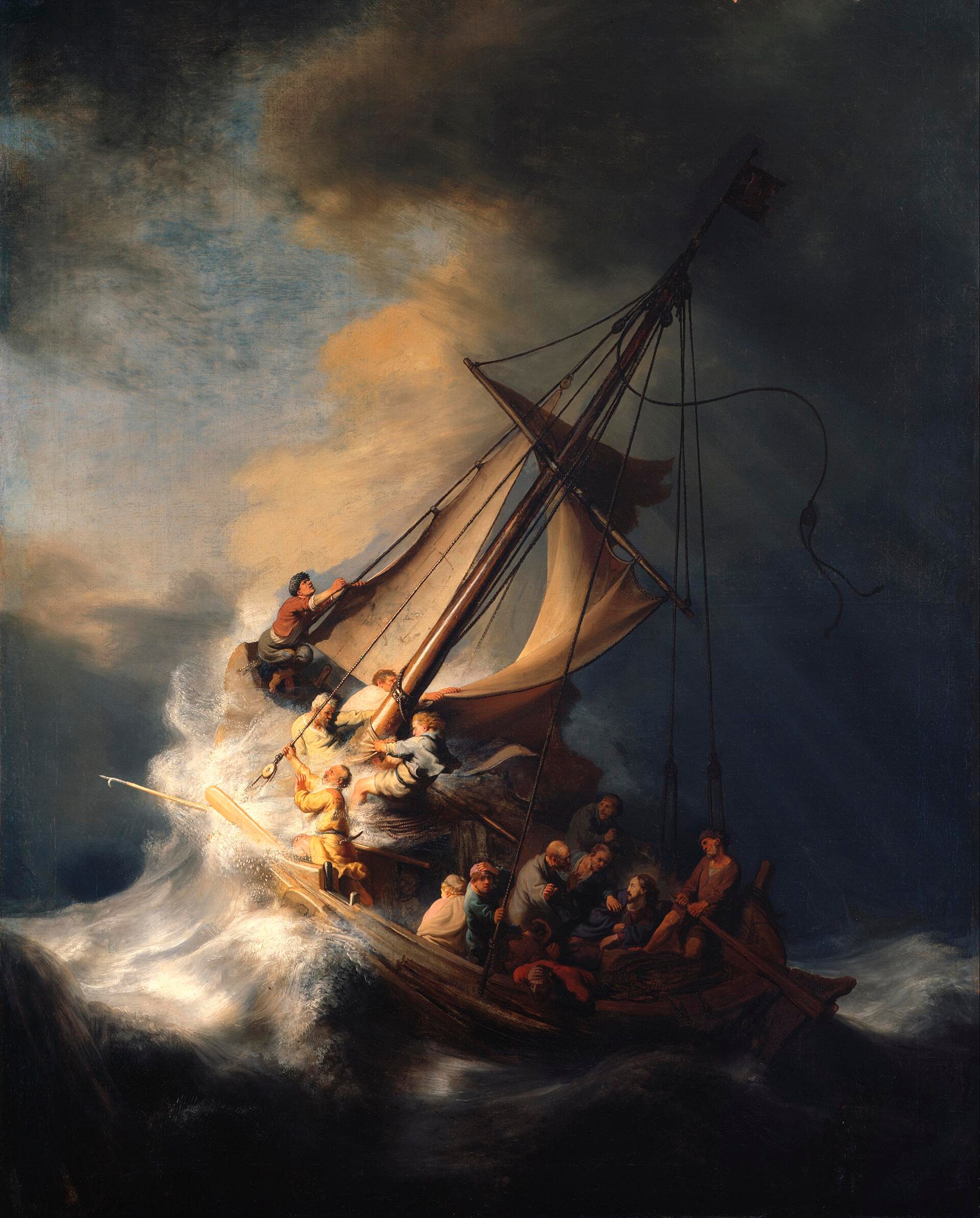
WE have here a word of comfort given to a shipload of Believers who were where their Lord had sent them. They had been unwilling to put out to sea, though it was probably calm enough at the time, but they did not wish to leave the Lord Jesus. He constrained them to go and thus their sailing was not merely under His sanction, but by His express command. They were in their right place and yet they met with a terrible storm.
A commentator
J.C. Ryle1816–1900
Expository Thoughts on the Gospels: Mark (lightly modernized text, Grace Gems edition) (1857)
proposed
Of all our Lord Jesus Christ's miracles, none is so frequently described in the Gospels, as that which we have now read. Each of the four Evangelists was inspired to record it. It is evident that it demands a more than ordinary attention from every reader of God's word. Let us observe, for one thing, in this passage, what an example this miracle affords of our Lord Jesus Christ's almighty POWER . We are told that He fed five thousand men, with five loaves and two fish. We are distinctly told that this multitude had nothing to eat. We are no less distinctly told that the whole provision for their sustenance consisted of only five loaves and two fish. And yet we read that our Lord took these loaves and fish, blessed, broke, and gave them to His disciples to set before the people. And the conclusion of the narrative tells us, that "they ate, and were filled," and that "twelve baskets full of fragments" were taken up. Here was creative power, beyond all question. Something real, solid, substantial, must manifestly have been called into being, which did not before exist. There is no room left for the theory, that the people were under the influence of an optical delusion, or a heated imagination. Five thousand hungry people would never have been satisfied, if they had not received into their mouths material bread. Twelve baskets full of fragments would never have been taken up, if the five loaves had not been miraculously multiplied. In short, it is plain that the hand of Him who made the world out of nothing was present on this occasion. None but He who at the first created all things, and sent down manna in the desert, could thus have "spread a table in the wilderness." It becomes all true Christians to store up facts like these in their minds, and to remember them in time of need. We live in the midst of an evil world, and see few with us, and many against us.
A commentator
Charles Spurgeon1834–1892
The Metropolitan Tabernacle Pulpit, Sermon No. 3128: “Good Cheer From Christ's Real Presence” (lightly modernized text, CCEL edition) · Written before 1892.
proposed
WE have here a word of comfort given to a shipload of Believers who were where their Lord had sent them. They had been unwilling to put out to sea, though it was probably calm enough at the time, but they did not wish to leave the Lord Jesus. He constrained them to go and thus their sailing was not merely under His sanction, but by His express command. They were in their right place and yet they met with a terrible storm. The little inland sea upon which they sailed lies in a deep hollow and from the shore there pours a sudden downdraft of tremendous wind for which it is not possible to be prepared. By one of these whirlwinds the whole sea was stirred up to boiling, as only those little lakes can be. So, though they were where Jesus bade them go, they were in desperate peril, and you, dear Friends, must not think that you are in a wrong position because you are in trouble. Do not consider that adverse circumstances are a proof that you have missed your road, for they may even be an evidence that you are in the good old way since the path of Believers is seldom without trial. You did well to embark and to leave the shore, but remember, though your Lord has insured the vessel and guaranteed that you shall reach your haven, He has not promised that you shall sail over a sea of glass. On the contrary, He has told you that "in the world you shall have tribulation"—and you may all the more confidently believe in Him because you find His warning to be true! Their Lord had bid His disciples make for the other side and, therefore, they did their best and continued rowing all night, but making no progress whatever because the wind was dead against them. It was with difficulty that they could keep what little way they had made and not be blown back again to the starting place.
A commentator
J.C. Ryle1816–1900
Expository Thoughts on the Gospels: Mark (lightly modernized text, Grace Gems edition) (1857)
proposed
Of all our Lord Jesus Christ's miracles, none is so frequently described in the Gospels, as that which we have now read. Each of the four Evangelists was inspired to record it. It is evident that it demands a more than ordinary attention from every reader of God's word. Let us observe, for one thing, in this passage, what an example this miracle affords of our Lord Jesus Christ's almighty POWER . We are told that He fed five thousand men, with five loaves and two fish. We are distinctly told that this multitude had nothing to eat.
Modern Voices1 voice
The tremendous figure which fills the Gospels towers in this respect, as in every other, above all the thinkers who ever thought themselves tall. His pathos was natural, almost casual. The Stoics, ancient and modern, were proud of concealing their tears. He never concealed His …
The words behind it
8 Greek wordsEvery Greek word of this verse in the order it stands, with what it means and the door to its own study. The last column counts the times a word stands in the whole Bible: the rarer the word, the more the places it appears belong together.
| Greek | Sound | Meaning | Word study | In the Bible |
|---|---|---|---|---|
| καὶ | kai | And | G2532 → | 9120 times |
| ἀποταξάμενος | apotaxamenos | having taken leave | G657 → | |
| αὐτοῖς | autois | of them | G846 → | 5565 times |
| ἀπῆλθεν | apelthen | He departed | G565 → | 115 times |
| εἰς | eis | into | G1519 → | 1755 times |
| τὸ | to | the | G3588 → | 19766 times |
| ὄρος | oros | mountain | G3735 → | 62 times |
| προσεύξασθαι.¶ | proseuxasthai | to pray. | G4336 → | 85 times |
καὶAnd
kaiG2532 →9120 times
ἀποταξάμενοςhaving taken leave
apotaxamenosG657 →
αὐτοῖςof them
autoisG846 →5565 times
ἀπῆλθενHe departed
apelthenG565 →115 times
εἰςinto
eisG1519 →1755 times
τὸthe
toG3588 →19766 times
ὄροςmountain
orosG3735 →62 times
προσεύξασθαι.¶to pray.
proseuxasthaiG4336 →85 times
A shaded row is a word that stands 400 times or fewer in the Bible.
The walk
8 stopsEach card is a verse this one points to, and under it the verses that one points to in turn. Where several paths arrive at the same place, that place is listed first: the text keeps returning to it.
Through
Mark 1:35Early in the morning, while it was still dark, Jesus got up and slipped out to a solitary place to pray.
it leads to
Through
Matthew 6:6But when you pray, go into your inner room, shut your door, and pray to your Father, who is unseen. And your Father, who sees what is done in secret, will reward you.
it leads to
- 2 Kings 4:33
So he went in, closed the door behind the two of them, and prayed to the LORD.
- Matthew 14:23
After He had sent them away, He went up on the mountain by Himself to pray. When evening came, He was there alone,
- Isaiah 65:24
Even before they call, I will answer, and while they are still speaking, I will hear.
- Acts 9:40
Then Peter sent them all out of the room. He knelt down and prayed, and turning toward her body, he said, “Tabitha, get up!” She opened her eyes, and seeing Peter, she sat up.
- Psalms 34:15
The eyes of the LORD are on the righteous, and His ears are inclined to their cry.
- 2 Kings 4:33
Through
1 Peter 2:21For to this you were called, because Christ also suffered for you, leaving you an example, that you should follow in His footsteps:
it leads to
- 1 John 2:6
Whoever claims to abide in Him must walk as Jesus walked.
- 1 John 2:6
Where this verse is studied
On this page
Studies3
On this verse
On this chapter
About Mark
This page draws on 10 works. Open the list of works
This page draws on Bede, Catena Aurea by Aquinas; Bede, On the Gospel of Mark; Charles Spurgeon, The Metropolitan Tabernacle Pulpit, Sermon No. 3128: “Good Cheer From Christ's Real Presence” (lightly modernized text, CCEL edition); GK Chesterton, Orthodoxy, Ch. 9: Authority and the Adventurer (1908); J.C. Ryle, Expository Thoughts on the Gospels: Mark (lightly modernized text, Grace Gems edition); John Gill, Exposition of the New Testament (1746-1748); Matthew Henry, Commentary on the Whole Bible; Pseudo-Chrysostom, Catena Aurea by Aquinas; Theophylact of Ohrid, Catena Aurea by Aquinas and Theophylact of Ohrid, Commentary on Mark.