
Mark 6:53
in Mark 6When they had crossed over, they landed at Gennesaret and moored the boat.
BSB
The same verse in ASV and KJV ▾
ASV
And when they had crossed over, they came to the land unto Gennesaret, and moored to the shore.
KJV
And when they had passed over, they came into the land of Gennesaret, and drew to the shore.
⋯
This verse in Mark 6
Commentary
9 notes on this verseAnd when they had passed over,.... The lake of Gennesaret, or sea of "Galilee", they came into the land of Gennesaret; See Gill on Mat 14:34; to Capernaum, as appears from Joh 6:17 for Capernaum was in the land of Gennesaret; to which agrees what Josephus says, that the land of Gennesaret was watered with a very excellent spring, which the inhabitants of that place called Capernaum (h): and drew to the shore: this is omitted in the Syriac and Persic versions: and the Arabic reads, "and they cast anchors". (h) De Bello Jud. l. 3. c. 35.
The record, by era
The Medieval Church3 voices
When they had disembarked from the boat, they immediately recognized him: And running through that whole region, they began to carry those who were ill on mats to wherever they heard he was. They recognized him by reputation, not by face: or certainly because of …
The Lord arrived at this place, it seems, after no small time (of absence); therefore the evangelist also says: "when they recognized Him... they began to bring the sick." They did not yet invite Him into their homes, but themselves brought the sick, beseeching to …
(non occ.) The Evangelist, having shown the danger which the disciples had sustained in their passage, and their deliverance from it, now shows the place to which they sailed, saying, And when they had passed over, they came into the land of Gennesaret, and drew to the shore.
The Puritans and the Awakening1 voice
Christ makes a visit to his own country, the place not of his birth, but of his education; that was Nazareth; where his relations were. He had been in danger of his life among them ( Luke iv. 29 ), and yet he came among them again; so strangely doth he wait to be gracious, and seek the salvation of his enemies.
The Nineteenth Century1 voice
The land of Gennesaret - This country lay on the coast of the sea of Galilee: it is described by Josephus as being exceedingly pleasant and fertile. It had its name of Gennesaret from גן, gen, a garden, and סר sar, a prince, either because the king had a garden there, or because of its great fertility.
3 more voices on this verse
The Nineteenth Century3 voices
A commentator
J.C. Ryle1816–1900
Expository Thoughts on the Gospels: Mark (lightly modernized text, Grace Gems edition) (1857)
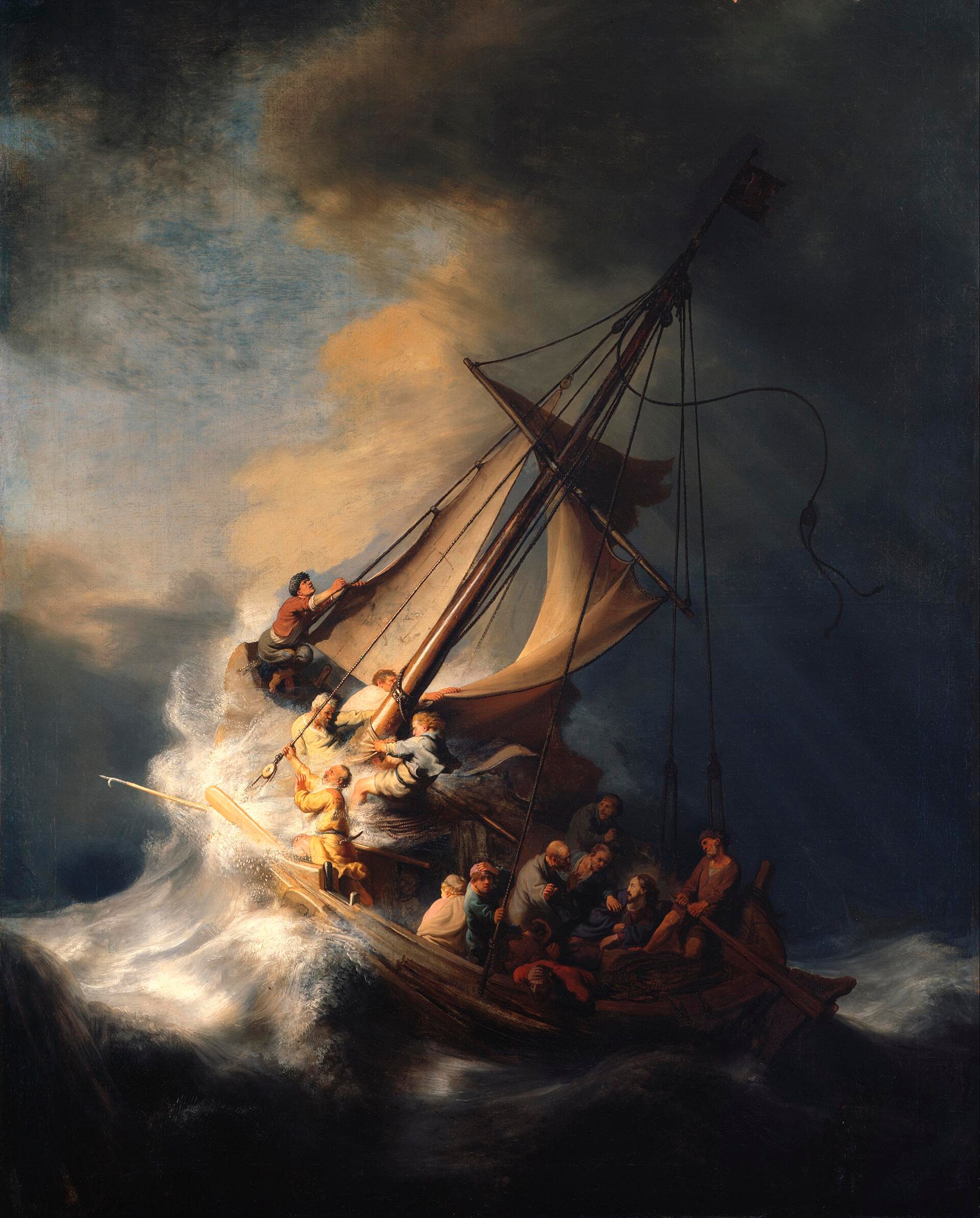
The event first recorded in these verses, is a beautiful emblem of the position of all believers, between the first and second advents of Jesus Christ. Like the disciples, we are now tossed to and fro by storms, and do not enjoy the visible presence of our Lord. Like the disciples, we shall see our Lord face to face again, though it may be a time of great extremity, when He returns. Like the disciples, we shall see all things changed for the better, when our Master comes to us. We shall no longer be buffeted by storms.
A commentator
Jamieson, Fausset & Brown1802–1910
Commentary Critical and Explanatory on the Whole Bible (1871)
And when they had passed over, they came into the land of Gennesaret--from which the lake sometimes takes its name, stretching along its western shore. Capernaum was their landing-place (Joh 6:24, 25). and drew to the shore--a nautical phrase, nowhere else used in the New Testament.
A commentator
J.C. Ryle1816–1900
Expository Thoughts on the Gospels: Mark (lightly modernized text, Grace Gems edition) (1857)
proposed
The event first recorded in these verses, is a beautiful emblem of the position of all believers, between the first and second advents of Jesus Christ. Like the disciples, we are now tossed to and fro by storms, and do not enjoy the visible presence of our Lord. Like the disciples, we shall see our Lord face to face again, though it may be a time of great extremity, when He returns. Like the disciples, we shall see all things changed for the better, when our Master comes to us. We shall no longer be buffeted by storms. There will be a great calm. There is nothing fanciful in such an application of the passage. We need not doubt that there is a deep meaning in every step of His life, who was "God manifest in the flesh." For the present, however, let us confine ourselves to the plain, practical lessons which these verses contain. Let us notice, in the first place, how our Lord sees the troubles of His believing people, and in due time will help them . We read that when "the ship was in the midst of the sea, and He alone on the land," He "saw His disciples toiling in rowing" came to them walking on the sea — cheered them with the gracious words, "It is I, be not afraid" and changed the storm into a calm. There are thoughts of comfort here for all true believers. Wherever they may be, or whatever their circumstances, the Lord Jesus sees them. Alone, or in company — in sickness or in health — by sea or by land — in perils in the city — in perils in the wilderness — the same eye which saw the disciples tossed on the lake, is ever looking at us. We are never beyond the reach of His care. Our way is never hidden from Him. He knows the path that we take, and is still able to help. He may not come to our aid at the time we like best, but He will never allow us utterly to fail. He who walked upon the water never changes.
The words behind it
10 Greek wordsEvery Greek word of this verse in the order it stands, with what it means and the door to its own study. The last column counts the times a word stands in the whole Bible: the rarer the word, the more the places it appears belong together.
| Greek | Sound | Meaning | Word study | In the Bible |
|---|---|---|---|---|
| Καὶ | kai | And | G2532 → | 9120 times |
| διαπεράσαντες | diaperasantes | having passed over | G1276 → | |
| ἐπὶ | epi | to | G1909 → | 883 times |
| τὴν | ten | the | G3588 → | 19766 times |
| γῆν | gen | land | G1093 → | 248 times |
| ἦλθον | elthon | they came | G2064 → | 628 times |
| εἰς | eis | to | G1519 → | 1755 times |
| Γεννησαρὲτ | gennesaret | Gennesaret | G1082 → | |
| καὶ | kai | and | G2532 → | 9120 times |
| προσωρμίσθησαν. | prosormisthesan | drew to shore. | G4358 → |
ΚαὶAnd
kaiG2532 →9120 times
διαπεράσαντεςhaving passed over
diaperasantesG1276 →
ἐπὶto
epiG1909 →883 times
τὴνthe
tenG3588 →19766 times
γῆνland
genG1093 →248 times
ἦλθονthey came
elthonG2064 →628 times
εἰςto
eisG1519 →1755 times
ΓεννησαρὲτGennesaret
gennesaretG1082 →
καὶand
kaiG2532 →9120 times
προσωρμίσθησαν.drew to shore.
prosormisthesanG4358 →
A shaded row is a word that stands 400 times or fewer in the Bible.
The walk
5 stopsEach card is a verse this one points to, and under it the verses that one points to in turn. Where several paths arrive at the same place, that place is listed first: the text keeps returning to it.
Through
Luke 5:1On one occasion, while Jesus was standing by the Lake of Gennesaret with the crowd pressing in on Him to hear the word of God,
it leads to
- Mark 1:16–20
As Jesus was walking beside the Sea of Galilee, He saw Simon and his brother Andrew. They were casting a net into the sea, for they were fishermen.
- Matthew 4:18–22
As Jesus was walking beside the Sea of Galilee, He saw two brothers, Simon called Peter and his brother Andrew. They were casting a net into the sea, for they were fishermen.
- Mark 3:9
Jesus asked His disciples to have a boat ready for Him so that the crowd would not crush Him.
- Matthew 14:34
When they had crossed over, they landed at Gennesaret.
- Joshua 12:3
as well as the Arabah east of the Sea of Chinnereth to the Sea of the Arabah (the Salt Sea), eastward through Beth-jeshimoth, and southward below the slopes of Pisgah.
- Mark 1:16–20
Where this verse is studied
On this page
Studies3
On this verse
On this chapter
About Mark
This page draws on Adam Clarke, Commentary on the Bible; Bede, On the Gospel of Mark; Glossa Ordinaria, Catena Aurea by Aquinas; J.C. Ryle, Expository Thoughts on the Gospels: Mark (lightly modernized text, Grace Gems edition); Jamieson, Fausset & Brown, Commentary Critical and Explanatory on the Whole Bible; John Gill, Exposition of the New Testament (1746-1748); Matthew Henry, Commentary on the Whole Bible and Theophylact of Ohrid, Commentary on Mark.