
Mark 6:48
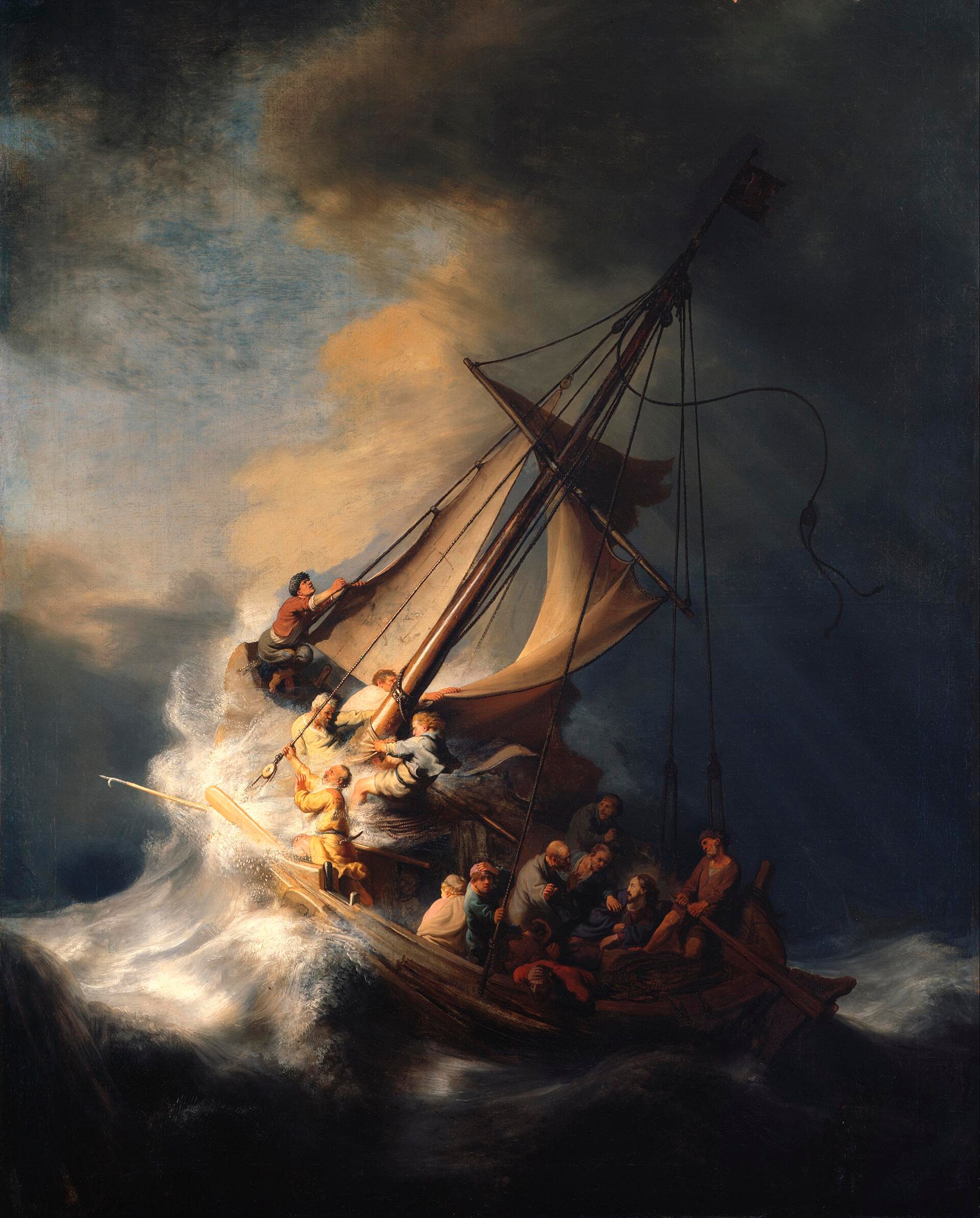
in Mark 6He could see that the disciples were straining to row, because the wind was against them. About the fourth watch of the night, Jesus went out to them, walking on the sea. He intended to pass by them,
BSB
The same verse in ASV and KJV ▾
ASV
And seeing them distressed in rowing, for the wind was contrary unto them, about the fourth watch of the night he cometh unto them, walking on the sea; and he would have passed by them:
KJV
And he saw them toiling in rowing; for the wind was contrary unto them: and about the fourth watch of the night he cometh unto them, walking upon the sea, and would have passed by them.
⋯
This verse in Mark 6
Commentary
21 notes on this verseBut what is the spiritual nuance of the boat into which Jesus constrained the disciples to enter? Is it perhaps the conflict of temptations and difficulties into which any one is constrained by the Word, and goes unwillingly? The Savior wishes to train by exercise the disciples in this boat which is distressed by the waves and the contrary wind.
The record, by era
The Church Fathers3 voices
(de Con. Evan. 2. 47) But how could they understand this, except from His going a different way, wishing to pass them as strangers; for they were so far from recognising Him, as to take Him for a spirit. For it goes on: But when they saw him walking upon the sea, they supposed it had been a spirit, and cried out. (ubi sup.) How then could He wish to pass them, whose fears He so reassures, if it were not that His wish to pass them would wring from them that cry, which called for His help?
(Vict. Ant. e Cat. in Marc.) Holy Scripture reckons four watches in the night, making each division three hours; wherefore by the fourth watch it means that which is after the ninth hour, that is, in the tenth or some following hour. There follows, And would have passed them. (Vict. Ant. e Cat. in Marc.) Or else, the first watch means the time up to the deluge; the second, up to Moses; the third, up to the coming of the Lord; in the fourth the Lord came and spoke to His disciples.
Simon, surnamed Peter, Chief disciple of Christ the Lord, On a day at the set of sun When the evening sky grows red, Unloosed his anchor's hook, And filled his sails with the swelling winds, And made ready to cross the sea. But night roused …
The Medieval Church2 voices
Now the Lord permitted His disciples to be in danger, that they might learn patience; wherefore He did not immediately come to their aid, but allowed them to remain in danger all night, that He might teach them to wait patiently, and not to hope at once for help in tribulations. For there follows, And he saw them toiling in rowing, for the wind was contrary unto them: and about the fourth watch of the night, he cometh unto them walking upon the sea.
It can also be asked why, when the disciples were laboring on the sea, the Lord stood on the shore after His resurrection, though before His resurrection He had walked on the waves of the sea before His disciples. The reason for this matter is quickly understood if the cause that was then present is considered. For what does the sea signify except the present age, which dashes itself against the tumults of affairs and the waves of corruptible life? What is figured by the solidity of the shore except that perpetuity of eternal rest? Because the disciples were still amid the waves of mortal life, they were laboring on the sea. But because our Redeemer had already passed beyond the corruption of the flesh, after His resurrection He was standing on the shore.
15 more voices on this verse
The Medieval Church7 voices
(ubi sup.) The disciples indeed, who were still carnal, were amazed at the greatness of His virtue, they could not yet however recognise in Him the truth of the Divine Majesty. Wherefore it goes on, For their hearts were hardened. But mystically, the toil of the disciples in rowing, and the contrary wind, mark out the labours of the Holy Church, who amidst the beating waves of the world, and the blasts of unclean spirits, strives to reach the repose of her celestial country. And well is it said that the ship was in the midst of the sea, and He alone on land, for sometimes the Church is afflicted by a pressure from the Gentiles so overwhelming, that her Redeemer seems to have entirely deserted her. But the Lord sees His own, toiling on the sea, for, lest they faint in tribulations, He strengthens them by the look of His love, and sometimes frees them by a visible assistance. Further, in the fourth watch He came to them as daylight approached, for when man lifts up his mind to the light of guidance from on high, the Lord will be with him, and the dangers of temptations will be laid asleep.
The Lord allows the disciples to be storm-tossed on the sea so that they might learn patience. For the same reason He does not appear to them immediately either, but allows them to be in danger from the storm the whole night, in order to …
They struggle through the entire dark time of the night, but as dawn approaches and the morning star promises the rise of the sun and day, the Lord comes, walking over, and subdues the swelling waves of the sea. For when human frailty, beset with …
And he wanted to pass them by. But when they saw him walking on the sea, they thought he was a ghost, and they cried out. For they all saw him and were troubled. Even now heretics think the Lord was a ghost and did …
(ubi sup.) Buty Theodorus, who was Bishop of Phanara, wrote that the Lord had no bodily weight in His flesh, and walked on the sea without weight; but the Catholic faith declares that He had weight according to the flesh. For Dionysius says, We know not how without plunging in His feet, which had bodily weight and the gravity of matter, He could walk on the wet and unstable subtance.
(ubi sup.) Often then does the love of heaven seem to have deserted the faithful in tribulation, so that it may be thought that Jesus wishes to pass by His disciples, as it were, toiling in the sea. And still do heretics suppose that the Lord was a phantom, and did not take upon Him real flesh from the Virgin1.
And in the fourth watch of the night He came to them, walking on the sea. Military stations and watches are divided into periods of three hours each. Therefore, when it says that the Lord came to them in the fourth watch of the night, …
The Puritans and the Awakening3 voices
The church is often like a ship at sea, tossed with tempests, and not comforted we may have Christ for us, and yet wind and tide against us; but it is a comfort to Christ's disciples in a storm, that their Master is in the heavenly mount, interceding for them. Christ made them a kind visit upon the water.
And he saw them toiling in rowing,....
Christ makes a visit to his own country, the place not of his birth, but of his education; that was Nazareth; where his relations were. He had been in danger of his life among them ( Luke iv. 29 ), and yet he came among them again; so strangely doth he wait to be gracious, and seek the salvation of his enemies.
The Nineteenth Century5 voices
A commentator
J.C. Ryle1816–1900
Expository Thoughts on the Gospels: Mark (lightly modernized text, Grace Gems edition) (1857)
The event first recorded in these verses, is a beautiful emblem of the position of all believers, between the first and second advents of Jesus Christ. Like the disciples, we are now tossed to and fro by storms, and do not enjoy the visible presence of our Lord. Like the disciples, we shall see our Lord face to face again, though it may be a time of great extremity, when He returns. Like the disciples, we shall see all things changed for the better, when our Master comes to us. We shall no longer be buffeted by storms.
A commentator
Charles Spurgeon1834–1892
The Metropolitan Tabernacle Pulpit, Sermon No. 3128: “Good Cheer From Christ's Real Presence” (lightly modernized text, CCEL edition) · Written before 1892.
WE have here a word of comfort given to a shipload of Believers who were where their Lord had sent them. They had been unwilling to put out to sea, though it was probably calm enough at the time, but they did not wish to leave the Lord Jesus. He constrained them to go and thus their sailing was not merely under His sanction, but by His express command. They were in their right place and yet they met with a terrible storm.
A commentator
Jamieson, Fausset & Brown1802–1910
Commentary Critical and Explanatory on the Whole Bible (1871)
He "saw" this from His mountain top, and through the darkness of the night, for His heart was all with them: yet would He not go to their relief till His own time came. and about the fourth watch of the night--The Jews, who used to divide the night into three watches, latterly adopted the Roman division into four watches, as here.
A commentator
J.C. Ryle1816–1900
Expository Thoughts on the Gospels: Mark (lightly modernized text, Grace Gems edition) (1857)
proposed
The event first recorded in these verses, is a beautiful emblem of the position of all believers, between the first and second advents of Jesus Christ. Like the disciples, we are now tossed to and fro by storms, and do not enjoy the visible presence of our Lord. Like the disciples, we shall see our Lord face to face again, though it may be a time of great extremity, when He returns. Like the disciples, we shall see all things changed for the better, when our Master comes to us. We shall no longer be buffeted by storms. There will be a great calm. There is nothing fanciful in such an application of the passage. We need not doubt that there is a deep meaning in every step of His life, who was "God manifest in the flesh." For the present, however, let us confine ourselves to the plain, practical lessons which these verses contain. Let us notice, in the first place, how our Lord sees the troubles of His believing people, and in due time will help them . We read that when "the ship was in the midst of the sea, and He alone on the land," He "saw His disciples toiling in rowing" came to them walking on the sea — cheered them with the gracious words, "It is I, be not afraid" and changed the storm into a calm. There are thoughts of comfort here for all true believers. Wherever they may be, or whatever their circumstances, the Lord Jesus sees them. Alone, or in company — in sickness or in health — by sea or by land — in perils in the city — in perils in the wilderness — the same eye which saw the disciples tossed on the lake, is ever looking at us. We are never beyond the reach of His care. Our way is never hidden from Him. He knows the path that we take, and is still able to help. He may not come to our aid at the time we like best, but He will never allow us utterly to fail. He who walked upon the water never changes.
A commentator
Charles Spurgeon1834–1892
The Metropolitan Tabernacle Pulpit, Sermon No. 3128: “Good Cheer From Christ's Real Presence” (lightly modernized text, CCEL edition) · Written before 1892.
proposed
WE have here a word of comfort given to a shipload of Believers who were where their Lord had sent them. They had been unwilling to put out to sea, though it was probably calm enough at the time, but they did not wish to leave the Lord Jesus. He constrained them to go and thus their sailing was not merely under His sanction, but by His express command. They were in their right place and yet they met with a terrible storm. The little inland sea upon which they sailed lies in a deep hollow and from the shore there pours a sudden downdraft of tremendous wind for which it is not possible to be prepared. By one of these whirlwinds the whole sea was stirred up to boiling, as only those little lakes can be. So, though they were where Jesus bade them go, they were in desperate peril, and you, dear Friends, must not think that you are in a wrong position because you are in trouble. Do not consider that adverse circumstances are a proof that you have missed your road, for they may even be an evidence that you are in the good old way since the path of Believers is seldom without trial. You did well to embark and to leave the shore, but remember, though your Lord has insured the vessel and guaranteed that you shall reach your haven, He has not promised that you shall sail over a sea of glass. On the contrary, He has told you that "in the world you shall have tribulation"—and you may all the more confidently believe in Him because you find His warning to be true! Their Lord had bid His disciples make for the other side and, therefore, they did their best and continued rowing all night, but making no progress whatever because the wind was dead against them. It was with difficulty that they could keep what little way they had made and not be blown back again to the starting place.
The words behind it
29 Greek wordsEvery Greek word of this verse in the order it stands, with what it means and the door to its own study. The last column counts the times a word stands in the whole Bible: the rarer the word, the more the places it appears belong together.
| Greek | Sound | Meaning | Word study | In the Bible |
|---|---|---|---|---|
| καὶ | kai | And | G2532 → | 9120 times |
| ἰδὼν | idon | seeing | G1492 → | 374 times |
| αὐτοὺς | autous | them | G846 → | 5565 times |
| βασανιζομένους | basanizomenous | straining | G928 → | |
| ἐν | en | in | G1722 → | 2738 times |
| τῷ | to | the | G3588 → | 19766 times |
| ἐλαύνειν, | elaunein | rowing, | G1643 → | |
| ἦν | en | was | G1510 → | 2333 times |
| γὰρ | gar | for | G1063 → | 1039 times |
| ὁ | ho | the | G3588 → | 19766 times |
| ἄνεμος | anemos | wind | G417 → | 31 times |
| ἐναντίος | enantios | contrary | G1727 → | |
| αὐτοῖς, | autois | to them, | G846 → | 5565 times |
| περὶ | peri | About | G4012 → | 332 times |
| τετάρτην | tetarten | [the] fourth | G5067 → | |
| φυλακὴν | phulaken | watch | G5438 → | 47 times |
| τῆς | tes | of the | G3588 → | 19766 times |
| νυκτὸς | nuktos | night | G3571 → | 61 times |
| ἔρχεται | erchetai | He comes | G2064 → | 628 times |
| πρὸς | pros | to | G4314 → | 700 times |
| αὐτοὺς | autous | them | G846 → | 5565 times |
| περιπατῶν | peripaton | walking | G4043 → | 94 times |
| ἐπὶ | epi | on | G1909 → | 883 times |
| τῆς | tes | the | G3588 → | 19766 times |
| θαλάσσης | thalasses | sea | G2281 → | 90 times |
| καὶ | kai | and | G2532 → | 9120 times |
| ἤθελεν | ethelen | He was wishing | G2309 → | 208 times |
| παρελθεῖν | parelthein | to pass by | G3928 → | 29 times |
| αὐτούς.¶ | autous | them. | G846 → | 5565 times |
καὶAnd
kaiG2532 →9120 times
ἰδὼνseeing
idonG1492 →374 times
αὐτοὺςthem
autousG846 →5565 times
βασανιζομένουςstraining
basanizomenousG928 →
ἐνin
enG1722 →2738 times
τῷthe
toG3588 →19766 times
ἐλαύνειν,rowing,
elauneinG1643 →
ἦνwas
enG1510 →2333 times
γὰρfor
garG1063 →1039 times
ὁthe
hoG3588 →19766 times
ἄνεμοςwind
anemosG417 →31 times
ἐναντίοςcontrary
enantiosG1727 →
αὐτοῖς,to them,
autoisG846 →5565 times
περὶAbout
periG4012 →332 times
τετάρτην[the] fourth
tetartenG5067 →
φυλακὴνwatch
phulakenG5438 →47 times
τῆςof the
tesG3588 →19766 times
νυκτὸςnight
nuktosG3571 →61 times
ἔρχεταιHe comes
erchetaiG2064 →628 times
πρὸςto
prosG4314 →700 times
αὐτοὺςthem
autousG846 →5565 times
περιπατῶνwalking
peripatonG4043 →94 times
ἐπὶon
epiG1909 →883 times
τῆςthe
tesG3588 →19766 times
θαλάσσηςsea
thalassesG2281 →90 times
καὶand
kaiG2532 →9120 times
ἤθελενHe was wishing
ethelenG2309 →208 times
παρελθεῖνto pass by
pareltheinG3928 →29 times
αὐτούς.¶them.
autousG846 →5565 times
A shaded row is a word that stands 400 times or fewer in the Bible.
The walk
8 stopsEach card is a verse this one points to, and under it the verses that one points to in turn. Where several paths arrive at the same place, that place is listed first: the text keeps returning to it.
Through
Psalms 104:3laying the beams of His chambers in the waters above, making the clouds His chariot, walking on the wings of the wind.
it leads to
- Amos 9:6
He builds His upper rooms in the heavens and founds His vault upon the earth. He summons the waters of the sea and pours them over the face of the earth. The LORD is…
- 2 Samuel 22:11
He mounted a cherub and flew; He soared on the wings of the wind.
- Psalms 18:10–11
He mounted a cherub and flew; He soared on the wings of the wind.
- Isaiah 19:1
This is the burden against Egypt: Behold, the LORD rides on a swift cloud; He is coming to Egypt. The idols of Egypt will tremble before Him, and the hearts of the Egyptians will…
- Amos 9:6
Through
Job 9:8He alone stretches out the heavens and treads on the waves of the sea.
it leads to
- Isaiah 44:24
Thus says the LORD, your Redeemer who formed you from the womb: “I am the LORD, who has made all things, who alone stretched out the heavens, who by Myself spread out the earth,
- Isaiah 40:22
He sits enthroned above the circle of the earth; its dwellers are like grasshoppers. He stretches out the heavens like a curtain, and spreads them out like a tent to dwell in.
- Psalms 104:2–3
He wraps Himself in light as with a garment; He stretches out the heavens like a tent,
- Isaiah 44:24
Through
Psalms 93:4Above the roar of many waters— the mighty breakers of the sea— the LORD on high is majestic.
it leads to
- Psalms 65:7
You stilled the roaring of the seas, the pounding of their waves, and the tumult of the nations.
- Psalms 65:7
Where this verse is studied
On this page
Studies3
On this verse
On this chapter
About Mark
This page draws on 14 works. Open the list of works
This page draws on Augustine of Hippo, Catena Aurea by Aquinas; Bede, Catena Aurea by Aquinas; Bede, On the Gospel of Mark; Charles Spurgeon, The Metropolitan Tabernacle Pulpit, Sermon No. 3128: “Good Cheer From Christ's Real Presence” (lightly modernized text, CCEL edition); Gregory the Dialogist, Forty Gospel Homilies, Homily 24; J.C. Ryle, Expository Thoughts on the Gospels: Mark (lightly modernized text, Grace Gems edition); Jamieson, Fausset & Brown, Commentary Critical and Explanatory on the Whole Bible; John Gill, Exposition of the New Testament (1746-1748); Matthew Henry, Commentary on the Whole Bible; Origen of Alexandria, COMMENTARY ON MATTHEW 11.5; Prudentius, AGAINST SYMMACHUS 2; Pseudo-Chrysostom, Catena Aurea by Aquinas; Theophylact of Ohrid, Catena Aurea by Aquinas and Theophylact of Ohrid, Commentary on Mark.