
Mark 6:47
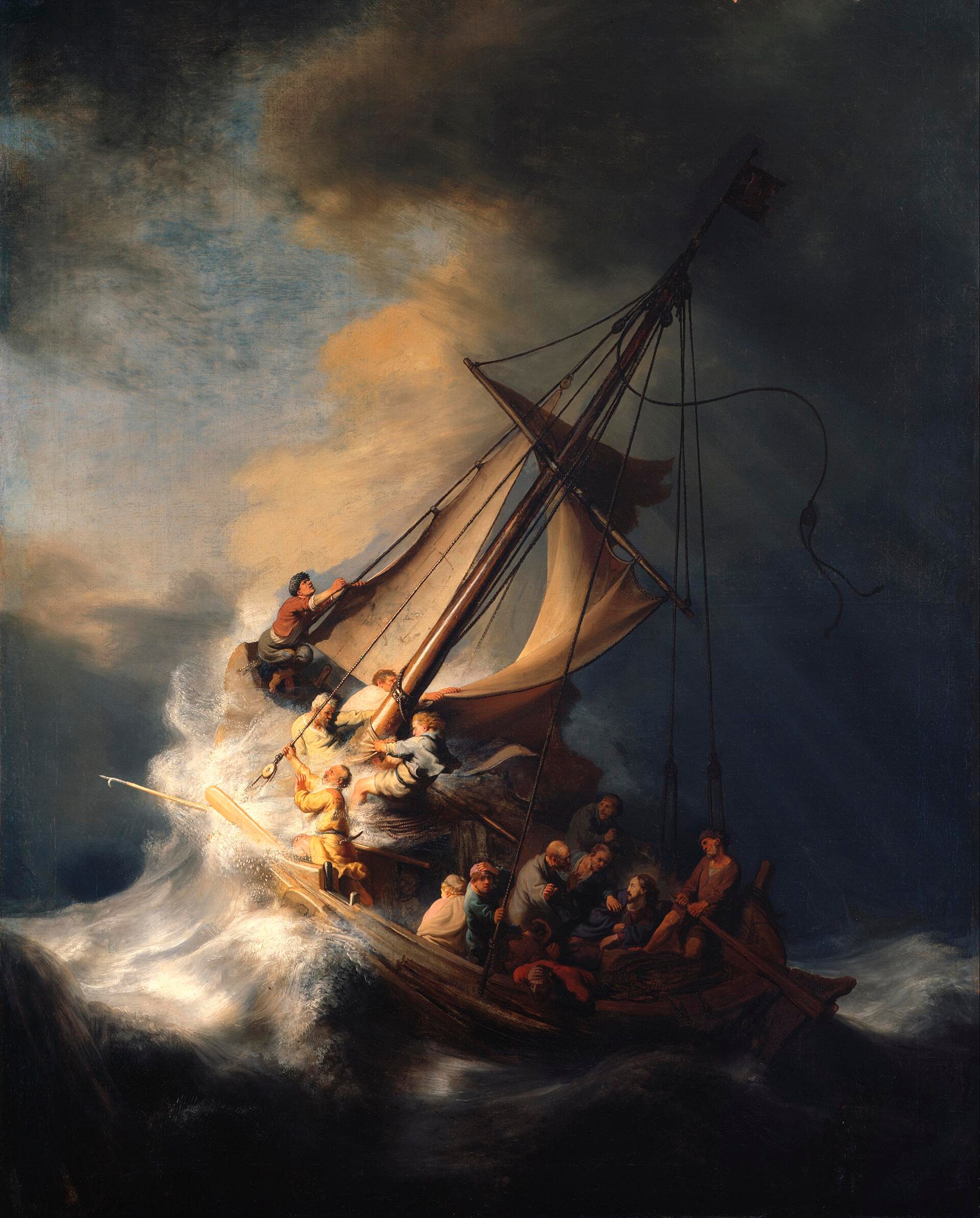
in Mark 6When evening came, the boat was in the middle of the sea, and Jesus was alone on land.
BSB
The same verse in ASV and KJV ▾
ASV
And when even was come, the boat was in the midst of the sea, and he alone on the land.
KJV
And when even was come, the ship was in the midst of the sea, and he alone on the land.
⋯
This verse in Mark 6
Commentary
12 notes on this verseNow the Lord permitted His disciples to be in danger, that they might learn patience; wherefore He did not immediately come to their aid, but allowed them to remain in danger all night, that He might teach them to wait patiently, and not to hope at once for help in tribulations. For there follows, And he saw them toiling in rowing, for the wind was contrary unto them: and about the fourth watch of the night, he cometh unto them walking upon the sea.
The record, by era
The Medieval Church3 voices
And when evening was come, the ship was in the midst of the sea, and he alone on the land. And seeing them toiling in rowing, for the wind was contrary to them. The labor of the disciples in rowing, and the wind being contrary …
(ubi sup.) The disciples indeed, who were still carnal, were amazed at the greatness of His virtue, they could not yet however recognise in Him the truth of the Divine Majesty. Wherefore it goes on, For their hearts were hardened. But mystically, the toil of the disciples in rowing, and the contrary wind, mark out the labours of the Holy Church, who amidst the beating waves of the world, and the blasts of unclean spirits, strives to reach the repose of her celestial country. And well is it said that the ship was in the midst of the sea, and He alone on land, for sometimes the Church is afflicted by a pressure from the Gentiles so overwhelming, that her Redeemer seems to have entirely deserted her. But the Lord sees His own, toiling on the sea, for, lest they faint in tribulations, He strengthens them by the look of His love, and sometimes frees them by a visible assistance. Further, in the fourth watch He came to them as daylight approached, for when man lifts up his mind to the light of guidance from on high, the Lord will be with him, and the dangers of temptations will be laid asleep.
The Lord allows the disciples to be storm-tossed on the sea so that they might learn patience. For the same reason He does not appear to them immediately either, but allows them to be in danger from the storm the whole night, in order to …
The Puritans and the Awakening2 voices
And when even was come,.... The second evening, and it was properly night: the ship was in the midst of the sea; of Galilee, about twenty five or thirty furlongs from the shore; see Joh 6:19; and he alone on the land; upon the mountain.
Christ makes a visit to his own country, the place not of his birth, but of his education; that was Nazareth; where his relations were. He had been in danger of his life among them ( Luke iv. 29 ), and yet he came among them again; so strangely doth he wait to be gracious, and seek the salvation of his enemies.
6 more voices on this verse
The Nineteenth Century6 voices
A commentator
J.C. Ryle1816–1900
Expository Thoughts on the Gospels: Mark (lightly modernized text, Grace Gems edition) (1857)
The event first recorded in these verses, is a beautiful emblem of the position of all believers, between the first and second advents of Jesus Christ. Like the disciples, we are now tossed to and fro by storms, and do not enjoy the visible presence of our Lord. Like the disciples, we shall see our Lord face to face again, though it may be a time of great extremity, when He returns. Like the disciples, we shall see all things changed for the better, when our Master comes to us. We shall no longer be buffeted by storms.
A commentator
Charles Spurgeon1834–1892
The Metropolitan Tabernacle Pulpit, Sermon No. 3128: “Good Cheer From Christ's Real Presence” (lightly modernized text, CCEL edition) · Written before 1892.
WE have here a word of comfort given to a shipload of Believers who were where their Lord had sent them. They had been unwilling to put out to sea, though it was probably calm enough at the time, but they did not wish to leave the Lord Jesus. He constrained them to go and thus their sailing was not merely under His sanction, but by His express command. They were in their right place and yet they met with a terrible storm.
A commentator
Jamieson, Fausset & Brown1802–1910
Commentary Critical and Explanatory on the Whole Bible (1871)
It had come even when the disciples embarked (Mt 14:23; Joh 6:16). the ship was in the midst of the sea, and he alone on the land--John says (Joh 6:17), "It was now dark, and Jesus was not come to them." Perhaps they made no great effort to push across at first, having a lingering hope that their Master would yet join them, and so allowed the darkness to come on.
A commentator
J.C. Ryle1816–1900
Expository Thoughts on the Gospels: Mark (lightly modernized text, Grace Gems edition) (1857)
proposed
The event first recorded in these verses, is a beautiful emblem of the position of all believers, between the first and second advents of Jesus Christ. Like the disciples, we are now tossed to and fro by storms, and do not enjoy the visible presence of our Lord. Like the disciples, we shall see our Lord face to face again, though it may be a time of great extremity, when He returns. Like the disciples, we shall see all things changed for the better, when our Master comes to us. We shall no longer be buffeted by storms. There will be a great calm. There is nothing fanciful in such an application of the passage. We need not doubt that there is a deep meaning in every step of His life, who was "God manifest in the flesh." For the present, however, let us confine ourselves to the plain, practical lessons which these verses contain. Let us notice, in the first place, how our Lord sees the troubles of His believing people, and in due time will help them . We read that when "the ship was in the midst of the sea, and He alone on the land," He "saw His disciples toiling in rowing" came to them walking on the sea — cheered them with the gracious words, "It is I, be not afraid" and changed the storm into a calm. There are thoughts of comfort here for all true believers. Wherever they may be, or whatever their circumstances, the Lord Jesus sees them. Alone, or in company — in sickness or in health — by sea or by land — in perils in the city — in perils in the wilderness — the same eye which saw the disciples tossed on the lake, is ever looking at us. We are never beyond the reach of His care. Our way is never hidden from Him. He knows the path that we take, and is still able to help. He may not come to our aid at the time we like best, but He will never allow us utterly to fail. He who walked upon the water never changes.
A commentator
Charles Spurgeon1834–1892
The Metropolitan Tabernacle Pulpit, Sermon No. 3128: “Good Cheer From Christ's Real Presence” (lightly modernized text, CCEL edition) · Written before 1892.
proposed
WE have here a word of comfort given to a shipload of Believers who were where their Lord had sent them. They had been unwilling to put out to sea, though it was probably calm enough at the time, but they did not wish to leave the Lord Jesus. He constrained them to go and thus their sailing was not merely under His sanction, but by His express command. They were in their right place and yet they met with a terrible storm. The little inland sea upon which they sailed lies in a deep hollow and from the shore there pours a sudden downdraft of tremendous wind for which it is not possible to be prepared. By one of these whirlwinds the whole sea was stirred up to boiling, as only those little lakes can be. So, though they were where Jesus bade them go, they were in desperate peril, and you, dear Friends, must not think that you are in a wrong position because you are in trouble. Do not consider that adverse circumstances are a proof that you have missed your road, for they may even be an evidence that you are in the good old way since the path of Believers is seldom without trial. You did well to embark and to leave the shore, but remember, though your Lord has insured the vessel and guaranteed that you shall reach your haven, He has not promised that you shall sail over a sea of glass. On the contrary, He has told you that "in the world you shall have tribulation"—and you may all the more confidently believe in Him because you find His warning to be true! Their Lord had bid His disciples make for the other side and, therefore, they did their best and continued rowing all night, but making no progress whatever because the wind was dead against them. It was with difficulty that they could keep what little way they had made and not be blown back again to the starting place.
The ship was in the midst of the sea - See all the parts of this wonderful transaction considered, on Mat 14:22-33 (note).
The words behind it
16 Greek wordsEvery Greek word of this verse in the order it stands, with what it means and the door to its own study. The last column counts the times a word stands in the whole Bible: the rarer the word, the more the places it appears belong together.
| Greek | Sound | Meaning | Word study | In the Bible |
|---|---|---|---|---|
| Καὶ | kai | And | G2532 → | 9120 times |
| ὀψίας | opsias | when evening | G3798 → | 15 times |
| γενομένης | genomenes | having come | G1096 → | 667 times |
| ἦν | en | was | G1510 → | 2333 times |
| τὸ | to | the | G3588 → | 19766 times |
| πλοῖον | ploion | boat | G4143 → | 67 times |
| ἐν | en | in | G1722 → | 2738 times |
| μέσῳ | meso | [the] midst | G3319 → | 56 times |
| τῆς | tes | of the | G3588 → | 19766 times |
| θαλάσσης, | thalasses | sea, | G2281 → | 90 times |
| καὶ | kai | and | G2532 → | 9120 times |
| αὐτὸς | autos | He himself | G846 → | 5565 times |
| μόνος | monos | alone | G3441 → | 110 times |
| ἐπὶ | epi | upon | G1909 → | 883 times |
| τῆς | tes | the | G3588 → | 19766 times |
| γῆς. | ges | land. | G1093 → | 248 times |
ΚαὶAnd
kaiG2532 →9120 times
ὀψίαςwhen evening
opsiasG3798 →15 times
γενομένηςhaving come
genomenesG1096 →667 times
ἦνwas
enG1510 →2333 times
τὸthe
toG3588 →19766 times
πλοῖονboat
ploionG4143 →67 times
ἐνin
enG1722 →2738 times
μέσῳ[the] midst
mesoG3319 →56 times
τῆςof the
tesG3588 →19766 times
θαλάσσης,sea,
thalassesG2281 →90 times
καὶand
kaiG2532 →9120 times
αὐτὸςHe himself
autosG846 →5565 times
μόνοςalone
monosG3441 →110 times
ἐπὶupon
epiG1909 →883 times
τῆςthe
tesG3588 →19766 times
γῆς.land.
gesG1093 →248 times
A shaded row is a word that stands 400 times or fewer in the Bible.
The walk
5 stopsEach card is a verse this one points to, and under it the verses that one points to in turn. Where several paths arrive at the same place, that place is listed first: the text keeps returning to it.
Through
Matthew 14:23After He had sent them away, He went up on the mountain by Himself to pray. When evening came, He was there alone,
it leads to
- Luke 6:12
In those days Jesus went out to the mountain to pray, and He spent the night in prayer to God.
- Mark 6:46
After bidding them farewell, He went up on the mountain to pray.
- Matthew 26:36
At that time Jesus went with His disciples to a place called Gethsemane, and He told them, “Sit here while I go over there and pray.”
- John 6:15–17
Then Jesus, realizing that they were about to come and make Him king by force, withdrew again to a mountain by Himself.
- Matthew 6:6
But when you pray, go into your inner room, shut your door, and pray to your Father, who is unseen. And your Father, who sees what is done in secret, will reward you.
- Luke 6:12
Where this verse is studied
On this page
Studies3
On this verse
On this chapter
About Mark
This page draws on 10 works. Open the list of works
This page draws on Adam Clarke, Commentary on the Bible; Bede, On the Gospel of Mark; Bede, Catena Aurea by Aquinas; Charles Spurgeon, The Metropolitan Tabernacle Pulpit, Sermon No. 3128: “Good Cheer From Christ's Real Presence” (lightly modernized text, CCEL edition); J.C. Ryle, Expository Thoughts on the Gospels: Mark (lightly modernized text, Grace Gems edition); Jamieson, Fausset & Brown, Commentary Critical and Explanatory on the Whole Bible; John Gill, Exposition of the New Testament (1746-1748); Matthew Henry, Commentary on the Whole Bible; Theophylact of Ohrid, Catena Aurea by Aquinas and Theophylact of Ohrid, Commentary on Mark.