
Lukechapter 23
56 verses · Luke · about AD 62 · The Gospels
And Jesus said to him, “Truly I tell you, today you will be with Me in Paradise.”
Introduction
Luke, The Gospels, Luke Overview.
Luke wrote this with the care of a man setting out a court record for a reader who might ask whether Jesus deserved his death. The chapter covers a single day, from the governor's hall in the morning to a tomb as the Sabbath began. Roman law, Herod's court and the crowd in the street each have a part in it. Listen for how often a verdict is given about the prisoner, and by whom. Listen also for the words of Jesus himself, which are few and each spoken to someone else. The chapter asks the reader to give a verdict of his own.
Context
- Who
- A Greek reader assessing whether the man was justly condemned
- What
- The trials before Pilate and Herod, the crucifixion between two criminals, the death of Jesus and his burial.
- Where
- Pilate's court and Herod's quarters in Jerusalem, the place called the Skull outside the city, and a tomb cut in the rock.
- When
- The day of Preparation before the Sabbath at Passover, about AD 30 or 33, from morning to sunset.
- Why
- To show a reader that Jesus was declared innocent again and again and still went to the cross for the guilty.
Historical context
Luke reports the charges as they were framed for a Roman court, and they are political: subverting the nation, forbidding tribute to Caesar, and claiming to be a king. Nobody expected a governor to act on a theological complaint.
Show the rest of the historical context, 4 more paragraphs
The referral to Herod Antipas fits the jurisdiction. Antipas ruled Galilee, and a governor could send a defendant to the authority of his home region; Antipas was in Jerusalem for the festival, as rulers were. It is a legal courtesy, and Luke notes that the two men became friends that day.
Pilate is a documented figure, and Luke's picture of a governor under pressure fits what Josephus and Philo record of his troubled relationship with the province, including his use of force against crowds and the complaints that eventually saw him recalled to Rome.
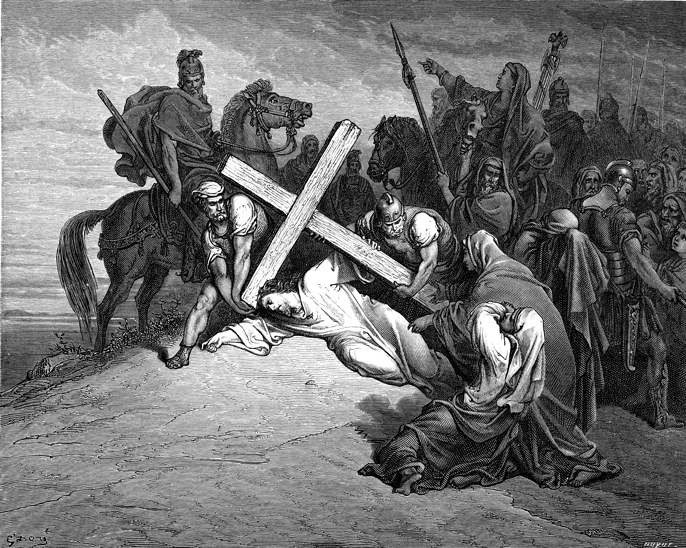
Simon of Cyrene is pressed into carrying the crossbeam under the standing Roman right to compel a provincial to carry a load. The condemned man normally carried it himself to the execution ground, wearing or preceded by a statement of his crime.
The burial is done against the clock. Sabbath began at sunset, and no work could be done after it, which is why Joseph of Arimathea moves fast and why the women, Luke says, went home and prepared spices and then rested according to the commandment. Rock-cut tombs with a low entrance closed by a heavy stone are found all around Jerusalem.
Significance
Luke's account has Pilate declare him innocent three times, Herod find no guilt, one of the criminals say he has done nothing wrong, and the centurion conclude that this man was righteous. For a reader weighing a court record, that is five verdicts of innocence around one execution.
Show the rest of the significance, 1 more paragraph
And the promise given to the dying criminal, today you will be with me in paradise, is Luke's Gospel in miniature. A condemned man with nothing to offer, no time to reform, and no standing at all, receives salvation on the last afternoon of his life.
The heads below are this chapter's scenes. The numbered points under each are its verses.
Pilate, Herod, and a Robe of Mockery
Luke 23:1-2
the whole council rose: Then the whole council rose and led Jesus away to Pilate, moving the charge from blasphemy to crimes Rome would hear. The second, forbidding payment of taxes to Caesar, is false, for at 20:25 Jesus said to give Caesar what is his. The third recasts the title Christ as sedition.
Luke 23:1
“The whole multitude - It seems most probable that the chief priests, elders, scribes, and captains of the temple, together with their servants, dependents, and other persons hired for the purpose, made up the multitude mentioned here. The common people were generally favourers of Christ; and for this reason the Jewish rulers caused him to be apprehended in the night, and in the absence of the people, Luk 22:6, and it was now but just the break of day, Luk 22:66.”
Adam Clarke · Commentary on the Bible (1810-1826)evangelical
1 more voice on this verseWhat preachers and commentators have said about this verse, in their own words.
Luke 23:1
“Our Lord is accused and is silent, for He needs no defence. Let them cast about for defence who fear to be conquered. He does not then confirm, the accusation by His silence, but He despises it by not refuting it. Why then should He fear who does not court safety? The Safety of all men forfeits His own, that He may gain that of all.”
Ambrose of Milan · written before 397 · Catena Aurea by Aquinaspatristic
subverting our nation: The accusers trade a religious charge for political ones. Matthew Henry notes the irony that they had rejected him for refusing worldly pomp and power, and now charge him as a rival to Caesar. Adam Clarke calls the charges the falsest slanders that could be invented.
Luke 23:2
“But let us see what was the manner of their wickedness, and what also they said to Pilate, when framing their accusations against our common Saviour Christ. "We found this man perverting our people, and forbidding to give tribute to Caesar, and saying of Himself that He is Christ a King." And yet, but a short time before He was tried by you, and of questions such as this no point was raised; only He was asked, whether He were the Christ. This it was which you then sought to learn, and beside it absolutely nothing.”
Cyril of Alexandria · written before 444 · Commentary on the Gospel of Luke, Sermon 151patristic
1 more voice on this verse
Luke 23:2
“Perverting the nation - The Greek word διαστρεφοντα, signifies stirring up to disaffection and rebellion. Many MSS. and versions add ἡμων, Our nation. They intimated that he not only preached corrupt doctrine, but that he endeavored to make them disaffected towards the Roman government, for which they now pretended to feel a strong affection! Several copies of the Itala add, Destroying our law and prophets. Et solventem legem nostram et prophetas. Forbidding to give tribute to Caesar - These were the falsest slanders that could be invented. The whole of our Lord’s conduct disproved them.”
Adam Clarke · Commentary on the Bible (1810-1826)evangelical
Luke 23:3-4
Asked if He was the King of the Jews, Jesus replied, You have said so, owning the title while leaving aside Pilate's political sense. Pilate's verdict, I find no basis for a charge against this man, is Luke's first of three acquittals, written for Gentile readers under Rome.
Luke 23:3
“Likewise, when Pirate asked Him, "Art thou Christ (the King)? "He answered, as He had before (to the Jewish council) "Thou sayest that I am" in order that He might not seem to have been driven by a fear of his power to give him a fuller answer.”
Tertullian · written before 220 · Against Marcion Book IVpatristic
This is the first of Pilate's three acquittals. Adam Clarke, following John 18, places it after Jesus had told Pilate that his kingdom belonged to another world. The royal claim therefore posed no threat to Rome.
Luke 23:4
“I find no fault in this man - According to Joh 18:36, Joh 18:38, Pilate did not say this till after our Lord had declared to him that his kingdom was not of this world; and probably not till after he had found, on examining witnesses, (Luk 23:14), that all their evidence amounted to no proof, of his having set up himself for a temporal king. See Bishop Pearce.”
Adam Clarke · Commentary on the Bible (1810-1826)evangelical
Luke 23:5-6
But they kept insisting: Galilee gives Pilate a way out. His question whether the man was a Galilean is one of jurisdiction, from a governor eager to hand off the case.
Luke 23:5
“The more fierce - The more urgent and pressing. They saw that there was a prospect of losing their cause, and they attempted to press on Pilate the point that would be most likely now to affect him. Pilate had, in fact, acquitted him of the charge of being an enemy to Caesar, and they, therefore, urged the other point more vehemently. Stirreth up the people - Excites them to tumult and sedition. All Jewry - All Judea. From Galilee to this place - To Jerusalem - that is, throughout the whole country.”
2 more voices on this verse
Luke 23:5
“But with these words they accuse not Him, but themselves. For to have taught the people, and by teaching to have roused them from their former idleness, and doing this to have passed through the whole land of promise, was an evidence not of sin, but of virtue.”
Bede · written before 735 · Catena Aurea by Aquinaspatristic
Luke 23:5
“And they were the more fierce,.... Or urgent to have him put to death; so the Hebrew word חזק is rendered in Exo 12:33 which answers to that here used.”
he asked if the man was a Galilean: Pilate's question is a legal one. Albert Barnes explains that a Galilean belonged to Herod's jurisdiction, so the word gave Pilate a way to pass the case on. Matthew Henry sees God ordering the transfer, so that Psalm 2:2, which Acts 4:26-27 applies to Herod and Pilate, would be fulfilled.
Luke 23:6
“Whether he were a Galilean - He asked this because, if he was, he properly belonged to Herod’s jurisdiction, who reigned over Galilee.”
2 more voices on this verse
Luke 23:6
Having been bound, Christ went from Caiaphas to Pilate; is this also written? Yes: "And having bound him, they led him away as a present to the King of Jarim." But some keen listener will object: "Pilate was not a king." (Let us pass over for the time the main points of the inquiry.) "How then, having bound him, did they lead him as a present to the king?" But read the Gospel: "Pilate, hearing that he was from Galilee, sent him to Herod; for Herod was then king and was present in Jerusalem."
Cyril of Jerusalem · written before 386 · Catechetical Lecture 13:14patristic
Luke 23:6
“But God ordered it so for the more evident fulfilling of the scripture, as appears Acts iv. 26, 27 , where that of David ( Ps. ii. 2 ), The kings of the earth and the rulers set themselves against the Lord and his Anointed, is expressly said to be fulfilled in Herod and Pontius Pilate.”
Matthew Henry · Commentary on the Whole Bible (1707-1721)puritan
Luke 23:7-8
he sent Him to Herod: This Herod is Antipas, who had beheaded John the Baptist and whom Jesus had called that fox. Pilate wants the case off his hands, and Herod wants a display.
Luke 23:7
“Herod’s jurisdiction - Herod Antipas, a son of Herod the Great. This was the same Herod that put John the Baptist to death. Jesus had passed the most of his life in the part of the country where he ruled, and it was, therefore, considered that he belonged to his jurisdiction - that is, that it belonged to Herod, not to Pilate, to try this cause.”
he was greatly pleased: Herod's pleasure is curiosity. Matthew Henry observes that he had many chances to see Christ in Galilee and never came, so now he is refused. Tertullian joins the scene to Isaiah 53:7, the lamb silent before the shearer, and notes that Herod heard no word from him.
Luke 23:8
" Herod was "exceeding glad" when he saw Jesus, but he heard not a word from Him. For, "as a lamb before the shearer is dumb, so He opened not His mouth," because "the Lord had given to Him a disciplined tongue, that he might know how and when it behoved Him to speak" -even that "tongue which clove to His jaws," as the Psalm said it should, through His not speaking.
Tertullian · written before 220 · Against Marcion Book IVpatristic
2 more voices on this verse
Luke 23:8
“He might have seen Christ and his wondrous works many a time in Galilee, and would not, and therefore it is justly said, Now he would see them, and shall not; they are hidden from his eyes, because he knew not the day of his visitation.”
Matthew Henry · Commentary on the Whole Bible (1707-1721)puritan
Luke 23:8
AFTER Pilate had declared to the chief priests and scribes that he found no fault at all in Jesus, they were afraid that their victim would escape and, therefore, their fury was raised to the highest pitch and they cried out the more vehemently against Him. In the course of their outcries they made use of the word, "Galilee," going, as it seems to me, a little out of their way in order to drag in the name—"He stirs up the people, teaching throughout all Jewry, beginning from Galilee to this place."
Luke 23:9-10
Herod questioned Jesus at great length: , but He gave no answer, and Herod is the one judge in Luke's account to whom Jesus says nothing. The silence recalls the servant of Isaiah 53:7 and meets a ruler who had rejected John's preaching and now asks for a sign.
Luke 23:9
“He was silent and did nothing, for Herod's unbelief deserved not to see Him, and the Lord shunned display. And perhaps typically in Herod are represented all the ungodly, who if they have not believed the Law and the Prophets, cannot see Christ's wonderful works in the Gospel.”
Ambrose of Milan · written before 397 · Catena Aurea by Aquinaspatristic
vehemently accusing Him: John Gill thinks the priests feared Herod might let him go if a miracle pleased him, so they pressed the same charges with more bitterness. Bede reads the Lord's few words before Pilate and his silence before Herod as deliberate, lest refuting the charge should win his release.
Luke 23:10
“And the chief priests and Scribes,.... The sanhedrim that followed him from Pilate's hall, to Herod's palace; fearing, lest Herod should be disposed to let him go, should he gratify him by working a miracle: stood; before Herod; so witnesses, and accusers, used to do; See Gill on Mar 14:57. and vehemently accused him; of the same things they had accused him before Pilate, with great bitterness and constancy, increasing, and aggravating the charges against him.”
1 more voice on this verse
Luke 23:10
“Or, they laughed at him as one that had lost his power, and was become weak as other men. Herod, who had been acquainted with John Baptist, and had more knowledge of Christ too than Pilate had, was more abusive to Christ than Pilate was; for knowledge without grace does but make men the more ingeniously wicked.”
Matthew Henry · Commentary on the Whole Bible (1707-1721)puritan
Luke 23:11-12
ridiculed and mocked Him: Luke alone records the reconciliation of Herod and Pilate. In Acts 4:27 the church applies Psalm 2:2, the kings and rulers gathered against the Lord, to these two men by name.
Luke 23:11
“Herod with his men of war - With his soldiers, or his body-guard. It is probable that in traveling he had “a guard” to attend him constantly. Set him at nought - Treated him with contempt and ridicule. A gorgeous robe - A white or shining robe, for this is the meaning of the original. The Roman princes wore “purple” robes, and “Pilate,” therefore, put such a robe on Jesus. The Jewish kings wore a “white” robe, which was often rendered very shining or gorgeous by much tinsel or silver interwoven.”
2 more voices on this verse
Luke 23:11
“It is not without reason that He is arrayed by Herod in a white robe, as bearing a sign of His immaculate Passion, that the Lamb of God without spot would take upon Himself the sins of the world.”
Ambrose of Milan · written before 397 · Catena Aurea by Aquinaspatristic
Luke 23:11
"Thus he implicated himself with Pilate in all the guilt of His condemnation, and with him accordingly he is classed" (Ac 4:27) [BENGEL]. at enmity--perhaps about some point of disputed jurisdiction, which this exchange of the Prisoner might tend to heal.
Jamieson, Fausset & Brown · Commentary Critical and Explanatory on the Whole Bible (1871)reformed
Herod and Pilate became friends: Luke alone records this reconciliation. Adam Clarke says no ancient author gives the cause of the enmity, though it is generally traced to Pilate's killing of Galileans in Luke 13. Matthew Henry says both men owned Christ's innocence and that agreement healed their quarrel.
Luke 23:12
“In the figure of Herod and Pilate also, who became friends from enemies through Jesus Christ, the figure of the people of Israel and the Gentile people is preserved, so that through the passion of the Lord there will be future harmony between them both: in such a way, however, that the pious people of the nations receive the word of God and transmit their faith to the Jewish people with their devotion; so that they too may clothe the body of Christ with the glory of their majesty, whom they had previously despised.”
Ambrose of Milan · written before 397 · Exposition of the Gospel of Luke 10.103patristic
2 more voices on this verse
Luke 23:12
“Pilate and Herod were made friends - I do not find any account of the cause of the enmity which subsisted between Herod and Pilate given by ancient authors; and the conjectures of the moderns on the subject should be considered as mere guesses. It is generally supposed that this enmity arose from what is related Luke 13, of the Galileans, whose blood Pilate hath mingled with that of their sacrifices. These were Herod’s subjects, and Pilate seems to have fallen on them at the time they were offering sacrifices to God at the temple.”
Adam Clarke · Commentary on the Bible (1810-1826)evangelical
Luke 23:12
“Observe how those that quarrelled with one another yet could unite against Christ; as Gebal, and Ammon, and Amalek, though divided among themselves, were confederate against the Israel of God, Ps. lxxxiii. Christ is the great peace-maker; both Pilate and Herod owned his innocency, and their agreeing in this cured their disagreeing in other things. Barabbas Preferred to Christ.”
Matthew Henry · Commentary on the Whole Bible (1707-1721)puritan
Barabbas Released, Jesus Delivered Up
Luke 23:13-16
called together the chief priests: Pilate called together the chief priests, the rulers, and the people to give his second acquittal: He has done nothing deserving of death. His offer, I will punish Him and release Him, is itself unjust, since a man found guilty of nothing should not be flogged at all.
Luke 23:13
“We should observe, for one thing, in this passage — what striking testimony was borne to our Lord Jesus Christ's perfect innocence by His judges. We are told that Pilate said to the Jews, "You brought me this man as one who was inciting the people to rebellion. I have examined him in your presence, and have found no basis for your charges against him. Neither has Herod — for he sent him back to us; as you can see — he has done nothing to deserve death." The Roman and the Galilean governors were both of one mind.”
inciting the people to rebellion: Pilate gathers the three charges into one, inciting rebellion, the count that mattered to Rome. The hearing took place in their presence. Adam Clarke, citing this verse, says all the evidence amounted to no proof that Jesus had set himself up as a temporal king.
Luke 23:14
“Said unto them, ye have brought this man unto me,.... Pointing to Jesus, who stood before him; as one that perverteth the people; from their religion, and laws, and allegiance to Caesar.”
1 more voice on this verse
Luke 23:14
“Perish then those writings, which, composed so long a time after Christ, convict not the accused of magical arts against Pilate, but the writers themselves of treachery and lying against Christ.”
Bede · written before 735 · Catena Aurea by Aquinaspatristic
He has done nothing deserving of death: Herod's return of the prisoner counts as a second verdict. Albert Barnes notes that the accusers had every opportunity to prove their charges before two judges in turn, and both declared Jesus innocent. He concludes that there could be no better evidence of his innocence.
Luke 23:15
“Nothing worthy of death is done unto him - Deserving of death. The charges are not proved against him. They had had every opportunity of proving them, first before Pilate and then before Herod, unjustly subjecting him to trial before “two” men in succession, and thus giving them a double opportunity of condemning him, and yet, after all, he was declared by both to be innocent. There could be no better evidence that he “was” innocent.”
Pilate's offer contradicts his own verdict. Albert Barnes notes that punishing a man found innocent was as unjust as crucifying him. John Gill thinks Pilate proposed it to please the accusers, giving their charges a show of weight while he tried to save Jesus from death.
Luke 23:16
“I will therefore chastise him,.... Give him some correction, as by scourging, or beating with rods: this he proposed, not because he thought him deserving of it, but in complaisance to the Jews; since it would look as if their charges were not altogether weak and groundless; and that Jesus was not entirely innocent: this would carry a show of guilt and punishment, and he hoped this might be thought sufficient, and so he should please them, and save Jesus from dying, which he much desired: and release him; from his bonds, and let him go.”
1 more voice on this verse
Luke 23:16
“I will therefore chastise him - The word “chastise” here means to “scourge or to whip.” This was usually done before capital punishment, to increase the sufferings of the man condemned. It is not easy to see the reason why, if Pilate supposed Jesus to be “innocent,” he should propose publicly to scourge him. It was as “really” unjust to do that as it was to crucify him.”
Luke 23:17-19
The name Barabbas means son of the father. The crowd frees one son of the father and condemns the Son of the Father, the guilty released and the innocent condemned in his place.
Luke 23:17
“For of necessity he must release one,.... And therefore proposed to release Jesus unto them at the feast; of passover, which now was; not that there was any law that obliged to it, but it having been customary with the Roman governor to do so, the people expected it; custom had made it necessary: and so the Syriac, Arabic, and Persic versions render it, "it was a custom to release", &c. not at each feast, or every feast, as the last of these versions read, only at the passover, as is expressed, Joh 18:39.”
The crowd answers with one voice. Ambrose reads the crowd as preferring a murderer to the true Son of God. Matthew Henry finds it fitting that the truly seditious man is the favourite of the mob, while the loyal one stands falsely accused of sedition.
Luke 23:18
“Away with this man - That is, Put him to death - αιρε τουτον, literally, Take this one away, i.e. to punishment - to death.”
Adam Clarke · Commentary on the Bible (1810-1826)evangelical
1 more voice on this verse
Luke 23:18
“Not unreasonably do they seek the pardon of a murderer, who were themselves demanding the death of the innocent. Such are the laws of iniquity, that what innocence hates, guilt loves. And here the interpretation of the name affords a figurative resemblance, for Barabbas is in Latin, the son of a father. Those then to whom it is said, Ye are of your father the Devil, are represented as about to prefer to the true Son of God the son of their father, that is, Antichrist.”
Ambrose of Milan · written before 397 · Catena Aurea by Aquinaspatristic
imprisoned for an insurrection in the city, and for murder.): Luke breaks into the scene to explain who Barabbas was. Bonaventure joins this verse to John 18, which calls Barabbas a robber, so the man was seditious, a murderer and a robber. The crowd asks for a man guilty of the very sedition they had charged against Jesus.
Luke 23:20-23
Wanting to release Jesus: Pilate's third acquittal matches the threefold temptation and Peter's three denials. A governor who knows the truth three times over yields when their clamor prevailed.
Luke 23:20
Pilate therefore willing to release Jesus,.... Being more and more convinced of his innocence; and still seeing more clearly into the wickedness, malice, and envy of his accusers; and having received a message from his wife: spake again to them; putting it again to them, which he should release; asking them what he should do with Jesus; plainly signifying his mind, that he thought him innocent, and that it would be right to let him go. The Ethiopic version represents him, saying, "will ye that I save for you, or release to you the Lord Jesus?"
they kept shouting: The crowd now demands the cross. The Apostolic Constitutions say the accusers became witnesses, judges and authors of the sentence all at once.
Luke 23:21
And themselves became accusers, and witnesses, and judges, and authors of the sentence, saying, "Crucify Him, crucify Him;" that it might be fulfilled which is written by the prophets concerning Him, "Unjust witnesses were gathered together against me, and injustice lied to itself;" and again, "Many dogs compassed me about, the assembly of the wicked laid siege against me;" and elsewhere, "My inheritance became to me as a lion in a wood, and has sent forth her voice against me."
Apostolic Constitutions · written before 380 · Constitutions of the Holy Apostles Book 5patristic
A third time he said to them: Pilate's third acquittal is the plainest. John Wesley sets it against Peter: a disciple dishonoured Christ by three denials, and a heathen honoured him by three verdicts of innocence. Adam Clarke adds that the verdict was given in public, so the record shows Christ dying as an innocent man.
Luke 23:22
“He said to them the third time, Why, what evil hath he done? - As Peter, a disciple of Christ, dishonoured him by denying him thrice, so Pilate, a heathen, honoured Christ, by thrice owning him to be innocent.”
John Wesley · Explanatory Notes upon the New Testament (1755)evangelical
2 more voices on this verse
Luke 23:22
“I have found no cause of death in him - I find no crime worthy of death in him. There is nothing proved against him that can at all justify me in putting him to death, So here our blessed Lord was in the most formal manner justified by his judge. Now as this decision was publicly known, and perhaps registered, it is evident that Christ died as an innocent person, and not as a malefactor.”
Adam Clarke · Commentary on the Bible (1810-1826)evangelical
Luke 23:22
“This chastisement wherewith Pilate sought to satisfy the people, lest their rage should go even so far as to crucify Jesus, John's words bear testimony that he not only threatened but performed together with mockings and scourgings. But when they saw all their charges which they brought against the Lord baffled by Pilate's diligent questioning, they resort at last to prayers only; entreating that He might be crucified.”
Bede · written before 735 · Catena Aurea by Aquinaspatristic
And their clamor prevailed: Luke ends the trial on the crowd's voices. Bede observes that once Pilate's questioning had baffled every charge, the accusers had nothing left but loud entreaty that Jesus be crucified. The verdict is carried by noise after the evidence has failed.
Luke 23:23
“They cry out the third time against Christ, that by this third voice, they may approve the murder to be their own, which by their entreaties they extorted; for it follows, And Pilate gave sentence that it should be as they required. And he released him that for sedition and murder was cast into prison, but delivered Jesus to their will.”
Theophylact of Ohrid · written before 1107 · Catena Aurea by Aquinaspatristic
Luke 23:24-25
So Pilate sentenced: Luke closes the trial with Jesus handed over to their will. Calvin notes that Pilate's legal authority made the miscarriage of justice a matter of public Roman record.
Luke 23:24
“Here is judgment turned away backward, and justice standing afar off, for fear of popular fury. Truth is fallen in the street, and equity cannot enter, Isa. lix. Judgment was looked for, but behold oppression; righteousness, but behold a cry, Isa. v. 7 .”
Matthew Henry · Commentary on the Whole Bible (1707-1721)puritan
handed Jesus over to their will: Luke leaves the released man unnamed. John Gill takes the omission as deliberate, a detestable man left unworthy of naming. Tertullian draws the exchange: the worst criminal goes free as if innocent, and the righteous Christ dies as if he were the murderer.
Luke 23:25
“And he released unto them, him,.... Barabbas, who is not named, as being a detestable person, and unworthy to be named; and is therefore described by the infamous, though just character of him, as follows: that for sedition and murder was cast into prison, as in Luk 23:19 whom they had desired; to be granted to them, and released; see Act 3:14 but he delivered Jesus to their will; to do as they would with him, to mock, and scourge, and crucify him.”
1 more voice on this verse
Luke 23:25
“Then Barabbas, the most abandoned criminal, is released, as if he were the innocent man; while the most righteous Christ is delivered to be put to death, as if he were the murderer. Moreover two malefactors are crucified around Him, in order that He might be reckoned amongst the transgressors.”
Tertullian · written before 220 · Against Marcion Book IVpatristic
Simon Carries the Cross; Weep for Yourselves
they seized Simon of Cyrene: The soldiers seized Simon of Cyrene on his way in from the country, and put the cross on him to carry behind Jesus. Cyrene was in North Africa, and Simon was very likely a Jew from abroad come up for the Passover. Mark names his sons, Alexander and Rufus.
Luke 23:26
“See the notes at Mat 27:32. After Jesus - Probably to bear one end of the cross. Jesus was feeble and unable to bear it alone, and they compelled Simon to help him.”
2 more voices on this verse
Luke 23:26
“Christ therefore bearing His cross, already as a conqueror carried His trophies. The cross is laid upon His shoulders, because, whether Simon or Himself bore it, both Christ bore it in the man, and the man in Christ. Nor do the accounts of the Evangelists differ, since the mystery reconciles them. And it is the rightful order of our advance that Christ should first Himself erect the trophy of His cross, then hand it down to be raised by His martyrs.”
Ambrose of Milan · written before 397 · Catena Aurea by Aquinaspatristic
Luke 23:26
“Cyrenian--of Cyrene, in Libya, on the north coast of Africa, where were many Jews who had a synagogue at Jerusalem (Ac 6:9, and see Ac 2:10). He was "the father of Alexander and Rufus" (Mr 15:21), probably better known afterwards than himself, as disciples.”
Jamieson, Fausset & Brown · Commentary Critical and Explanatory on the Whole Bible (1871)reformed
Luke 23:27-29
A great number of people: Among the crowd were women who kept mourning and wailing for Him. Jesus told them, Daughters of Jerusalem, do not weep for Me, but weep for yourselves and for your children. The scene is Luke's alone, and like 19:41-44 it looks past His suffering to the judgment on the city.
Luke 23:27
“The dying of the Lord Jesus may perhaps move natural affections in many that are strangers to devout affections; many bewail Christ that do not believe in him, and lament him that do not love him above all. Now here we are told what Christ said to these mourners.”
Matthew Henry · Commentary on the Whole Bible (1707-1721)puritan
Jesus redirects the women's grief to the city. Adam Clarke reads the words as a comfort to believers who cannot weep at the passion, since its sufferings were wholly expiatory. Athanasius reads the restraint as a sign that the Lord was going out to abolish death.
Luke 23:28
The Lord over death set out to abolish death. Being Lord, he accomplished his aim. We therefore have passed from death to life. The concept that the Jews and those who think like them held about the Lord was wrong. Things did not turn out at all according to their expectations, because the opposite was true. In fact, "he who sits in heaven shall laugh at them: the Lord shall have them in derision."That is the reason our Savior restrained the women from weeping when he was being led to death. He said, "Do not weep for me."
Athanasius of Alexandria · written before 373 · Festal Letter 9patristic
1 more voice on this verse
Luke 23:28
“Weep not for me - Many pious persons have been greatly distressed in their minds, because they could not weep on reading or hearing of the sufferings of Christ. For the relief of all such, let it be for ever known that no human spirit can possibly take any part in the passion of the Messiah. His sufferings were such as only God manifested in the flesh could bear; and, as they were all of an expiatory nature, no man can taste of or share in them.”
Adam Clarke · Commentary on the Bible (1810-1826)evangelical
To a Jewish woman, childlessness was a disgrace. Ryle notes that within fifty years the Roman siege under Titus fulfilled the saying through famine. Bede and John Gill likewise read it of the Roman siege, when those without children would be counted happy.
Luke 23:29
“For behold the days are coming,.... The time is hastening on; yet a little while, a few years more, and such times of distress will be: in the which they shall say; or it shall be commonly said; it will be in every one's mouth: blessed are the barren, and the wombs that never bare, and the paps that never gave suck; that is, happy wilt those persons be who have no children, to be starved to death, for want of bread; or to be killed with the sword before their eyes, which must greatly enhance their own miseries.”
2 more voices on this verse
Luke 23:29
“By these days He signifies the time of the siege and captivity which was coming upon them from the Romans, of which He had said before, Woe to them that are with child, and give suck in those days. It is natural, when captivity by an enemy is threatening, to seek for refuge in fastnesses or hidden places, where men may lie concealed. And so it follows, Then shall they begin to say to the mountains, Fall on us; and to the hills, Cover us.”
Bede · written before 735 · Catena Aurea by Aquinaspatristic
Luke 23:29
“These words must have sounded particularly terrible to the ears of a Jewish woman. To her, it was always a disgrace to be childless. The idea of a time coming when it would be a blessing to have no children — must have been a strange and fearsome thought to her mind. And yet within fifty years, this prediction of Christ was literally fulfilled! The siege of Jerusalem by the Roman army under Titus, brought down on all the inhabitants of the city the most horrible sufferings from famine and pestilence that can be conceived.”
Luke 23:30-31
At that time: The cry to the mountains and hills echoes Hosea 10:8. Revelation 6:16 uses it for the terror of the last day.
Luke 23:30
“Mountains, fall on us - As this refers to the destruction of Jerusalem, and as the same expressions are used, Rev 6:16, Dr. Lightfoot conjectures that the whole of that chapter may relate to the same event.”
Adam Clarke · Commentary on the Bible (1810-1826)evangelical
1 more voice on this verse
Luke 23:30
“This would be the language especially of the great and mighty men, Rev. vi. They that would not flee to Christ for refuge, and put themselves under his protection, will in vain call to hills and mountains to shelter them from his wrath. He shows how natural it was for them to infer this desolation from his sufferings.”
Matthew Henry · Commentary on the Whole Bible (1707-1721)puritan
Cross references
Luke 23:30
- QuotingHosea 10:8The high places of Aven will be destroyed—it is the sin of Israel; thorns and thistles will overgrow their altars. Then they will say to the mountains, “Cover us!” and to the hills, “Fall on us!”
'say to the mountains, Fall on us' (weeping women of Jerusalem)
while the tree is green: Jesus argues from lesser to greater. John Wesley calls it a Jewish proverb comparing a good man to a green tree, a bad man to a dead one. Albert Barnes explains that green wood is hard to kindle, so if the innocent suffers this, the guilty nation faces heavier judgment.
Luke 23:31
“For if they do these things in a green tree ... - This seems to be a proverbial expression. A “green” tree is not easily set on fire; a dry one is easily kindled and burns rapidly; and the meaning of the passage is - “If they, the Romans, do these things to me, who am innocent and blameless; if they punish me in this manner in the face of justice, what will they not do in relation to this guilty nation? What security have they that heavier judgments will not come upon them?”
2 more voices on this verse
Luke 23:31
“If they do these things in the green tree, what shall be done in the dry? - Our Lord makes use of a proverbial expression, frequent among the Jews, who compare a good man to a green tree, and a bad man to a dead one: as if he had said, If an innocent person suffer thus, what will become of the wicked? Of those who are as ready for destruction as dry wood for the fire?”
John Wesley · Explanatory Notes upon the New Testament (1755)evangelical
Luke 23:31
“Seize the opportunity of unexpected felicity: that you, who sometime were in God's sight nothing but "a drop of a bucket," and "dust of the threshing-floor," and "a potter's vessel," may thenceforward become that "tree which is sown beside the waters, is perennial in leaves, bears fruit at its own time," and shall not see fire," nor "axe.”
Tertullian · written before 220 · On Repentancepatristic
ConnectionsGalatians 3:13
Father, Forgive Them; Today in Paradise
Luke 23:32-33
Two others, who were criminals: , were also led away to be executed with Jesus. They crucified Him at the place called The Skull, Golgotha in Aramaic, outside the city wall (Hebrews 13:12). The company of criminals fulfils Isaiah 53:12, which Jesus quoted of Himself at 22:37.
Luke 23:32
“Two other malefactors - Ἑτεροι δυο κακουργοι, should certainly be translated two others, malefactors, as in the Bibles published by the King’s printer, Edinburgh. As it now stands in the text, it seems to intimate that our blessed Lord was also a malefactor.”
Adam Clarke · Commentary on the Bible (1810-1826)evangelical
the place called The Skull: John Gill explains the name by the skulls of executed men that lay about the place. He and Athanasius both record an ancient tradition that Adam was buried there. Athanasius draws the meaning: where corruption was seen, incorruption springs up.
Luke 23:33
“And when they were come to the place which was called Calvary,.... Or Cranion, which signifies a skull; so called from the skulls of persons that lay about, who were executed. It is a tradition of the ancients (y), that Adam was buried in this place where Christ was crucified, and that his skull lay here.”
Some of the earliest manuscripts, among them Vaticanus and the first hand of Sinaiticus, lack this prayer. Irenaeus and others cite it early, many textual critics judge it authentic, and Stephen echoes it in Acts 7:60.
Luke 23:34
“They know not what they do - If ignorance do not excuse a crime, it at least diminishes the atrocity of it. However, these persons well knew that they were crucifying an innocent man; but they did not know that, by this act of theirs, they were bringing down on themselves and on their country the heaviest judgments of God. In the prayer, Father, forgive them! that word of prophecy was fulfilled, He made intercession for the transgressors, Isa 53:12.”
Adam Clarke · Commentary on the Bible (1810-1826)evangelical
3 more voices on this verse
Luke 23:34
“While they are actually nailing him to the cross, he seems to feel the injury they did to their own souls more than the wounds they gave him; and as it were to forget his own anguish out of a concern for their own salvation. And how eminently was his prayer heard!”
John Wesley · Explanatory Notes upon the New Testament (1755)evangelical
Luke 23:34
“WHAT tenderness we have here; what self-forgetfulness; what almighty love! Jesus did not say to those who crucified Him, "Be gone!" One such word and they would have all fled. When they came to take Him in the garden, they went backward and fell to the ground when He spoke but a short sentence! And now that He is on the Cross, a single syllable would have made the whole company fall to the ground, or flee away in fright. Jesus says not a word in His own defense.”
Charles Spurgeon · written before 1892 · The Metropolitan Tabernacle Pulpit, Sermon No. 2263: “Christ's Plea for Ignorant Sinners” (lightly modernized text, CCEL edition)Particular Baptist
Luke 23:34
“Christ was crucified between two thieves, and in them were represented the different effects which the cross of Christ would have upon the children of men, to whom it would be brought near in the preaching of the gospel. They were all malefactors, all guilty before God. Now the cross of Christ is to some a savour of life unto life, to others of death unto death.”
Matthew Henry · Commentary on the Whole Bible (1707-1721)puritan
the rulers sneered at Him: The rulers' taunt, let Him save Himself, states the gospel backward, since His mission required that He not save Himself. The title Chosen One recalls the voice of 9:35.
Luke 23:35
“See the notes at Mat 27:41-44. Luk 23:38 In letters of Greek ... - See the notes at Mat 27:37. Luk 23:39 One of the malefactors - Matthew Mat 27:44 says “the thieves - cast the same in his teeth.” See the apparent contradiction in these statements reconciled in the notes at that place. If thou be Christ - If thou art the Messiah; if thou art what thou dost pretend to be. This is a taunt or reproach of the same kind as that of the priests in Luk 23:35. Save thyself and us - Save our lives.”
1 more voice on this verse
Luke 23:35
“If thou be the Christ; ver. 37. If thou be the king - The priests deride the name of Messiah: the soldiers the name of king.”
John Wesley · Explanatory Notes upon the New Testament (1755)evangelical
Luke 23:36-38
The soldiers also mocked Him: and came up to offer Him sour wine. Pilate meant the inscription above Him, THIS IS THE KING OF THE JEWS, as mockery, yet it states the truth over the cross. John 19:22 records that he refused to change it when the priests protested.
Luke 23:36
“Offering him vinegar - See on Mat 27:34 (note). Vinegar or small sour wine, was a common drink of the Roman soldiers; and it is supposed that wherever they were on duty they had a vessel of this liquor standing by. It appears that at least two cups were given to our Lord; one before he was nailed to the cross, viz. of wine mingled with myrrh, and another of vinegar, while he hung on the cross.”
Adam Clarke · Commentary on the Bible (1810-1826)evangelical
1 more voice on this verse
Luke 23:36
“And the soldiers also mocked him,.... The Roman soldiers, to whom the execution was committed, who crucified him, and parted his garments, and stood at his cross watching; these joined in the insult, which is not to be wondered at. Coming to him and offering him vinegar; which was what was a part of their allowance, and was their drink; See Gill on Joh 19:29.”
The soldiers take up the rulers' taunt from verse 35 and recast it in Roman terms, putting king in place of Christ. Bonaventure likens them to the servants of the Assyrian king who reproached the Lord in Isaiah 37. The mockery repeats Pilate's own charge.
THIS IS THE KING OF THE JEWS: Pilate meant the notice as the charge against a condemned man. Adam Clarke notes that it was written in Greek, Latin and Hebrew so that all might read why he was put to death. Matthew Henry sees God's design in it, that the gospel would be read in all languages.
Luke 23:38
“And rightly is the title placed above the cross, because Christ's kingdom is not of the human body, but of the power of God. I read the title of the King of the Jews, when I read, My kingdom is not of this world. (John 18:36.) I read the cause of Christ written above His head, when I read, And the Word was God. (John 1:1.) For the head of Christ is God. (1 Cor. 11:3.)”
Ambrose of Milan · written before 397 · Catena Aurea by Aquinaspatristic
2 more voices on this verse
Luke 23:38
“A superscription - See Mat 27:37. In letters of Greek, and Latin and Hebrew - The inscription was written in all these languages, which were the most common, that all might see the reason why he was put to death. The inscription was written in Greek, on account of the Hellenistic Jews, who were then at Jerusalem because of the passover; it was written in Latin, that being the language of the government under which he was crucified; and it was written in Hebrew, that being the language of the place in which this deed of darkness was committed.”
Adam Clarke · Commentary on the Bible (1810-1826)evangelical
Luke 23:38
“This was written in those that were called the three learned languages, Greek, and Latin, and Hebrew, for those are best learned that have learned Christ. It was written in these three languages that it might be known and read of all men; but God designed by it to signify that the gospel of Christ should be preached to all nations, beginning at Jerusalem, and be read in all languages.”
Matthew Henry · Commentary on the Whole Bible (1707-1721)puritan
One of the criminals: who hung there heaped abuse on Him, repeating the taunt of the rulers and soldiers that He save Himself. Matthew and Mark record both criminals reviling Him at first, and Luke's fuller account shows one of them changing in the hours on the cross.
Luke 23:39
“He never had any offer of Christ, nor day of grace, before how: he was designed to be made a singular instance of the power of Christ's grace now at a time when he was crucified in weakness.”
Matthew Henry · Commentary on the Whole Bible (1707-1721)puritan
2 more voices on this verse
Luke 23:39
“But it must also be explained how the others, that is, Matthew and Mark, introduced two thieves reviling, while Luke, one reviling, the other resisting him. Perhaps this other at first reviled, but was suddenly converted. It may also have been spoken of one, but in the plural number; as in the Hebrews, They wandered in goat-skins, and they were sawn asunder; (Heb. 11:37.) whereas Elijah alone is related to have had a goat-skin, and Isaiah to have been sawn asunder.”
Ambrose of Milan · written before 397 · Catena Aurea by Aquinaspatristic
Luke 23:39
“One of the malefactors which were hanged - It is likely that the two robbers were not nailed to their crosses, but only tied to them by cords, and thus they are represented in ancient paintings. If not nailed, they could not have suffered much, and therefore they were found still alive when the soldiers came to give the coup de grace, which put a speedy end to their lives. Joh 19:31-33.”
Adam Clarke · Commentary on the Bible (1810-1826)evangelical
Luke 23:40-41
But the other one rebuked him: The other criminal is the fourth voice in Luke to clear Jesus, after Pilate's three acquittals. The centurion follows at verse 47.
Luke 23:40
“Dost not thou--"thou" is emphatic: "Let others jeer, but dost thou?" fear God--Hast thou no fear of meeting Him so soon as thy righteous Judge? Thou art within an hour or two of eternity, and dost thou spend it in reckless disregard of coming judgment? in the same condemnation--He has been condemned to die, but is it better with thee?”
Jamieson, Fausset & Brown · Commentary Critical and Explanatory on the Whole Bible (1871)reformed
3 more voices on this verse
Luke 23:40
“The other rebuked him - What a surprising degree was here of repentance, faith, and other graces! And what abundance of good works, in his public confession of his sin, reproof of his fellow criminal, his honourable testimony to Christ, and profession of faith in him, while he was in so disgraceful circumstances as were stumbling even to his disciples!”
John Wesley · Explanatory Notes upon the New Testament (1755)evangelical
Luke 23:40
“Dost not thou fear God - The sufferings of this person had been sanctified to him, so that his heart was open to receive help from the hand of the Lord: he is a genuine penitent, and gives the fullest proof he can give of it, viz. the acknowledgment of the justice of his sentence. He had sinned, and he acknowledges his sin; his heart believes unto righteousness, and with his tongue he makes confession unto salvation. While he condemns himself he bears testimony that Jesus was innocent.”
Adam Clarke · Commentary on the Bible (1810-1826)evangelical
Luke 23:40
“A GREAT many persons, whenever they hear of the conversion of the dying thief, remember that he was saved in the very article of death and they dwell upon that fact, and that, alone. He has always been quoted as a case of salvation at the 11th hour and so, indeed, he is. In his case it is proven that as long as a man can repent, he can obtain forgiveness. The Cross of Christ avails even for a man hanging on a gallows and drawing near to his last breath.”
The thief confesses his own guilt before he clears Jesus. Cyril of Alexandria calls the confession wise and beautiful, making the thief a confessor of the Saviour's glory. His words agree with Pilate's three verdicts, spoken by a man with nothing to gain.
Luke 23:41
"This man," he says, "has done nothing that is hateful." O how beautiful is this confession! How wise the reasoning and how excellent the thoughts! He became the confessor of the Savior's glory and the accuser of the pride of those who crucified him.
Cyril of Alexandria · written before 444 · Commentary on Luke, Homily 153patristic
Luke 23:42-43
remember me when You come: The thief asks, Jesus, remember me when You come into Your kingdom; the promise follows, today you will be with Me in Paradise. The Greek word order and the earliest translations join today to the promise, so the thief is with Christ that same day.
Luke 23:42
“Let us look at his most beautiful confession of faith. He says, "Jesus, remember me when you come in your kingdom." You see him crucified and call him a king. You expect the One who bears scorn and suffering to come in godlike glory. You see him surrounded by a Jewish crowd, the wicked gang of the Pharisees, and Pilate's band of soldiers. All of these were mocking him, and no one confessed him.”
Cyril of Alexandria · written before 444 · Commentary on Luke, Homily 153patristic
3 more voices on this verse
Luke 23:42
“Remember me when thou comest - From heaven, in thy kingdom - He acknowledges him a king, and such a king, as after he is dead, can profit the dead. The apostles themselves had not then so clear conceptions of the kingdom of Christ.”
John Wesley · Explanatory Notes upon the New Testament (1755)evangelical
Luke 23:42
“Lord, remember me, etc. - It is worthy of remark, that this man appears to have been the first who believed in the intercession of Christ.”
Adam Clarke · Commentary on the Bible (1810-1826)evangelical
Luke 23:42
“This is the prayer of a dying sinner to a dying Saviour. It was the honour of Christ to be thus prayed to, though he was upon the cross reproached and reviled.”
Matthew Henry · Commentary on the Whole Bible (1707-1721)puritan
Jesus answers the thief's someday with today. John Wesley reads Paradise as the place where the souls of the righteous remain from death until the resurrection. Matthew Henry likens the cross to a throne of judgment, one thief departing with a curse and the other with a blessing.
Luke 23:43
“And Jesus said unto him,.... Jesus immediately answered him, though he said not one word to the other that railed at him, or to the multitude that abused him; and promised him more than he asked for, and sooner than he expected.”
4 more voices on this verse
Luke 23:43
“That flaming, flashing sword was keeping Paradise safe. No one could open the gates that Christ closed. The thief was the first to enter with Christ. His great faith received the greatest of rewards. His faith in the kingdom did not depend on seeing Christ. He did not see him in his radiant glory or behold him looking down from heaven. He did not see the angels serving him. To put it plainly, he certainly did not see Christ walking about in freedom, but on a gibbet, drinking vinegar and crowned with thorns.”
Jerome · written before 420 · On Lazarus and Divespatristic
Luke 23:43
“Learn (1) How "One is taken and another left"; (2) How easily divine teaching can raise the rudest and worst above the best instructed and most devoted servants of Christ; (3) How presumption and despair on a death hour are equally discountenanced here, the one in the impenitent thief, the other in his penitent fellow.”
Jamieson, Fausset & Brown · Commentary Critical and Explanatory on the Whole Bible (1871)reformed
Luke 23:43
“In paradise - The place where the souls of the righteous remain from death till the resurrection. As if he had said, I will not only remember thee then, but this very day.”
John Wesley · Explanatory Notes upon the New Testament (1755)evangelical
Luke 23:43
“Christ upon the cross is like Christ upon the throne; for now is the judgment of this world: one departs with a curse, the other with a blessing. Though Christ himself was now in the greatest struggle and agony, yet he had a word of comfort to speak to a poor penitent that committed himself to him.”
Matthew Henry · Commentary on the Whole Bible (1707-1721)puritan
Darkness, the Rent Veil, and the Last Breath
Luke 23:44-45
about the sixth hour: It was about the sixth hour, and darkness came over all the land until the ninth hour. An eclipse cannot occur at the Passover full moon, and later Christian writers cite Thallus as reporting a darkness. The torn veil opened the way into the holy place, as Hebrews 10:19-20 argues.
Luke 23:44
“Darkness over all the earth - See the note on Mat 27:45. The darkness began at the sixth hour, about our twelve o’clock at noon, and lasted till the ninth hour, which answered to our three o’clock in the afternoon.”
Adam Clarke · Commentary on the Bible (1810-1826)evangelical
2 more voices on this verse
Luke 23:44
“The sun also is eclipsed to the sacrilegious, that it may overshadow the scene of their awful wickedness; darkness was spread over the eyes of the unbelieving, that the light of faith might rise again.”
Ambrose of Milan · written before 397 · Catena Aurea by Aquinaspatristic
Luke 23:44
“There was darkness over all the earth - The noon-tide darkness, covering the sun, obscured all the upper hemisphere. And the lower was equally darkened, the moon being in opposition to the sun, and so receiving no light from it.”
John Wesley · Explanatory Notes upon the New Testament (1755)evangelical
the veil of the temple was torn down the middle: Luke sets the torn veil before the death cry. John Gill calls the darkness preternatural, for a full moon stood over the Passover, and reads it as fulfilling Amos 8:9. Ambrose reads the torn veil as the synagogue's covering drawn back, so that the inward mysteries of faith stand revealed.
Luke 23:45
“And the sun was darkened,.... There was an eclipse of it, which was preternatural, it being now full moon, and lasted three hours, and so total, as to darken the whole earth; and now was the prophecy in Amo 8:9 literally fulfilled: and the vail of the temple was rent in the midst. The Persic version renders it, "the gate of the temple"; and so the Syriac version, "the face of the gate of the temple"; See Gill on Mat 27:51.”
2 more voices on this verse
Luke 23:45
“The sun was darkened - See an examination of the accounts of Phlegon, Thallus, and Dionysius, on Mat 27:45 (note). The veil - was rent - See Mat 27:51.”
Adam Clarke · Commentary on the Bible (1810-1826)evangelical
Luke 23:45
“The veil also is rent, by which is declared the division of the two people, and the profanation of the synagogue. The old veil is rent that the Church may hang up the new veils of faith. The covering of the synagogue is drawn up, that we may behold with the eyes of the mind the inward mysteries of religion now revealed to us. It took place also at that time when every mystery of Christ's assumed mortality was fulfilled, and His immortality alone remained; as it follows, And when Jesus had cried with a loud voice, he said.”
Ambrose of Milan · written before 397 · Catena Aurea by Aquinaspatristic
called out in a loud voice: His last words are those of Psalm 31:5. The loud voice, noted in all three Synoptics, points to a death given up by His own will. John 10:18 says no one takes His life from Him.
Luke 23:46
“Into thy hands I commend my spirit - Or, I will commit my spirit - I deposit my soul in thy hands. Another proof of the immateriality of the soul, and of its separate existence when the body is dead.”
Adam Clarke · Commentary on the Bible (1810-1826)evangelical
Cross references
Luke 23:46
- QuotingPsalms 31:5“Into Your hands I commit my spirit; You have redeemed me, O LORD, God of truth.”
'Into thy hands I commend my spirit', the last word from the cross
ConnectionsPsalms 31:5
The centurion gave glory to God with the words Surely this was a righteous man, where Matthew and Mark have the Son of God. A Gentile officer reaches the verdict opposite to the council's, the first of the nations whose coming Luke's Gospel has led the reader to expect.
Luke 23:47
“Now when the centurion saw what was done,.... The eclipse of the sun, the darkness upon the land, the earthquake, the rocks rent, and Jesus expire in so uncommon a manner: he glorified God; by confessing that Christ was the Son of God, and declaring him an innocent person: saying, certainly, this was a righteous man; clear of the charges exhibited against him, and has suffered wrongfully; and this he concluded from those unusual appearances, and which he considered as tokens of divine resentment.”
1 more voice on this verse
Luke 23:47
“Certainly this was a righteous man - Which implies an approbation of all he had done and taught.”
John Wesley · Explanatory Notes upon the New Testament (1755)evangelical
Luke 23:48-49
they returned home beating their breasts: The crowd returned home beating their breasts, a Jewish sign of grief and confession. Their turn from mockery to grief looks ahead to the repentance Peter calls for at Pentecost. The women who followed Him from Galilee watched from a distance, a group Luke keeps in view.
Luke 23:48
“And all the people - All were deeply affected except the priests, and those whom they had employed to serve their base purposes. The darkness, earthquake, etc., had brought terror and consternation into every heart. How dreadful is the state of those who, in consequence of their long opposition to the grace and truth of God, are at last given up to a reprobate mind!”
Adam Clarke · Commentary on the Bible (1810-1826)evangelical
1 more voice on this verse
Luke 23:48
“MANY in that crowd came together to behold the crucifixion of Jesus, in a condition of the most furious malice. They had hounded the Savior as dogs pursue a stag and at last, all mad with rage, they hemmed Him in for death. Others, willing enough to spend an idle hour and to gaze upon a sensational spectacle, swelled the mob until a vast assembly congregated around the little hill upon which the three crosses were raised. There unanimously, whether of malice or of wantonness, they all joined in mockery of the Victim who hung upon the center Cross.”
stood at a distance watching these things: These women are Luke's witnesses. They watch the death here, see the burial in verse 55, and find the tomb empty in chapter 24. Theophylact notes that the race of women, once under the curse, is the first renewed by the blessing that flows from the passion.
Luke 23:49
“But the race of women formerly cursed remains and sees all these things; for it follows, And the women which followed him from Galilee, seeing these things. And thus they are the first to be renewed by justification, or by the blessing which flows from His passion, as also from His resurrection.”
Theophylact of Ohrid · written before 1107 · Catena Aurea by Aquinaspatristic
Joseph of Arimathea and the Watching Women
Luke 23:50-51
a Council member named Joseph: Joseph, a good and righteous man, had not consented to their decision or action, so the council's verdict was divided. John calls him a disciple in secret for fear of the Jews. He was waiting for the kingdom of God, like Zechariah, Simeon and Anna before him in Luke.
Luke 23:50
“And behold, there was a man named Joseph,.... See Gill on Mat 27:57. a counsellor; Mark says, he was an "honourable" one; he was either one of the council of the high priest, or a member of the great sanhedrim; See Gill on Mar 15:43. and he was a good man, and a just; he was kind and beneficent in his temper, and just, and righteous in his life and actions; a like character is given of Joseph the husband of Mary, the mother of our Lord, Mat 1:19.”
1 more voice on this verse
Luke 23:50
“We know nothing of Joseph except what is here told us. In no part of the Acts or Epistles, do we find any mention of his name. At no former period of our Lord's ministry, does he ever come forward. We cannot explain his reason for not openly joining the disciples before this time. But here, at the eleventh hour, this man is not afraid to show himself to be one of our Lord's friends. At the very time when the apostles had forsaken Jesus — Joseph is not ashamed to show his love and respect.”
who had not consented to their decision or action: Joseph belonged to the council that condemned Jesus. John Gill says he sat with them yet gave no consent to the counsel to put Christ to death. Tertullian applies Psalm 1:1 to him, the blessed man who walks apart from the counsel of the ungodly.
Luke 23:51
“The only shift left to the impudence of the heretics, is to admit that what remained there was the phantom of a phantom! But what if Joseph knew that it was a body which he treated with so much piety? That same Joseph "who had not consented" with the Jews in their crime? The "happy man who walked not in the counsel of the ungodly, nor stood in the way of sinners, nor sat in the seat of the scornful.”
Tertullian · written before 220 · Against Marcion Book IVpatristic
Luke 23:52-53
to ask for the body: Joseph's request for the body was an act of courage. Asking for the corpse of a man condemned for sedition risked his standing with Rome. Isaiah 53:9 foretold a burial with a rich man.
Luke 23:52
“This man went unto Pilate,.... Mark says, he went "boldly" to him; See Gill on Mar 15:43. and begged the body of Jesus; knowing he was dead; that he might bury it, as the Ethiopic version adds, and prevent its being inferred with the two malefactors, or abused by the mob.”
where no one had yet been laid: The new tomb matters for the resurrection account. John Gill notes that no body had lain there before, so no one could claim another corpse was raised in place of Christ's. Ambrose adds that the Conqueror of death had no grave of his own, and is laid in Joseph's.
Luke 23:53
“And he took it down,.... From the cross, with the help of others, having obtained leave of Pilate so to do; and wrapped it in linen; as was the custom of the Jews in burying their dead; See Gill on Mat 27:59. and laid it in a sepulchre that was hewn in stone; cut out of a rock; See Gill on Mat 27:60. wherein never man before was laid; so that it could not be said it was another body, and not that of Christ's, that was raised from the dead.”
1 more voice on this verse
Luke 23:53
“Nor without meaning has one Evangelist spoken of a new tomb, another of the tomb of Joseph. For the grave is prepared by those who are under the law of death; the Conqueror of death has no grave of His own. For what fellowship hath God with the grave. He alone is enclosed in this tomb, because the death of Christ, although it was common according to the nature of the body, yet was it peculiar in respect of power. But Christ is rightly buried in the tomb of the just, that He may rest in the habitation of justice.”
Ambrose of Milan · written before 397 · Catena Aurea by Aquinaspatristic
Luke 23:54-56
It was Preparation Day: , and the Sabbath was beginning, so the burial is hurried. The women saw the tomb and how His body was placed, and rested on the Sabbath, according to the commandment. Because they marked the tomb, they can return at first light and find it empty (24:1).
Luke 23:54
“And the Sabbath drew on - Or, The Sabbath was lighting up, επεφωσκε, i.e. with the candles which the Jews light just before six in the evening, when the Sabbath commences. The same word is used for the dawning of the day, Mat 28:1. Wakefield.”
Adam Clarke · Commentary on the Bible (1810-1826)evangelical
they saw the tomb and how His body was placed: The women mark the tomb and how His body was placed, so they could find it again. John Gill notes that they saw the body wrapped in linen and not yet anointed. Luke names them at 24:10.
Luke 23:55
“And the women also which came with him from Galilee,.... See Gill on Luk 23:49. followed after; Joseph; and those that were with him, when they carried the body of Jesus, in order to inter it: and beheld, the sepulchre; took notice of it, what an one it was, whereabout it stood in the garden, that they might know, and find it again: and how his body was laid; in what position, form, and order; and observed that it was only wrapped in linen, and not anointed, or embalmed.”
2 more voices on this verse
Luke 23:55
“Finally, not all were able to bury Christ: although religious women stood from afar, they diligently observed the place in order to bring ointments and pour them out. However, they are both anxious and depart from the tomb and return to the tomb: although constancy is lacking, diligence is not. The gender falters, devotion burns. Finally, at the time of the resurrection, they are present, and while the men were fleeing, only the women are admonished by the angel to not be afraid. The disciples call Peter and the others in earnest, but the later ones come with confidence.”
Ambrose of Milan · written before 397 · Exposition of the Gospel of Luke 10.144-46patristic
Luke 23:55
“The women also, which came - These were Mary of Magdala, Joanna, and Mary the mother of James, Luk 24:10. To these three, Mark, in Mar 16:1, adds, Salome; but some think that this was only a surname of one of these Marys.”
Adam Clarke · Commentary on the Bible (1810-1826)evangelical
they rested on the Sabbath, according to the commandment: The women keep the Sabbath even in grief. Adam Clarke reads the spices as proof that they had no hope of a resurrection on the third day, since they meant to embalm him. Their rest sets the scene for the first day of the week in chapter 24.
Luke 23:56
“Prepared spices and ointments - This was in order to embalm him; which sufficiently proves that they had no hope of his resurrection the third day.”
Adam Clarke · Commentary on the Bible (1810-1826)evangelical
Keep studying
Studies16
People and groups1
Places1
Words12
Subjects1
Sources for this chapter
The summary
Jamieson, Fausset & Brown, Commentary Critical and Explanatory; John Calvin, Commentaries; John Wesley, Explanatory Notes Upon the New Testament and Matthew Henry, Complete Commentary.
The exposition
Adam Clarke, Commentary on the Bible; Albert Barnes; Ambrose of Milan; Apostolic Constitutions, Constitutions of the Holy Apostles Book 5; Athanasius of Alexandria; Bede; Bonaventure, Commentary on Luke, Chapter 23; Bruce Metzger, A Textual Commentary on the Greek New Testament; Charles Spurgeon, The Gospel of the Kingdom; Cyril of Alexandria; J. C. Ryle, Expository Thoughts on the Gospels, Luke; J.C. Ryle, Expository Thoughts on the Gospels: Luke; Jamieson, Fausset & Brown, Commentary Critical and Explanatory on the Whole Bible; Jerome, ON LAZARUS AND DIVES; John Calvin, Commentary on a Harmony of the Evangelists; John Chrysostom, Homilies on the Gospel of Matthew; John Gill; John Wesley, Explanatory Notes upon the New Testament; Matthew Henry, Commentary on the Whole Bible; Tertullian, Against Marcion Book IV and Theophylact of Ohrid, Catena Aurea by Aquinas.
The painting
The Arrival at Calvary, Gustave Doré (engraving), public domain