
Luke 23:26
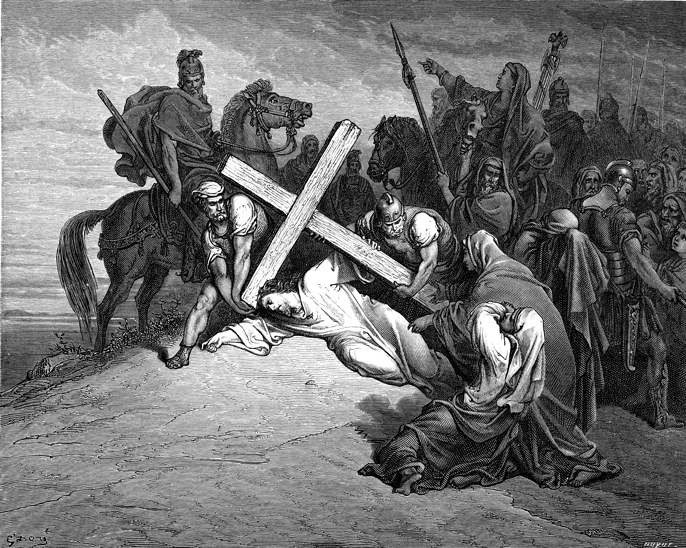
in Luke 23As the soldiers led Him away, they seized Simon of Cyrene on his way in from the country, and put the cross on him to carry behind Jesus.
BSB
The same verse in ASV and KJV ▾
ASV
And when they led him away, they laid hold upon one Simon of Cyrene, coming from the country, and laid on him the cross, to bear it after Jesus.
KJV
And as they led him away, they laid hold upon one Simon, a Cyrenian, coming out of the country, and on him they laid the cross, that he might bear it after Jesus.
⋯
This verse in Luke 23
Commentary
19 notes on this verseChrist therefore bearing His cross, already as a conqueror carried His trophies. The cross is laid upon His shoulders, because, whether Simon or Himself bore it, both Christ bore it in the man, and the man in Christ. Nor do the accounts of the Evangelists differ, since the mystery reconciles them. And it is the rightful order of our advance that Christ should first Himself erect the trophy of His cross, then hand it down to be raised by His martyrs.
This site's exposition
one Simon, a Cyrenian
As they lead Jesus away they lay hold on Simon of Cyrene, coming in from the country, and compel him to bear the cross behind Jesus, a detail Mark preserves further by naming his sons Alexander and Rufus, likely known to Mark's first readers. Cyrene was in North Africa, and the bench takes Simon as very likely a Jew of the diaspora come up for Passover, an unwitting participant pressed into the one act of cross-bearing the Gospels literally record. Bede reads Simon's compelled service as a picture of every disciple later called to take up a cross he did not choose.
The record, by era
The Church Fathers4 voices
(de Con. Ev. lib. iii. c. 10.) But John relates that Jesus bore His own cross, from which is understood that He was Himself carrying His cross, when He went forth to that place which is called Calvary; but as they journeyed Simon was forced into the service on the road, and the cross was given him to carry as far as that place.
A commentator
Ephrem the SyrianCOMMENTARY ON TATIAN'S DIATESSARON 20.20 · Written before 373.
proposed
After he took up the wood of his cross and set out, they found and stopped a man of Cyrene, that is, from among the Gentiles, and placed the wood of the cross on him. It was only right that they should have given the …
Christ, moreover, he affirms to have been sent, not by this maker of the world, but by the above-named Abraxas; and to have come in a phantasm, and been destitute of the substance of flesh: that it was not He who suffered among the Jews, but that Simon was crucified in His stead: whence, again, there must be no believing on him who was crucified, lest one confess to having believed on Simon.
A commentator
Cyril of AlexandriaCommentary on the Gospel of Luke, Sermon 152 · Written before 444.
proposed
The Redeemer therefore was led to His saving passion: but they laid His cross, it says, upon Simon the Cyrenian. Another holy evangelist, however, tells us that the Lord Himself carried, the tree: and necessarily both the one and the other are true. For the Saviour indeed bore the cross, but in the middle of the way perhaps the Cyrenian met them, and they seized him, and made him carry it instead. And there is an important reason for the fact, that Christ the Saviour of all did carry the cross: for it is said of Him by the voice of Isaiah, that "to us a Child is born: a Son also is given us, Whose government is upon His shoulder." For His government was the cross, by which He became King over the world, if so be that it is true that "He became obedient to the Father to death, even the death of the cross: for this reason God also has greatly exalted Him, and given Him a name that is above every name, that at the name of Jesus Christ every knee should bow, of things in heaven, and things in earth, and of things under the earth: and every tongue shall confess that Jesus Christ is Lord to the glory of God the Father." And this also, I think, it is important here to observe, that when the blessed Abraham went up to the mountain that had been shown him, that there he might sacrifice Isaac, according to God's command, he laid the wood upon the lad; and he was a type of Christ carrying His own cross upon His shoulders, and going up to the glory of His passion. For that His passion was Christ's glory, He has Himself taught us, saying, "Now is the Son of man glorified, and God is glorified in Him. If God be glorified in Him, God shall also glorify Him in Himself, and shall immediately glorify Him."
The Medieval Church1 voice
This is well signified by that Simon who, found on the road, carries the Lord's cross under compulsion. For burdens belonging to another are carried under compulsion when something is done through the pursuit of vanity. Who then are designated by Simon, if not the abstinent and arrogant? They indeed afflict the flesh through abstinence, but they do not seek the fruit of abstinence within. Therefore Simon carries the Lord's cross under compulsion, because when he is not led to a good work by good will, a sinner performs the deed of a just man without fruit. Hence the same Simon carries the cross but does not die, because the abstinent and arrogant indeed afflict the body through abstinence, but through the desire for glory they live to the world.
12 more voices on this verse
The Medieval Church6 voices
Jesus was led away and at first the cross was laid upon Him, and He went bearing this burden. For none of the others would undertake to carry it, since they considered it a cursed tree. Then, finding a certain Simon of Cyrene, they laid …
Simon is by interpretation "obedient," Cyrene "an heir." By this man therefore the people of the Gentiles are denoted, who formerly foreigners and aliens to the covenant, have now by obedience been made heirs of God. But Simon coming out of a village, bears the cross after Jesus, because forsaking the pagan rites, he obediently embraces the footsteps of our Lord's Passion. For a village is in Greek called πάγος, from whence Pagans derive their name.
(non occ.) Having related the condemnation of Christ, Luke naturally goes on to speak of His crucifixion; as it is said, And as they led him away, they laid hold upon one Simon, &c.
And as they led him away, they seized a certain Simon, a Cyrenian, coming from the countryside, and they laid on him the cross to carry it behind Jesus. The evangelist John narrates that the Lord himself carried his own cross. From this it is …
For no one else accepted to bear the cross, because the wood was counted an abomination. Accordingly upon Simon the Cyrenian they imposed as it were to his dishonour the bearing of the cross, which others refused. Here is fulfilled that prophecy of Isaiah, Whose government shall be upon his shoulder. (Isa. 9:6.) For the government of Christ is His cross; for which the Apostle says, God hath exalted him. (Phil. 2:9.) And as for a mark of dignity, some wear a belt, others a head dress, so our Lord the cross. And if thou seekest, thou wilt find that Christ does not reign in us save by hardships, whence it comes that the luxurious are the enemies of the cross of Christ. Or he takes up the cross of Christ, who comes from the village; that is, he leaves this world and its labours, going forward to Jerusalem, that is, heavenly liberty. Hereby also we receive no slight instruction. For to be a master after the example of Christ, a man must himself first take up his cross, and in the fear of God crucify his own flesh, that he may so lay it upon those that are subject and obedient to him.
First, therefore, as regards the leading of Christ to the gibbet, he says: And as they led him, they seized a certain Simon of Cyrene coming from the country, and they laid upon him the cross to carry after Jesus. But the contrary of this …
The Puritans and the Awakening2 voices
), lest Jesus should faint under it and die away, and so prevent the further instances of malice they designed. It was pity, but a cruel pity, that gave him this ease.
quarantine:debris (2026-07-29) — leading-punctuation+unbalanced-parens
And as they led him away,....
The Nineteenth Century4 voices
A commentator
Albert Barnes1798–1870
Notes, Explanatory and Practical, on the Old and New Testaments (1832-1869)
See the notes at Mat 27:32. After Jesus - Probably to bear one end of the cross. Jesus was feeble and unable to bear it alone, and they compelled Simon to help him.
A commentator
Jamieson, Fausset & Brown1802–1910
Commentary Critical and Explanatory on the Whole Bible (1871)
Cyrenian--of Cyrene, in Libya, on the north coast of Africa, where were many Jews who had a synagogue at Jerusalem (Ac 6:9, and see Ac 2:10). He was "the father of Alexander and Rufus" (Mr 15:21), probably better known afterwards than himself, as disciples.
A commentator
J.C. Ryle1816–1900
Expository Thoughts on the Gospels: Luke (lightly modernized text, Grace Gems edition) (1858)
proposed
These words must have sounded particularly terrible to the ears of a Jewish woman. To her, it was always a disgrace to be childless. The idea of a time coming when it would be a blessing to have no children — must have been a strange and fearsome thought to her mind. And yet within fifty years, this prediction of Christ was literally fulfilled! The siege of Jerusalem by the Roman army under Titus, brought down on all the inhabitants of the city the most horrible sufferings from famine and pestilence that can be conceived. Women are reported to have actually eaten their own children during the siege for lack of food. Upon none did the last judgments sent upon the Jewish nation fall so heavily, as upon the wives, the mothers, and the little children. Let us beware of supposing that the Lord Jesus holds out to man nothing but mercy, pardon, love, and forgiveness. Beyond all doubt, He is plenteous in mercy. His mercy is like a mighty stream. He "delights in mercy." But we must never forget that there is justice with Him — as well as mercy . He is preparing punishments for the impenitent and the unbelieving. There is wrath revealed in the Gospel, for those who harden themselves in wickedness. The same cloud which was bright to Israel — was dark to the Egyptians. The same Lord Jesus who invites the laboring and heavy-laden to come to Him and rest — declares most plainly that unless a man repents — he will certainly perish; and that he who does not believe — shall be damned. (Luke 13:3; Mark 16:16.) The same Savior who now holds out His hands to the disobedient and rebellious — will come one day "from Heaven in blazing fire with his powerful angels. He will punish those who do not know God, and do not obey the gospel of our Lord Jesus.
Simon, a Cyrenian - See on Mat 27:32 (note).
The words behind it
19 Greek wordsEvery Greek word of this verse in the order it stands, with what it means and the door to its own study. The last column counts the times a word stands in the whole Bible: the rarer the word, the more the places it appears belong together.
| Greek | Sound | Meaning | Word study | In the Bible |
|---|---|---|---|---|
| Καὶ | kai | And | G2532 → | 9120 times |
| ὡς | hos | as | G5613 → | 500 times |
| ἀπήγαγον | apegagon | they led away | G520 → | 15 times |
| αὐτόν, | auton | Him, | G846 → | 5565 times |
| ἐπιλαβόμενοι | epilabomenoi | having laid hold on | G1949 → | 19 times |
| Σίμωνά | simona | Simon | G4613 → | 75 times |
| τινα | tina | a certain | G5100 → | 528 times |
| Κυρηναῖον | kurenaion | from Cyrene | G2956 → | |
| ἐρχόμενον | erchomenon | is coming | G2064 → | 628 times |
| ἀπ᾽ | ap᾽ | from | G575 → | 640 times |
| ἀγροῦ | agrou | [the] country | G68 → | 35 times |
| ἐπέθηκαν | epethekan | they put upon | G2007 → | 38 times |
| αὐτῷ | auto | him | G846 → | 5565 times |
| τὸν | ton | the | G3588 → | 19766 times |
| σταυρὸν | stauron | cross | G4716 → | 27 times |
| φέρειν | pherein | to carry | G5342 → | 66 times |
| ὄπισθεν | opisthen | behind | G3693 → | |
| τοῦ | tou | <the> | G3588 → | 19766 times |
| Ἰησοῦ.¶ | iesou | Jesus. | G2424 → | 908 times |
ΚαὶAnd
kaiG2532 →9120 times
ὡςas
hosG5613 →500 times
ἀπήγαγονthey led away
apegagonG520 →15 times
αὐτόν,Him,
autonG846 →5565 times
ἐπιλαβόμενοιhaving laid hold on
epilabomenoiG1949 →19 times
ΣίμωνάSimon
simonaG4613 →75 times
τιναa certain
tinaG5100 →528 times
Κυρηναῖονfrom Cyrene
kurenaionG2956 →
ἐρχόμενονis coming
erchomenonG2064 →628 times
ἀπ᾽from
ap᾽G575 →640 times
ἀγροῦ[the] country
agrouG68 →35 times
ἐπέθηκανthey put upon
epethekanG2007 →38 times
αὐτῷhim
autoG846 →5565 times
τὸνthe
tonG3588 →19766 times
σταυρὸνcross
stauronG4716 →27 times
φέρεινto carry
phereinG5342 →66 times
ὄπισθενbehind
opisthenG3693 →
τοῦ<the>
touG3588 →19766 times
Ἰησοῦ.¶Jesus.
iesouG2424 →908 times
A shaded row is a word that stands 400 times or fewer in the Bible.
The walk
8 stopsEach card is a verse this one points to, and under it the verses that one points to in turn. Where several paths arrive at the same place, that place is listed first: the text keeps returning to it.
Through
Luke 9:23Then Jesus said to all of them, “If anyone wants to come after Me, he must deny himself and take up his cross daily and follow Me.
it leads to
- Matthew 10:38–39
and anyone who does not take up his cross and follow Me is not worthy of Me.
- Luke 14:26–27
“If anyone comes to Me and does not hate his father and mother and wife and children and brothers and sisters—yes, even his own life—he cannot be My disciple.
- Romans 8:13
For if you live according to the flesh, you will die; but if by the Spirit you put to death the deeds of the body, you will live.
- Mark 8:34–38
Then Jesus called the crowd to Him along with His disciples, and He told them, “If anyone wants to come after Me, he must deny himself and take up his cross and follow Me.
- John 12:25–26
Whoever loves his life will lose it, but whoever hates his life in this world will keep it for eternal life.
- Matthew 10:38–39
Through
Luke 14:27And whoever does not carry his cross and follow Me cannot be My disciple.
it leads to
- Matthew 10:38
and anyone who does not take up his cross and follow Me is not worthy of Me.
- Luke 9:23–25
Then Jesus said to all of them, “If anyone wants to come after Me, he must deny himself and take up his cross daily and follow Me.
- Mark 10:21
Jesus looked at him, loved him, and said to him, “There is one thing you lack: Go, sell everything you own and give to the poor, and you will have treasure in heaven. Then…
- Matthew 10:38
Where this verse is studied
About Luke
This page draws on 19 works. Open the list of works
This page draws on Adam Clarke, Commentary on the Bible; Albert Barnes, Notes, Explanatory and Practical, on the Old and New Testaments (1832-1869); Ambrose of Milan, Catena Aurea by Aquinas; Augustine of Hippo, Catena Aurea by Aquinas; Bede, Commentary on Luke; Bede, Catena Aurea by Aquinas; Bede, On the Gospel of Luke; Bonaventure, Commentary on Luke, Chapter 23; Cyril of Alexandria, Commentary on the Gospel of Luke, Sermon 152; Ephrem the Syrian, COMMENTARY ON TATIAN'S DIATESSARON 20.20; Glossa Ordinaria, Catena Aurea by Aquinas; Gregory the Dialogist, Forty Gospel Homilies, Homily 32; J.C. Ryle, Expository Thoughts on the Gospels: Luke (lightly modernized text, Grace Gems edition); Jamieson, Fausset & Brown, Commentary Critical and Explanatory on the Whole Bible; John Gill, Exposition of the New Testament (1746-1748); Matthew Henry, Commentary on the Whole Bible; Tertullian, Pseudo-Tertullian Against All Heresies; Theophylact of Ohrid, Commentary on Luke and Theophylact of Ohrid, Catena Aurea by Aquinas.