
Luke 23:33
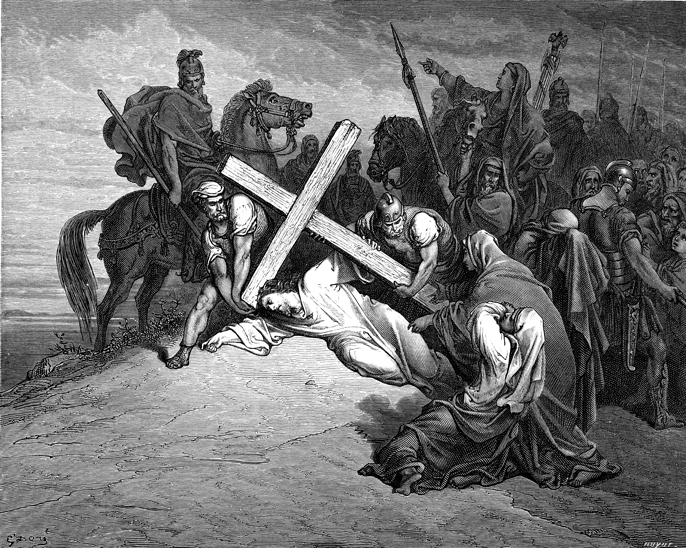
in Luke 23When they came to the place called The Skull, they crucified Him there, along with the criminals, one on His right and the other on His left.
BSB
The same verse in ASV and KJV ▾
ASV
And when they came unto the place which is called The skull, there they crucified him, and the malefactors, one on the right hand and the other on the left.
KJV
And when they were come to the place, which is called Calvary, there they crucified him, and the malefactors, one on the right hand, and the other on the left.
⋯
This verse in Luke 23
Commentary
21 notes on this verse(Hom. in Pass. Dom.) When mankind became corrupted, then Christ manifested His own body, that where corruption has been seen, there might spring up incorruption. Wherefore He is crucified in the place of Calvary; which place the Jewish doctors say was the burial-place of Adam. (de Inc. Verb. Dei.) Now our Saviour came to accomplish not His own death, but that of man, for He experienced not death who is Life. Therefore not by His own death did He put off the body, but He endured that which was inflicted by men.
This site's exposition
Two others, who were criminals
on Luke 23:32-33
Two others, who were criminals, were also led away to be executed with Jesus. They crucified Him at the place called The Skull, Golgotha in Aramaic, outside the city wall (Hebrews 13:12). The company of criminals fulfils Isaiah 53:12, which Jesus quoted of Himself at 22:37.
This site's exposition
the place called The Skull
John Gill explains the name by the skulls of executed men that lay about the place. He and Athanasius both record an ancient tradition that Adam was buried there. Athanasius draws the meaning: where corruption was seen, incorruption springs up.
The record, by era
The Church Fathers5 voices
But the very place of the cross, either in the middle, as visible to all, or above Adam, as the Hebrews argue, for burial. For it was fitting that there our first-fruits of life should be placed, where the beginnings of death had been.
(de Gr. Nov. Test. Ep. 140.) For not without reason did He choose this kind of death, in order that He might be the master of breadth and length, and heighth and depth. For breadth lies in that cross piece of wood which is fastened from above. This belongs to good works, because on it the hands are outstretched. Length lies in that which is seen reaching from the former piece to the ground, for there in a certain manner we stand, that is, abide firm or persevere. And this is applied to longsuffering. Heighth is in that piece of wood which is left reaching upwards from that which is fixed across, that is, to the head of the Crucified; for the expectation of those who hope for better things is upward. Again, that part of the wood which is fixed hidden in the ground, signifies the depth of unrestrained grace.
But if, on the contrary, after His intercourse with men, He suddenly disappeared, flying away to avoid death, He might be likened by man to a phantom. And just as if any one wished to exhibit some incombustible vessel, which triumphed over the nature of fire, he would put it into the flame, and then directly draw it out from the flame unharmed; so the Word of God, wishing to show that the instrument which He used for the salvation of men was superior to death, exposed His mortal body to death to manifest His nature, then after a little rescued it from death by the force of His divine power. This is indeed the first cause of Christ's death. But the second is the manifestation of the divine power of Christ inhabiting a body. For seeing that men of old deified those who were destined to a like end with themselves, and whom they called Heroes and Gods, He taught that He alone of the dead must be acknowledged the true God, who having vanquished death is adorned with the rewards of victory, having trodden death under His feet. The third reason is, that a victim must be slain for the whole race of mankind, which being offered, the whole power of the evil spirits was destroyed, and every error put to silence. There is also another cause of the healthgiving death, that the disciples with secret faith might behold the resurrection after death. Whereunto they were taught to lift up their own hopes, that despising death they might embark cheerfully in the conflict with error.
(Orat. 1. de Res. Christ.) But the figure of the cross from one centre of contact branching out into four separate terminations, signifies the power and providence of Him who hung upon it extending every where.
Moreover two malefactors are crucified around Him, in order that He might be reckoned amongst the transgressors. Although His raiment was, without doubt, parted among the soldiers, and partly distributed by lot, yet Marcion has erased it all (from his Gospel), for he had his eye upon the Psalm: "They parted my garments amongst them, and cast lots upon my vesture.
13 more voices on this verse
The Church Fathers4 voices
The only-begotten Son of God did not Himself in His own nature in which He is God suffer the things which belong to the body, but rather in His earthly nature. For of one and the same Son both may be affirmed, namely, that He doth not suffer in His divine nature, and that He suffered in His human.
By becoming like us and bearing our sufferings for our sakes, Christ restores human nature to how it was in the beginning. The first man was certainly in the Paradise of delight in the beginning. The absence of suffering and of corruption exalted him. He despised the commandment given to him and fell under a curse, condemnation and the snare of death by eating the fruit of the forbidden tree. By the very same thing, Christ restores him to his original condition. He became the fruit of the tree by enduring the precious cross for our sakes, that he might destroy death, which by means of the tree [of Adam] had invaded the bodies of humankind.
When he hung on the precious cross, two thieves were hung with him. What comes from this? It was truly a mockery as far as the plan of the Jews, but it was also the commemoration of prophecy. It is written, "He was also numbered with the transgressors." For our sakes, he became a curse. That is, he became accursed. It is written again, "Cursed is every one that hangs on a tree." His act did away with the curse that was on us. We are blessed with him and because of him. Knowing this, blessed David says, "Blessed are we of the Lord, who made heaven and earth." Blessings descend to us by his sufferings. He paid our debts in our place. He bore our sins. He was stricken in our place, as it is written. He took our sins in his own body on the tree, because it is true that his bruises heal us. He also was sick because of our sins, and we are delivered from the sicknesses of the soul.
(Hom. 87. in Matt.) Two thieves also they crucified on the two sides, that He might be a partaker of their reproach; as it follows, And the thieves one on his right hand, the other on his left. But it did not so turn out. For of them nothing is said, but His cross is every where honoured. Kings, laying aside their crowns, assume the cross on their purple, on their diadems, on their arms. On the consecrated table, throughout the whole earth, the cross glitters. Such things are not of men. For even in their lifetime those who have acted nobly are mocked by their own actions, and when they perish their actions perish also. But in Christ it is quite different. For before the cross all things were gloomy, after it all things are joyful and glorious, that you may know that not a mere man was crucified.
The Medieval Church6 voices
Second, as to the atrocity of the punishment, it is added: And after they came to the place which is called Calvary, there they crucified him. This place is called Calvary, as some say, because Adam lay there, and the skull of his head was …
Or else, without the gate were the places where the heads of condemned criminals were cut off, and they received the name of Calvary, that is, beheaded. Thus for the salvation of all men the innocent is crucified among the guilty, that where sin abounded, there grace might much more abound. But the two robbers crucified with Christ signify those who under the faith of Christ undergo either the pains of martyrdom, or the rules of a still stricter continence. But they do this for eternal glory, who imitate the actions of the thief on the right hand; while they who do it to gain the praise of men, imitate the thief on the left hand.
And after they came to the place that is called Calvary, there they crucified him. Outside the city of Jerusalem and outside the gate there were places where they beheaded the condemned, and they took the name Calvary, that is, of the beheaded. Therefore the …
And the thieves, one on the right and the other on the left. The thieves who are crucified with the Lord on either side signify those who, under the faith and confession of Christ, either undergo the struggle of martyrdom or the discipline of stricter …
But the Devil, desiring to engender an evil opinion of our Lord, caused robbers also to be crucified with Him; whence it follows, And there were two other malefactors led with him to be put to death. Because also by a tree death bad entered, it must needs be that by a tree it should be abolished, and that the Lord passing unconquered through the pains of a tree should subdue the pleasures which flow from a tree.
They lead Him to the place of the Skull, where, they say, the forefather was buried, so that where the fall occurred through a tree, there also the restoration was accomplished through a tree.
The Puritans and the Awakening1 voice
And when they were come to the place which was called Calvary,.... Or Cranion, which signifies a skull; so called from the skulls of persons that lay about, who were executed. It is a tradition of the ancients (y), that Adam was buried in this place where Christ was crucified, and that his skull lay here.
The Nineteenth Century2 voices
A commentator
J.C. Ryle1816–1900
Expository Thoughts on the Gospels: Luke (lightly modernized text, Grace Gems edition) (1858)
proposed
These words must have sounded particularly terrible to the ears of a Jewish woman. To her, it was always a disgrace to be childless. The idea of a time coming when it would be a blessing to have no children — must have been a strange and fearsome thought to her mind. And yet within fifty years, this prediction of Christ was literally fulfilled! The siege of Jerusalem by the Roman army under Titus, brought down on all the inhabitants of the city the most horrible sufferings from famine and pestilence that can be conceived. Women are reported to have actually eaten their own children during the siege for lack of food. Upon none did the last judgments sent upon the Jewish nation fall so heavily, as upon the wives, the mothers, and the little children. Let us beware of supposing that the Lord Jesus holds out to man nothing but mercy, pardon, love, and forgiveness. Beyond all doubt, He is plenteous in mercy. His mercy is like a mighty stream. He "delights in mercy." But we must never forget that there is justice with Him — as well as mercy . He is preparing punishments for the impenitent and the unbelieving. There is wrath revealed in the Gospel, for those who harden themselves in wickedness. The same cloud which was bright to Israel — was dark to the Egyptians. The same Lord Jesus who invites the laboring and heavy-laden to come to Him and rest — declares most plainly that unless a man repents — he will certainly perish; and that he who does not believe — shall be damned. (Luke 13:3; Mark 16:16.) The same Savior who now holds out His hands to the disobedient and rebellious — will come one day "from Heaven in blazing fire with his powerful angels. He will punish those who do not know God, and do not obey the gospel of our Lord Jesus.
The place - called Calvary - See on Mat 27:33 (note). They crucified him - See the nature of this punishment explained Mat 27:35 (note).
The words behind it
23 Greek wordsEvery Greek word of this verse in the order it stands, with what it means and the door to its own study. The last column counts the times a word stands in the whole Bible: the rarer the word, the more the places it appears belong together.
| Greek | Sound | Meaning | Word study | In the Bible |
|---|---|---|---|---|
| καὶ | kai | And | G2532 → | 9120 times |
| ὅτε | hote | when | G3753 → | 103 times |
| ἦλθον | elthon | they came | G2064 → | 628 times |
| ἐπὶ | epi | to | G1909 → | 883 times |
| τὸν | ton | the | G3588 → | 19766 times |
| τόπον | topon | place | G5117 → | 94 times |
| τὸν | ton | which | G3588 → | 19766 times |
| καλούμενον | kaloumenon | is being called | G2564 → | 147 times |
| Κρανίον, | kranion | [The] Skull, | G2898 → | |
| ἐκεῖ | ekei | there | G1563 → | 105 times |
| ἐσταύρωσαν | estaurosan | they crucified | G4717 → | 46 times |
| αὐτὸν | auton | Him | G846 → | 5565 times |
| καὶ | kai | and | G2532 → | 9120 times |
| τοὺς | tous | the | G3588 → | 19766 times |
| κακούργους, | kakourgous | criminals, | G2557 → | 4 times |
| ὃν | hon | the | G3739 → | 1405 times |
| μὲν | men | one | G3303 → | 176 times |
| ἐκ | ek | on [the] | G1537 → | 911 times |
| δεξιῶν, | dexion | right, | G1188 → | 53 times |
| ὃν | hon | another | G3739 → | 1405 times |
| δὲ | de | and | G1161 → | 2765 times |
| ἐξ | ex | on | G1537 → | 911 times |
| ἀριστερῶν. | aristeron | [the] left. | G710 → |
καὶAnd
kaiG2532 →9120 times
ὅτεwhen
hoteG3753 →103 times
ἦλθονthey came
elthonG2064 →628 times
ἐπὶto
epiG1909 →883 times
τὸνthe
tonG3588 →19766 times
τόπονplace
toponG5117 →94 times
τὸνwhich
tonG3588 →19766 times
καλούμενονis being called
kaloumenonG2564 →147 times
Κρανίον,[The] Skull,
kranionG2898 →
ἐκεῖthere
ekeiG1563 →105 times
ἐσταύρωσανthey crucified
estaurosanG4717 →46 times
αὐτὸνHim
autonG846 →5565 times
καὶand
kaiG2532 →9120 times
τοὺςthe
tousG3588 →19766 times
κακούργους,criminals,
kakourgousG2557 →4 times
ὃνthe
honG3739 →1405 times
μὲνone
menG3303 →176 times
ἐκon [the]
ekG1537 →911 times
δεξιῶν,right,
dexionG1188 →53 times
ὃνanother
honG3739 →1405 times
δὲand
deG1161 →2765 times
ἐξon
exG1537 →911 times
ἀριστερῶν.[the] left.
aristeronG710 →
A shaded row is a word that stands 400 times or fewer in the Bible.
The walk
8 stopsEach card is a verse this one points to, and under it the verses that one points to in turn. Where several paths arrive at the same place, that place is listed first: the text keeps returning to it.
Through
Zechariah 12:10Then I will pour out on the house of David and on the people of Jerusalem a spirit of grace and prayer, and they will look on Me, the One they have pierced. They…
it leads to
- Revelation 1:7
Behold, He is coming with the clouds, and every eye will see Him—even those who pierced Him. And all the tribes of the earth will mourn because of Him. So shall it be! Amen.
- Ezekiel 39:29
And I will no longer hide My face from them, for I will pour out My Spirit on the house of Israel, declares the Lord GOD.”
- Joel 2:28–29
And afterward, I will pour out My Spirit on all people. Your sons and daughters will prophesy, your old men will dream dreams, your young men will see visions.
- John 19:34–37
Instead, one of the soldiers pierced His side with a spear, and immediately blood and water flowed out.
- Jeremiah 6:26
O daughter of my people, dress yourselves in sackcloth and roll in ashes. Mourn with bitter wailing, as you would for an only son, for suddenly the destroyer will come upon us.
- Revelation 1:7
Through
Deuteronomy 21:23you must not leave the body on the tree overnight, but you must be sure to bury him that day, because anyone who is hung on a tree is under God’s curse. You must…
it leads to
- Galatians 3:13
Christ redeemed us from the curse of the law by becoming a curse for us. For it is written: “Cursed is everyone who is hung on a tree.”
- John 19:31
It was the day of Preparation, and the next day was a High Sabbath. In order that the bodies would not remain on the cross during the Sabbath, the Jews asked Pilate to have…
- Galatians 3:13
Through
John 18:32This was to fulfill the word that Jesus had spoken to indicate the kind of death He was going to die.
it leads to
- Matthew 20:19
and will deliver Him over to the Gentiles to be mocked and flogged and crucified. And on the third day He will be raised to life.”
- Matthew 20:19
Where this verse is studied
On this page
About Luke
This page draws on 18 works. Open the list of works
This page draws on Adam Clarke, Commentary on the Bible; Albert Barnes, Notes, Explanatory and Practical, on the Gospels; Ambrose of Milan, EXPOSITION OF THE GOSPEL OF LUKE 10.114; Athanasius of Alexandria, Catena Aurea by Aquinas; Augustine of Hippo, Catena Aurea by Aquinas; Bede, Catena Aurea by Aquinas; Bede, On the Gospel of Luke; Bonaventure, Commentary on Luke, Chapter 23; Cyril of Alexandria, Catena Aurea by Aquinas; Cyril of Alexandria, COMMENTARY ON LUKE, HOMILY 153; Eusebius of Caesarea, Catena Aurea by Aquinas; Gregory of Nyssa, Catena Aurea by Aquinas; J.C. Ryle, Expository Thoughts on the Gospels: Luke (lightly modernized text, Grace Gems edition); John Chrysostom, Catena Aurea by Aquinas; John Gill, Exposition of the New Testament (1746-1748); Tertullian, Against Marcion Book IV; Theophylact of Ohrid, Catena Aurea by Aquinas and Theophylact of Ohrid, Commentary on Luke.