
Luke 23:25
in Luke 23As they had requested, he released the one imprisoned for insurrection and murder, and handed Jesus over to their will.
BSB
The same verse in ASV and KJV ▾
ASV
And he released him that for insurrection and murder had been cast into prison, whom they asked for; but Jesus he delivered up to their will.
KJV
And he released unto them him that for sedition and murder was cast into prison, whom they had desired; but he delivered Jesus to their will.
⋯
This verse in Luke 23
Commentary
15 notes on this verseThen Barabbas, the most abandoned criminal, is released, as if he were the innocent man; while the most righteous Christ is delivered to be put to death, as if he were the murderer. Moreover two malefactors are crucified around Him, in order that He might be reckoned amongst the transgressors.
This site's exposition
Pilate gave sentence
on Luke 23:24-25
Pilate gives sentence as they required, releases the man guilty of sedition and murder, and delivers Jesus to their will, Luke's blunt closing line on the trial. The bench notes the double injustice condensed into one verse, a murderer freed and the sinless one condemned, and reads it as the pattern of the atonement itself, the guilty going free because the innocent bears the sentence in his place. Calvin observes that Pilate's formal legal authority makes the miscarriage of justice a matter of public Roman record, not merely a private grievance of the Jewish leaders.
The record, by era
The Church Fathers5 voices
He is sent to Herod, sent back to Pilate. And although neither of them pronounce him guilty, they still comply with the desires of someone else's cruelty. Indeed, Pilate washed his hands, but he did not wash away his deeds; for a judge ought not to yield to envy or fear, so as to deliver the blood of an innocent person. His wife warned him: grace shone in the darkness; divinity was evident; yet she did not temper the sacrilegious sentence in this way.
Similarly, I think that this is a prototype of all judgments that they would condemn those whom they believed to be innocent. However, it is evident that the Gentiles are more tolerant than the Jews, as Pilate's association with them demonstrates, and they are more persuaded by divine works.
The word of the Lord is rich, and according to the opinion of Solomon, "it must be written on the heart" not once but also twice and "three times." Let us to the best of our ability also now attempt to add something to what was said long ago. Let us show how "as a type of things to come" this one male goat was sacrificed to the Lord as an offering and the other one was sent away "living." Hear in the Gospels what Pilate said to the priests and the Jewish people: "Which of these two do you want me to send out to you: Jesus, who is called the Christ, or Barabbas?" Then all the people cried out to release Barabbas and to hand Jesus over to be killed. Look, you have a male goat who was sent "living into the wilderness." He carried with him the sins of the people who cried out and said, "Crucify, crucify!" The first is a male goat sent "living into the wilderness." The second is the male goat that was offered to God as an offering to atone for sins. Christ made a true atonement for those who believe in him.
Celsus goes on to say that "those who killed Jesus suffered nothing for a long a time afterwards." We must inform him and all who are prone to learn the truth. The Jewish people called for the crucifixion of Jesus with shouts of "Crucify him, crucify him!" They preferred to set free the robber who had been thrown into prison for sedition and murder. They wanted Jesus, who had been delivered through envy, to be crucified. The city where all these things happened was attacked shortly after this. After a long siege, it was totally overthrown and destroyed. God judged the inhabitants of that place unworthy of living the life of citizens together. Although it may seem incredible to say, God spared this people in delivering them to their enemies. He saw that they were incurably against any improvement and were daily sinking deeper and deeper into evil. All this happened to them because the blood of Jesus was shed at their instigation and on their land. The land was no longer able to bear those who were guilty of so fearful a crime against Jesus.
They brought the holy and just One to Pilate. They spoke violent and unrestrained words against him and poured out falsely invented accusations. They persisted in the ferocity with which they accused him. Pilate then ruled that it should be as they desired, although he had publicly said, "I find no wickedness in this man." It says, "They cried out, 'Away with him, crucify him!' " The Lord had rebuked this unmerciful and unlawful cry by the voice of the prophet Isaiah. It is written, "The vineyard of the Lord of hosts is the house of Israel, and the men of Judah are his pleasant planting; and he looked for justice, but behold, bloodshed; for righteousness, but behold, a cry!" In another place, he said of them, "Woe to them, for they have strayed from me! Destruction to them, for they have rebelled against me! I would redeem them, but they speak lies against me." It is written again, "Their princes shall fall by the sword, because of the rudeness of their tongue."
8 more voices on this verse
The Church Fathers2 voices
Many have been crucified throughout the world, but the demons are not afraid of any of these. These people died because of their own sins, but Christ died for the sin of others. He "did not sin, neither was deceit found in his mouth." It was not Peter, who could be suspected of partiality, who said this, but Isaiah, who, although not present in the flesh, in spirit foresaw the Lord's coming in the flesh. Why do I bring only the prophet as a witness? Take the witness of Pilate himself. He passed judgment on him, by saying, "I find no guilt in this man." When he delivered him over and washed his hands, he said, "I am innocent of the blood of this just man." The robber is another witness to Jesus' innocence. He is the first man to enter paradise. He rebuked his friend and said, "We are receiving what our deeds deserved, but this man has done nothing wrong, because you and I were present at his judgment."
Here Pilate, who as a judge acquits Christ, is made the minister of His crucifixion. He is sent to Herod, sent back to Pilate, as it follows, Nor yet Herod, for I sent you to him, and behold nothing worthy of death is done unto him. They both refuse to pronounce Him guilty, yet for fear's sake, Pilate gratifies the cruel desires of the Jews.
The Medieval Church2 voices
Now Pilate deviated by giving a distorted sentence in absolving the wicked man: therefore he says: And he released to them him who had been cast into prison for murder and sedition, whom they requested; and as regards the condemnation of the just man: and …
They cry out the third time against Christ, that by this third voice, they may approve the murder to be their own, which by their entreaties they extorted; for it follows, And Pilate gave sentence that it should be as they required. And he released him that for sedition and murder was cast into prison, but delivered Jesus to their will.
The Puritans and the Awakening2 voices
And he released unto them, him,.... Barabbas, who is not named, as being a detestable person, and unworthy to be named; and is therefore described by the infamous, though just character of him, as follows: that for sedition and murder was cast into prison, as in Luk 23:19 whom they had desired; to be granted to them, and released; see Act 3:14 but he delivered Jesus to their will; to do as they would with him, to mock, and scourge, and crucify him.
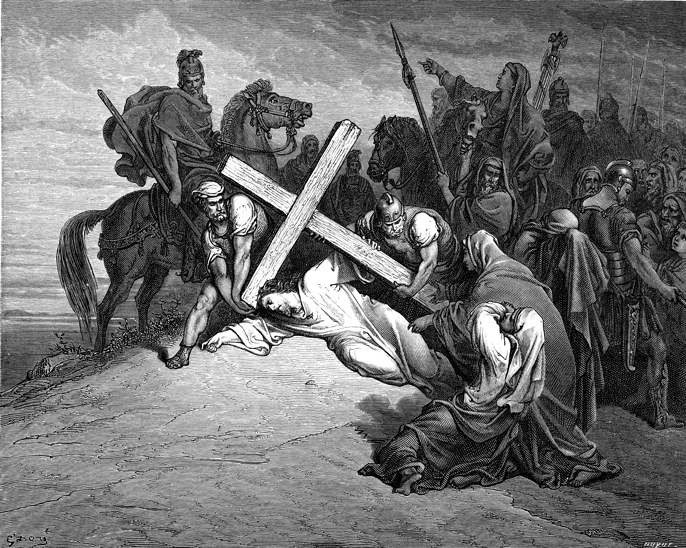
Now as they led him away to death we find, I. One that was a bearer, that carried his cross, Simon by name, a Cyrenian, who probably was a friend of Christ, and was known to be so, and this was done to put a reproach upon him; they laid Christ's cross upon him, that he might bear it after Jesus (
quarantine:debris (2026-07-29) — unbalanced-parens
The Nineteenth Century2 voices
A commentator
J.C. Ryle1816–1900
Expository Thoughts on the Gospels: Luke (lightly modernized text, Grace Gems edition) (1858)
We should observe, for one thing, in this passage — what striking testimony was borne to our Lord Jesus Christ's perfect innocence by His judges. We are told that Pilate said to the Jews, "You brought me this man as one who was inciting the people to rebellion. I have examined him in your presence, and have found no basis for your charges against him. Neither has Herod — for he sent him back to us; as you can see — he has done nothing to deserve death." The Roman and the Galilean governors were both of one mind.
A commentator
J.C. Ryle1816–1900
Expository Thoughts on the Gospels: Luke (lightly modernized text, Grace Gems edition) (1858)
proposed
We should observe, for one thing, in this passage — what striking testimony was borne to our Lord Jesus Christ's perfect innocence by His judges. We are told that Pilate said to the Jews, "You brought me this man as one who was inciting the people to rebellion. I have examined him in your presence, and have found no basis for your charges against him. Neither has Herod — for he sent him back to us; as you can see — he has done nothing to deserve death." The Roman and the Galilean governors were both of one mind. Both agreed in pronouncing our Lord not guilty of the things laid to His charge. There was a peculiar fitness in this public declaration of Christ's innocence . Our Lord, we must remember, was about to be offered up as a sacrifice for our sins. It was proper and right that those who examined Him should formally pronounce Him to be an innocent and blameless person. It was fit and right that the Lamb of God should be found by those who slew Him, to be "a Lamb without blemish and without spot." (1 Peter 1:19.) The over-ruling hand of God so ordered the events of His trial, that even when His enemies were judges — they could find no fault with Him, nor prove any charge against Him. The circumstance before us, may seem of trifling importance to a careless Bible reader. It ought however to commend itself to the heart of every well-instructed Christian. We ought to be daily thankful that our great Substitute was in all respects perfect — and that our Surety was a complete and faultless Surety. What man can count the number of his sins? We leave undone, things which we should do; and we do things which we ought not to do — every day we live. But this must be our comfort, that Christ the Righteous One has undertaken to stand in our place, to pay the debt we all owe, and to fulfill the law we have all broken. He did fulfill that law completely.
The words behind it
19 Greek wordsEvery Greek word of this verse in the order it stands, with what it means and the door to its own study. The last column counts the times a word stands in the whole Bible: the rarer the word, the more the places it appears belong together.
| Greek | Sound | Meaning | Word study | In the Bible |
|---|---|---|---|---|
| ἀπέλυσεν | apelusen | He released | G630 → | 63 times |
| δὲ | de | then | G1161 → | 2765 times |
| τὸν | ton | the [one] | G3588 → | 19766 times |
| διὰ | dia | on account of | G1223 → | 664 times |
| στάσιν | stasin | insurrection | G4714 → | |
| καὶ | kai | and | G2532 → | 9120 times |
| φόνον | phonon | murder | G5408 → | |
| βεβλημένον | beblemenon | cast | G906 → | 121 times |
| εἰς | eis | into | G1519 → | 1755 times |
| φυλακὴν | phulaken | prison | G5438 → | 47 times |
| ὃν | hon | whom | G3739 → | 1405 times |
| ᾐτοῦντο· | etounto | they were asking for; | G154 → | 70 times |
| τὸν | ton | <the> | G3588 → | 19766 times |
| δὲ | de | and | G1161 → | 2765 times |
| Ἰησοῦν | iesoun | Jesus | G2424 → | 908 times |
| παρέδωκεν | paredoken | he delivered | G3860 → | 119 times |
| τῷ | to | to the | G3588 → | 19766 times |
| θελήματι | thelemati | will | G2307 → | 62 times |
| αὐτῶν.¶ | auton | of them. | G846 → | 5565 times |
ἀπέλυσενHe released
apelusenG630 →63 times
δὲthen
deG1161 →2765 times
τὸνthe [one]
tonG3588 →19766 times
διὰon account of
diaG1223 →664 times
στάσινinsurrection
stasinG4714 →
καὶand
kaiG2532 →9120 times
φόνονmurder
phononG5408 →
βεβλημένονcast
beblemenonG906 →121 times
εἰςinto
eisG1519 →1755 times
φυλακὴνprison
phulakenG5438 →47 times
ὃνwhom
honG3739 →1405 times
ᾐτοῦντο·they were asking for;
etountoG154 →70 times
τὸν<the>
tonG3588 →19766 times
δὲand
deG1161 →2765 times
ἸησοῦνJesus
iesounG2424 →908 times
παρέδωκενhe delivered
paredokenG3860 →119 times
τῷto the
toG3588 →19766 times
θελήματιwill
thelematiG2307 →62 times
αὐτῶν.¶of them.
autonG846 →5565 times
A shaded row is a word that stands 400 times or fewer in the Bible.
The walk
8 stopsEach card is a verse this one points to, and under it the verses that one points to in turn. Where several paths arrive at the same place, that place is listed first: the text keeps returning to it.
Through
Acts 3:14You rejected the Holy and Righteous One and asked that a murderer be released to you.
it leads to
- Mark 1:24
“What do You want with us, Jesus of Nazareth? Have You come to destroy us? I know who You are—the Holy One of God!”
- Acts 7:52
Which of the prophets did your fathers fail to persecute? They even killed those who foretold the coming of the Righteous One. And now you are His betrayers and murderers—
- 1 Peter 3:18
For Christ also suffered for sins once for all, the righteous for the unrighteous, to bring you to God. He was put to death in the body but made alive in the Spirit,
- Acts 4:27
In fact, this is the very city where Herod and Pontius Pilate conspired with the Gentiles and the people of Israel against Your holy servant Jesus, whom You anointed.
- Mark 1:24
Through
Luke 23:2And they began to accuse Him, saying, “We found this man subverting our nation, forbidding payment of taxes to Caesar, and proclaiming Himself to be Christ, a King.”
it leads to
- Acts 17:6–7
But when they could not find them, they dragged Jason and some other brothers before the city officials, shouting, “These men who have turned the world upside down have now come here,
- Acts 17:6–7
Through
Mark 15:15And wishing to satisfy the crowd, Pilate released Barabbas to them. But he had Jesus flogged, and handed Him over to be crucified.
it leads to
- Isaiah 50:6
I offered My back to those who struck Me, and My cheeks to those who tore out My beard. I did not hide My face from scorn and spittle.
- John 19:1
Then Pilate took Jesus and had Him flogged.
- Matthew 27:26
So Pilate released Barabbas to them. But he had Jesus flogged, and handed Him over to be crucified.
- Isaiah 50:6
Where this verse is studied
About Luke
This page draws on 15 works. Open the list of works
This page draws on Albert Barnes, Notes, Explanatory and Practical, on the Gospels; Ambrose of Milan, EXPOSITION OF THE GOSPEL OF LUKE 10.100; Ambrose of Milan, EXPOSITION OF THE GOSPEL OF LUKE 10.101; Ambrose of Milan, Catena Aurea by Aquinas; Bonaventure, Commentary on Luke, Chapter 23; Cyril of Alexandria, COMMENTARY ON LUKE, HOMILY 152; Cyril of Jerusalem, Catechetical Lecture 13:3; J.C. Ryle, Expository Thoughts on the Gospels: Luke (lightly modernized text, Grace Gems edition); John Calvin, Commentary on a Harmony of the Evangelists; John Gill, Exposition of the New Testament (1746-1748); Matthew Henry, Commentary on the Whole Bible; Origen of Alexandria, HOMILIES ON LEVITICUS 10.2.2; Origen of Alexandria, AGAINST CELSUS 8.42; Tertullian, Against Marcion Book IV and Theophylact of Ohrid, Catena Aurea by Aquinas.