
Luke 23:31
in Luke 23For if men do these things while the tree is green, what will happen when it is dry?”
BSB
The same verse in ASV and KJV ▾
ASV
For if they do these things in the green tree, what shall be done in the dry?
KJV
For if they do these things in a green tree, what shall be done in the dry?
⋯
This verse in Luke 23
Commentary
20 notes on this verseSeize the opportunity of unexpected felicity: that you, who sometime were in God's sight nothing but "a drop of a bucket," and "dust of the threshing-floor," and "a potter's vessel," may thenceforward become that "tree which is sown beside the waters, is perennial in leaves, bears fruit at its own time," and shall not see fire," nor "axe.
This site's exposition
At that time
on Luke 23:30-31
The cry to the mountains and hills echoes Hosea 10:8. Revelation 6:16 uses it for the terror of the last day.
This site's exposition
while the tree is green
Jesus argues from lesser to greater. John Wesley calls it a Jewish proverb comparing a good man to a green tree, a bad man to a dead one. Albert Barnes explains that green wood is hard to kindle, so if the innocent suffers this, the guilty nation faces heavier judgment.
The record, by era
The Church Fathers1 voice
A commentator
Ephrem the SyrianCOMMENTARY ON TATIAN'S DIATESSARON 20.21 · Written before 373.
proposed
The Lord said, "If they do that to the green wood." He compared his divinity with the green wood and those who received his gifts to the dry wood. What is green bears fruit, as these words that he spoke testify: "For which of my …
The Medieval Church4 voices
As though He said to the Jews, If then the Romans have so raged against Me, a fruit-bearing and ever flourishing tree, what will they not attempt against you the people, who are a dry tree, destitute of every lifegiving virtue, and bearing no fruit?
(Mor. 12. c. 4) He has called Himself the green wood and us the dry, for He has in Himself the life and strength of the Divine nature; but we who are mere men are called the dry wood.
For if they do these things to the green wood, what will happen to the dry one? The green wood signifies himself and his chosen ones, while the dry one signifies the impious and sinners. Therefore, if I, he says, who have not committed sin, …
It follows, But if they do these things in a green tree, what shall be done in the dry?
12 more voices on this verse
The Medieval Church3 voices
Or as if He spake to all: If I who have done no sin being called the tree of life, do not depart from the world without suffering the fire of my Passion, what torment think ye awaits those who are barren of all fruits?
But that such horrible days are to be awaited without doubt, dreaded, and anticipated with weeping, he shows from the consideration of his own passion, when he adds: For if they do these things in the green wood, what will be done in the dry? …
For if the Romans have done this to Me, a moist tree, fruit-bearing, ever green and ever living by the power of the Godhead, and nourishing all with the fruits of My teaching, what will they not do to you, that is, to the people, …
The Puritans and the Awakening3 voices
If they do these things in the green tree, what shall be done in the dry? - Our Lord makes use of a proverbial expression, frequent among the Jews, who compare a good man to a green tree, and a bad man to a dead one: as if he had said, If an innocent person suffer thus, what will become of the wicked? Of those who are as ready for destruction as dry wood for the fire?
36 And the soldiers also mocked him, coming to him, and offering him vinegar, 37 And saying, If thou be the king of the Jews, save thyself. 38 And a superscription also was written over him in letters of Greek, and Latin, and Hebrew, THIS IS THE KING OF THE JEWS. 39 And one of the malefactors which were hanged railed on him, saying, If thou be Christ, save thyself and us.
quarantine:scripture (2026-07-29) — verbatim-scripture
For if they do these things in a green tree,....
The Nineteenth Century6 voices
A commentator
Albert Barnes1798–1870
Notes, Explanatory and Practical, on the Old and New Testaments (1832-1869)
For if they do these things in a green tree ... - This seems to be a proverbial expression. A “green” tree is not easily set on fire; a dry one is easily kindled and burns rapidly; and the meaning of the passage is - “If they, the Romans, do these things to me, who am innocent and blameless; if they punish me in this manner in the face of justice, what will they not do in relation to this guilty nation? What security have they that heavier judgments will not come upon them?
A commentator
Jamieson, Fausset & Brown1802–1910
Commentary Critical and Explanatory on the Whole Bible (1871)
proposed
green tree--that naturally resists the fire. the dry--that attracts the fire, being its proper fuel. The proverb here plainly means: "If such sufferings alight upon the innocent One, the very Lamb of God, what must be in store for those who are provoking the flames?" Lu 23:32-38, 44-46.
quarantine:debris (2026-07-29) — starts-lowercase
A commentator
J.C. Ryle1816–1900
Expository Thoughts on the Gospels: Luke (lightly modernized text, Grace Gems edition) (1858)
proposed
These words must have sounded particularly terrible to the ears of a Jewish woman. To her, it was always a disgrace to be childless. The idea of a time coming when it would be a blessing to have no children — must have been a strange and fearsome thought to her mind. And yet within fifty years, this prediction of Christ was literally fulfilled! The siege of Jerusalem by the Roman army under Titus, brought down on all the inhabitants of the city the most horrible sufferings from famine and pestilence that can be conceived. Women are reported to have actually eaten their own children during the siege for lack of food. Upon none did the last judgments sent upon the Jewish nation fall so heavily, as upon the wives, the mothers, and the little children. Let us beware of supposing that the Lord Jesus holds out to man nothing but mercy, pardon, love, and forgiveness. Beyond all doubt, He is plenteous in mercy. His mercy is like a mighty stream. He "delights in mercy." But we must never forget that there is justice with Him — as well as mercy . He is preparing punishments for the impenitent and the unbelieving. There is wrath revealed in the Gospel, for those who harden themselves in wickedness. The same cloud which was bright to Israel — was dark to the Egyptians. The same Lord Jesus who invites the laboring and heavy-laden to come to Him and rest — declares most plainly that unless a man repents — he will certainly perish; and that he who does not believe — shall be damned. (Luke 13:3; Mark 16:16.) The same Savior who now holds out His hands to the disobedient and rebellious — will come one day "from Heaven in blazing fire with his powerful angels. He will punish those who do not know God, and do not obey the gospel of our Lord Jesus.
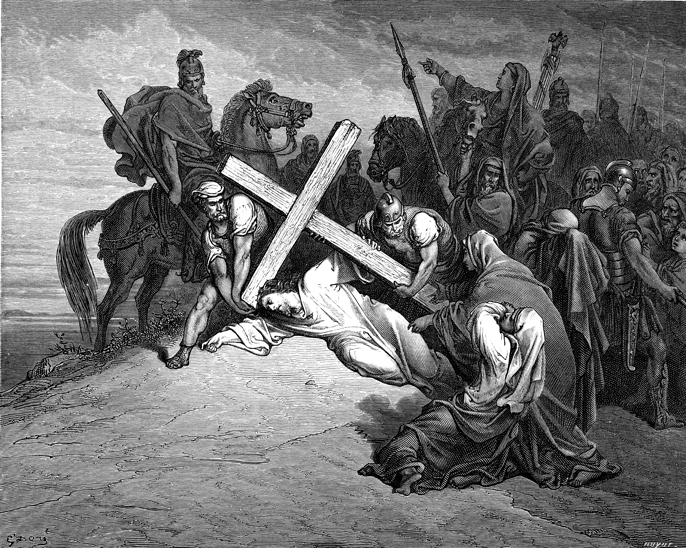
CAN you picture the scene? Jesus is given up by Pilate to the Jews that they may do their will with Him and, led by a small band of soldiers, He is conducted into the public street, bearing His Cross upon His shoulders. Perhaps they judged Him to be weary with His night of watching and worn with His suffering from the scourge, and they feared lest He might die upon the road and, therefore, with a cruel mercy, they laid hold upon one in the crowd who had too loudly expressed His sympathy, impressed him into military service and compelled him to assist in carrying the instrument of execution. You see the haughty scribes and the ribald throng—but the center of the spectacle, and the cause of it all was our Lord Himself—Jesus of Nazareth, the King of the Jews. We cannot paint Him. All who have ever attempted to do so have, to a large extent, been unsuccessful, for there was upon His face a mingled majesty and meekness, loveliness and lowliness, sanctity and sorrow which it would not be possible to express upon canvas or to represent in words. About His Person there were abundant marks of cruelty. He had been scourged. Everyone could see it. His own garments, which they had put upon Him, could not conceal the marks of the Roman lash. The traces of the crown of thorns were on His brow and the rough treatment of the soldiers had left its tokens, too, so that His visage was more marred than that of any man. And His form more than the sons of men. And now He is being led away to be put to the shameful death of the Cross. There were some glad eyes there, delighted that, at last, their victim was in their power and that the eloquent tongue which had exposed their hypocrisy would now be silenced in death. There, too, were the unfeeling Romans, to whom human life was a trifle. And all around, gathered in dense masses, the brutal mob, bribed to shout against their best Friend.
CAN you picture the scene? Jesus is given up by Pilate to the Jews that they may do their will with Him and, led by a small band of soldiers, He is conducted into the public street, bearing His Cross upon His shoulders.
If they do these things in a green tree - This seems to be a proverbial expression, the sense of which is: If they spare not a tree which, by the beauty of its foliage, abundance and excellence of its fruits, deserves to be preserved, then the tree which is dry and withered will surely be cut down. If an innocent man be put to death in the very face of justice, in opposition to all its dictates and decisions, by a people who profess to be governed and directed by Divine laws, what desolation, injustice, and oppression may not be expected, when anarchy and confusion sit in the place where judgment and justice formerly presided? Our Lord alludes prophetically to those tribulations which fell upon the Jewish people about forty years after. See the notes on Matthew 24:1-51 (note).
The words behind it
13 Greek wordsEvery Greek word of this verse in the order it stands, with what it means and the door to its own study. The last column counts the times a word stands in the whole Bible: the rarer the word, the more the places it appears belong together.
| Greek | Sound | Meaning | Word study | In the Bible |
|---|---|---|---|---|
| ὅτι | hoti | For | G3754 → | 1292 times |
| εἰ | ei | if | G1487 → | 508 times |
| ἐν | en | in | G1722 → | 2738 times |
| τῷ | to | the | G3588 → | 19766 times |
| ὑγρῷ | hugro | green | G5200 → | |
| ξύλῳ | xulo | tree | G3586 → | |
| ταῦτα | tauta | these things | G3778 → | 1381 times |
| ποιοῦσιν, | poiousin | they do, | G4160 → | 569 times |
| ἐν | en | in | G1722 → | 2738 times |
| τῷ | to | the | G3588 → | 19766 times |
| ξηρῷ | xero | dry | G3584 → | 8 times |
| τί | ti | what | G5101 → | 563 times |
| γένηται;¶ | genetai | may happen? | G1096 → | 667 times |
ὅτιFor
hotiG3754 →1292 times
εἰif
eiG1487 →508 times
ἐνin
enG1722 →2738 times
τῷthe
toG3588 →19766 times
ὑγρῷgreen
hugroG5200 →
ξύλῳtree
xuloG3586 →
ταῦταthese things
tautaG3778 →1381 times
ποιοῦσιν,they do,
poiousinG4160 →569 times
ἐνin
enG1722 →2738 times
τῷthe
toG3588 →19766 times
ξηρῷdry
xeroG3584 →8 times
τίwhat
tiG5101 →563 times
γένηται;¶may happen?
genetaiG1096 →667 times
A shaded row is a word that stands 400 times or fewer in the Bible.
The walk
8 stopsEach card is a verse this one points to, and under it the verses that one points to in turn. Where several paths arrive at the same place, that place is listed first: the text keeps returning to it.
Through
John 15:6If anyone does not remain in Me, he is like a branch that is thrown away and withers. Such branches are gathered up, thrown into the fire, and burned.
it leads to
- Matthew 7:19
Every tree that does not bear good fruit is cut down and thrown into the fire.
- Hebrews 6:7–8
For land that drinks in the rain often falling on it and that produces a crop useful to those for whom it is tended receives the blessing of God.
- Matthew 13:41
The Son of Man will send out His angels, and they will weed out of His kingdom every cause of sin and all who practice lawlessness.
- John 15:2
He cuts off every branch in Me that bears no fruit, and every branch that does bear fruit, He prunes to make it even more fruitful.
- Matthew 3:10
The axe lies ready at the root of the trees, and every tree that does not produce good fruit will be cut down and thrown into the fire.
- Matthew 7:19
Through
Matthew 3:12His winnowing fork is in His hand to clear His threshing floor and to gather His wheat into the barn; but He will burn up the chaff with unquenchable fire.”
it leads to
- Malachi 4:1
“For behold, the day is coming, burning like a furnace, when all the arrogant and every evildoer will be stubble; the day is coming when I will set them ablaze,” says the LORD of…
- Matthew 13:30
Let both grow together until the harvest. At that time I will tell the harvesters: First collect the weeds and tie them in bundles to be burned; then gather the wheat into my barn.’”
- Luke 3:17
His winnowing fork is in His hand to clear His threshing floor and to gather the wheat into His barn; but He will burn up the chaff with unquenchable fire.”
- Malachi 4:1
Where this verse is studied
On this page
Studies14
On this verse
On this chapter
About Luke
This page draws on 17 works. Open the list of works
This page draws on Adam Clarke, Commentary on the Bible; Albert Barnes, Notes, Explanatory and Practical, on the Old and New Testaments (1832-1869); Bede, On the Gospel of Luke; Bede, Catena Aurea by Aquinas; Bonaventure, Commentary on Luke, Chapter 23; Charles Spurgeon, The Metropolitan Tabernacle Pulpit, Sermon No. 1320: “Why Should I Weep?” (lightly modernized text, CCEL edition); Ephrem the Syrian, COMMENTARY ON TATIAN'S DIATESSARON 20.21; Gregory the Dialogist, Catena Aurea by Aquinas; J.C. Ryle, Expository Thoughts on the Gospels: Luke (lightly modernized text, Grace Gems edition); Jamieson, Fausset & Brown, Commentary Critical and Explanatory on the Whole Bible; John Gill, Exposition of the New Testament; John Gill, Exposition of the New Testament (1746-1748); John Wesley, Explanatory Notes upon the New Testament; Matthew Henry, Commentary on the Whole Bible; Tertullian, On Repentance; Theophylact of Ohrid, Catena Aurea by Aquinas and Theophylact of Ohrid, Commentary on Luke.