
Luke 23:30
in Luke 23At that time ‘they will say to the mountains, “Fall on us!” and to the hills, “Cover us!”’
BSB
The same verse in ASV and KJV ▾
ASV
Then shall they begin to say to the mountains, Fall on us; and to the hills, Cover us.
KJV
Then shall they begin to say to the mountains, Fall on us; and to the hills, Cover us.
⋯
This verse in Luke 23
Commentary
12 notes on this verseBy these days He signifies the time of the siege and captivity which was coming upon them from the Romans, of which He had said before, Woe to them that are with child, and give suck in those days. It is natural, when captivity by an enemy is threatening, to seek for refuge in fastnesses or hidden places, where men may lie concealed. And so it follows, Then shall they begin to say to the mountains, Fall on us; and to the hills, Cover us.
This site's exposition
At that time
on Luke 23:30-31
The cry to the mountains and hills echoes Hosea 10:8. Revelation 6:16 uses it for the terror of the last day.
The record, by era
The Church Fathers1 voice
He then says, "Then they will begin to say to the mountains, 'Fall on us'; and to the hills, 'Cover us.' " In extreme miseries, those less severe misfortunes become, so to speak, desirable.
The Medieval Church2 voices
Tears bring consolation not to those who suffer willingly, but to those who suffer unwillingly. Therefore He forbids them to weep for Him, and urges them to turn their attention to the future calamities and to weep over those calamities, when women without pity will …
And with this understanding what follows is more consonant: Then they will begin to say to the mountains: Fall upon us, and to the hills: Cover us. This will be at the appearance of the Judge, according to that passage in Revelation 6: "They hid …
The Puritans and the Awakening2 voices
This would be the language especially of the great and mighty men, Rev. vi. They that would not flee to Christ for refuge, and put themselves under his protection, will in vain call to hills and mountains to shelter them from his wrath. He shows how natural it was for them to infer this desolation from his sufferings.
Then shall they begin to say,....
5 more voices on this verse
The Nineteenth Century5 voices
Mountains, fall on us - As this refers to the destruction of Jerusalem, and as the same expressions are used, Rev 6:16, Dr. Lightfoot conjectures that the whole of that chapter may relate to the same event.
A commentator
J.C. Ryle1816–1900
Expository Thoughts on the Gospels: Luke (lightly modernized text, Grace Gems edition) (1858)
proposed
These words must have sounded particularly terrible to the ears of a Jewish woman. To her, it was always a disgrace to be childless. The idea of a time coming when it would be a blessing to have no children — must have been a strange and fearsome thought to her mind. And yet within fifty years, this prediction of Christ was literally fulfilled! The siege of Jerusalem by the Roman army under Titus, brought down on all the inhabitants of the city the most horrible sufferings from famine and pestilence that can be conceived. Women are reported to have actually eaten their own children during the siege for lack of food. Upon none did the last judgments sent upon the Jewish nation fall so heavily, as upon the wives, the mothers, and the little children. Let us beware of supposing that the Lord Jesus holds out to man nothing but mercy, pardon, love, and forgiveness. Beyond all doubt, He is plenteous in mercy. His mercy is like a mighty stream. He "delights in mercy." But we must never forget that there is justice with Him — as well as mercy . He is preparing punishments for the impenitent and the unbelieving. There is wrath revealed in the Gospel, for those who harden themselves in wickedness. The same cloud which was bright to Israel — was dark to the Egyptians. The same Lord Jesus who invites the laboring and heavy-laden to come to Him and rest — declares most plainly that unless a man repents — he will certainly perish; and that he who does not believe — shall be damned. (Luke 13:3; Mark 16:16.) The same Savior who now holds out His hands to the disobedient and rebellious — will come one day "from Heaven in blazing fire with his powerful angels. He will punish those who do not know God, and do not obey the gospel of our Lord Jesus.
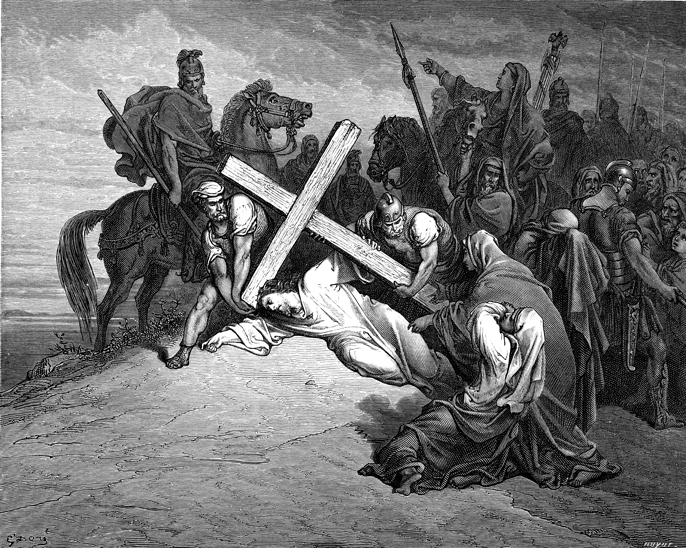
CAN you picture the scene? Jesus is given up by Pilate to the Jews that they may do their will with Him and, led by a small band of soldiers, He is conducted into the public street, bearing His Cross upon His shoulders. Perhaps they judged Him to be weary with His night of watching and worn with His suffering from the scourge, and they feared lest He might die upon the road and, therefore, with a cruel mercy, they laid hold upon one in the crowd who had too loudly expressed His sympathy, impressed him into military service and compelled him to assist in carrying the instrument of execution. You see the haughty scribes and the ribald throng—but the center of the spectacle, and the cause of it all was our Lord Himself—Jesus of Nazareth, the King of the Jews. We cannot paint Him. All who have ever attempted to do so have, to a large extent, been unsuccessful, for there was upon His face a mingled majesty and meekness, loveliness and lowliness, sanctity and sorrow which it would not be possible to express upon canvas or to represent in words. About His Person there were abundant marks of cruelty. He had been scourged. Everyone could see it. His own garments, which they had put upon Him, could not conceal the marks of the Roman lash. The traces of the crown of thorns were on His brow and the rough treatment of the soldiers had left its tokens, too, so that His visage was more marred than that of any man. And His form more than the sons of men. And now He is being led away to be put to the shameful death of the Cross. There were some glad eyes there, delighted that, at last, their victim was in their power and that the eloquent tongue which had exposed their hypocrisy would now be silenced in death. There, too, were the unfeeling Romans, to whom human life was a trifle. And all around, gathered in dense masses, the brutal mob, bribed to shout against their best Friend.
CAN you picture the scene? Jesus is given up by Pilate to the Jews that they may do their will with Him and, led by a small band of soldiers, He is conducted into the public street, bearing His Cross upon His shoulders.
A commentator
Albert Barnes1798–1870
Notes, Explanatory and Practical, on the Old and New Testaments (1832-1869)
proposed
To the mountains, Fall on us ... - This is an image of great calamities and judgments. So great will be the calamities that they will seek for shelter from the storm, and will call on the hills to protect them. The same figure is used respecting the wicked in the day of judgment in Rev 6:16-17. Compare also Isa 2:21.
The words behind it
13 Greek wordsEvery Greek word of this verse in the order it stands, with what it means and the door to its own study. The last column counts the times a word stands in the whole Bible: the rarer the word, the more the places it appears belong together.
| Greek | Sound | Meaning | Word study | In the Bible |
|---|---|---|---|---|
| τότε | tote | Then | G5119 → | 160 times |
| ἄρξονται | arxontai | They will begin | G757 → | 85 times |
| λέγειν | legein | to say | G3004 → | 1325 times |
| τοῖς | tois | to the | G3588 → | 19766 times |
| ὄρεσιν· | oresin | mountains; | G3735 → | 62 times |
| πέσετε | pesete | do fall | G4098 → | 90 times |
| ἐφ᾽ | eph᾽ | upon | G1909 → | 883 times |
| ἡμᾶς· | hemas | us; | G3165 → | 1936 times |
| καὶ | kai | and | G2532 → | 9120 times |
| τοῖς | tois | to the | G3588 → | 19766 times |
| βουνοῖς· | bounois | hills; | G1015 → | |
| καλύψατε | kalupsate | do cover | G2572 → | |
| ἡμᾶς. | hemas | us. | G3165 → | 1936 times |
τότεThen
toteG5119 →160 times
ἄρξονταιThey will begin
arxontaiG757 →85 times
λέγεινto say
legeinG3004 →1325 times
τοῖςto the
toisG3588 →19766 times
ὄρεσιν·mountains;
oresinG3735 →62 times
πέσετεdo fall
peseteG4098 →90 times
ἐφ᾽upon
eph᾽G1909 →883 times
ἡμᾶς·us;
hemasG3165 →1936 times
καὶand
kaiG2532 →9120 times
τοῖςto the
toisG3588 →19766 times
βουνοῖς·hills;
bounoisG1015 →
καλύψατεdo cover
kalupsateG2572 →
ἡμᾶς.us.
hemasG3165 →1936 times
A shaded row is a word that stands 400 times or fewer in the Bible.
The walk
8 stopsEach card is a verse this one points to, and under it the verses that one points to in turn. Where several paths arrive at the same place, that place is listed first: the text keeps returning to it.
Through
Revelation 6:16And they said to the mountains and the rocks, “Fall on us and hide us from the face of the One seated on the throne, and from the wrath of the Lamb.
it leads to
- Hosea 10:8
The high places of Aven will be destroyed—it is the sin of Israel; thorns and thistles will overgrow their altars. Then they will say to the mountains, “Cover us!” and to the hills, “Fall…
Reached by 3 separate paths from here.
- Revelation 4:2
At once I was in the Spirit, and I saw a throne standing in heaven, with someone seated on it.
- Revelation 20:11
Then I saw a great white throne and the One seated on it. Earth and heaven fled from His presence, and no place was found for them.
- Hosea 10:8
Through
Hosea 10:8The high places of Aven will be destroyed—it is the sin of Israel; thorns and thistles will overgrow their altars. Then they will say to the mountains, “Cover us!” and to the hills, “Fall…
it leads to
- Revelation 6:16
And they said to the mountains and the rocks, “Fall on us and hide us from the face of the One seated on the throne, and from the wrath of the Lamb.
Reached by 2 separate paths from here.
- Revelation 6:16
Through
Revelation 9:6In those days men will seek death and will not find it; they will long to die, but death will escape them.
it leads to
- Isaiah 2:19
Men will flee to caves in the rocks and holes in the ground, away from the terror of the LORD and from the splendor of His majesty, when He rises to shake the earth.
Reached by 2 separate paths from here.
- Jeremiah 8:3
And wherever I have banished them, the remnant of this evil family will choose death over life,” declares the LORD of Hosts.
- Job 7:15–16
so that I would prefer strangling and death over my life in this body.
- Isaiah 2:19
Through
Isaiah 2:19Men will flee to caves in the rocks and holes in the ground, away from the terror of the LORD and from the splendor of His majesty, when He rises to shake the earth.
it leads to
- Isaiah 2:10
Go into the rocks and hide in the dust from the terror of the LORD and the splendor of His majesty.
- Isaiah 2:10
Where this verse is studied
On this page
About Luke
This page draws on 12 works. Open the list of works
This page draws on Adam Clarke, Commentary on the Bible; Albert Barnes, Notes, Explanatory and Practical, on the Old and New Testaments (1832-1869); Bede, Catena Aurea by Aquinas; Bonaventure, Commentary on Luke, Chapter 23; Charles Spurgeon, The Metropolitan Tabernacle Pulpit, Sermon No. 1320: “Why Should I Weep?” (lightly modernized text, CCEL edition); Cyril of Alexandria, COMMENTARY ON LUKE, HOMILY 152; J.C. Ryle, Expository Thoughts on the Gospels: Luke (lightly modernized text, Grace Gems edition); Jamieson, Fausset & Brown, Commentary Critical and Explanatory on the Whole Bible; John Gill, Exposition of the New Testament; John Gill, Exposition of the New Testament (1746-1748); Matthew Henry, Commentary on the Whole Bible and Theophylact of Ohrid, Commentary on Luke.