
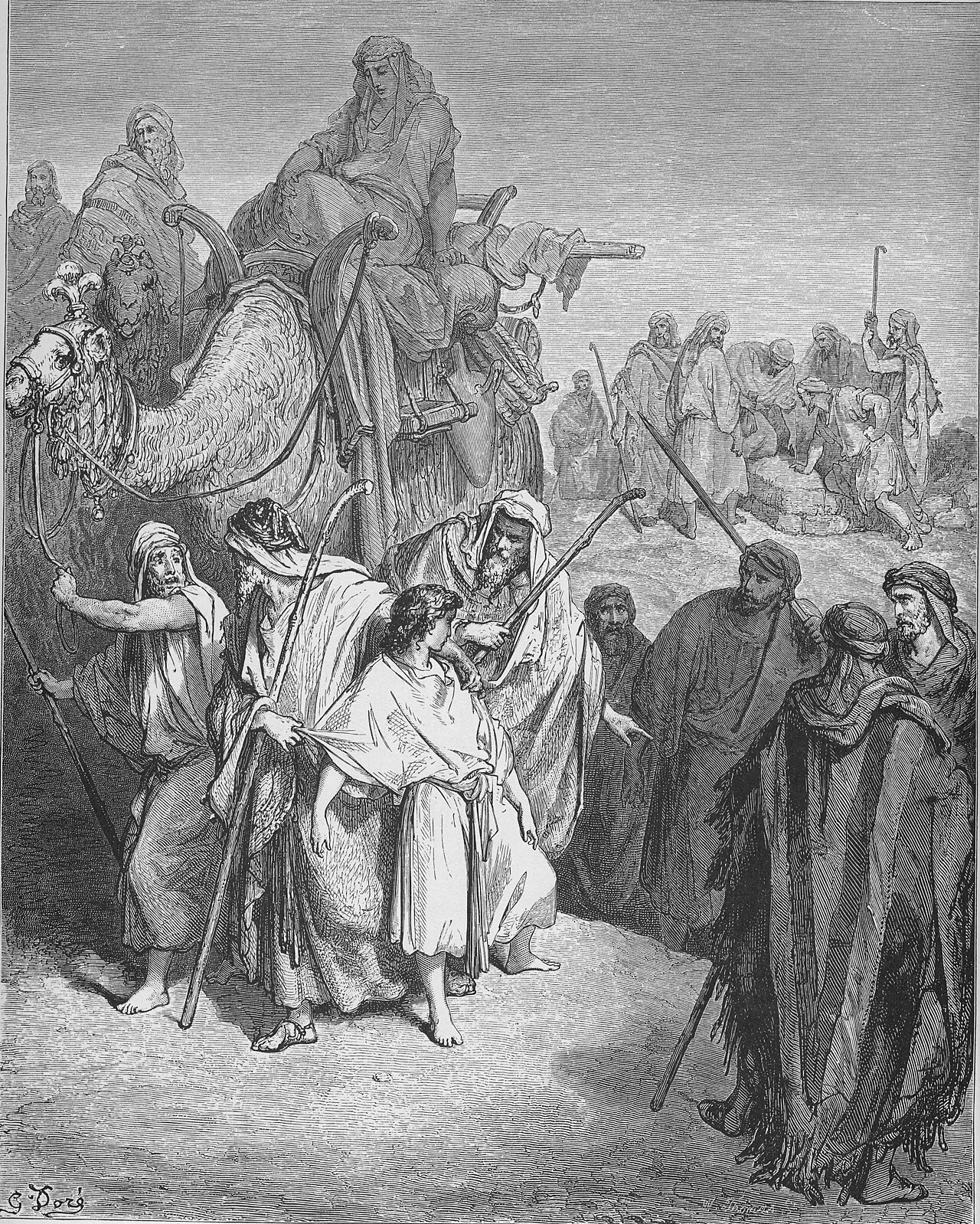
Genesischapter 37
36 verses · Moses, by tradition · 15th to 13th century BC · The Law
Now Jacob lived in the land where his father had resided, the land of Canaan.
Introduction
Moses, by tradition, The Law, Genesis Overview.
This chapter opens the last and longest story in Genesis, and Israel heard it as the account of how their fathers came to be in Egypt. It begins inside one household, where a father's favour and a son's dreams turn ten brothers against one of their own. What follows is a family crime, carried out in open country and hidden with a lie. Listen for the garment that passes from hand to hand, and for which brothers try to limit the harm. Notice how far apart the father and the son are when it ends. Everything in the next thirteen chapters grows from what happens here.
Context
- Who
- Israel in the wilderness, descendants of the brothers who did this
- What
- A narrative of Joseph's dreams, his brothers' hatred, and his sale to traders bound for Egypt.
- Where
- The valley of Hebron, the pastures near Shechem and Dothan, and the trade road from Gilead down to Egypt.
- When
- About 1898 BC by the traditional dating, when Genesis 37:2 gives Joseph's age as seventeen.
- Why
- To explain how the family of Israel came to be in Egypt, and to set out the dreams the rest of Genesis brings to pass.
Historical context
The chapter is Joseph's and his brothers', and Joseph is a boy of seventeen kept at home while the others work the flocks.
Show the rest of the historical context, 5 more paragraphs
The ground runs from Hebron north to Shechem and on to Dothan, which sits on the main trade route from Gilead down to the coastal road, which is why a caravan appears at that moment. The occasion is an errand, since Israel sends the favoured son fifty miles north to see how his brothers are faring, and the town he is sent to is the one Simeon and Levi had emptied at Genesis 34.
A first hearer knew what the coat meant. The phrase used of it points to a long garment reaching the wrists and the ankles, wall paintings from the era show Semitic men in decorated robes of that kind, and it is a garment a man cannot work in, so giving it to the eleventh son was a public announcement about who would lead.
He knew the cargo as well, since the caravan carries gum, balm and myrrh, resins from east of the Jordan bound for Egypt, where they were used in medicine and in embalming, and slaves were an ordinary sideline for such traders.
Twenty shekels of silver is the going price for a young male slave in the early second millennium, and Leviticus 27:5 later fixes that same figure for a male between five and twenty years of age.
The pit is a cistern, a bell shaped plastered water hole cut into rock and empty in the dry season, and a torn and bloodied garment was recognised proof that an animal had killed, which released a shepherd from liability. The brothers use that convention to lie to their father.
Significance
The nation heard how it came to be in Egypt, and the answer was a family crime rather than an accident or an invasion.
Show the rest of the significance, 2 more paragraphs
The two dreams that start the chapter hang over the rest of the book unfulfilled, and Israel heard this in the desert already knowing how it turned out.
Stephen puts the same reading to the council at Acts 7:9, that the patriarchs were jealous of Joseph and sold him into Egypt, and that God was with him.
This chapter in Jewish lifeWhat this chapter is in Jewish life and reading.
How it is read
Rashi opens the chapter on the question of why Esau's line was told briefly and Jacob's at length, and answers that Scripture passes over the settlements of the one and follows the other into every trouble that befell it (Rashi on Genesis 37:1:1 and 37:2:1, the Pentateuch with Rashi's commentary by M. Rosenbaum and A. M. Silbermann, 1929 to 1934, public domain). Through the rest of the chapter he reads the brothers as men who are hard but not false. Of their inability to speak peaceably he says, "from what is stated to their discredit we may infer something to their credit", because they at least did not say one thing while meaning another (Rashi on Genesis 37:4:1). He notes the scribal dots over a word in the twelfth verse "to denote that they went only to feed themselves", on Genesis Rabbah 84:13 (Rashi on Genesis 37:12:1), and reads Joseph's answer to his father as obedience against his own interest: "An expression denoting humility and readiness: he was zealous to perform his father's bidding, although he was aware that his brothers hated him" (Rashi on Genesis 37:13:1). The man who finds Joseph wandering he identifies from Daniel, "This was the angel Gabriel", on Genesis Rabbah 84:14 and Midrash Tanchuma, Vayeshev 2:3 (Rashi on Genesis 37:15:1), and the report that the brothers had gone from that place he reads twice over, the second time as a comment on them: "they have departed from all feeling of brotherhood" (Rashi on Genesis 37:17:1). Reuben's plan he defends out of Scripture itself, "The Holy Spirit (Scripture) bears witness for Reuben that he said this only for the purpose of saving his brother" (Rashi on Genesis 37:22:1). Radak reads the dreams as plain and Joseph's telling of them as unwise. On the second dream he says the meaning is clear, "Sun and moon refer to Joseph's parents, whereas the stars refer to his brothers", counting eleven stars against eleven brothers (Radak on Genesis 37:9:1, translated by Eliyahu Munk, HaChut Hameshulash, CC-BY), and on the first he holds that Joseph wanted his brothers to feel their own jealousy (Radak on Genesis 37:5:1). Sforno reads the brothers' name for Joseph as an accusation of motive, "They meant that Joseph had wanted them to commit a sin as a result of their anger" (Sforno on Genesis 37:19:1, Munk translation, CC-BY). One further comment of Sforno at 37:6:1 and one of Ibn Ezra at 37:16:1 stand without English in the corpus, so both are citations.
What the rabbis say
The corpus records forty rabbinic locators on this chapter, thirty-four of them Midrash and six Talmud. Bereshit Rabbah follows the story closely at 84:1, 84:9, 84:16, 84:19, 84:20, 84:21 and 84:22, with 85:3 and 85:11 at the sending and the bloodied coat, and 1:5, 33:6, 88:5 and 99:8 drawn in from elsewhere in the midrash. Aggadat Bereshit is cited at 40:1, 53:3, 58:1, 59:1, 61:3, 68:2, 73:1 and 73:3, Bereshit Rabbati at Parashat Vayeshev 4, 5, 7, 8 and 43, Bamidbar Rabbah at 4:10, 9:24 and 13:18, and Midrash Aggadah at Genesis 37:3:1, 37:3:2 and 37:6:1. The six Talmud locators mark the chapter's worst turns: Avot DeRabbi Natan 2:5 at the beginning and 34:5 at the going out to pasture, Bava Batra 15a:12 at Joseph's search, Berakhot 7b:8 at Reuben's intervention, Avot DeRabbi Natan, Recension B 45:6 at the pit and Arakhin 16a:13 at the selling. Rashi hands on further sayings with their locators, among them Genesis Rabbah 84:8, 84:13 and 84:14 and Midrash Tanchuma, Vayeshev 2:3.
Sources: Rashi, Rashi on Genesis 37:1:1, 37:2:1, 37:3:1, 37:4:1, 37:7:1, 37:8:1, 37:10:1, 37:11:1, 37:12:1, 37:13:1, 37:14:1, 37:15:1, 37:17:1, 37:18:1, 37:20:1, 37:21:1, 37:22:1, 37:23:1 and 37:24:1, the Pentateuch with Rashi's commentary by M. Rosenbaum and A. M. Silbermann, 1929 to 1934, public domain; Radak, Radak on Genesis 37:5:1 and 37:9:1, translated by Eliyahu Munk, HaChut Hameshulash, CC-BY; Sforno, Sforno on Genesis 37:19:1, translated by Eliyahu Munk, HaChut Hameshulash, CC-BY; Sforno on Genesis 37:6:1, cited only; Ibn Ezra, Ibn Ezra on Genesis 37:16:1, cited only, no English version in the corpus under a licence permitting quotation; Midrash, Bereshit Rabbah 1:5, 33:6, 84:1, 84:9, 84:16, 84:19, 84:20, 84:21, 84:22, 85:3, 85:11, 88:5 and 99:8; Aggadat Bereshit 40:1, 53:3, 58:1, 59:1, 61:3, 68:2, 73:1 and 73:3; Bereshit Rabbati, Parashat Vayeshev 4, 5, 7, 8 and 43; Bamidbar Rabbah 4:10, 9:24 and 13:18; Midrash Aggadah, Genesis 37:3:1, 37:3:2 and 37:6:1; Esther Rabbah 7:25; Ein Yaakov (Glick Edition), Zevachim 9:1; Midrash Tanchuma, Vayeshev 2:3, as Rashi cites it; Babylonian Talmud, Bava Batra 15a:12, Berakhot 7b:8, Arakhin 16a:13; Avot DeRabbi Natan, Avot DeRabbi Natan 2:5 and 34:5; Avot DeRabbi Natan, Recension B 45:6.
The heads below are this chapter's scenes. The numbered points under each are its verses.
The Coat and the Dreams
the land where his father had resided: Jacob settles in Canaan, the land God promised him, and the verse calls it the land where his father had resided. Isaac had lived there all his life and owned none of it. The only ground the three patriarchs ever bought is the cave at Machpelah in Genesis 23 and a plot at Shechem in Genesis 33. Eleven verses later the brothers pasture flocks on that plot.
Genesis 37:1
“Moses confirms what he had before declared, that, by the departure of Esau, the land was left to holy Jacob as its sole possessor. Although in appearance he did not obtain a single clod; yet, contented with the bare sight of the land, he exercised his faith; and Moses expressly compares him with his father, who had been a stranger in that land all his life.”
John Calvin · Commentaries (1554)reformed
1 more voice on this verseWhat preachers and commentators have said about this verse, in their own words.
Genesis 37:1
“Jacob dwelt in the land wherein his father was a stranger--that is, "a sojourner"; "father" used collectively. The patriarch was at this time at Mamre, in the valley of Hebron (compare Ge 35:27); and his dwelling there was continued in the same manner and prompted by the same motives as that of Abraham and Isaac (Heb 11:13).”
Jamieson, Fausset & Brown · Commentary Critical and Explanatory on the Whole Bible (1871)reformed
This is the account of Jacob: , the eleventh and last of the headings that divide Genesis. The first stands at Genesis 2:4 over the heavens and the earth, and this one opens on a single household. Missler read the whole book by these eleven divisions. What follows the heading is a boy of seventeen tending the flock and bringing his father a bad report about his brothers.
Genesis 37:2
“These are the generations - תלדות toledoth, the history of the lives and actions of Jacob and his sons; for in this general sense the original must be taken, as in the whole of the ensuing history there is no particular account of any genealogical succession. Yet the words may be understood as referring to the tables or genealogical lists in the preceding chapter; and if so, the original must be understood in its common acceptation.”
Adam Clarke · Commentary on the Bible (1810-1826)evangelical
Genesis 37:3-4
Israel loved Joseph more than his other sons: Israel loved Joseph more than the rest, and the robe of many colors put the preference where everyone could see it. Clarke describes the garment as a long tunic reaching to the wrists and ankles, the dress of a son kept at home while his brothers worked the flocks. Isaac favored Esau and Rebekah favored Jacob at Genesis 25:28, and Jacob favored Rachel at Genesis 29:30. They hated him and had no kind word for him.
Genesis 37:3
“A coat of many colors - כתנת פסים kethoneth passim, a coat made up of stripes of differently colored cloth. Similar to this was the toga praetexta of the Roman youth, which was white, striped or fringed with purple; this they wore till they were seventeen years of age, when they changed it for the toga virilis, or toga pura, which was all white. Such vestures as clothing of distinction are worn all over Persia, India, and China to the present day.”
Adam Clarke · Commentary on the Bible (1810-1826)evangelical
2 more voices on this verse
Genesis 37:3
“But it was not surprising that the boy should be a great favorite with his aged father, for so it is wont to happen: and no just ground is here given for envy; seeing that sons of a more robust age, by the dictate of nature, might well concede such a point.”
John Calvin · Commentaries (1554)reformed
Genesis 37:3
“And so we are taught the proper nature of parental love and filial gratitude. It is pleasant to love one's children and very pleasant to love them exceedingly, but often even parental love does harm to the children unless it is practiced with restraint; for it may give the beloved child free rein out of excessive indulgence or, by preference shown to one child, may alienate the others from the spirit of brotherly love. That son gains more who gains the love of his brothers.”
Ambrose of Milan · written before 397 · On Joseph the Patriarchpatristic
could not speak a kind word to him: The Hebrew says they could not speak to him for peace, and shalom was the word of the ordinary daily greeting. The brothers withheld even that from him. Their anger fell on the son, and the choice they resented was their father's.
Genesis 37:4
“And Joseph was loved by his father a great deal. And he gave him a multicolored garment as an excellent gift and a proof of the love with which he accompanied him. And this was an incentive to envy for his brothers and a cause of hatred, as the following events will demonstrate. In fact, the Pharisees were inflamed with anger against the beloved, that is, Christ, because he had been clothed by God the Father with a multiform glory.”
Cyril of Alexandria · written before 444 · GLAPHYRA ON GENESIS, 6. 4patristic
1 more voice on this verse
Genesis 37:4
“And could not speak peaceably unto him - Does not this imply, in our use of the term, that they were continually quarrelling with him? but this is no meaning of the original: ולא יכלו דברו לשלם velo yachelu dabbero leshalom, they could not speak peace to him, i. e., they would not accost him in a friendly manner. They would not even wish him well. The eastern method of salutation is, Peace be to thee! שלום לך shalom lecha, among the Hebrews, and salam, peace, or salam kebibi, peace to thee my friend, among the Arabs.”
Adam Clarke · Commentary on the Bible (1810-1826)evangelical
Genesis 37:5-8
Joseph had a dream: of sheaves of grain in a field, and his brothers needed no interpreter for it. Their answer came back as two questions, whether he meant to reign over them and whether he would actually rule them. Joseph is the eleventh son, and the sheaves that bow are the sheaves of ten older brothers. Each telling raised the hatred a step.
Genesis 37:5
“But this dream was evidently symbolical. The meaning was easily discerned, and, from its being repeated under different emblems, the fulfilment was considered certain (compare Ge 41:32), whence it was that "his brethren envied him, but his father observed the saying" [Ge 37:11].”
Jamieson, Fausset & Brown · Commentary Critical and Explanatory on the Whole Bible (1871)reformed
Earlier dreams in Genesis carry a spoken word from God, to Abimelech at Genesis 20:3 and to Jacob at Genesis 28:13. Joseph's two dreams are pictures only, and no voice speaks in them. The meaning is left to the hearers.
Genesis 37:6
“And he said unto them, hear, I pray you, this dream which I have dreamed. Hear now, so the Targums of Onkelos and Jonathan, immediately, directly, lest he should forget it, having perhaps dreamt it the night before; though our version expresses more modesty and submission.”
We were binding sheaves of grain in the field: A family of shepherds dreams of a grain harvest, and grain is how the dream comes true. The brothers go down to Egypt to buy grain and bow before Joseph with their faces to the ground at Genesis 42:6. He holds the grain they need.
Genesis 37:7
“Indeed, God's grace shone on Joseph even in his boyhood. For he had a dream that when he was binding sheaves with his brothers—so it appeared to him in the vision—this sheaf rose up and stood straight, while the sheaves of his brothers turned and bowed down to his sheaf. Now in this the resurrection of the Lord Jesus that was to come was revealed.”
Ambrose of Milan · written before 397 · On Joseph the Patriarchpatristic
1 more voice on this verse
Genesis 37:7
“We were binding sheaves in the field - Though in these early times we read little of tillage, yet it is evident from this circumstance that it was practiced by Jacob and his sons.”
Adam Clarke · Commentary on the Bible (1810-1826)evangelical
because of his dream and his statements: Both questions double the verb in Hebrew, reign will you reign and rule will you rule, and the Berean carries that force with the word actually. Joseph gives the answer at Genesis 45:8, where God has made him ruler over all the land of Egypt. The Hebrew says dreams, plural.
Genesis 37:8
“Thou that art the youngest, over us that are elder? The reign of Jesus Christ, our Joseph, is despised and striven against by an unbelieving world, who cannot endure to think that this man should reign over them. The dominion also of the upright in the morning of the resurrection is thought of with the utmost disdain.”
John Wesley · Explanatory Notes upon the Old Testament (1765)evangelical
Genesis 37:9-11
the sun and moon and eleven stars: The second dream says the same thing on a larger scale, the sun and moon and eleven stars bowing down. Jacob rebukes the telling and then keeps in mind what Joseph said. Rachel had already died at Genesis 35:19, and Clarke names that difficulty about the moon and leaves it standing. His brothers were jealous of him.
Genesis 37:9
“He dreamed yet another dream - This is as clear as the preceding. But how could Jacob say, Shall I and thy mother, etc., when Rachel his mother was dead some time before this? Perhaps Jacob might hint, by this explanation, the impossibility of such a dream being fulfilled, because one of the persons who should be a chief actor in it was already dead. But any one wife or concubine of Jacob was quite sufficient to fulfill this part of the dream.”
Adam Clarke · Commentary on the Bible (1810-1826)evangelical
but his father rebuked him: Jacob asks, with a rebuke, whether he himself will bow to the ground before his son. Isaac had blessed Jacob at Genesis 27:29 with the wish that his mother's sons would bow down to him. Now he hears that blessing spoken over his own son.
Genesis 37:10
“Moreover, Joseph saw another dream and told it to his father and brothers, that the sun and moon and eleven stars were bowing down to him. On this account his father reproved him and said, "What will be the meaning of this vision that you have dreamed? Can it be that I and your mother and your brothers will come and bow to the ground before you?" Who is he before whom parents and brothers bowed down to the ground but Jesus Christ?”
Ambrose of Milan · written before 397 · On Joseph the Patriarchpatristic
his father kept in mind what he had said: Stephen names this jealousy at Acts 7:9 as the reason the patriarchs sold Joseph into Egypt, and he adds that God was with him. Jacob kept the saying and waited on it. Mary treasured the words spoken about her son in the same way at Luke 2:19.
Genesis 37:11
“And his brethren envied him,.... Notwithstanding all the precaution Jacob took to prevent it; they suspecting and fearing that these dreams portended the pre-eminence of Joseph over them, or however served to fill his mind with the hopes and expectation of it: but his father observed the saying; what Joseph had said in relating his dream; he laid it up in his mind and kept it there, often thought of it, and waited to see its accomplishment.”
Thrown into a Dry Pit
Genesis 37:12-14
to pasture their father’s flocks near Shechem: Shechem is the plot Jacob bought at Genesis 33:19, and it is the town where Simeon and Levi killed every male in Genesis 34. Israel sends the favored son there alone to see how his brothers are faring. Joseph answers that he is ready. His bones come back to that same ground at Joshua 24:32.
Genesis 37:12
“And his brethren went to feed their father's flock in Shechem.”
Joseph's reply is one Hebrew word, hinneni, the answer of a servant ready to go. Abraham gave the same answer when God called him at Genesis 22:1, before he took his beloved son up the mountain. Here the father sends the loved son, and the son goes.
Genesis 37:13
“Note, Those children that are best beloved by their parents should be most obedient to their parents; and then their love is well-bestowed and well-returned.”
Matthew Henry · Commentary on the Whole Bible (1707-1721)puritan
see how your brothers and the flocks are faring: The Hebrew reads see the shalom of your brothers and the shalom of the flock, the word the brothers could not speak to him at verse 4. He sets out from the Valley of Hebron, where Abraham and Isaac had lived, and walks some fifty miles north. Joseph never brings that word back.
Genesis 37:14
“Therefore the patriarch did not refuse to believe in a dream so mighty, for in a twofold prophecy he prophesied both together; that is, he represented and personified the just man and the people, because the Son of God was going to come to earth to be loved by just men and denied by unbelievers. And so Jacob, in sending his son to his brothers to see if it was well with the sheep, foresaw the mysteries of the incarnation that was to come.”
Ambrose of Milan · written before 397 · On Joseph the Patriarchpatristic
1 more voice on this verse
Genesis 37:14
“Go - see whether it be well with thy brethren - Literally, Go, I beseech thee, and see the peace of thy brethren, and the peace of the flock. Go and see whether they are all in prosperity. See Clarke on Gen 37:4 (note).”
Adam Clarke · Commentary on the Bible (1810-1826)evangelical
Genesis 37:15-17
a man found him wandering: The account stops to record a man who finds Joseph wandering in the field outside Shechem. The text leaves him nameless and gives him one line, that the brothers had moved on to Dothan. Joseph sets out after them and finds them there.
Genesis 37:15
"And Joseph was wandering about," because he could not find his brothers. And it was right that he wandered about, for he was seeking those that were going astray. Yes, "the Lord knows who are his." Indeed, Jesus also, when he was wearied from his journey, sat at the well. He was wearied, for he was not finding the people of God whom he was seeking; they had gone out from the face of the Lord. The person who follows sin goes out from Christ. The sinner goes out; the just person enters in.
Ambrose of Milan · written before 397 · On Joseph the Patriarchpatristic
The Hebrew puts the words for his brothers first in Joseph's sentence, ahead of the verb. Shechem was empty when he arrived, and a report of that to his father would have answered the errand. He keeps searching for men who could not wish him peace.
Genesis 37:16
“And he said, I seek my brethren,.... Whom, no doubt, he described to the man, and told him who they were, and to whom they belonged; or otherwise the man would have been at a loss to know who he meant, and what further to say to him, and without which Joseph would never have made the following request to him: tell me, I pray thee, where they feed their flocks; in what part of the country they are, what field they are in, how far to it, and which the way.”
Dothan lay about thirteen miles north of Shechem, near the trade road that ran from Gilead down to the coast and Egypt. That road brings the caravan of verse 25. Elisha was later surrounded at Dothan by the Aramean army at 2 Kings 6:13 to 17.
Genesis 37:17
“Now Joseph found his brothers in Dothan, which means "desertion." And where is the person who deserts God but in desertion? No wonder if they deserted who did not hear him saying, "Come to me, all you who labor and are burdened, and I will give you rest." Therefore Joseph came to Dothan, "and they saw him coming from afar, before he drew near to them, and they raged that they might kill him." It is right that they were far off who were in desertion, and so they were raging, because Christ had not drawn near to them.”
Ambrose of Milan · written before 397 · On Joseph the Patriarchpatristic
1 more voice on this verse
Genesis 37:17
“Joseph went after his brethren, and found them in Dothan--Hebrew, Dothaim, or "two wells," recently discovered in the modern "Dothan," situated a few hours' distance from Shechem.”
Jamieson, Fausset & Brown · Commentary Critical and Explanatory on the Whole Bible (1871)reformed
Genesis 37:18-19
saw him in the distance: The brothers settle the plot while Joseph is still in the distance, before he reaches them and before a word passes. Wesley reads that as malice thought out in cold blood. Their name for him, that dreamer, is in Hebrew master of dreams, and JFB hears a sneer at a man they took for a pretender. Cain killed his brother in a field at Genesis 4:8.
Genesis 37:18
“And when they saw him afar off they conspired against him - It was not in a heat, or upon a sudden provocation, that they thought to slay him, but from malice propense, and in cold blood.”
John Wesley · Explanatory Notes upon the Old Testament (1765)evangelical
The Hebrew behind to one another is a man to his brother. Talk of killing a brother passes from brother to brother. The same phrase returns at Genesis 42:21, where they say to one another in Egypt that they are being punished because of their brother.
Genesis 37:19
“Behold, this dreamer cometh--literally, "master of dreams"--a bitterly ironical sneer. Dreams being considered suggestions from above, to make false pretensions to having received one was detested as a species of blasphemy, and in this light Joseph was regarded by his brethren as an artful pretender.”
Jamieson, Fausset & Brown · Commentary Critical and Explanatory on the Whole Bible (1871)reformed
The brothers set out to end the dreams by killing the dreamer. Ambrose of Milan and Cyril of Alexandria both read Joseph as a figure of Christ, a brother sold by his own family whose going down saves them. Joseph says as much at Genesis 45:7, that God sent him ahead to preserve their lives. The pit is where the dreams begin to come true.
Genesis 37:20
“And in Genesis they also said, "And we shall see what will become of his dreams." This is written in regard to Joseph, but it is fulfilled in regard to Christ, when the Jews said in the course of his passion, "If he is the King of Israel, let him come down now from the cross, and we will believe him. He trusts in God; let him deliver him now, if he wants him." But were those brothers so unholy as to kill their brother?”
Ambrose of Milan · written before 397 · On Joseph the Patriarchpatristic
1 more voice on this verse
Genesis 37:20
“This shows what it was that fretted and enraged them. They could not endure to think of doing homage to him; this was what they were plotting to prevent by the murder of him. Note, Men that fret and rage at God's counsels are impiously aiming to defeat them; but they imagine a vain thing, Ps. ii.”
Matthew Henry · Commentary on the Whole Bible (1707-1721)puritan
Genesis 37:21-22
he tried to rescue Joseph from their hands: Reuben is the firstborn, and he had already forfeited that standing by lying with his father's concubine at Genesis 35:22. Here he works to get the boy out alive and back to his father, and he does it by steering his brothers toward the pit. The plan fails while he is away. Jacob takes the birthright from him at Genesis 49:4.
Genesis 37:21
Indeed, Reuben and Judah observed the holy bonds of brotherhood and desired to free Joseph from their hands. Judah receives the preference by his father's blessing, and rightly so, when it is said to him, "The sons of your father shall bow down to you. A lion's whelp is Judah, and he is the expectation of nations."
Ambrose of Milan · written before 397 · On Joseph the Patriarchpatristic
1 more voice on this verse
Genesis 37:21
“Reuben heard it - Though Reuben appears to have been a transgressor of no ordinary magnitude, if we take Gen 35:22 according to the letter, yet his bosom was not the habitation of cruelly. He determined, if possible, to save his brother from death, and deliver him safely to his father, with whose fondness for him he was sufficiently acquainted.”
Adam Clarke · Commentary on the Bible (1810-1826)evangelical
Throw him into this pit in the wilderness: The pit Reuben names is a bor, a cistern cut into the rock of the wilderness to hold rainwater, narrow at the mouth and wide below. A man thrown into one could die there with no blood shed and no hand laid on him. Jeremiah was lowered into such a pit at Jeremiah 38:6.
Genesis 37:23-24
The first thing they take is the robe, the one mark of the father's love. Then they throw Joseph into a pit that the writer stops to describe, empty and with no water. Joseph loses a second garment to Potiphar's wife at Genesis 39:12, and that one puts him in prison. Both times the garment is the evidence.
Genesis 37:23
“Accordingly, even at that time, the cross that was to come was prefigured in sign; and at the same time that he was stripped of his tunic, that is, of the flesh he took on, he was stripped of the handsome diversity of colors that represented the virtues. Therefore his tunic, that is, his flesh, was stained with blood, but not his divinity; and his enemies were able to take from him his covering of flesh but not his immortal life.”
Ambrose of Milan · written before 397 · On Joseph the Patriarchpatristic
the pit was empty, with no water in it: Chapter 37 records no word from Joseph in the pit. The brothers supply it at Genesis 42:21, where they remember his distress as he pleaded with them and they refused to listen. Zechariah 9:11 uses the same picture of prisoners released from a waterless pit.
Genesis 37:24
“Note, Where envy reigns pity is banished, and humanity itself is forgotten, Prov. xxvii. So full of deadly poison is malice that the more barbarous any thing is the more grateful it is.”
Matthew Henry · Commentary on the Whole Bible (1707-1721)puritan
Sold to Traders for Twenty Pieces
Genesis 37:25-27
they sat down to eat a meal: They sit down to a meal with their brother still in the pit. Clarke says that one detail describes the men better than any adjective. The camels going past carry spices, balm and myrrh down to Egypt, the road Abram took in the famine at Genesis 12:10. Judah argues profit, and that the boy is their own flesh.
Genesis 37:25
“They sat down to eat bread - Every act is perfectly in character, and describes forcibly the brutish and diabolic nature of their ruthless souls. A company of Ishmaelites - We may naturally suppose that this was a caravan, composed of different tribes that, for their greater safety, were traveling together, and of which Ishmaelites and Midianites made the chief. In the Chaldee they are called Arabians, which, from ערב arab, to mingle, was in all probability used by the Targumist as the word Arabians is used among us, which comprehends a vast number of clans, or tribes of people.”
Adam Clarke · Commentary on the Bible (1810-1826)evangelical
Cover up his blood recalls Abel, whose blood cried out to God from the ground at Genesis 4:10. A hidden killing still has a witness. Judah speaks here for the first time in Genesis, and at Genesis 44:33 he offers himself as a slave in place of Rachel's other son.
Genesis 37:26
“What profit is it if we slay our brother? - It will be less guilt and more gain to sell him. And as Joseph was sold by the contrivance of Judah for twenty pieces of silver, so was our Lord Jesus for thirty, and by one of the same name too, Judas.”
John Wesley · Explanatory Notes upon the Old Testament (1765)evangelical
1 more voice on this verse
Genesis 37:26
“What profit is it if we slay our brother?--The sight of these travelling merchants gave a sudden turn to the views of the conspirators; for having no wish to commit a greater degree of crime than was necessary for the accomplishment of their end, they readily approved of Judah's suggestion to dispose of their obnoxious brother as a slave.”
Jamieson, Fausset & Brown · Commentary Critical and Explanatory on the Whole Bible (1871)reformed
Judah borrows Reuben's words from verse 22, lay a hand on him, and turns them toward a sale. The law later sets death as the penalty for a man who kidnaps one of his brothers and sells him, at Deuteronomy 24:7. The Hebrew says his brothers listened.
Genesis 37:27
“Also, to signify the figure of the Lord's Passion, Judah the patriarch says: Let us sell Joseph to the Ishmaelites: but let not our hands be upon him. And earlier he had said well: But let not our hands be upon him. What the Jews said in the Lord's Passion: It is not lawful for us to put any man to death. This is to fulfill Jesus' words, signifying by what death He would die.”
Ambrose of Milan · written before 397 · On Joseph the Patriarchpatristic
sold him for twenty shekels of silver: Twenty shekels is the price Leviticus 27:5 later fixes for a male between five and twenty years old. The buyers are Ishmaelites, descended from the elder son who was passed over for Isaac at Genesis 17:19, and they carry a younger son down into Egypt. Joseph goes down into Egypt first and alone. God tells Jacob at Genesis 46:4 that He will go down with him and bring him up again.
Genesis 37:28
“For twenty pieces of silver - In the Anglo-Saxon it is thirty pence. This, I think, is the first instance on record of selling a man for a slave; but the practice certainly did not commence now, it had doubtless been in use long before. Instead of pieces, which our translators supply, the Persian has miskal, which was probably intended to signify a shekel; and if shekels be intended, taking them at three shillings each, Joseph was sold for about three pounds sterling.”
Adam Clarke · Commentary on the Bible (1810-1826)evangelical
ConnectionsMatthew 26:15
Genesis 37:29-30
he tore his clothes: Reuben comes back to an empty pit and tears his clothes. Clarke keeps the cry in the Hebrew, four words, the boy is gone, and what am I going to do. He is the eldest, and the father will hold him to account for the boy. Jacob tears his own clothes five verses later, over evidence his sons made.
Genesis 37:29
“And Reuben returned unto the pit,.... It is very probable he had pretended to go somewhere on business, with an intention to take a circuit, and come to the pit and deliver his brother, and go home with him to his father. The Jews say (b) he departed from his brethren, and sat down on a certain mountain, that he might descend in the night and take Joseph out of the pit, and accordingly he came down in the night, and found him not.”
1 more voice on this verse
Genesis 37:29
“Ruben returned unto the pit - It appears he was absent when the caravan passed by, to whom the other brethren had sold Joseph.”
Adam Clarke · Commentary on the Bible (1810-1826)evangelical
Reuben goes back to his brothers and stays with them, and in the next verse the robe is dipped in goat's blood. He shares in the lie told to his father. At Genesis 42:22 he reminds his brothers that he warned them against sinning against the boy.
Genesis 37:30
“The child is not; and I, whither shall I go? - The words in the original are very plaintive, הילד איננו ואני אנה אני בא haiyeled einennu, vaani anah, ani ba!”
Adam Clarke · Commentary on the Bible (1810-1826)evangelical
Genesis 37:31-33
slaughtered a young goat: Jacob had deceived his blind father with goat skins and his brother's garment at Genesis 27:16. His sons bring him goat's blood and his son's robe. They hand him the robe and ask him to examine it, and he reaches the conclusion himself. Gill reports the rabbinic observation that goat's blood most resembles a man's.
Genesis 37:31
“And they took Joseph's coat,.... After they had told Reuben what they had done with him, who being willing to make the best of things as it was, joined with them in the following scheme: by this it appears, that when they took Joseph out of the pit they did not put his coat on him, but sold him naked, or almost so, to the merchants: and killed a kid of the goats, and dipped the coat in the blood; that being, as the Targum of Jonathan and Jarchi observe, most like to human blood.”
Examine it to see whether it is: The Hebrew verb behind examine is nakar, to recognize, and it runs through the whole story. Isaac failed to recognize Jacob under the goat skins at Genesis 27:23, and at Genesis 42:8 Joseph recognizes his brothers while they fail to know him. The brothers call him your son.
Genesis 37:32
“They pretended they had found it in the fields, and Jacob himself must be scornfully asked, Is this thy son's coat? Now the badge of his honour is the discovery of his fate; and it is rashly inferred from the bloody coat that Joseph, without doubt, is rent in pieces.”
Matthew Henry · Commentary on the Whole Bible (1707-1721)puritan
Torn to pieces is a doubled verb in Hebrew, torn, yes torn. A shepherd cleared himself of a torn animal by bringing the remains as evidence, as Exodus 22:13 later sets down, and the sons bring their father a bloodied robe. Years later he still says it at Genesis 44:28.
Genesis 37:33
“Joseph is without doubt rent in pieces! - It is likely he inferred this from the lacerated state of the coat, which, in order the better to cover their wickedness, they had not only besmeared with the blood of the goat, but it is probable reduced to tatters. And what must a father’s heart have felt in such a case! As this coat is rent, so is the body of my beloved son rent in pieces! and Jacob rent his clothes.”
Adam Clarke · Commentary on the Bible (1810-1826)evangelical
Genesis 37:34-36
put sackcloth around his waist: Jacob puts on sackcloth and refuses every comfort his sons offer, and they know exactly where the boy is. He says he will go down to Sheol mourning for his son. He does go down to his son, into Egypt and alive, at Genesis 46:29. The chapter's last line puts Joseph alive in Potiphar's house.
Genesis 37:34
“Jacob rent his clothes, and put sackcloth upon his loins--the common signs of Oriental mourning. A rent is made in the skirt more or less long according to the afflicted feelings of the mourner, and a coarse rough piece of black sackcloth or camel's hair cloth is wound round the waist.”
Jamieson, Fausset & Brown · Commentary Critical and Explanatory on the Whole Bible (1871)reformed
Sheol makes its first appearance in Scripture here, the Hebrew name for the place of the dead. Every other use in Genesis is also Jacob's, at 42:38, 44:29 and 44:31, and each speaks of his gray hair going down there in sorrow over a son. Grief has become his future.
Genesis 37:35
“All his sons and all his daughters - He had only one daughter, Dinah; but his sons’ wives may be here included. But what hypocrisy in his sons to attempt to comfort him concerning the death of a son who they knew was alive; and what cruelty to put their aged father to such torture, when, properly speaking, there was no ground for it!”
Adam Clarke · Commentary on the Bible (1810-1826)evangelical
1 more voice on this verse
Genesis 37:35
“He refused to be comforted - He resolved to go down to the grave mourning; Great affection to any creature doth but prepare for so much the greater affliction, when it is either removed from us, or embittered to us: inordinate love commonly ends in immoderate grief.”
John Wesley · Explanatory Notes upon the Old Testament (1765)evangelical
an officer of Pharaoh and captain of the guard: Captain of the guard is literally chief of the slaughterers in Hebrew, the officer over the royal bodyguard and its executioners. The verse calls the sellers Midianites, and Genesis 39:1 calls them Ishmaelites. Judges 8:24 uses Ishmaelites as a name for Midianites.
Genesis 37:36
“Potiphar, an officer of Pharaoh’s - The word סריס saris, translated officer, signifies a eunuch; and lest any person should imagine that because this Potiphar had a wife, therefore it is absurd to suppose him to have been a eunuch, let such persons know that it is not uncommon in the east for eunuchs to have wives, nay, some of them have even a harem or seraglio where they keep many women, though it does not appear that they have any progeny; and probably discontent on this ground might have contributed as much to the unfaithfulness of Potiphar’s wife, as…”
Adam Clarke · Commentary on the Bible (1810-1826)evangelical
1 more voice on this verse
Genesis 37:36
“Jacob was lamenting the loss of his life; had he known all he would have lamented, though not so passionately, the loss of liberty. Shall Jacob's freeborn son exchange the best robe of his family for the livery of an Egyptian lord, and all the marks of servitude? How soon was the land of Egypt made a house of bondage to the seed of Jacob!”
Matthew Henry · Commentary on the Whole Bible (1707-1721)puritan
How this psalm is built
The form: A narrative opening the account of Jacob, built on two dreams and two garments, as Missler classes it.
The patterns in this chapter
| Device | What it does | Where to see it |
|---|---|---|
| Two dreams, the second larger than the first | The sheaves of grain bow in the field and then the sun, the moon and eleven stars bow in the sky. The brothers need no interpreter for the first and answer it with two questions, whether he means to reign over them and whether he will actually rule them. Each telling raises the hatred a step.Jamieson, Fausset & Brown, Commentary Critical and Explanatory on the Whole Bible, 1871, on Genesis 37:5 to 8. | Genesis 37:7, Genesis 37:8, Genesis 37:9 |
| The robe taken and the robe returned | The robe goes off him first at verse 23, the one mark of his father's love. It comes back to Jacob at verse 32 dipped in goat's blood, with the brothers telling him to examine it. Joseph loses a second garment to Potiphar's wife at Genesis 39:12, and both times the garment is the evidence.Matthew Henry, Commentary on the Whole Bible, 1710, on Genesis 37:31 to 33. | Genesis 37:23, Genesis 37:31, Genesis 37:32 |
| A goat and a garment, used on the father who used them | Jacob had deceived his blind father with goatskins and his brother's clothes at Genesis 27:16, and his sons bring him goat's blood and his son's robe. They hand it over and ask him to examine it, and he reaches the conclusion himself. John Gill reports the rabbinic observation that goat's blood resembles a man's.John Gill, Exposition of the Old Testament, 1748 to 1763, on Genesis 37:31 to 33. | Genesis 37:31, Genesis 37:32, Genesis 37:33 |
| Master of dreams, said as a sneer | The name the brothers give Joseph at verse 19 is in Hebrew master of dreams, and Jamieson, Fausset and Brown hear a sneer at a man they took for a pretender. They settle the plot while he is still in the distance, which John Wesley reads as malice thought out in cold blood.Jamieson, Fausset & Brown, Commentary Critical and Explanatory on the Whole Bible, 1871, on Genesis 37:18 and 19. | Genesis 37:19, Genesis 37:20 |
The historical value
11 more paragraphs on the patterns
The price at verse 28 is twenty shekels of silver, which is the valuation Leviticus 27:5 later fixes for a male between five and twenty years of age. Joseph is seventeen at verse 2.
The buyers are Ishmaelites, descended from the elder son passed over for Isaac at Genesis 17:19, and the caravan is carrying spices, balm and myrrh down to Egypt, which is the trade road Abram had taken in the famine at Genesis 12:10.
The robe itself is a record of how a household was run. Adam Clarke describes the garment as a long tunic reaching to the wrists and ankles, the dress of a son kept at home while his brothers worked the flocks.
The debated concept
The moon of the second dream is the chapter's difficulty. The sun, the moon and eleven stars bow down, and Jacob reads the dream as himself, the boy's mother and his brothers. Rachel had died at Genesis 35:19, before the dream is told. Adam Clarke names the difficulty and leaves it standing. One reading takes the moon as Leah, who is alive and is the mother of the house. A second takes the dream as a full figure of the family in which each element stands for a place rather than for a living person, which is how Jacob's own rebuke reads it. The text gives the rebuke and gives no answer, and Genesis never reports the dream fulfilled with a mother in it.
The second question is Reuben's part. He is the firstborn who had already forfeited that standing at Genesis 35:22, and he works to get the boy out alive by steering his brothers to the pit. Whether he is repairing his own position or saving his brother is left open, and the plan fails while he is away.
The New Testament's use
Acts 7:9 is the New Testament's own reading of the chapter. Stephen says the patriarchs were jealous of Joseph and sold him as a slave into Egypt, and adds that God was with him. The word he uses for the motive is the word Genesis uses at verse 11.
The chapter's other reach is Joshua 24:32, which buries Joseph's bones in the plot at Shechem that Jacob had bought at Genesis 33:19, the same ground his brothers were pasturing on when the errand of verse 14 was given.
The divine connection
God is not named as acting anywhere in Genesis 37, and Joseph himself supplies the reading at Genesis 45:7, where he tells his brothers that God sent him ahead to preserve their lives. At the Evidence Standard the claim rests on that later verse and on Acts 7:9 rather than on this chapter, which reports the hatred, the pit and the sale and says nothing about a purpose. Ambrose of Milan and Cyril of Alexandria read the brother sold by his own family and going down to save them as a figure of Christ, and that is a reading of the pattern rather than a statement of the text.
Keep studying
Studies5
Words12
Trails1
Sources for this chapter
The summary
Jamieson, Fausset & Brown, Commentary Critical and Explanatory; John Calvin, Commentaries; John Wesley, Notes on the Old Testament and Matthew Henry, Complete Commentary.
The context
John Calvin, Commentary on Genesis and Matthew Henry, Commentary on the Whole Bible.
The form and classifications
Ambrose of Milan, On Joseph the Patriarch, c. 388, on Genesis 37:20; Chuck Missler, The Book of Genesis, on Genesis 37:2; John Calvin, Commentary on Genesis, 1554, on Genesis 37:2 and John Wesley, Explanatory Notes upon the Old Testament, 1765, on Genesis 37:18 and 19.
The exposition
Adam Clarke, Commentary on the Bible; Ambrose of Milan, On Joseph the Patriarch; Chuck Missler, The Book of Genesis; Cyril of Alexandria, Glaphyra on Genesis; Jamieson, Fausset & Brown, Commentary Critical and Explanatory on the Whole Bible; John Calvin, Commentary on Genesis; John Gill, Exposition of the Old Testament; John Wesley, Explanatory Notes upon the Old Testament; Keil and Delitzsch, Biblical Commentary on the Old Testament and Matthew Henry, Commentary on the Whole Bible.