
Genesis 37:36
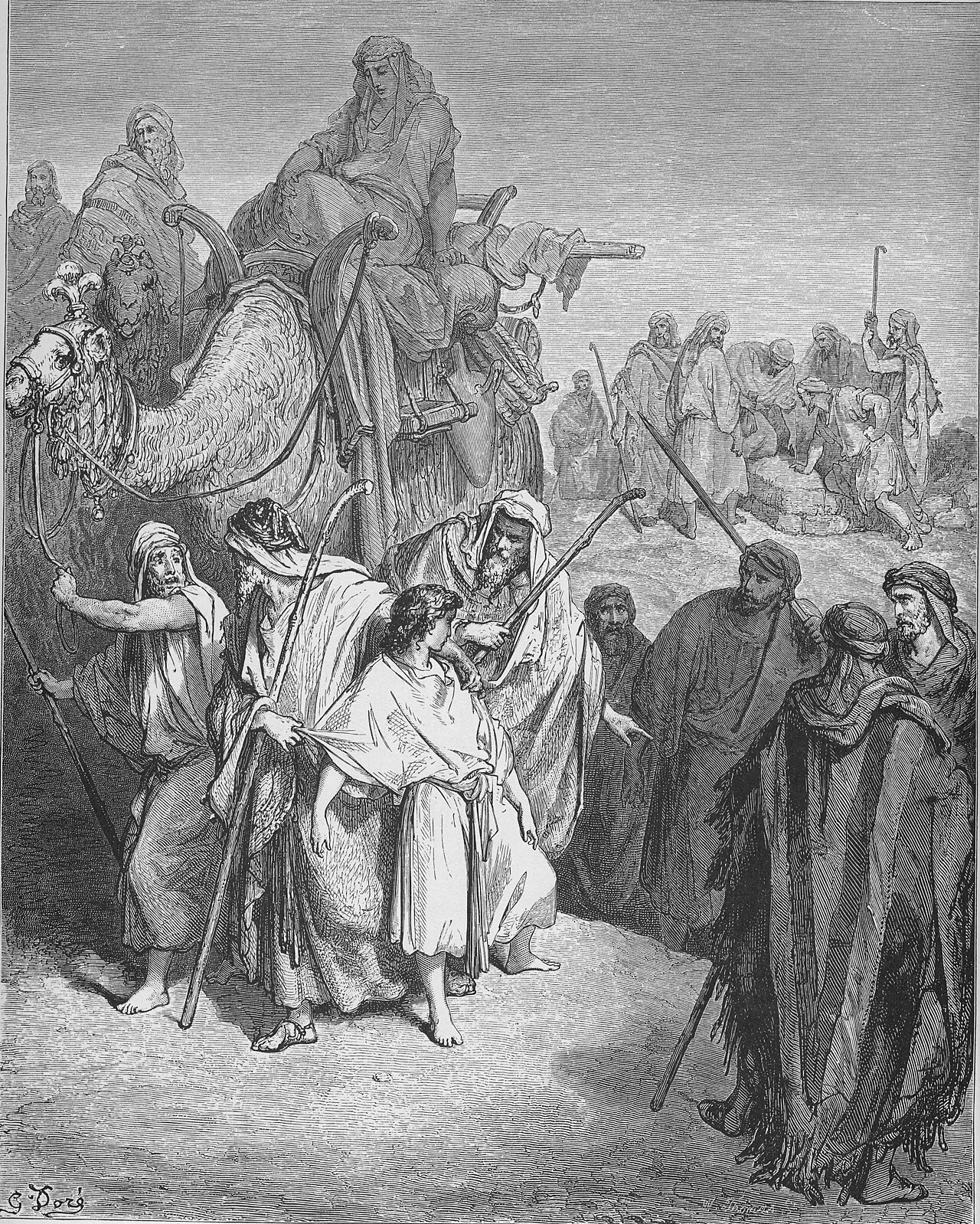
in Genesis 37Meanwhile, the Midianites sold Joseph in Egypt to Potiphar, an officer of Pharaoh and captain of the guard.
BSB
The same verse in ASV and KJV ▾
ASV
And the Midianites sold him into Egypt unto Potiphar, an officer of Pharaoh’s, the captain of the guard.
KJV
And the Midianites sold him into Egypt unto Potiphar, an officer of Pharaoh’s, and captain of the guard.
⋯
This verse in Genesis 37
Commentary
9 notes on this verse(Verse 36.) Now the Midianites sold Joseph in Egypt to Potiphar, an eunuch of Pharaoh and the chief of the royal executioners. In many places the Scriptures mention the chief of the executioners as the chief of the cooks, for μαγειρεύειν in Greek means to cook. Therefore, Joseph was sold to the chief of the army and the warriors, not to Potiphar, as it is written in Latin, but to Potiphar the eunuch. The question arises, how he is later said to have a wife.
This site's exposition
put sackcloth around his waist
on Genesis 37:34-36
Jacob puts on sackcloth and refuses every comfort his sons offer, and they know exactly where the boy is. He says he will go down to Sheol mourning for his son, and he does go down to his son, into Egypt and alive, at Genesis 46:29. The chapter's last line puts Joseph alive in Potiphar's house.
The record, by era
The Church Fathers3 voices
I think this was a further blow to those men: they saw that Jacob gave evidence of such ardent love for the one who was not present, nay rather was considered taken by wild beasts, and they were even more racked with envy. But whereas they would merit no excuse for being so cruel to their brother and their father, even the Midianites … serve the divine plan further by handing Joseph over to Potiphar, Pharaoh's chief steward. Do you see how things proceed gradually and systematically, and how in every circumstance Joseph shows his characteristic virtue and endurance so that, just as an athlete who has nobly contended will be crowned with the kingdom's garland, likewise the fulfillment of the dreams would … teach those who sold him that no advantage accrued to them from their awful ruse? Virtue, you see, has such power that even when under attack it emerges even more conspicuous. Nothing, after all, is stronger than virtue, nothing more powerful … not because it has such power of itself but because the one who acquires it also enjoys grace from on high. By enjoying grace from on high and being accorded assistance from there, virtue would be more powerful than anything, invincible and proof against not only the wiles of human beings but also the snares of the demons.
But as for what pertains to the moral interpretation, because our God wishes all people to be saved, through Joseph he also gave consolation to those who are in slavery, and he gave them instruction. Even in the lowliest status, people should learn that their character can be superior and that no state of life is devoid of virtue if the soul of the individual knows itself. The flesh is subject to slavery, not the spirit, and many humble servants are more free than their masters, if in their condition of slavery they consider that they should abstain from the works of a slave. Every sin is slavish, while blamelessness is free. On this account the Lord also says, "Everyone who commits sin is a slave of sin." Indeed, how is each greedy person not a slave, seeing that he auctions himself off for a very tiny sum of money? The person who has piled up what he is not going to use is afraid that he may lose all that he has piled up; the more numerous his acquisitions, the greater the risk he will run in keeping them.…Moreover, how is that person who is subject to lust not also a slave? First, he blazes with his own fires, and he is burned up by the torches within his own breast. To such people the prophet rightly says, "Walk in the light of your own fire and in the flame that you have kindled." Fear takes hold of them all and lies in wait for each one when he is asleep; so that he may gain control over one object of desire, a person becomes the slave of them all. The one who makes his own masters is the slave to a wretched slavery indeed, for he wishes to have masters that he may fear; indeed, nothing is so characteristic of slavery as the constant fear. But that one, whatever his servile status, will always be free who is not seduced by love or held by the chains of greed or bound by fear of reproach, who looks to the present with tranquility and is not afraid of the future.
Then Jacob sent Joseph to the flock that he might bring back to him a report on his brothers. But the brothers, by means of the cloak that was bespattered with blood, sent Jacob a report on Joseph.
The Puritans and the Awakening2 voices
Jacob was lamenting the loss of his life; had he known all he would have lamented, though not so passionately, the loss of liberty. Shall Jacob's freeborn son exchange the best robe of his family for the livery of an Egyptian lord, and all the marks of servitude? How soon was the land of Egypt made a house of bondage to the seed of Jacob!
And all this was working together for good. 1 And Jacob dwelt in the land wherein his father was a stranger, in the land of Canaan. 2 These are the generations of Jacob.
quarantine:scripture (2026-07-29) — scripture-overlap:84%@v1-3
2 more voices on this verse
The Puritans and the Awakening1 voice
And the Midianites sold him into Egypt,....
The Nineteenth Century1 voice
Potiphar, an officer of Pharaoh’s - The word סריס saris, translated officer, signifies a eunuch; and lest any person should imagine that because this Potiphar had a wife, therefore it is absurd to suppose him to have been a eunuch, let such persons know that it is not uncommon in the east for eunuchs to have wives, nay, some of them have even a harem or seraglio where they keep many women, though it does not appear that they have any progeny; and probably discontent on this ground might have contributed as much to the unfaithfulness of Potiphar’s wife, as that less principled motive through which it is commonly believed she acted.
The words behind it
10 Hebrew wordsEvery Hebrew word of this verse in the order it stands, with what it means and the door to its own study. The last column counts the times a word stands in the whole Bible: the rarer the word, the more the places it appears belong together.
| Hebrew | Sound | Meaning | Word study | In the Bible |
|---|---|---|---|---|
| וְהַ֨מְּדָנִ֔ים | vehamedanim | and the Medanites | H4092 → | |
| מָכְר֥וּ | makheru | they sold | H4376 → | 80 times |
| אֹת֖וֹ | ʾoto | <obj.> him | H853 → | 10935 times |
| אֶל־ | ʾel- | into | H413 → | 5510 times |
| מִצְרָ֑יִם | mitzrayim | Egypt | H4714 → | 641 times |
| לְפֽוֹטִיפַר֙ | lefotifar | to Potiphar | H6318 → | |
| סְרִ֣יס | seris | an official of | H5631 → | 42 times |
| פַּרְעֹ֔ה | paroh | Pharaoh | H6547 → | 274 times |
| שַׂ֖ר | sar | [the] commander of | H8269 → | 421 times |
| הַטַּבָּחִֽים׃ פ | hatabachim | the bodyguards | H2876 → | 32 times |
וְהַ֨מְּדָנִ֔יםand the Medanites
vehamedanimH4092 →
מָכְר֥וּthey sold
makheruH4376 →80 times
אֹת֖וֹ<obj.> him
ʾotoH853 →10935 times
אֶל־into
ʾel-H413 →5510 times
מִצְרָ֑יִםEgypt
mitzrayimH4714 →641 times
לְפֽוֹטִיפַר֙to Potiphar
lefotifarH6318 →
סְרִ֣יסan official of
serisH5631 →42 times
פַּרְעֹ֔הPharaoh
parohH6547 →274 times
שַׂ֖ר[the] commander of
sarH8269 →421 times
הַטַּבָּחִֽים׃ פthe bodyguards
hatabachimH2876 →32 times
A shaded row is a word that stands 400 times or fewer in the Bible.
The walk
8 stopsEach card is a verse this one points to, and under it the verses that one points to in turn. Where several paths arrive at the same place, that place is listed first: the text keeps returning to it.
Through
Genesis 37:28So when the Midianite traders passed by, his brothers pulled Joseph out of the pit and sold him for twenty shekels of silver to the Ishmaelites, who took him to Egypt.
it leads to
- Acts 7:9
Because the patriarchs were jealous of Joseph, they sold him as a slave into Egypt. But God was with him
- Psalms 105:17
He sent a man before them— Joseph, sold as a slave.
- Genesis 45:4–5
Then Joseph said to his brothers, “Please come near me.” And they did so. “I am Joseph, your brother,” he said, “the one you sold into Egypt!
- Genesis 25:2
and she bore him Zimran, Jokshan, Medan, Midian, Ishbak, and Shuah.
- Judges 6:1–3
Again the Israelites did evil in the sight of the LORD; so He delivered them into the hand of Midian for seven years,
- Acts 7:9
Through
Isaiah 56:3Let no foreigner who has joined himself to the LORD say, “The LORD will utterly exclude me from His people.” And let the eunuch not say, “I am but a dry tree.”
it leads to
- 1 Corinthians 6:17
But he who unites himself with the Lord is one with Him in spirit.
- Matthew 19:12–30
For there are eunuchs who were born that way; others were made that way by men; and still others live like eunuchs for the sake of the kingdom of heaven. The one who can…
- Acts 10:34
Then Peter began to speak: “I now truly understand that God does not show favoritism,
- 1 Corinthians 6:17
Where this verse is studied
On this page
Studies4
On this verse
About Genesis
Who and where
2 names in this verse with a page on the site.
This page draws on Adam Clarke, Commentary on the Bible; Ambrose of Milan, On Joseph the Patriarch; Ephrem the Syrian, COMMENTARY ON GENESIS 33:2; Jerome, Hebrew Questions on Genesis; John Chrysostom, HOMILIES ON GENESIS 61.2; John Gill, Exposition of the Old Testament (1748-1763); John Wesley, Explanatory Notes upon the Old Testament and Matthew Henry, Commentary on the Whole Bible.