
Genesis 37:26
in Genesis 37Then Judah said to his brothers, “What profit will we gain if we kill our brother and cover up his blood?
BSB
The same verse in ASV and KJV ▾
ASV
And Judah said unto his brethren, What profit is it if we slay our brother and conceal his blood?
KJV
And Judah said unto his brethren, What profit is it if we slay our brother, and conceal his blood?
⋯
This verse in Genesis 37
Commentary
7 notes on this verseA commentator
Jamieson, Fausset & Brown1802–1910
Commentary Critical and Explanatory on the Whole Bible (1871)
What profit is it if we slay our brother?--The sight of these travelling merchants gave a sudden turn to the views of the conspirators; for having no wish to commit a greater degree of crime than was necessary for the accomplishment of their end, they readily approved of Judah's suggestion to dispose of their obnoxious brother as a slave.
This site's exposition
they sat down to eat a meal
on Genesis 37:25-27
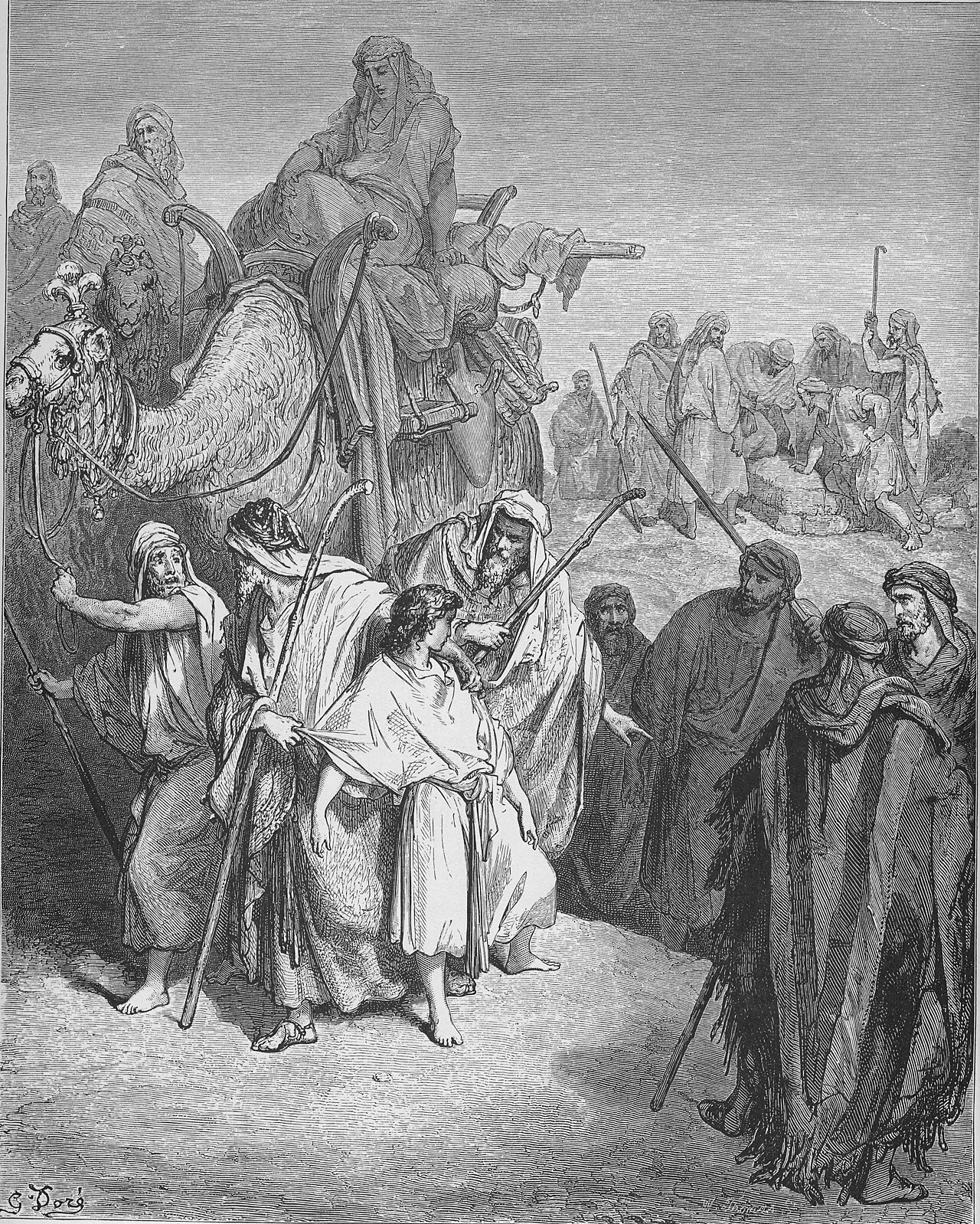
They sit down to a meal with their brother still in the pit. Clarke says that one detail describes the men better than any adjective. The camels going past carry spices, balm and myrrh down to Egypt, the road Abram took in the famine at Genesis 12:10. Judah argues profit, and that the boy is their own flesh.
This site's exposition
What profit will we gain
Cover up his blood recalls Abel, whose blood cried out to God from the ground at Genesis 4:10. A hidden killing still has a witness. Judah speaks here for the first time in Genesis, and at Genesis 44:33 he offers himself as a slave in place of Rachel's other son.
The record, by era
The Church Fathers1 voice
A commentator
Clement of RomeClement's First Letter to the Corinthians, Chapters 3-4 · Written before 99.
proposed
Every kind of honour and happiness was bestowed upon you, and then was fulfilled that which is written, "My beloved ate and drank, and was enlarged and became fat, and kicked." [Deuteronomy 32:15] Hence flowed emulation and envy, strife and sedition, persecution and disorder, war and captivity. So the worthless rose up against the honoured, those of no reputation against such as were renowned, the foolish against the wise, the young against those advanced in years.
The Puritans and the Awakening3 voices
What profit is it if we slay our brother? - It will be less guilt and more gain to sell him. And as Joseph was sold by the contrivance of Judah for twenty pieces of silver, so was our Lord Jesus for thirty, and by one of the same name too, Judas.
): " What profit is it if we slay our brother? it will be less guilt, and more gain, to sell him." Note, When we are tempted to sin, we should consider the unprofitableness of it. It is what there is nothing to be got by.
quarantine:debris (2026-07-29) — leading-punctuation+unbalanced-parens
And Judah said unto his brethren,....
The words behind it
13 Hebrew wordsEvery Hebrew word of this verse in the order it stands, with what it means and the door to its own study. The last column counts the times a word stands in the whole Bible: the rarer the word, the more the places it appears belong together.
| Hebrew | Sound | Meaning | Word study | In the Bible |
|---|---|---|---|---|
| וַיֹּ֥אמֶר | vaiyomer | and he said | H559 → | 5305 times |
| יְהוּדָ֖ה | yehudah | Judah | H3063 → | 819 times |
| אֶל־ | ʾel- | to | H413 → | 5510 times |
| אֶחָ֑יו | ʾechav | brothers his | H251 → | 630 times |
| מַה־ | mah- | what? | H4100 → | 752 times |
| בֶּ֗צַע | betza' | [is the] profit | H1215 → | |
| כִּ֤י | ki | if | H3588 → | 4482 times |
| נַהֲרֹג֙ | naharog | we will kill | H2026 → | 167 times |
| אֶת־ | ʾet- | <obj.> | H853 → | 10935 times |
| אָחִ֔ינוּ | ʾachinu | brother our | H251 → | 630 times |
| וְכִסִּ֖ינוּ | vekhisinu | and we will conceal | H3680 → | 152 times |
| אֶת־ | ʾet- | <obj.> | H853 → | 10935 times |
| דָּמֽוֹ׃ | damo | blood his | H1818 → | 360 times |
וַיֹּ֥אמֶרand he said
vaiyomerH559 →5305 times
יְהוּדָ֖הJudah
yehudahH3063 →819 times
אֶל־to
ʾel-H413 →5510 times
אֶחָ֑יוbrothers his
ʾechavH251 →630 times
מַה־what?
mah-H4100 →752 times
בֶּ֗צַע[is the] profit
betza'H1215 →
כִּ֤יif
kiH3588 →4482 times
נַהֲרֹג֙we will kill
naharogH2026 →167 times
אֶת־<obj.>
ʾet-H853 →10935 times
אָחִ֔ינוּbrother our
ʾachinuH251 →630 times
וְכִסִּ֖ינוּand we will conceal
vekhisinuH3680 →152 times
אֶת־<obj.>
ʾet-H853 →10935 times
דָּמֽוֹ׃blood his
damoH1818 →360 times
A shaded row is a word that stands 400 times or fewer in the Bible.
The walk
8 stopsEach card is a verse this one points to, and under it the verses that one points to in turn. Where several paths arrive at the same place, that place is listed first: the text keeps returning to it.
Through
Matthew 16:26What will it profit a man if he gains the whole world, yet forfeits his soul? Or what can a man give in exchange for his soul?
it leads to
- Job 27:8
For what is the hope of the godless when he is cut off, when God takes away his life?
- Mark 8:36–37
What does it profit a man to gain the whole world, yet forfeit his soul?
- Luke 9:25
What does it profit a man to gain the whole world, yet lose or forfeit his very self?
- Luke 12:20
But God said to him, ‘You fool! This very night your life will be required of you. Then who will own what you have accumulated?’
- Psalms 49:7–8
No man can possibly redeem his brother or pay his ransom to God.
- Job 27:8
Through
Genesis 4:10“What have you done?” replied the LORD. “The voice of your brother’s blood cries out to Me from the ground.
it leads to
- Hebrews 12:24
to Jesus the mediator of a new covenant, and to the sprinkled blood that speaks a better word than the blood of Abel.
- Psalms 72:14
He will redeem them from oppression and violence, for their blood is precious in his sight.
- Hebrews 11:4
By faith Abel offered God a better sacrifice than Cain did. By faith he was commended as righteous when God gave approval to his gifts. And by faith he still speaks, even though he…
- Hebrews 12:24
Where this verse is studied
On this page
Studies4
On this verse
About Genesis
Who and where
1 name in this verse with a page on the site.
This page draws on Adam Clarke, Commentary on the Bible; Clement of Rome, Clement's First Letter to the Corinthians, Chapters 3-4; Jamieson, Fausset & Brown, Commentary Critical and Explanatory on the Whole Bible; John Gill, Exposition of the Old Testament (1748-1763); John Wesley, Explanatory Notes upon the Old Testament; Keil and Delitzsch, Biblical Commentary on the Old Testament and Matthew Henry, Commentary on the Whole Bible.