
Luke 22:1
in Luke 22Now the Feast of Unleavened Bread, called the Passover, was approaching,
BSB
The same verse in ASV and KJV ▾
ASV
Now the feast of unleavened bread drew nigh, which is called the Passover.
KJV
Now the feast of unleavened bread drew nigh, which is called the Passover.
⋯
This verse in Luke 22
Commentary
12 notes on this verseNow the feast of unleavened bread drew nigh,.... Which lasted seven days; during which the Jews eat their bread without leaven, in commemoration of the haste in which they went out of Egypt; being such, that they had not time to leaven their dough, but took it with their kneadingtroughs along with them, as it was; and as figurative of the unleavened bread of sincerity and truth, with which the Gospel feast is to be kept; see Exo 12:
This site's exposition
the feast of unleavened bread drew nigh
on Luke 22:1-2
The feast of unleavened bread drew nigh, which is called the Passover, Luke naming the two feasts as one since by the first century they had merged into a single week-long observance. The chief priests and scribes sought how they might kill him, for they feared the people, the same fear that stayed their hand in the temple two days before now driving them toward a plan that avoids the crowds altogether. The bench reads the timing as itself theological, the true Passover lamb about to be slain during the very feast that commemorated the first lamb's blood on Israel's doorposts.
The record, by era
The Church Fathers2 voices
The actions of the Jews were a shadow of our own. Accordingly if you ask of a Jew concerning the Passover, and the feast of unleavened bread, he will tell you nothing momentous, mentioning the deliverance from Egypt; whereas should a man inquire of me he would not hear of Egypt or Pharaoh, but of freedom from sin and the darkness of Satan, not by Moses, but by the Son of God; Chrys. Hom. 79. in Matt.) The Chief Priests set about their impious deed on the feast, as it follows, And the Chief Priests and Scribes, &c. Moses ordained only one Priest, at whose death another was to be appointed. But at that time, when the Jewish customs had begun to fall away, there were many made every year. These then wishing to kill Jesus, are not afraid of God, lest in truth the holy time should aggravate the pollution of their sin, but every where fear man. Hence it follows, For they feared the people.
Let us see the course of the devil's spite and the result of his crafty plans against Christ. The devil had implanted in the leaders of the Jewish synagogue envy against Christ, which even leads to murder. This disorder always leads, so to speak, to the guilt of murder. At least, this is the natural course of this vice. It was this way with Cain and Abel, and it clearly was so in the case of Joseph and his brothers. The divine Paul also very clearly makes these sins neighbors and relatives of one another.
The Medieval Church3 voices
Now the Passover, which is called in Hebrew "Phase," is not so named from the Passion, but from the passing over, because the destroying angel, seeing the blood on the doors of the Israelites, passed over them, and touched not their first-born. Or the Lord Himself, giving assistance to His people, walked over them. But herein is the difference between the Passover and the feast of unleavened bread, that by the Passover is meant that day alone on which the lamb was slain towards the evening, that is, on the fourteenth day of the first month, but on the fifteenth, when the Israelites went out of Egypt, followed the feast of unleavened bread for seven days, up to the twenty-first of the same month. Hence the writers of the Gospel substitute one indifferently for the other. As here it is said, The day of unleavened bread, which is called the Passover. But it is signified by a mystery, that Christ having suffered once for us, has commanded us through the whole time of this world which is passed in seven days, to live in the unleavened bread of sincerity and truth. Not indeed that they apprehended sedition, but were afraid lest by the interference of the people He should be taken out of their hands. And these things Matthew reports to have taken place two days before the Passover, when they were assembled in the judgment hall of Caiaphas.
Now the feast of unleavened bread, which is called the Passover, was approaching. The Passover, which in Hebrew is called phase, is named not from suffering, as many suppose, but from the transition, because the destroyer, seeing the blood on the doors of the Israelites, …
(non occ.) Whose Passion the Evangelist being about to relate, introduces the figure of it, saying, Now the feast of unleavened bread drew nigh, which is called the Passover.
5 more voices on this verse
The Medieval Church1 voice
The medicine of the passion is treated in two ways. Now the feast day of unleavened bread was drawing near etc. After that part which concerns the incarnation of the Word has been completed, and that which concerns his preaching and teaching, here the passion …
The Puritans and the Awakening1 voice
About as long before that feast as they began to make preparation for it, here was preparation making for our Passover's being offered for us. His sworn enemies contriving it (
quarantine:debris (2026-07-29) — unbalanced-parens
The Nineteenth Century3 voices
A commentator
J.C. Ryle1816–1900
Expository Thoughts on the Gospels: Luke (lightly modernized text, Grace Gems edition) (1858)
proposed
The chapter which opens with these verses, begins Luke's account of our Lord's sufferings and death. No part of the Gospels is so important as this. The death of Christ — was the life of the world. No part of our Lord's history is so fully given by all the gospel writers as this. Only two of them describe the circumstances of Christ's birth. All four dwell minutely on Christ's death. And of all the four, no one supplies us with such full and interesting details as Luke.
A commentator
J.C. Ryle1816–1900
Expository Thoughts on the Gospels: Luke (lightly modernized text, Grace Gems edition) (1858)
proposed
The chapter which opens with these verses, begins Luke's account of our Lord's sufferings and death. No part of the Gospels is so important as this. The death of Christ — was the life of the world. No part of our Lord's history is so fully given by all the gospel writers as this. Only two of them describe the circumstances of Christ's birth. All four dwell minutely on Christ's death. And of all the four, no one supplies us with such full and interesting details as Luke. We see, firstly, in these verses — that high offices in the church do not preserve the holders of them from great blindness and sin. We read that "the chief priests and scribes sought how they might kill Jesus." The first step in putting Christ to death, was taken by the religious teachers of the Jewish nation. The very men who ought to have welcomed the Messiah — were the men who conspired to kill Him. The very teachers who ought to have rejoiced at the appearing of the Lamb of God — had the chief hand in slaying Him. They sat in Moses' seat. They claimed to be "guides of the blind," and "lights of those who were in darkness." (Romans 2:19.) They belonged to the tribe of Levi. They were, most of them — in direct succession and descent from Aaron. Yet they were the very men who crucified the Lord of glory! With all their boasted knowledge — they were far more ignorant than the few Galilean fishermen who followed Christ. Let us beware of attaching an excessive importance to Christian ministers because of their office. Ordination and religious office confer no exemption from error. The greatest heresies have been sown, and the greatest practical abuses have been introduced into the church — by ordained men! Respect is undoubtedly due to high official position. Order and discipline ought not to be forgotten.
The feast of unleavened bread, etc. - See this largely explained, Exo 23:14 (note); Leviticus 23:2-40 (note), and on Mat 26:2 (note).
How the passage was read
On Luke 22:1-23On Luke 22:1-23
The cups on the table
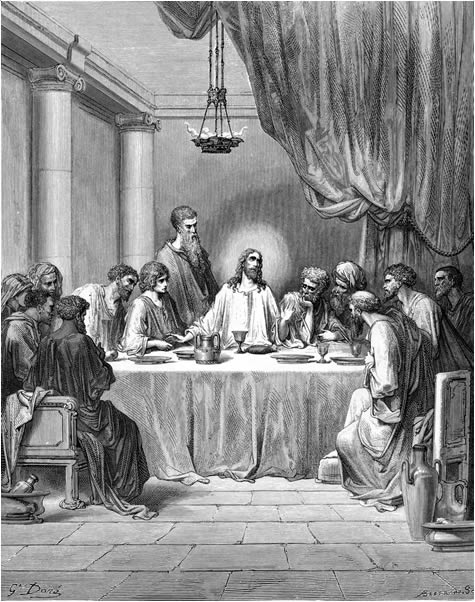
Luke alone records TWO cups (22:17, 22:20), and the detail is at home in the feast: the Passover meal was ordered around four cups of wine, a structure already fixed in the Mishnah, the first written code of Jewish oral law (Pesachim 10:1). Passover (Pesach) is the spring feast remembering the exodus; its meal, the seder (“order”), moved through blessing, story, and psalm with a cup at each station. Jesus takes the feast's own furniture, and at the cup after supper says the words that made it new: “this cup... is the new covenant in my blood.”
The seder as Jewish families keep it today descends from the same order, reshaped after the Temple fell in AD 70; the lamb on the table then is matzah and remembrance now.
This section is reception history: how the passage was read and kept in the Jewish tradition. Where a reading parts from an essential of the Christian faith, the section says so at that point.
Sources: Mishnah Pesachim 10:1 (the four cups) · The Lord's Supper (this site's study)
The words behind it
9 Greek wordsEvery Greek word of this verse in the order it stands, with what it means and the door to its own study. The last column counts the times a word stands in the whole Bible: the rarer the word, the more the places it appears belong together.
| Greek | Sound | Meaning | Word study | In the Bible |
|---|---|---|---|---|
| Ἤγγιζεν | engizen | Was drawing near | G1448 → | 42 times |
| δὲ | de | now | G1161 → | 2765 times |
| ἡ | he | the | G3588 → | 19766 times |
| ἑορτὴ | he'orte | Feast | G1859 → | 25 times |
| τῶν | ton | <the> | G3588 → | 19766 times |
| ἀζύμων | azumon | of Unleavened [Bread] | G106 → | |
| ἡ | he | which | G3588 → | 19766 times |
| λεγομένη | legomene | is being named | G3004 → | 1325 times |
| πάσχα, | pascha | Passover, | G3957 → | 29 times |
ἬγγιζενWas drawing near
engizenG1448 →42 times
δὲnow
deG1161 →2765 times
ἡthe
heG3588 →19766 times
ἑορτὴFeast
he'orteG1859 →25 times
τῶν<the>
tonG3588 →19766 times
ἀζύμωνof Unleavened [Bread]
azumonG106 →
ἡwhich
heG3588 →19766 times
λεγομένηis being named
legomeneG3004 →1325 times
πάσχα,Passover,
paschaG3957 →29 times
A shaded row is a word that stands 400 times or fewer in the Bible.
Where this verse is studied
On this page
Studies12
About Luke
This page draws on 11 works. Open the list of works
This page draws on Adam Clarke, Commentary on the Bible; Albert Barnes, Notes, Explanatory and Practical, on the Gospels; Bede, Catena Aurea by Aquinas; Bede, On the Gospel of Luke; Bonaventure, Commentary on Luke, Chapter 22; Cyril of Alexandria, COMMENTARY ON LUKE, HOMILY 140; Glossa Ordinaria, Catena Aurea by Aquinas; J.C. Ryle, Expository Thoughts on the Gospels: Luke (lightly modernized text, Grace Gems edition); John Chrysostom, Catena Aurea by Aquinas; John Gill, Exposition of the New Testament (1746-1748) and Matthew Henry, Commentary on the Whole Bible.