
Study trail
The Scarlet Thread
Trace the blood covenant from Eden to Revelation: the crimson thread woven through every page of Scripture.
Where this trail goes
Pull one thread and the whole Bible moves. In Eden, before a single sacrifice is offered, God promises a deliverer who will crush the serpent's head and bleed doing it (Genesis 3:15). From that moment, blood runs through Scripture like a scarlet thread: a lamb God provides on Moriah, blood on Egyptian doorposts, a law that places atonement in the blood, a prophet who names sin scarlet and promises it white as snow. This walk follows that thread through ten stops: from the first promise to the throne room of heaven, where a countless multitude stands in robes "made white in the blood of the Lamb" (Revelation 7:14). These are not ten scattered verses. They are one story, told across fifteen centuries by many hands, and the thread has a name.
The route
The stops are in the order the Bible presents them.
The route: 10 stops, Genesis 3:15 to Revelation 7:14
10 stops, in order
Stop 1 of 10: Genesis 3:15
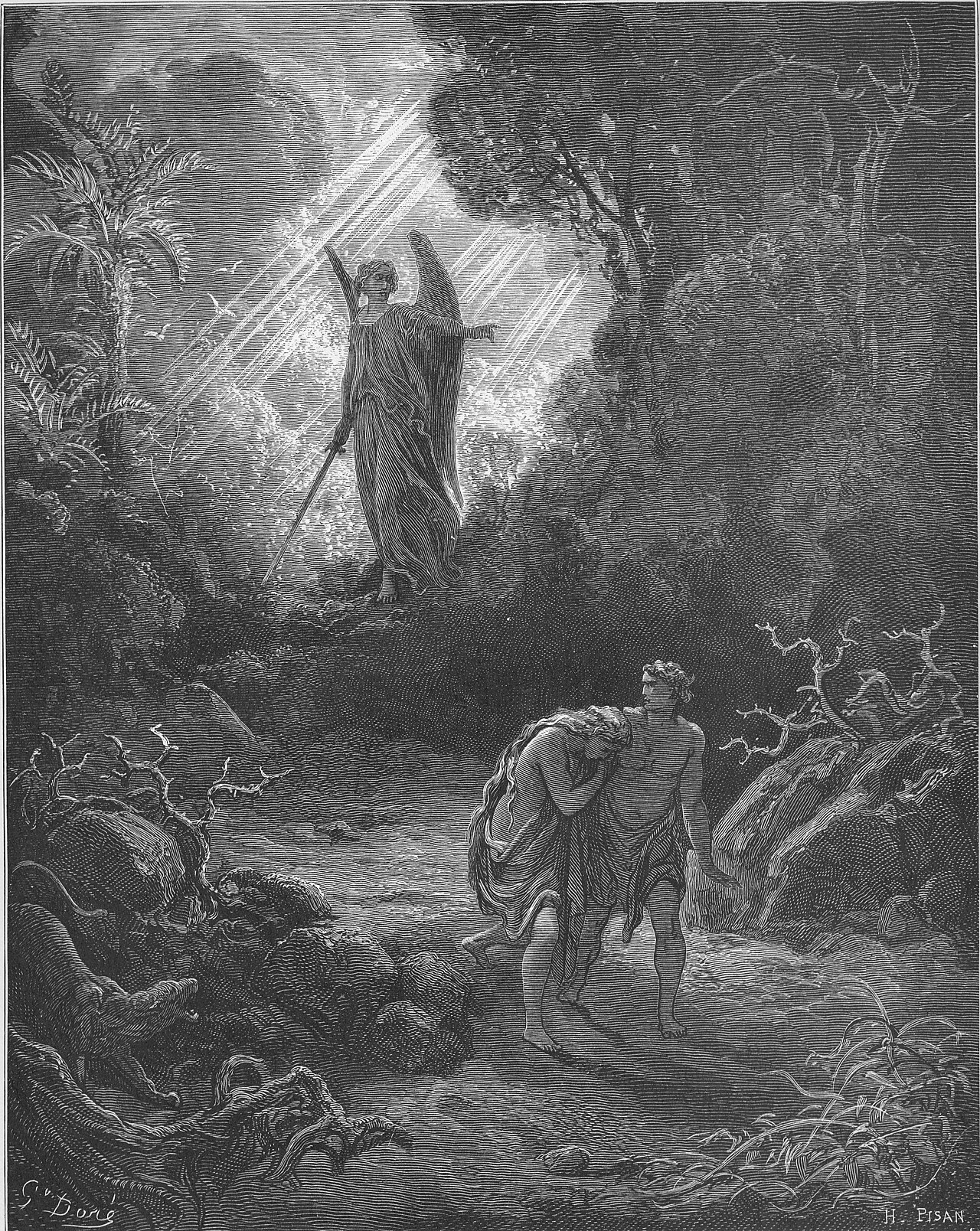
And I will put enmity between you and the woman, and between your seed and her seed. He will crush your head, and you will strike his heel.The thread begins: God's first promise of a deliverer who conquers by being wounded.
The Hebrew word for seed here is singular, and the same verb is used in both clauses: the serpent strikes the heel, the seed crushes the head. One wound is survivable and one is not. Every altar in the rest of the Bible is an installment on this sentence.
The word for seed is singular. The promise names the woman's seed, not a man's.
Show more on this stopwhat it adds to the trail, 1 voice and the exposition
In this trail
Singular seed can be read collectively, as it is of Hagar's descendants at Genesis 16:10, so the grammar alone settles nothing here. Two other things carry the Christian reading: the promise is traced through a woman in a book that reckons descent through men, and Paul at Galatians 3:16 presses the singular in the promises made to Abraham and names that seed as Christ. This trail follows the second reading from here.
A voice on this verse
Irenaeus, writing about 180, reads this verse as the war the whole Bible then fights, and names the crushed head as the work of Christ.
“He has therefore, in His work of recapitulation, summed up all things, both waging war against our enemy, and crushing him who had at the beginning led us away captives in Adam, and trampled upon his head, as thou canst perceive in Genesis that God said to the serpent, ‘And I will put enmity between thee and the woman, and between thy seed and her seed; He shall be on the watch for thy head, and thou on the watch for His heel.’”
Irenaeus · Against Heresies 5.21.1Patristic
The exposition on this verse
your seed and her seed: Her seed will crush the serpent's head, and the serpent will strike his heel. Spurgeon called this the first gospel sermon ever preached on earth. The word seed is the one Paul presses at Galatians 3:16, where the promise runs to one descendant who is Christ.
This exposition draws on Charles Spurgeon, The Metropolitan Tabernacle Pulpit, Sermon No. 1326: Christ the Conqueror of Satan and Matthew Henry, Commentary on the Whole Bible.
Stop 2 of 10: Genesis 22:8
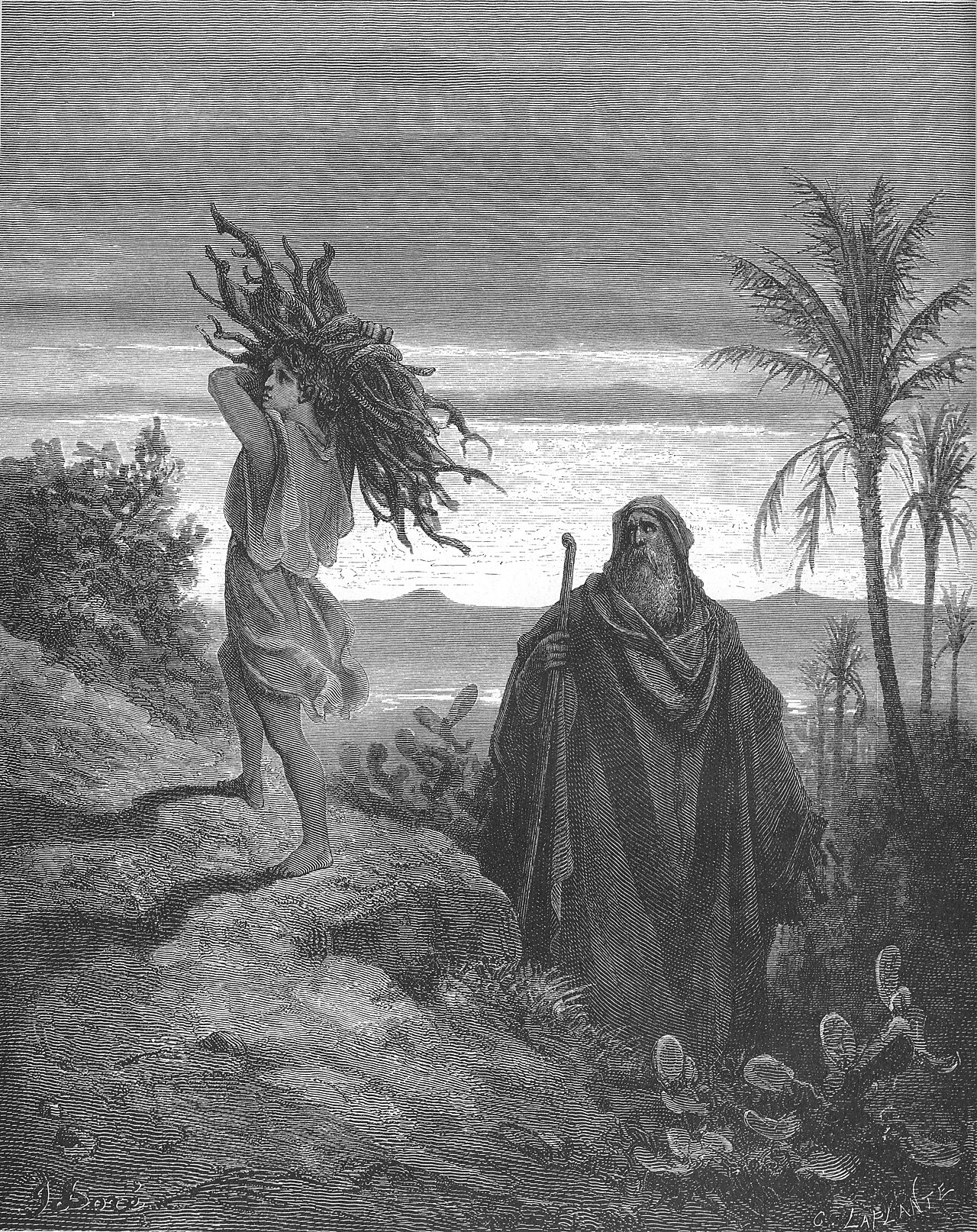
Abraham answered, “God Himself will provide the lamb for the burnt offering, my son.” And the two walked on together.God names Himself the lamb's provider: the rest of the walk looks for that lamb.
Abraham's answer is literally
"God will see for himself the lamb."
A ram is caught in the thicket and dies instead of Isaac, but a ram is not a lamb, so the word he used goes unanswered on this mountain. Moriah holds the question open, and the walk goes looking for the lamb.
Show more on this stopwhat it adds to the trail, 2 voices and the exposition
In this trail
The word Abraham uses, seh, covers a sheep or a goat of any age, so the ram caught on the mountain answers it in the letter. What stands open is the substitution: something dies in the place of the one who was bound. That shape is the trail's, from the doorposts of Exodus to the Lamb at the last stop.
Voices on this verse
Origen notices that Abraham answers a question about the present with a sentence about the future, and reads that future as Christ.
“Abraham's response, sufficiently accurate and cautious, moves me. I do not know what he saw in his spirit, for he does not speak about the present but about the future: ‘God himself will provide himself a sheep.’ He responded to his son's inquiry about present things with future things. For ‘the Lord himself will provide himself a sheep’ in Christ, because also, ‘Wisdom herself has built herself a house,’ and ‘He himself humbled himself unto death.’”
Origen of Alexandria · Homilies On Genesis 8.6Patristic
Clarke takes Abraham's answer as prophecy rather than reassurance, and connects the lamb he names to the Lamb of God.
“My son, God will provide himself a lamb - Here we find the same obedient unshaken faith for which this pattern of practical piety was ever remarkable. But we must not suppose that this was the language merely of faith and obedience; the patriarch spoke prophetically, and referred to that Lamb of God which He had provided for himself, who in the fullness of time should take away the sin of the world, and of whom Isaac was a most expressive type.”
Adam Clarke · Commentary on the BibleEvangelical
The exposition on this verse
where is the lamb for the burnt offering: These are the only words Isaac speaks in the account, and they are the right question. Abraham answers that God Himself will provide the lamb, and what God provides is a ram. Clarke takes the answer as prophecy and points to the Lamb of God at John 1:29.
God Himself will provide the lamb: Origen marks that Abraham answers a question about the present with a word about the future. Origen and John Wesley both read the provided lamb as Christ. Wesley says no one in heaven or earth could have found that lamb until God found the ransom Himself.
This exposition draws on Adam Clarke, Commentary on the Bible; John Wesley, Explanatory Notes upon the Old Testament and Origen of Alexandria, HOMILIES ON GENESIS 8.6.
Stop 3 of 10: Exodus 12:13
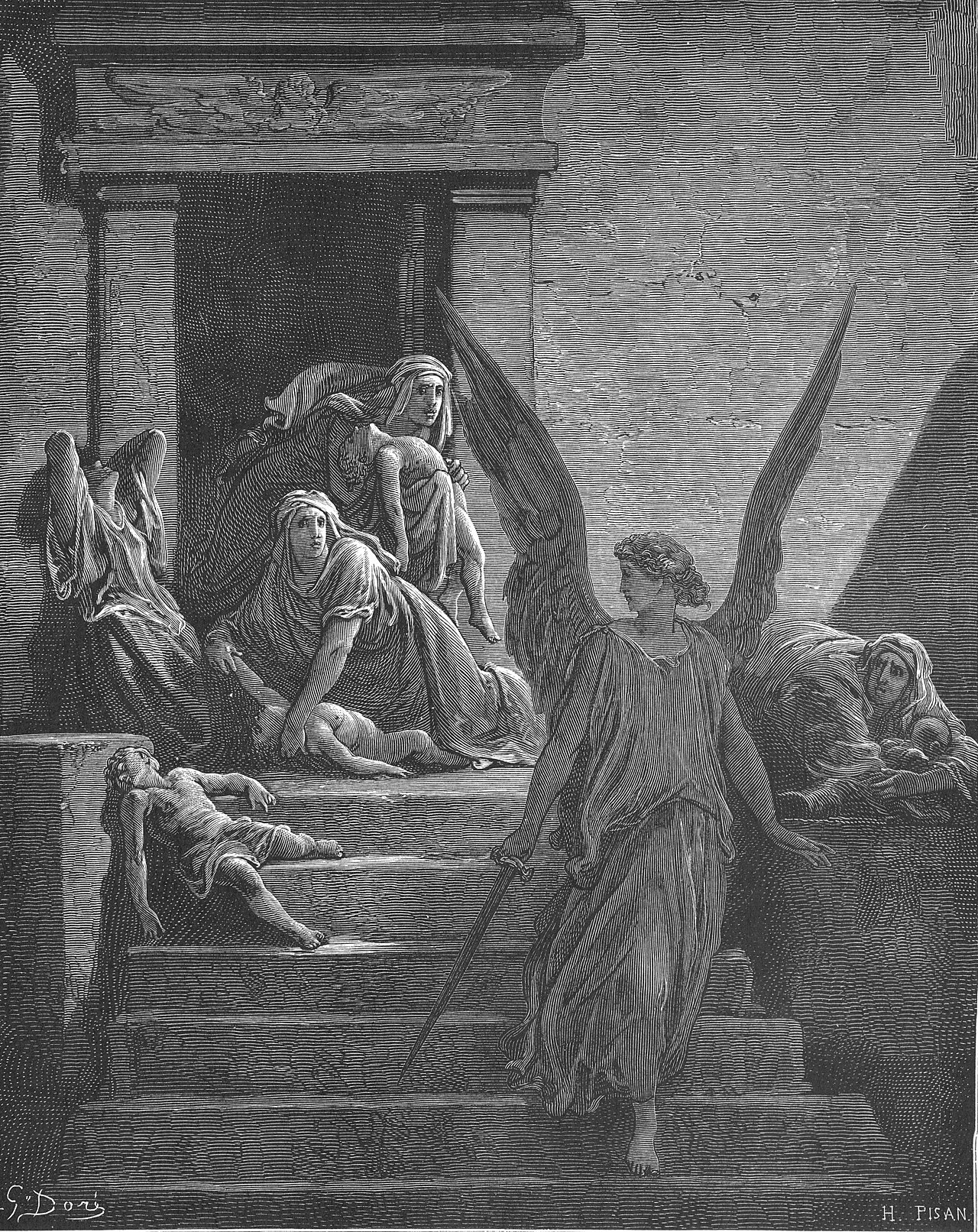
The blood on the houses where you are staying will distinguish them; when I see the blood, I will pass over you. No plague will fall on you to destroy you when I strike the land of Egypt.Blood moves from promise to protection: applied blood makes judgment pass over.
The blood is not poured on an altar but painted on the door of the house where the family lives. What saves is the blood applied:
"When I see the blood, I will pass over you."
The deciding evidence is on the outside of the house, visible to God, and has nothing to do with the character of the people inside.
Show more on this stopwhat it adds to the trail and the exposition
In this trail
Exodus 12 is where the trail's substitution becomes a thing done rather than a thing promised, and where it is done to a household instead of at a sanctuary. Leviticus at the next stop states the rule this night already obeys, and stop 7 is Jesus holding this same meal.
The exposition on this verse
I will pass through the land of Egypt: God names two targets, the firstborn of Egypt and all the gods of Egypt. Numbers 33:4 says the same, so the plagues were a contest as well as a punishment.
The blood on the houses where you are staying will distinguish them: Behind will distinguish them stands the Hebrew word for a sign, the word used of the signs of 4:8 and 7:3. Adam Clarke reads the blood as a sign that the house stood under God's protection. Earlier signs struck Egypt, and this one guarded Israel.
This exposition draws on Adam Clarke, Commentary on the Bible; Chuck Missler, Learn the Bible in 24 Hours and Keil and Delitzsch, Biblical Commentary on the Old Testament: The Pentateuch.
Stop 4 of 10: Leviticus 17:11
For the life of the flesh is in the blood, and I have given it to you to make atonement for your souls upon the altar; for it is the blood that makes atonement for the soul.Atonement means covering a wrong so the guilty person can stand before God again.
God states the rule the whole thread runs on: atonement is by blood, life for life.
"For the life of the flesh is in the blood... it is the blood that maketh an atonement for the soul."
God gives the reason, not only the rule: blood carries life, so a life can cover a life. Every sacrifice before this verse and every sacrifice after it runs on this one sentence.
Show more on this stopwhat it adds to the trail and the exposition
In this trail
This is the sentence the rest of the trail rests on. Genesis 22 and Exodus 12 are both instances of it before it is stated, and Hebrews 9:22 at stop 9 argues from it directly.
The exposition on this verse
eats any blood: Verse 11 is the one place in the Torah where sacrifice states its own ground: "it is the blood that makes atonement for the soul". Genesis 9:4 withheld blood from Noah, and this verse explains why.
the life of the flesh is in the blood: John Chrysostom limits the verse to animals. For the beast its blood is its life, while the human soul is incorporeal and immortal and outranks the body. John Wesley reads the atonement here as a type fulfilled in the blood of Christ.
This exposition draws on Andrew Bonar, A Commentary on Leviticus; John Chrysostom, HOMILIES ON GENESIS 13:10; John Wesley, Explanatory Notes upon the Old Testament and Sir Robert Anderson, Types in Hebrews.
Stop 5 of 10: Isaiah 1:18
“Come now, let us reason together,” says the LORD. “Though your sins are like scarlet, they will be as white as snow; though they are as red as crimson, they will become like wool.The thread's color named outright, and its goal: crimson sin made white.
Scarlet and crimson were the two fastest dyes in the ancient world, colors that would not wash out of cloth. God names the two most permanent stains available and promises them white as snow. The image is chosen on purpose: what cannot be laundered can still be atoned.
Show more on this stopwhat it adds to the trail, 1 voice and the exposition
In this trail
Isaiah gives the trail its colour and its exchange. Stop 10 closes the same image from the far end, where the stain is gone and the agent of the washing is blood.
A voice on this verse
Ambrose joins the whitening of this verse to the blood of the lamb sprinkled in Exodus, which is the move this trail makes between stops 3 and 5.
“[One] who is baptized is seen to be purified both according to the law and according to the gospel. According to the law, because Moses sprinkled the blood of the lamb with a bunch of hyssop; according to the gospel, because Christ's garments were white as snow, when in the gospel he manifested the glory of his resurrection, [one] then whose guilt is remitted is made whiter than snow.”
Ambrose of Milan · On the Mysteries 7:34Patristic
The exposition on this verse
Come now, let us reason together: The LORD invites the very people He has just indicted to argue the case with Him. Scarlet and crimson were fast dyes, set against snow and wool, a stain beyond any remedy promised removal. Verses 19 and 20 set the offer beside its opposite, the rebels "devoured by the sword."
This exposition draws on Adam Clarke, Commentary on the Bible and John Calvin, Commentary on the Book of the Prophet Isaiah.
Stop 6 of 10: Isaiah 53:5
But He was pierced for our transgressions, He was crushed for our iniquities; the punishment that brought us peace was upon Him, and by His stripes we are healed.A guilt offering is the sacrifice the law required when a wrong had to be paid for.
The lamb gets a face: a person bruised for others, as Eden foretold.
Seven centuries before the cross, the sufferer is singular and the beneficiaries are plural:
"he was wounded for OUR transgressions."
Verse 10 says it is the LORD who bruises him and calls his life a guilt offering, using the Levitical word for it. The sacrificial vocabulary has landed on a person.
Show more on this stopwhat it adds to the trail, 1 voice and the exposition
In this trail
What this stop adds is a person. From here the trail can move to the sufferer naming the covenant his blood seals at stop 7, and to a witness reporting these wounds as fact at stop 8.
A voice on this verse
Athanasius presses the difference between healing a wound and carrying it, which is what makes this servant a substitute rather than a physician.
“It did not say, ‘He remedied our infirmities,’ lest, as being external to the body and only healing it, as he has always done, he should leave people subject still to death. Rather, he carries our infirmities, and he himself bears our sins, that it might be shown that he has become human for us, and that the body that in him bore them was his own body.”
Athanasius of Alexandria · Discourses Against the Arians 3.31Patristic
The exposition on this verse
Surely He took on our infirmities: The pronouns carry the exchange: “He was pierced for our transgressions, He was crushed for our iniquities”. Matthew 8:17 quotes verse 4 of the healings of Jesus, and 1 Peter 2:24 quotes verse 5. Verse 6 ends: “the LORD has laid upon Him the iniquity of us all”.
He was pierced for our transgressions: Jamieson, Fausset & Brown take pierced as a bodily wound, and set it beside the pierced hands and feet of Psalm 22:16. Clarke reads the punishment for peace as the penalty by which sinners are brought into peace with God. Jerome reads the stripes as one wound healing many wounds.
This exposition draws on Adam Clarke, Commentary on the Bible; Albert Barnes, Notes on the Book of Isaiah; Jamieson, Fausset & Brown, Commentary Critical and Explanatory on the Whole Bible; Jerome, Commentary on Isaiah and Matthew Henry, Commentary on the Whole Bible.
Stop 7 of 10: Matthew 26:28
This is My blood of the covenant, which is poured out for many for the forgiveness of sins.A covenant is a binding agreement, sworn once and kept for good.
Jesus claims the entire thread: His own blood is the covenant blood.
Jesus lifts the Passover cup and reassigns it:
"this is my blood of the new testament, which is shed for many for the remission of sins."
He is holding the memorial of Exodus 12 and naming Himself the lamb of it, while still alive, before the arrest, in His own words.
Show more on this stopwhat it adds to the trail and the exposition
In this trail
This is the stop where the trail's subject speaks for himself. He is holding the Exodus 12 meal of stop 3 and the rule of stop 4 when he says it, and stop 8 is the same blood shed the next day.
The exposition on this verse
this is My body: Jesus takes bread, speaks a blessing and breaks it, saying "this is My body," then gives the cup to all. He builds the meal the church still keeps on the Passover bread and cup. "This is My blood of the covenant" echoes the covenant sealed in blood at Exodus 24:8.
My blood of the covenant: Adam Clarke notes that Luke and Paul give the saying as the cup being the new covenant in his blood. John Wesley and John Gill read the wine as a sign of the blood, and Charles Spurgeon argues against transubstantiation. Wesley reads many as all the children of Adam.
This exposition draws on Adam Clarke, Commentary on the Bible; Charles Spurgeon, The Metropolitan Tabernacle Pulpit, Sermon No. 1971: “The Blood Shed For Many” (lightly modernized text, CCEL edition); John Calvin, Commentary on a Harmony of the Evangelists; John Gill, Exposition of the New Testament (1746-1748); John Wesley, Explanatory Notes upon the New Testament and Matthew Henry, Commentary on the Whole Bible.
Stop 8 of 10: John 19:34
Instead, one of the soldiers pierced His side with a spear, and immediately blood and water flowed out.The blood actually falls: every sacrificial type meets fact at the pierced side.
The spear thrust was a legal check for death, and John stops the narrative to swear to what he saw. Blood and water separating is the clinical mark of a ruptured heart; John reads it as the two things the temple required (sacrifice and cleansing) coming out of one side.
Show more on this stopwhat it adds to the trail and the exposition
In this trail
Everything the earlier stops taught as pattern has a date and a witness here. The lamb of Genesis 22, the doorway blood of Exodus 12 and the wounded servant of Isaiah 53 all end at one body.
The exposition on this verse
one of the soldiers pierced His side with a spear: A spear opens His side and blood and water come out, which physicians have read as the mark of a heart that had already stopped. John stakes his own eyewitness claim on this detail and says his testimony is true. The purpose he gives is belief, stated again at 20:31.
This exposition draws on B. F. Westcott, The Gospel according to St. John and J. C. Ryle, Expository Thoughts on the Gospels, John.
Stop 9 of 10: Hebrews 9:22
According to the law, in fact, nearly everything must be purified with blood, and without the shedding of blood there is no forgiveness.Remission means a debt cancelled for good.
Scripture explains its own pattern: why every stop before this required blood.
"Without shedding of blood is no remission."
Hebrews argues that the whole tabernacle was a copy: the copies were cleansed with animal blood, the reality with a better sacrifice. This is Scripture explaining its own pattern: why every stop before this one needed an altar.
Show more on this stopwhat it adds to the trail, 1 voice and the exposition
In this trail
The law does let a poor man bring flour instead of a lamb, and Leviticus 5:11-13 says he is forgiven, so the word almost in this verse is doing real work. That offering is still laid on the altar where the blood is put, which is the argument Hebrews makes: the copies were cleansed with animal blood and the reality with a better sacrifice. Read backward, the verse says why every stop before it needed an altar.
A voice on this verse
Gill weighs the word almost, and takes the exceptions as the cleansings the law made without blood, while the forgiveness of sin is put on the altar.
“And almost all things are by the law purged with blood,.... All ‘except a few things’, as the Arabic version renders it; for some things were cleansed by water, and others purged by fire, Num 31:23. Some join the word almost with the word purged, as if the sense was, that all things were purged by blood, but not perfectly, only almost; but the former sense is best.”
John Gill · Exposition of the New TestamentReformed
The exposition on this verse
not put into effect without blood: At Sinai, Exodus 24, Moses sprinkled the scroll and the people with blood, saying This is the blood of the covenant. The rule follows: without the shedding of blood there is no forgiveness. The word nearly allows exceptions, such as the flour offering of Leviticus 5:11.
without the shedding of blood: Jamieson, Fausset and Brown take the shedding as both the slaughter of the victim and the pouring out of its blood at the altar. That pouring was the heart of the sacrifice, according to Leviticus 17:11. Every rite pointed to Christ's blood, in John Wesley's reading.
This exposition draws on Jamieson, Fausset & Brown, Commentary Critical and Explanatory; John Gill, Exposition of the New Testament; John Wesley, Explanatory Notes Upon the New Testament and Matthew Henry, Commentary on the Whole Bible.
Stop 10 of 10: Revelation 7:14
“Sir,” I answered, “you know.” So he replied, “These are the ones who have come out of the great tribulation; they have washed their robes and made them white in the blood of the Lamb.The thread's destination: a numberless multitude made white forever in the Lamb's blood.
"They... have washed their robes, and made them white in the blood of the Lamb."
Blood does not bleach cloth; the picture is deliberately impossible, and it closes the loop opened in Isaiah 1:18. The thread ends in a crowd no one can count, every one of them wearing the evidence.
Show more on this stopwhat it adds to the trail, 1 voice and the exposition
In this trail
The trail ends where Isaiah 1:18 pointed at stop 5: the stain that would not wash out is gone. What began as a sentence spoken to a serpent finishes in front of the throne, and the thread has the name the whole walk was looking for.
A voice on this verse
Tertullian reads the white robes as the mark of those who came through persecution, washed in the blood of the Lamb rather than in their own.
“For yet again a countless throng are revealed, clothed in white and distinguished by palms of victory, celebrating their triumph doubtless over Antichrist, since one of the elders says, ‘These are they who come out of that great tribulation, and have washed their robes, and made them white in the blood of the Lamb.’ For the flesh is the clothing of the soul.”
Tertullian · ScorpiacePatristic
The exposition on this verse
one of the elders addressed me: An elder asks who the ones in white robes are, and John answers you know. They have come out of the great tribulation, and washed their robes and made them white in the blood of the Lamb.
they have washed their robes: Tertullian saw them as those who triumph over Antichrist. Wesley saw a multitude too large to count for martyrs alone, and took in every righteous servant of God from the beginning of the world. Henry saw that only the blood of the Lamb washes robes white.
This exposition draws on John Gill, Exposition of the New Testament; John Wesley, Explanatory Notes upon the New Testament; Matthew Henry, Commentary on the Whole Bible and Tertullian, Scorpiace.
What this trail means
Walked end to end, the pattern is unmistakable. Genesis 3:15 promises a deliverer who wins by being wounded. Genesis 22:8 declares God Himself will provide the lamb. Exodus 12:13 shows what a lamb's blood does: judgment passes over the house it marks. Leviticus 17:11 states the principle beneath it all: life for life; God gave blood on the altar to make atonement. Isaiah then names both the problem, sins scarlet as crimson (1:18), and the answer in flesh: a servant "wounded for our transgressions... with his stripes we are healed" (53:5).
Then Jesus takes the cup and claims the whole thread: "this is my blood of the covenant, which is poured out for many unto remission of sins" (Matthew 26:28). Every earlier stop was pointing here. At the cross the thread stops being picture and becomes fact: blood and water from a pierced side (John 19:34). Hebrews 9:22 supplies the logic in one line: apart from shedding of blood there is no remission. The cross was not a tragedy God salvaged; it was the necessity He announced in Eden. And Revelation 7:14 shows where the thread ends: a multitude no one can number, robes washed white, the exact color-reversal Isaiah promised. One promise, one Lamb, one blood, from the garden to the throne. The scarlet thread is Jesus.
Show the verses this closing names10 verses
And I will put enmity between you and the woman, and between your seed and her seed. He will crush your head, and you will strike his heel.Abraham answered, “God Himself will provide the lamb for the burnt offering, my son.” And the two walked on together.The blood on the houses where you are staying will distinguish them; when I see the blood, I will pass over you. No plague will fall on you to destroy you when I strike the land of Egypt.For the life of the flesh is in the blood, and I have given it to you to make atonement for your souls upon the altar; for it is the blood that makes atonement for the soul.“Come now, let us reason together,” says the LORD. “Though your sins are like scarlet, they will be as white as snow; though they are as red as crimson, they will become like wool.But He was pierced for our transgressions, He was crushed for our iniquities; the punishment that brought us peace was upon Him, and by His stripes we are healed.This is My blood of the covenant, which is poured out for many for the forgiveness of sins.Instead, one of the soldiers pierced His side with a spear, and immediately blood and water flowed out.According to the law, in fact, nearly everything must be purified with blood, and without the shedding of blood there is no forgiveness.“Sir,” I answered, “you know.” So he replied, “These are the ones who have come out of the great tribulation; they have washed their robes and made them white in the blood of the Lamb.Show what you now know
- The promise came before the sacrifice: Genesis 3:15 sets the terms (a wounded deliverer) and every altar after it is an installment.
- Blood works by substitution and by application. Leviticus 17:11 gives the principle; Exodus 12 shows it has to be on the door.
- Isaiah puts a face on the lamb seven centuries early, and Jesus claims the whole line for Himself over a Passover cup.
- The thread does not end at the cross. It ends in a crowd no one can number, wearing robes made white by blood.
Follow it again from any stop: the verse pages carry the fuller pool of commentary, and the words open into the Hebrew and Greek behind them.