
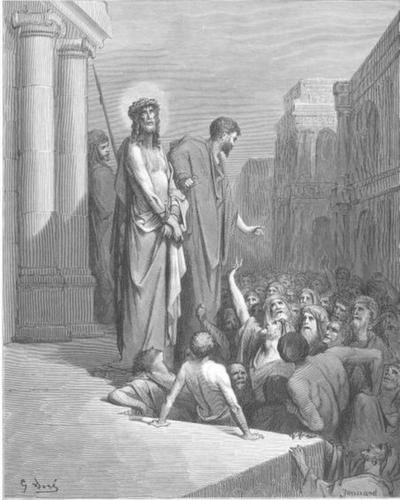
Johnchapter 19
42 verses · John, by tradition · AD 85 to 95 · The Gospels
Now these things happened so that the Scripture would be fulfilled: “Not one of His bones will be broken.”
Introduction
John, by tradition, The Gospels, John Overview.
This chapter was written by the disciple who says he stood at the cross, and it carries his own word that what he saw is true. He writes for readers far from Jerusalem who needed to know how the Messiah could die the death Rome gave to rebels. The chapter holds the sentence, the execution and the burial within one day before a feast. Listen for the Scriptures of Israel named as they come true. Listen also for the title king, spoken by soldiers, crowd and governor in turn. Read it as the account of the hour the Gospel has pointed to since its second chapter.
Context
- Who
- Readers who had seen crucifixions on their own roads
- What
- The flogging and mockery of Jesus, His sentence under Pilate, His crucifixion and death, and His burial by Joseph of Arimathea and Nicodemus.
- Where
- Jerusalem, at the Praetorium and the Stone Pavement, then at the Place of the Skull near the city and a new tomb in a garden close by.
- When
- The day of Preparation for the Passover, in about AD 30 or 33 on the usual datings of the crucifixion, with the hour of the sentence given by the chapter as about the sixth.
- Why
- To show that the death of Jesus was the finished work of the King, carried out as the Scriptures had said, and witnessed by one who saw it.
Historical context
Roman flogging was done with a whip of leather thongs weighted with bone or metal, and it regularly killed men outright. The purple robe and the crown of thorns were a soldiers' parody of an emperor, purple was the imperial colour and the emperor wore a laurel wreath, performed by men who found the idea of a Jewish king funny.
Show the rest of the historical context, 3 more paragraphs
The pressure that decides the case is a political title. Friend of Caesar was a real honorific granted to men in imperial favour, and Pilate's patron in Rome had recently fallen; the threat that he was no friend of Caesar if he released this man was a threat to his career and possibly his life. Josephus and Philo both record earlier incidents in which Pilate mishandled Jewish sensitivities and was forced to back down.
Crucifixion's mechanics are documented and grim: a public road, a placard naming the crime, the victim's clothing as a soldier's perquisite, and death by exhaustion and suffocation over hours or days. Breaking the legs hastened it by removing the ability to push up for breath. The one physical example ever recovered, a heel bone from a first-century tomb at Giv'at ha-Mivtar near Jerusalem, still pierced by an iron nail, confirms the practice down to the hardware.
The burial is a rich man's burial done in a hurry. Nicodemus brings about seventy-five pounds of myrrh and aloes, a quantity used for royalty, and Joseph of Arimathea supplies a new rock-cut tomb in a nearby garden. Both were council members, which means two men from the body that condemned him buried him.
Significance
John notes two details as fulfilments and expects his readers to catch them: not a bone of him was broken, which is the rule for the Passover lamb, and they divided his garments and cast lots for his tunic, which is Psalm 22 word for word.
Show the rest of the significance, 1 more paragraph
The title Pilate nailed above him was written in Hebrew, Latin, and Greek, the three languages of that city, and he refused to change it. The charge sheet for the execution was, in the languages of religion, empire, and commerce, an announcement.
The heads below are this chapter's scenes. The numbered points under each are its verses.
Scourged and Crowned With Thorns: Behold, the Man!
Pilate took Jesus and had Him flogged: Pilate has Jesus flogged, and a flogging under Rome could kill a man before any cross was raised. The soldiers used leather thongs weighted with bone, and the governor meant the beating to satisfy a crowd shouting Crucify Him. Isaiah 53:5 names the stripes that heal.
John 19:1
“Pilate, seeing the people so outrageous, and being disappointed in his project of releasing him upon the people's choice, took Jesus, and scourged him, that is, appointed the lictors that attended him to do it. Bede is of opinion that Pilate scourged Jesus himself with his own hands, because it is said, He took him and scourged him, that it might be done favourably.”
Matthew Henry · Commentary on the Whole Bible (1707-1721)puritan
John 19:2-3
twisted together a crown of thorns: The soldiers stage a coronation: a crown of thorns, a purple robe, and the salute given to Caesar. Thorns came with the curse of the ground at Genesis 3:18. They are pressed onto the head of the man who carries that curse away.
John 19:2
“He scourges Him unjustly, and suffers the crowd of soldiers to insult Him, and put a crown of thorns about His Head, and throw a purple robe upon Him, and buffet Him with the palms of their hands, and otherwise dishonour Him. For he thought he could easily put to shame the people of the Jews, if they saw the Man Who was altogether free from guilt suffering this punishment, only without a cause.”
Cyril of Alexandria · written before 444 · Commentary on the Gospel of John, Book 12patristic
2 more voices on this verse
John 19:2
“And the soldiers platted a crown of thorns,.... This was an emblem of his being surrounded by wicked men, sons of Belial, comparable to thorns, whilst he hung suffering on the cross; and of the sins of his people compassing him about, which were as thorns, very grievous to him; and of his various troubles in life, and of his being made a curse for us at death; thorns being the produce of the curse upon the earth.”
John 19:2
“And the soldiers, platting a crown of thorns. This was unquestionably done by the authority of Pilate, in order to affix a mark of infamy on the Son of God, for having made himself a king; and that in order to satisfy the rage of the Jews, as if he had been convinced that the accusations which they brought against Christ were well founded.”
John Calvin · Commentaries (1554)reformed
The soldiers act out the title King of the Jews. Cyril of Jerusalem reads the mockery as a proclamation in spite of itself. The robe was a king's robe, and the crown of thorns was still a crown.
John 19:3
“And said, Hail, King of the Jews!--doing Him derisive homage, in the form used on approaching the emperors. "And they spit upon Him, and took the reed and smote Him on the head" (Mt 27:30). The best comment on these affecting details is to cover the face.”
Jamieson, Fausset & Brown · Commentary Critical and Explanatory on the Whole Bible (1871)reformed
1 more voice on this verse
John 19:3
“They dressed him in a purple robe in mockery, of course. But they also fulfilled the prophecy, doing so under inspiration. For he was a King. However much they did it in a spirit of derision, still they did it. His royal dignity was emblematically heralded. So, likewise, though it was with thorns they crowned him, it was still a crown. And it was soldiers who crowned him. Kings are proclaimed by soldiers.”
Cyril of Jerusalem · written before 386 · Sermon on the Paralytic 12patristic
John 19:4-5
Pilate brings Jesus out beaten, the crown and the robe still on Him, and says again that he finds no basis for a charge. Here is the man, ecce homo in the Latin, is the line the church has carried ever since. Pilate's aim was political.
John 19:4
“He confesses the wrong he had done, and is not ashamed. For he admitted that he had scourged Him without a cause, and declares that he will show Him unto them, supposing that he would glut their savage passion by so pitiable a spectacle, and well-nigh accuses them henceforth, and that publicly, of putting Him to death unjustly, and of compelling him openly to be a law-breaker, who, if he transgressed his own laws, could not escape scot free.”
Cyril of Alexandria · written before 444 · Commentary on the Gospel of John 12patristic
Pilate shows the beaten prisoner to the crowd. Barnes takes Here is the man as an appeal for pity and a proof of innocence. Clarke hears scorn for the accusers who called Jesus an enemy of Caesar.
John 19:5
“There was clearly a struggle in the breast of this wretched man. Not only was he reluctant to surrender to mere clamor an innocent man, but a feeling of anxiety about His mysterious claims, as is plain from what follows, was beginning to rack his breast, and the object of his exclamation seems to have been to move their pity.”
Jamieson, Fausset & Brown · Commentary Critical and Explanatory on the Whole Bible (1871)reformed
John 19:6-7
The chief priests drop the charge of kingship and name the real one. By their law He must die for declaring that He is the Son of God. Their account of His claim is accurate, and He had made it at 5:18 and 10:33.
John 19:6
“Pilate is in consternation, that the people of the Jews and the inhuman crowd of the chief priests should attain to such a pitch of presumption, as not even to shrink from subjecting Christ to so frightful a death, though no fault was found in Him to bring Him to such a doom. And, therefore, he says, almost like one annoyed at an insult offered to himself: "Make you me a judge of this unjust shedding of blood?”
Cyril of Alexandria · written before 444 · Commentary on the Gospel of John, Book 12patristic
2 more voices on this verse
John 19:6
“Now by this it appears that their malice against Christ was, (1.) Unreasonable and most absurd, in that they offer not to make good their charges against him, nor to object against the judgment of Pilate concerning him; but, though he be innocent, he must be crucified. (2.) It was insatiable and very cruel.”
Matthew Henry · Commentary on the Whole Bible (1707-1721)puritan
John 19:6
“Crucify Him - Αυτον, which is necessary to the text, and which is wanting in the common editions, and is supplied by our version in Italics, is added here on the authority of almost every MS. and version of importance. As it is omitted in the common editions, it affords another proof, that they were not taken from the best MSS.”
Adam Clarke · Commentary on the Bible (1810-1826)evangelical
The Jews change the charge. The law they mean is the law of blasphemy at Leviticus 24:16, as Barnes notes. On it the council had condemned Jesus at Matthew 26:63 to 65.
John 19:7
“When their false accusation that they had at first contrived proved fruitless, and they established against Him no attempt at revolution or revolt against Caesar's rule (for the Lord parried these charges, saying: My Kingdom is not of this world; if my Kingdom were of this world, then would My servants fight, that I should not be delivered to the Jews), and when Pilate thereupon gave a just and impartial verdict, and did not as yet comply with their will, but said openly that He found no fault in Him, the audacious Jews completely changed their tactics, and asserted that…”
Cyril of Alexandria · written before 444 · Commentary on the Gospel of John, Book 12patristic
2 more voices on this verse
John 19:7
“We have a law - The law respecting blasphemy, Lev 24:16; Deu 13:1-5. They had arraigned Jesus on that charge before the Sanhedrin, and condemned him for it, Mat 26:63-65. But this was not the charge on which they had arraigned him before Pilate. They had accused him of sedition, Luk 23:2. On this charge they were now convinced that they could not get Pilate to condemn him. He declared him innocent.”
John 19:7
“Whoever falsely pretended to be the Son of God was guilty of blasphemy, Lev. xxiv. But then, [2.] It was false that Christ pretended to be the Son of God, for he really was so; and they ought to have enquired into the proofs he produced of his being so.”
Matthew Henry · Commentary on the Whole Bible (1707-1721)puritan
John 19:8-9
he was even more afraid: The title Son of God drives Pilate back into the Praetorium to ask where Jesus is from. Jesus gives no answer, having already answered this governor at 18:33 to 37 about His kingdom. Isaiah 53:7 has the lamb silent before the shearers.
John 19:8
“He was the more afraid - While Jesus was accused only as a disturber of the peace of the nation, which accusation Pilate knew to be false, he knew he could deliver him, because the judgment in that case belonged to himself; but when the Jews brought a charge against him of the most capital nature, from their own laws, he then saw that he had every thing to fear, if he did not deliver Jesus to their will.”
Adam Clarke · Commentary on the Bible (1810-1826)evangelical
1 more voice on this verse
John 19:8
“The malicious design of the Jews had a result they little expected. For they wished to pile up the indictment against Christ, by saying that He had ventured to sin against the Person of God Himself. But the weighty character of the accusation itself increased Pilate's caution, and he was the more oppressed with alarm, and more careful concerning Christ than before, and questioned Him the more particularly, what He was, and whence He came; not disbelieving, as I think, that though He was a Man, He might be also the Son of God.”
Cyril of Alexandria · written before 444 · Commentary on the Gospel of John 12patristic
Pilate asks about the origin of Jesus. Barnes notes that Pilate already knew He came from Galilee, so the question asks whether He was a man or the Son of God. Origen holds that the silence belongs to His will to suffer.
John 19:9
“Since he willed to suffer on behalf of the world, he is silent when examined and beaten by Pilate. For if he had spoken, he would not have been crucified from weakness, since there is no weakness in the words that the Word speaks.”
Origen of Alexandria · written before 253 · Commentary on the Gospel of John 19.61patristic
John 19:10-11
Pilate claims two powers, to release and to crucify, and Jesus traces the whole of it to what was given from above. Rome's authority stands under God even here. The greater sin lies on the one who handed Him over, read as Caiaphas or as Judas.
John 19:10
“Then saith Pilate unto him, Speakest thou not to me?--The "me" is the emphatic word in the question. He falls back upon the pride of office, which doubtless tended to blunt the workings of his conscience. knowest thou not that I have power to crucify thee, and have power to release thee?--said to work upon Him at once by fear and by hope.”
Jamieson, Fausset & Brown · Commentary Critical and Explanatory on the Whole Bible (1871)reformed
3 more voices on this verse
John 19:10
“Men in power are apt to be puffed up with their power, and the more absolute and arbitrary it is the more it gratifies and humours their pride. But he magnifies his power to an exorbitant degree when he boasts that he has power to crucify one whom he had declared innocent, for no prince or potentate has authority to do wrong.”
Matthew Henry · Commentary on the Whole Bible (1707-1721)puritan
John 19:10
“Pilate thought this silence the silence of a madman. Therefore, he stretches over Him, as it were, the wand of his official power, and thought that he could induce Him by fear, against His Will, to return a fruitless answer. For he says that nothing could hinder his inclining whichever way he chose, either to punish Him, or to take compassion upon Him; and that there was nothing to turn him aside, to give a verdict against his will, with whom alone rested the fate of the accused.”
Cyril of Alexandria · written before 444 · Commentary on the Gospel of John 12patristic
John 19:10
“Speakest thou not ... - This is the expression of a man of pride. He was not accustomed to be met with silence like this. He endeavored, therefore, to address the fears of Jesus, and to appall him with the declaration that his life was at his disposal, and that his safety depended on his favor. This arrogance called forth the reply of the Savior, and he told him that he had no power except what was given him from above. Jesus was not, therefore, to be intimidated by any claim of power in Pilate.”
given to you from above: Jesus traces the authority of Pilate to God. Barnes reads the answer as a rebuke to a proud official who holds only the power given him from above. Cyprian draws the lesson that power over God's people is permitted, as over Job, to correct them or to prove them.
John 19:11
“No power - No such power as you claim. You have not originated the power which you have. You have just as much as is given, and your ability extends no further. Except it were given thee - It has been conceded or granted to you. God has ordered your life, your circumstances, and the extent of your dominion. This was a reproof of a proud man in office, who was forgetful of the great Source of his authority, and who supposed that by his own talents or fortune he had risen to his present place.”
1 more voice on this verse
John 19:11
“He that delivered Christ to Pilate was either, 1. The people of the Jews, who cried out, Crucify him, crucify him. They had seen Christ's miracles, which Pilate had not; to them the Messiah was first sent; they were his own; and to them, who were now enslaved, a Redeemer should have been most welcome, and therefore it was much worse in them to appear against him than in Pilate.”
Matthew Henry · Commentary on the Whole Bible (1707-1721)puritan
John 19:12-13
you are no friend of Caesar: Friend of Caesar was a real title under Tiberius, and the shout turns a religious case into a charge the governor cannot survive. Pilate sits on the judgment seat at the Stone Pavement, Gabbatha in Hebrew. John gives the local name, as a witness does.
John 19:12
“The exclamation of the Jews afflicts Pilate with panic, and sharpens the keenness of his caution, and makes him pause before putting Him to death. For they shouted out, that that very prisoner had made Himself the Son of God, Whom Pilate had been most anxious to release from all danger, and to acquit of every false accusation, having this fear at heart.”
Cyril of Alexandria · written before 444 · Commentary on the Gospel of John, Book 12patristic
1 more voice on this verse
John 19:12
“Pilate sought to release him - Pilate made five several attempts to release our Lord; as we may learn from Luk 23:4, Luk 23:15, Luk 23:20, Luk 23:22; Joh 19:4, Joh 19:12, Joh 19:13. Thou art not Caesar’s friend - Thou dost not act like a person who has the interest of the emperor at heart. Ambassadors, prefects, counsellors, etc., were generally termed the friends of the emperor. This insinuation determined Pilate to make no longer resistance: he was afraid of being accused, and he knew Tiberius was one of the most jealous and distrustful princes in the world.”
Adam Clarke · Commentary on the Bible (1810-1826)evangelical
sat on the judgment seat: Pilate takes his seat to give sentence. Barnes explains the judgment seat as the tribunal of formal sentence, and the Stone Pavement as a floor of small coloured stones, common in palaces. Theophylact marks how little courage the governor showed when he heard the charge of disloyalty to Caesar.
John 19:13
“Paul might the better stand at Cæsar's judgment-seat when his Master had stood there before him. [2.] Notice is here taken of the place and time. First, The place where Christ was condemned: in a place called the Pavement, but in Hebrew, Gabbatha, probably the place where he used to sit to try causes or criminals.”
Matthew Henry · Commentary on the Whole Bible (1707-1721)puritan
1 more voice on this verse
John 19:13
“Judgment-seat - The tribunal or place of pronouncing sentence. He came here to deliver him, in due form of law, into the hands of the Jews. Pavement - This was an area or room of the judgment hall whose floor was made of small square stones of various colors. This was common in palaces and houses of wealth and splendor. See the notes at Mat 9:2. Gabbatha - This word is not elsewhere used. It comes from a word signifying to be elevated.”
John 19:14-15
about the sixth hour: John fixes the day and the hour, the Passover Preparation at about the sixth hour. Here is your King mocks the crowd, and the chief priests answer that they have no king but Caesar. Rome burned their temple within forty years.
John 19:14
“On the day of the preparation, then, at the third hour, He received the sentence from Pilate, the Father permitting that to happen; at the sixth hour He was crucified; at the ninth hour He gave up the ghost; and before sunset He was buried. During the Sabbath He continued under the earth in the tomb in which Joseph of Arimathaea had laid Him.”
Ignatius of Antioch · written before 108 · Epistle of Ignatius to the Trallianspatristic
4 more voices on this verse
John 19:14
“This is mentioned as an aggravation of their sin, in persecuting Christ with so much malice and fury, that it was when they should have been purging out the old leaven, to get ready for the passover; but the better the day the worse the deed. The hour: It was about the sixth hour. Some ancient Greek and Latin manuscripts read it about the third hour, which agrees with Mark xv.”
Matthew Henry · Commentary on the Whole Bible (1707-1721)puritan
John 19:14
“PILATE said much more than he meant and, therefore, we shall not restrict our consideration of his words to what he intended. John tells us considering Caiaphas, "and this spoke he not of himself," and we may say the same of Pilate. Everything said or done in connection with the Savior during the day of His Crucifixion was full of meaning, far fuller of meaning than the speakers or actors were aware. Transformed by the Cross, even the commonplace becomes solemn and weighty!”
John 19:14
“And it was the preparation of the passover,.... So the Jews (x) say, that Jesus suffered on the eve of the passover; and the author of the blasphemous account of his life says (y), it was the eve both of the passover and the sabbath; which account so far agrees with the evangelic history; but then this preparation of the passover was not of the passover lamb, for that had been prepared and eaten the night before.”
John 19:14
“The Evangelist, when he thus speaks, throws the whole burden, as it were, of the charge of shedding Christ's blood upon the Jews. For he now clearly says, that Pilate was well-nigh overcome against his will by their opposition, so that he put away the thought of justice, and paid little heed to the consequence; and, therefore, he was dragged down to do the will of Christ's murderers, though he had often expressly told them, that Jesus had been found guilty of no fault at all, and it is this which will make Him subject to the worst of penalties.”
Cyril of Alexandria · written before 444 · Commentary on the Gospel of John, Book 12patristic
The crowd calls for His death. Clarke takes Away with Him as a demand to kill, and sets it beside Isaiah 57:1 in the Septuagint, where the righteous are taken away. Augustine reads Shall I crucify your King as the last attempt of Pilate to shame the chief priests.
John 19:15
“Away with him - Αρον: probably this means, kill him. In Isa 57:1, it is said, και ανδρες, δικαιοι αιρονται, and just men are taken away; that is, according to some, by a violent death.”
Adam Clarke · Commentary on the Bible (1810-1826)evangelical
John 19:16-17
Then Pilate handed Jesus over to be crucified: The sentence passes from words to execution, and Jesus goes out carrying His own cross, the Roman practice for the condemned. Matthew, Mark and Luke record Simon of Cyrene pressed into carrying it along the way. Golgotha is the Hebrew name of that place.
John 19:16
“Then delivered he him - This was not till after he had washed his hands, Mat 27:24, to show, by that symbolical action, that he was innocent of the death of Christ. John omits this circumstance, together with the insults which Christ received from the soldiers. See Mat 27:26, etc.; Mar 15:16, etc.”
Adam Clarke · Commentary on the Bible (1810-1826)evangelical
2 more voices on this verse
John 19:16
“Pilate henceforward permits the Jews, in their unbridled resentment, to run to all lengths in lawlessness; and, divesting himself of the power due unto a judge, suffers their uncontrolled passions at length to take their course unreproved, in allowing them to crucify One Who was wholly guiltless, and Who received this monstrous condemnation merely because He said He was the Son of God.”
Cyril of Alexandria · written before 444 · Commentary on the Gospel of John, Book 12patristic
John 19:16
“How Christ was made sin for us. We deserved to have been condemned, but Christ was condemned for us, that to us there might be no condemnation. God was now entering into judgment with his Son, that he might not enter into judgment with his servants.”
Matthew Henry · Commentary on the Whole Bible (1707-1721)puritan
Crucified Between Two: Behold, Thy Mother
Carrying His own cross: Jesus goes out carrying His own cross. Clarke joins the Gospels in order, with Jesus carrying it alone at first and Simon of Cyrene made to help when He grew weak.
John 19:17
“Bearing his cross - He bore it all alone first; when he could no longer carry the whole through weakness, occasioned by the ill usage he had received, Simon, a Cyrenian, helped him to carry it: see the note on Mat 27:32. Golgotha - See on Mat 27:33 (note).”
Adam Clarke · Commentary on the Bible (1810-1826)evangelical
2 more voices on this verse
John 19:17
“Now Christ's carrying his cross may be considered, (1.) As a part of his sufferings; he endured the cross literally. It was a long and thick piece of timber that was necessary for such a use, and some think it was neither seasoned nor hewn.”
Matthew Henry · Commentary on the Whole Bible (1707-1721)puritan
John 19:17
“Bearing his cross - Not the whole cross, (for that was too large and heavy,) but the transverse beam of it, to which his hands were afterward fastened.”
John Wesley · Explanatory Notes upon the New Testament (1755)evangelical
with Him two others, one on each side: Three crosses stand, with Jesus in the middle and a man on each side. Isaiah 53:12 numbers the servant with the transgressors, and the soldiers put Him there. John states the fact and adds nothing.
John 19:18
“Two robbers were crucified together with Christ, and this was owing to the malice of the Jews. For, as though to emphasize the dishonour of our Saviour's death, they involved the just Man in the same condemnation as the transgressors of the Law. And we may take the condemned criminals, who hung by Christ's side, as symbolical of the two nations who were shortly about to be brought into close contact with Him, I mean the children of Israel and the Gentiles. And why do we take condemned criminals as the type?”
Cyril of Alexandria · written before 444 · Commentary on the Gospel of John, Book 12patristic
2 more voices on this verse
John 19:18
“Two other - Matthew and Mark in the parallel places calls them robbers or murderers; they probably belonged to the gang of Barabbas. See about the figure of the cross, and the nature of crucifixion, on Mat 27:35 (note).”
Adam Clarke · Commentary on the Bible (1810-1826)evangelical
John 19:18
“But thus the scripture was fulfilled, He was numbered among the transgressors. He did not die at the altar among the sacrifices, nor mingle his blood with that of bulls and goats; but he died among the criminals, and mingled his blood with theirs who were sacrificed to public justice.”
Matthew Henry · Commentary on the Whole Bible (1707-1721)puritan
John 19:19-22
Pilate also had a notice posted on the cross: The notice named Jesus of Nazareth King of the Jews, written in Hebrew, Latin and Greek. Pilate meant it against the nation that had forced his hand, and he refused the priests' correction with what I have written, I have written. Three languages carried the sentence to everyone who passed.
John 19:19
“Pilate wrote a title, and put it on the cross . . . Jesus of Nazareth, the King of the Jews . . . and it was written in Hebrew--or Syro-Chaldaic, the language of the country. and Greek--the current language. and Latin--the official language.”
Jamieson, Fausset & Brown · Commentary Critical and Explanatory on the Whole Bible (1871)reformed
2 more voices on this verse
John 19:19
“This is, in fact, the bond against us which, as the inspired Paul says, the Lord nailed to His Cross, and in it led in triumph the principalities and the powers as vanquished, and as having revolted from His rule. And if it were not Christ Himself that fixed the title on the Cross, but the fellow-worker and minister of the Jews, still, as He suffered it so to be, it is as though He were recorded as having inscribed it with His own Hand. And He triumphed over principalities in it.”
Cyril of Alexandria · written before 444 · Commentary on the Gospel of John, Book 12patristic
John 19:19
“IT was the usual custom of the Romans, when a man was put to death by crucifixion to affix to the cross, somewhere where it might be read, an account of his crime. His name and title would be given and the accusation that had been brought against him so that all who passed by might read the reason why he had been put to such an ignominious death. Our Savior, therefore, being numbered with the transgressors, must be treated in all respects as they were.”
Charles Spurgeon · written before 1892 · The Metropolitan Tabernacle Pulpit, Sermon No. 3123: “'The King of the Jews'” (lightly modernized text, CCEL edition)Particular Baptist
Many of the Jews read this sign: John gives the reason so many read it: the place lay near the city. A feast had filled Jerusalem with Jews and, as Theophylact notes, with Gentiles. Hebrews 13:12 recalls that Jesus suffered outside the city gate.
John 19:20
“It was written in Latin - For the majesty of the Roman empire; in Hebrew - Because it was the language of the nation; and in Greek - For the information of the Hellenists, who spoke that language, and came in great numbers to the feast.”
John Wesley · Explanatory Notes upon the New Testament (1755)evangelical
1 more voice on this verse
John 19:20
“It was providential and the fruit of God's inexpressible purpose that the title was written in three languages: one in Hebrew, another in Latin and another in Greek. For it lay in plain view, proclaiming the kingdom of our Savior Christ in the most widely known of all languages … fulfilling the prophecy that had been spoken concerning him. For the wise Daniel said that there was given him glory and a kingdom and that all nations and languages shall serve him.”
Cyril of Alexandria · written before 444 · Commentary on the Gospel of John, Book 12patristic
The chief priests want the title turned into a claim. Cyril answers that the King was King whether they accepted Him or not. Augustine reads the exchange by Romans 11, the Gentile governor as the wild olive grafted in and the chief priests as the branches broken off.
John 19:21
“The rulers of the Jews took ill the writing on the title, and, full of bitter hatred, once more denied the Kingship of Christ, and said in their great folly that He had never reigned in fact, nor been accepted as King, but had merely used this expression: not knowing that to lie is contrary to the nature of truth, and Christ is Truth. He was, then, King of the Jews, if He was proved to have given Himself this title, as they themselves also confirmed by their own words.”
Cyril of Alexandria · written before 444 · Commentary on the Gospel of John, Book 12patristic
Pilate refuses the change. Clarke gives two backgrounds: Roman law forbade altering a sentence once pronounced, and the words were a common Jewish idiom for what stands as written. Augustine sets Pilate beside the magi, two Gentiles who named the King of the Jews.
John 19:22
“Pilate answered, what I have written I have written,.... He seems to say this, as one angry and displeased with them; either because they would not consent to release Jesus, which he was desirous of, but pressed him so very hard to crucify him; or at their insolence, in directing him in what form to put the superscription, which he determines shall stand unaltered, as he had wrote it.”
1 more voice on this verse
John 19:22
“What I have written, I have written - That is, I will not alter what I have written. The Roman laws forbad the sentence to be altered when once pronounced; and as this inscription was considered as the sentence pronounced against our Lord, therefore, it could not be changed: but this form of speech is common in the Jewish writings, and means simply, what is done shall continue. Pilate seems to speak prophetically. This is the king of the Jews: they shall have no other Messiah for ever.”
Adam Clarke · Commentary on the Bible (1810-1826)evangelical
John 19:23-24
woven in one piece from top to bottom: Four soldiers take four parts of the clothing and cast lots for the tunic, woven top to bottom in one piece. John quotes Psalm 22:18, written centuries before Rome used the cross. Josephus describes the high priest's robe as one woven piece.
John 19:23
“His garments - The plural here is used to denote the outer garment. It was made, commonly, so as to be easily thrown on or off, and when they labored or walked it was girded about the loins. See the notes at Mat 5:40. Four parts - It seems, from this, that there were four soldiers employed as his executioners. His coat - His under garment, called the tunic. Was without seam - Josephus (Antiq., b.”
The soldiers cast lots for the tunic. Clarke notes that the fulfilment line stands in John in every manuscript, while at Matthew 27:35 most witnesses lack it. Cyril reads the dividing of His garments as the hardness of soldiers toward the man they had crucified.
John 19:24
“The soldiers, then, divided our Saviour's garments among themselves, and this is indicative of their brutal ferocity and inhuman disposition. For it is the custom of executioners to be unmoved by the misery of condemned criminals, and to obey orders sometimes with unnecessary harshness, and to show a masculine indifference to the fate of the sufferers, and to divide their garments among themselves, as though the lot fell upon them by some sufficient and lawful reason. They divided, then, the dissevered garments into four portions, but kept the one coat whole and uncut.”
Cyril of Alexandria · written before 444 · Commentary on the Gospel of John, Book 12patristic
2 more voices on this verse
John 19:24
“That the scripture might be fulfilled - These words are found in the common printed text, in Mat 27:35; but they are omitted by ABDEFGHKLMSU, Mt. BHV, 150 others; the principal versions, Chrysostom, Titus Bost., Euthymius, Theophylact, Origen, Hilary, Augustin, Juven. See Griesbach’s second edition. But in the text of John they are not omitted by one MS., version, or ancient commentator. The words are taken from Psa 22:18, where it appears they were spoken prophetically of this treatment which Jesus received, upwards of a thousand years before it took place!”
Adam Clarke · Commentary on the Bible (1810-1826)evangelical
John 19:24
“They parted my garments among them - No circumstance of David's life bore any resemblance to this, or to several other passages in the 22nd Psalm. So that in this scripture, as in some others, the prophet seems to have been thrown into a preternatural ecstasy, wherein, personating the Messiah, he spoke barely what the Spirit dictated, without any regard to himself.”
John Wesley · Explanatory Notes upon the New Testament (1755)evangelical
Cross references
John 19:24
- QuotingPsalms 22:18“They divide my garments among them and cast lots for my clothing.”
'They parted my raiment among them' (soldiers cast lots; 'that the scripture might be fulfilled')
ConnectionsPsalms 22:18
John 19:25-27
Near the cross of Jesus stood His mother and her sister: Four women stand at the cross: His mother, her sister, Mary Magdalene, and Mary the wife of Clopas. From the cross Jesus gives His mother to the disciple He loved, and the disciple takes her into his home that hour. Woman here is the respectful address of 2:4.
John 19:25
“The Mary who is described as the mother of James the Less was the wife of Alphæus and sister of Mary the Lord's mother, the one who is called by John the Evangelist "Mary of Clopas," whether after her father, or kindred, or for some other reason. But if you think they are two persons because elsewhere we read, "Mary the mother of James the Less," and here, "Mary of Clopas," you have still to learn that it is customary in Scripture for the same individual to bear different names.”
Jerome · written before 420 · Against Helvidius, Section 15patristic
2 more voices on this verse
John 19:25
“His mother's sister - But we do not read she had any brother. She was her father's heir, and as such transmitted the right of the kingdom of David to Jesus: Mary, the wife of Cleopas - Called likewise Alpheus, the father, as Mary was the mother of James, and Joses, and Simon, and Judas.”
John Wesley · Explanatory Notes upon the New Testament (1755)evangelical
John 19:25
“Mary the wife of Cleophas - She is said, in Mat 27:56, (see the note there), and Mar 15:40, to have been the mother of James the Less, and of Joses; and this James her son is said, in Mat 10:3, to have been the son of Alpheus; hence it seems that Alpheus and Cleopas were the same person. To which may be added, that Hegesippus is quoted by Eusebius, Hist. Eccl. l. iii. c. 11, as saying that Cleopas was the brother of Joseph, the husband of the virgin.”
Adam Clarke · Commentary on the Bible (1810-1826)evangelical
Jesus provides for His mother from the cross. Cyril names the disciple whom He loved as John, the writer of the book. Barnes takes Here is your son to point to that disciple, who was to care for her as a son.
John 19:26
“He took thought for His mother, paying no heed to His own bitter agony, for His sufferings affected Him not. He gave her into the charge of the beloved disciple (this was John, the writer of this book), and bade him take her home, and regard her as a mother; and enjoined His own mother to regard him as none other than her true son----by his tenderness, that is, and affection, fulfilling and stepping into the place of Him, Who was her Son by nature.”
Cyril of Alexandria · written before 444 · Commentary on the Gospel of John, Book 12patristic
The disciple takes Mary into his home. Barnes notes that John seems better placed than the other apostles, known to the high priest at 18:16. He records the tradition that she lived with him until her death.
John 19:27
“For we judge people's virtue not by their sex but by their character, and we hold those to be worthy of the highest glory who have renounced both rank and wealth. It was for this reason that Jesus loved the Evangelist John more than the other disciples. For John was of noble birth and known to the high priest, yet he was so little intimidated by the plotting of the Jews that he introduced Peter into his court and was the only one of the apostles bold enough to take his stand before the cross.”
Jerome · written before 420 · LETTER 127.5patristic
It Is Finished
John 19:28-29
knowing that everything had now been accomplished: Jesus says He is thirsty, and John names the word as a fulfillment of Scripture, Psalm 69:21. The sponge is lifted on a stalk of hyssop, the plant that put the Passover blood on the doorposts at Exodus 12:22. The Lamb dies as the feast is kept.
John 19:28
“After this, Jesus knowing that all things were now accomplished--that is, the moment for the fulfilment of the last of them; for there was one other small particular, and the time was come for that too, in consequence of the burning thirst which the fevered state of His frame occasioned (Ps 22:15). that the scripture-- (Ps 69:21). might be fulfilled saith, I thirst.”
Jamieson, Fausset & Brown · Commentary Critical and Explanatory on the Whole Bible (1871)reformed
2 more voices on this verse
John 19:28
“I thirst - The scripture that referred to his drinking the vinegar is Psa 69:21. The fatigue which he had undergone, the grief he had felt, the heat of the day, and the loss of blood, were the natural causes of this thirst. This he would have borne without complaint; but he wished to give them the fullest proof of his being the Messiah, by distinctly marking how every thing relative to the Messiah, which had been written in the prophets, had its complete fulfillment in him.”
Adam Clarke · Commentary on the Bible (1810-1826)evangelical
John 19:28
“This part of John's narrative of Christ's passion, contains points of deep interest, which are silently passed over by Matthew, Mark, and Luke. The reason of this silence we are not told. Suffice it for us to remember that, both in what they recorded and in what they did not record, all four Evangelists wrote by inspiration of God. Let us mark, for one thing, in these verses, the frequent fulfillments of prophetic Scripture throughout every part of Christ's crucifixion. Three different predictions are specially mentioned, in Exodus, Psalms, and Zechariah, which received their accomplishment at the cross.”
A jar of sour wine was: The sour wine, Clarke notes, was the soldiers' own drink. Matthew 27:48 and Mark 15:36 put the sponge on a reed. Theophylact records the view that hyssop is named for a reed its leaves resemble.
John 19:29
“A vessel full of vinegar - This was probably that tart small wine which we are assured was the common drink of the Roman soldiers. Our word vinegar comes from the French vin aigre, sour or tart wine; and, although it is probable that it was brought at this time for the use of the four Roman soldiers who were employed in the crucifixion of our Lord, yet it is as probable that it might have been furnished for the use of the persons crucified; who, in that lingering kind of death, must necessarily be grievously tormented with thirst.”
Adam Clarke · Commentary on the Bible (1810-1826)evangelical
2 more voices on this verse
John 19:29
“He is given vinegar to drink mingled with gall. Who? He who turned water into wine, the destroyer of the bitter taste who is sweetness and altogether desire.”
Gregory of Nazianzus · written before 390 · On the Son, Theological Oration 3(29).20patristic
John 19:29
"The rest said, Let be"--[that is, as would seem, 'Stop that officious service'] "let us see whether Elias will come to save Him" (Mt 27:49). This was the last cruelty He was to suffer, but it was one of the most unfeeling.
Jamieson, Fausset & Brown · Commentary Critical and Explanatory on the Whole Bible (1871)reformed
ConnectionsExodus 12:22
It is finished is one word, tetelestai, which stood on paid bills in the papyri of that century. He yielded up His spirit with His head already bowed, taking the moment of dying into His own hands. He had said at 10:18 that He lays His life down Himself.
John 19:30
“When this indignity had been added to the rest, the Saviour exclaimed, It is finished; meaning that the measure of the iniquity of the Jews, and of their furious rage against Him, was completed. For what had the Jews left untried, and what extremity of atrocity had they not practised against Him? For what kind of insult was omitted, and what crowning act of outrage do they seem to have left undone? Therefore rightly did He exclaim, It is finished, the hour already summoning Him to preach to the spirits in hell.”
Cyril of Alexandria · written before 444 · Commentary on the Gospel of John, Book 12patristic
2 more voices on this verse
John 19:30
“It is finished - As if he had said: “I have executed the great designs of the Almighty - I have satisfied the demands of his justice - I have accomplished all that was written in the prophets, and suffered the utmost malice of my enemies; and now the way to the holy of holies is made manifest through my blood.” An awful, yet a glorious finish.”
Adam Clarke · Commentary on the Bible (1810-1826)evangelical
John 19:30
“IN the original Greek of John's Gospel there is only one word for this utterance of our Lord. To translate it into English, we have to use three words, but when it was spoken, it was only one—an ocean of meaning in a drop of language, a mere drop, for that is all that we can call one word! "It is finished." Yet it would need all the other words that ever were spoken, or ever can be spoken, to explain this one word. It is altogether immeasurable! It is high—I cannot attain to it.”
Charles Spurgeon · written before 1892 · The Metropolitan Tabernacle Pulpit, Sermon No. 2344: “Christ's Dying Word for His Church” (lightly modernized text, CCEL edition)Particular Baptist
A Pierced Side and a Rich Man's New Tomb
John 19:31-33
the next day was a High Sabbath: The Jews here are the Judean authorities, who want the bodies off the crosses before a Sabbath that fell inside the feast. Breaking the legs killed a crucified man quickly, since he could no longer push up to breathe. The soldiers find Jesus already dead.
John 19:31
“The preparation - Joh 19:14. That the bodies ... - The law required that the bodies of those who were hung should not remain suspended during the night. See Deu 21:22-23. That law was made when the punishment by crucifixion was unknown, and when those who were suspended would almost immediately expire. In the punishment by crucifixion, life was lengthened out for four, five, or eight days. The Jews therefore requested that their death might be hastened, and that the land might not be polluted by their bodies remaining suspended on the Sabbath day.”
2 more voices on this verse
John 19:31
“For that Sabbath was a great day - Being not only a Sabbath, but the second day of the feast of unleavened bread (from whence they reckoned the weeks to pentecost:) and also the day for presenting and offering the sheaf of new corn: so that it was a treble solemnity.”
John Wesley · Explanatory Notes upon the New Testament (1755)evangelical
John 19:31
“The Jews strained out the gnat while they swallowed the camel. They completely discounted the most outrageous and awful of all crimes against God, while they exercised the greatest diligence with reference to the most paltry and insignificant matters, showing their folly in either case.”
Cyril of Alexandria · written before 444 · Commentary on the Gospel of John, Book 12patristic
broke the legs of the first: The soldiers break the legs of the two others. Bonaventure notes they came at the request of the Jews, and Theophylact gives the purpose: men with broken legs could do nothing if they lived. Aquinas reads the breaking as the cruelty of the executioners.
John 19:32
“WHAT a wonderful conjunction of Prophecy and Providence! I want you to behold it, and admire it. Two texts of Scripture predict, the one in Exodus the other in Zechariah (such a long interval having occurred between the distinct records), the former that not a bone of the Paschal Lamb should be broken—the latter that He should be pierced. How were these two to be fulfilled in the minuteness of one incident? The rough Roman soldier comes with the iron bar to break the bones of the three prisoners who have been crucified. He has orders to break their legs.”
Charles Spurgeon · written before 1892 · The Metropolitan Tabernacle Pulpit, Sermon No. 3559: “The Pierced Heart of Jesus” (lightly modernized text, CCEL edition)Particular Baptist
saw that He was already dead: Jesus was already dead when the soldiers came. Aquinas explains the order, a soldier going first to each of the others. Barnes notes that His death came early after all He had borne, and Mark 15:44 records the surprise of Pilate.
John 19:33
“Saw that he was dead - Saw by the indications of death on his person, and perhaps by the testimony of the centurion, Mat 27:54. The death of Jesus was doubtless hastened by the intense agony of the garden, and the special sufferings endured as an atonement for sin on the cross. Compare Mat 27:46.”
1 more voice on this verse
John 19:33
“Whence, too, it was that there flowed out of the wound in the Lord's side water and blood, the materials of either baptism.”
Tertullian · written before 220 · On Modestypatristic
John 19:34-35
one of the soldiers pierced His side with a spear: A spear opens His side and blood and water come out, which physicians have read as the mark of a heart that had already stopped. John stakes his own eyewitness claim on this detail and says his testimony is true. The purpose he gives is belief, stated again at 20:31.
John 19:34
“With a spear pierced his side - The soldier who pierced our Lord’s side has been called by the Roman Catholic writers Longinus, which seems to be a corruption of λογχη, lonche, a spear or dart, the word in the text. They moreover tell us that this man was converted - that it was he who said, Truly this was the Son of God - that he traveled into Cappadocia, and there preached the Gospel of Christ, and received the crown of martyrdom.”
Adam Clarke · Commentary on the Bible (1810-1826)evangelical
2 more voices on this verse
John 19:34
“Forthwith there came out blood and water - It was strange, seeing he was dead, that blood should come out; more strange, that water also; and most strange of all, that both should come out immediately, at one time, and yet distinctly. It was pure and true water, as well as pure and true blood.”
John Wesley · Explanatory Notes upon the New Testament (1755)evangelical
John 19:34
“Had life still remained, it must have fled now. and forthwith came thereout blood and water--"It is now well known that the effect of long-continued and intense agony is frequently to produce a secretion of a colorless lymph within the pericardium (the membrane enveloping the heart), amounting in many cases to a very considerable quantity" [WEBSTER and WILKINSON].”
Jamieson, Fausset & Brown · Commentary Critical and Explanatory on the Whole Bible (1871)reformed
The one who saw it has testified: The witness here is John himself. Theodore of Mopsuestia and Barnes both read the one who saw it as the writer, speaking of himself in the third person. Augustine marks the purpose, that one who saw testified so that those who had not seen may believe his testimony.
John 19:35
“He that saw it - John himself. He is accustomed to speak of himself in the third person. His record is true - His testimony is true. Such was the known character of this writer, such his sacred regard for truth, that he could appeal to that with full assurance that all would put confidence in him. He often appeals thus to the fact that his testimony was known to be true. It would be well if all Christians had such a character that their word would be assuredly believed.”
John 19:36-37
The unbroken bones belong to the Passover lamb at Exodus 12:46 and to the righteous man of Psalm 34:20. The piercing quotes Zechariah 12:10, where Israel looks on the One they pierced and mourns. Two threads meet in one spear thrust.
John 19:36
“That the scripture should be fulfilled - See Exo 12:46. John here regards the paschal lamb as an emblem of Christ; and as in the law it was commanded that a bone of that lamb should not be broken, so, in the providence of God, it was ordered that a bone of the Saviour should not be broken. The Scripture thus received a complete fulfillment respecting both the type and the antitype. Some have supposed, however, that John referred to Psa 34:20.”
2 more voices on this verse
John 19:36
“A bone of it shall not be broken - This was originally spoken of the paschal lamb, an eminent type of Christ.”
John Wesley · Explanatory Notes upon the New Testament (1755)evangelical
John 19:36
“Very different from such violence was that spear-thrust, for which not only doubting Thomas would thank the soldier, but intelligent believers in every age, to whom the certainty of their Lord's death and resurrection is the life of their whole Christianity.”
Jamieson, Fausset & Brown · Commentary Critical and Explanatory on the Whole Bible (1871)reformed
Cross references
John 19:36
- QuotingExodus 12:46“It must be eaten inside one house. You are not to take any of the meat outside the house, and you may not break any of the bones.”
'A bone of him shall not be broken' (Passover-lamb law; w/ Num 9:12, Ps 34:20)
ConnectionsExodus 12:46, Psalms 34:20
John quotes another Scripture. The One they have pierced comes from the Hebrew of Zechariah 12:10, as Jerome and Jamieson, Fausset and Brown note. Barnes marks that the soldiers had no design to fulfil it.
John 19:37
“And again another scripture saith, They shall look on him whom they pierced--The quotation is from Zec 12:10; not taken as usual from the Septuagint (the current Greek version), which here is all wrong, but direct from the Hebrew.”
Jamieson, Fausset & Brown · Commentary Critical and Explanatory on the Whole Bible (1871)reformed
3 more voices on this verse
John 19:37
“Look at this instance from Zechariah where the Evangelist John quotes from the Hebrew, "They shall look on him whom they pierced." We read in the Septuagint, "And they shall look on me because they have mocked me." In the Latin version, we read, "And they shall look on me for the things that they have mocked or insulted." Here the Evangelist, the Septuagint and our own version all differ. And yet, the divergence of language is atoned for by oneness of spirit.”
Jerome · written before 420 · LETTER 57.7patristic
John 19:37
“They shall look on him whom they have pierced - He was pierced by the soldier's spear. They who have occasioned his sufferings by their sins (and who has not?) shall either look upon him in this world with penitential sorrow: or with terror, when he cometh in the clouds of heaven, Rev. i, 7.”
John Wesley · Explanatory Notes upon the New Testament (1755)evangelical
John 19:37
“Another’ scripture - Zec 12:10. We must here be struck with the wonderful providence of God, that so many scriptures were fulfilled in his death. All these things happened without any such design on the part of the men engaged in these scenes; but whatever was done by Jew or Gentile tended to the fulfillment of prophecies long on record, and with which the Jews themselves ought to have been familiar. Little did they suppose, when delivering him to Pilate when he was mocked when they parted his garments when they pierced him - that they were fulfilling ancient predictions.”
Cross references
John 19:37
- QuotingZechariah 12:10“Then I will pour out on the house of David and on the people of Jerusalem a spirit of grace and prayer, and they will look on Me, the One they have pierced. They will mourn for Him as one mourns for an only child, and grieve bitterly for Him as one grieves for a firstborn son.”
'They shall look on him whom they pierced' ('another scripture saith')
ConnectionsZechariah 12:10
Joseph of Arimathea, who was a disciple of Jesus: Joseph of Arimathea had kept his discipleship secret for fear of the Jews, whose power to expel a man from the synagogue stands at 9:22. He asks Pilate for the body in the open, at the hour it can cost him everything.
John 19:38
“Joseph of Arimathea asked Pilate - And Nicodemus also came - Acknowledging Christ, when even his chosen disciples forsook him. In that extremity Joseph was no longer afraid, Nicodemus no longer ashamed.”
John Wesley · Explanatory Notes upon the New Testament (1755)evangelical
2 more voices on this verse
John 19:38
“Concerning the request for the Body of the Lord: This saying is indeed fraught with a grievous charge against the Jews, as it shows that to become a disciple of Christ was dangerous, and exposed a man to penalties; for he plainly introduces this most excellent young man----I mean Joseph----to our notice, as most especially anxious to escape the notice of the Jews, though he had been induced by Christ's teaching to choose that worship which was the reality itself, and better and more pleasing to the God Who loves virtue than the commandment of the Law, and at the…”
Cyril of Alexandria · written before 444 · Commentary on the Gospel of John, Book 12patristic
John 19:38
“But if this be the first instance, it is not the last, that a seemingly dead Christ has wakened a sympathy which a living one had failed to evoke. The heroism of faith is usually kindled by desperate circumstances, and is not seldom displayed by those who before were the most timid, and scarce known as disciples at all.”
Jamieson, Fausset & Brown · Commentary Critical and Explanatory on the Whole Bible (1871)reformed
John 19:39-40
a mixture of myrrh and aloes: Nicodemus came to Jesus at night in chapter 3 and comes now in daylight to bury Him. The myrrh and aloes weigh about seventy-five pounds, the quantity used at a royal burial. They wrap the body in linen and spices.
John 19:39
“Nicodemus - See on Joh 3:1 (note), etc. Myrrh and aloes - Which drugs were used to preserve bodies from putrefaction. Calmet says that the aloes mentioned here is a liquor which runs from an aromatic tree, and is widely different from that called aloes among us. Some have objected that a hundred pounds’ weight of myrrh and aloes was enough to embalm two hundred dead bodies; and instead of ἑκατον, a hundred, some critics have proposed to read ἑκατερων - a mixture of myrrh and aloes, of about a pound Each. See Bowyer’s Conjectures.”
Adam Clarke · Commentary on the Bible (1810-1826)evangelical
2 more voices on this verse
John 19:39
“And there came also Nicodemus,.... To the cross, at the same time as Joseph did; who, whether they were brethren, as some conjecture, and met here by consent, since one prepared one thing, and another, for the interment of Christ, is not certain. This Nicodemus is thought to be the same with Nicodemus ben Gorion, the Talmudists speaks of, who, they say (u), was one of the three rich men in Jerusalem; as this appears to be a rich man, from the large quantity of myrrh and aloes he brought with him, and which must be very costly.”
John 19:39
“He says that this disciple was not alone in taking counsel wisely, as well as in fervent zeal, to go to dress the sacred Body for burial, but he makes mention of a second along with the first. This was Nicodemus, who completed the body of testimony to the event that is respected by the Law. For, says the Law: In the mouth of two or three witnesses shall every word be established.”
Cyril of Alexandria · written before 444 · Commentary on the Gospel of John, Book 12patristic
according to the Jewish burial custom: The burial follows Jewish custom. Aquinas raises the difference of number, linen cloths here and one linen cloth at Matthew 27:59. Bede records that the church's custom of consecrating the body of the Lord on clean linen traces to this burial of Jesus.
John 19:40
“Christ was numbered among the dead, Who for our sake became dead, according to the Flesh, but Whom we conceive to be, and Who is, in fact, Life, of Himself, and through His Father. And, that He might fulfil all righteousness, that is, all that was appropriate to the form of man, He of His own Will subjected the Temple of His Body not merely to death, but also to what follows after death, that is, burial and being laid in the tomb.”
Cyril of Alexandria · written before 444 · Commentary on the Gospel of John, Book 12patristic
1 more voice on this verse
John 19:40
“But even if one could conceive them mistaken, could anyone have lain thus enveloped for the period during which He was in the grave, and life still remained? When, therefore, He walked forth from the tomb, we can say with the most absolute certainty, "Now is Christ risen from the dead, and become the first-fruits of them that slept" (1Co 15:20).”
Jamieson, Fausset & Brown · Commentary Critical and Explanatory on the Whole Bible (1871)reformed
John 19:41-42
a new tomb in which no one had yet been laid: The tomb stands in a garden near the place of the crucifixion, and no one had been laid in it before. An empty new tomb leaves no other body to confuse with His three days later. The Preparation was closing, so they used the nearest tomb.
John 19:41
“Christ himself is a virgin. His mother is also a virgin. In fact, although she is his mother, she is still a virgin. For Jesus has entered in through the closed doors, and in his sepulcher—a new one hewn out of the hardest rock—no one is laid either before him or after him.”
Jerome · written before 420 · LETTER 48.21patristic
1 more voice on this verse
John 19:41
“There was a garden - It was an ancient custom for particular families to have burying places in their gardens. See 2Ki 21:18, 2Ki 21:26. New sepulchre - See on Mat 27:60 (note).”
Adam Clarke · Commentary on the Bible (1810-1826)evangelical
the tomb was nearby, they placed: They laid Jesus in the nearby tomb. Clarke gathers the guesses, that the body was to be moved to a grander tomb after the feast or that time allowed nothing else. He settles on the nearness John gives.
John 19:42
“Because of the Jews’ preparation - From this it may be conjectured that they had designed to have put him in a more magnificent tomb; or, that they intended to make one expressly for himself after the passover: or, that they had designed to have put him somewhere else, but could not do it for want of time; and that they put him here because the tomb was nigh. It appears plainly, from embalming, etc., that none of these persons had any hope of the resurrection of Christ.”
Adam Clarke · Commentary on the Bible (1810-1826)evangelical
2 more voices on this verse
John 19:42
“Because of the preparation - That is, they chose the rather to lay him in that sepulchre which was nigh, because it was the day before the Sabbath, which also was drawing to an end, so that they had no time to carry him far.”
John Wesley · Explanatory Notes upon the New Testament (1755)evangelical
John 19:42
“Surely if no one had as yet been laid there, men and women were afterward laid there. For this is the meaning for those who consider carefully.… He who said, "We have been buried with Christ through baptism and have risen with him," has himself been after Christ buried together with Christ in a new and spiritual tomb hewn in the rock.”
Origen of Alexandria · written before 253 · Commentary on Matthew 143patristic
How this psalm is built
The form: The execution told as fulfilment, with Scripture named at each turn as it comes true, as Barnes classes it.
The patterns in this chapter
| Device | What it does | Where to see it |
|---|---|---|
| Four fulfilments in one afternoon | John names Scripture coming true four times: the garments and the lots at verse 24, the thirst at verse 28, the unbroken bones at verse 36 and the piercing at verse 37. Albert Barnes marks that the men who did these things had no design to fulfil any prophecy. Jamieson, Fausset and Brown note that the quotation at verse 37 is taken from the Hebrew of Zechariah 12:10.Albert Barnes, Notes, Explanatory and Practical, on the Old and New Testaments, 1832 to 1869, on John 19:37. | John 19:24, John 19:28, John 19:36, John 19:37 |
| The title King, said by every party | The word King stands at verses 3, 14, 15, 19 and 21: the soldiers' salute, Pilate's Here is your King, his question Shall I crucify your King, the notice on the cross, and the priests' protest against it. At verse 15 the chief priests answer with the name of Caesar.The chapter's text counted from the store, The Berean Standard Bible, John 19, the verses carrying the word King. | John 19:3, John 19:14, John 19:15, John 19:19, John 19:21 |
| In and out of the Praetorium, completed | The movement that began at 18:29 runs on here: Pilate comes out at verse 4, goes back in at verse 9, and brings Jesus out at verse 13 to sit on the judgment seat. The last move out is the one that ends in the sentence.The chapter's text counted from the store, The Berean Standard Bible, John 18:28 to 19:13, the verbs of going out and going in. | John 19:4, John 19:9, John 19:13 |
The debated readings in this chapter
4 more paragraphs on the patterns
The hour. Verse 14 gives about the sixth hour for the sentence, and Mark 15:25 gives the third hour for the crucifixion. Augustine offers more than one answer, one of them reading the sixth hour as counted from the Preparation (Tractates on John 117, on John 19:14). Matthew Henry records that some ancient Greek and Latin manuscripts read about the third hour here, which agrees with Mark (Commentary on the Whole Bible, 1710, on John 19:14), and Theophylact records that some resolve the difference as a scribal error (Commentary on John, on John 19:14). Albert Barnes takes the sixth hour as noon and refers the reader to his note on Mark (Notes, Explanatory and Practical, on the Old and New Testaments, 1832 to 1869, on John 19:14). Ignatius of Antioch gives a timetable of his own, the sentence at the third hour and the crucifixion at the sixth (Epistle of Ignatius to the Trallians). Each position is stated by its holder and the page settles none of them.
The blood and the water. Verse 34 records blood and water from the pierced side. John Wesley holds that both came out at once and distinctly, pure and true water and pure and true blood (Explanatory Notes upon the New Testament, on John 19:34). Tertullian reads them as the materials of either baptism (On Modesty), and Bonaventure quotes Augustine that the side was opened as a door from which the sacraments of the church flowed (Commentary on John, Chapter 19, on John 19:34). The site's published note on verses 34 and 35 records that physicians have read the flow as the mark of a heart already stopped.
What the chapter hands forward
The burial of verses 38 to 42 is made in haste before the Sabbath, in a garden tomb close to the cross, and chapter 20 opens at that tomb on the first day of the week. Nicodemus, who came by night in chapter 3, returns here in the open.
Keep studying
Studies26
- Blue, Purple and Scarlet
- Hanged on a tree
- How Greek Works
- Irony in Scripture: More Than the Speaker Knows
- Mary Magdalene: the Witness at the Tomb
- Mary of Nazareth
Show the next 6 titles
- Messianic Prophecy
- Nicodemus at Night. John 3
- Passover
- The Scarlet Thread
- Scribes and the Sanhedrin
- The Appointed Times Read as a Calendar of Prophecy
Show the next 6 titles
Places1
Sources for this chapter
The summary
Jamieson, Fausset & Brown, Commentary Critical and Explanatory; John Calvin, Commentaries; John Wesley, Explanatory Notes Upon the New Testament and Matthew Henry, Complete Commentary.
The context
C. F. Keil, The Twelve Minor Prophets and E. B. Pusey, The Minor Prophets: A Commentary.
The form and classifications
Albert Barnes, Notes, Explanatory and Practical, on the Old and New Testaments, 1832 to 1869, on John 19:37 and Alcuin of York, Catena Aurea by Aquinas, on John 19:14.
The exposition
Adam Clarke, Commentary on the Bible; Albert Barnes, Notes, Explanatory and Practical, on the Gospels; Augustine, Tractates on the Gospel of John; Augustine of Hippo; B. F. Westcott, The Gospel according to St. John; Bede, On the Gospel of Mark 4.15; Bonaventure, Commentary on John, Chapter 19; Cyprian, Treatise IV On the Lord's Prayer; Cyril of Alexandria, Commentary on the Gospel of John, Book 12; Cyril of Jerusalem, SERMON ON THE PARALYTIC 12; Gregory of Nazianzus, ON THE SON, THEOLOGICAL ORATION 3(29).20; J. C. Ryle, Expository Thoughts on the Gospels, John; Jamieson, Fausset & Brown, Commentary Critical and Explanatory on the Whole Bible; Jerome; John Calvin, Commentary on the Gospel according to John; John Chrysostom, Homilies on St. John; John Gill, Exposition of the New Testament; John Lightfoot, Horae Hebraicae et Talmudicae on John; John Wesley, Explanatory Notes upon the New Testament; Matthew Henry, Commentary on the Whole Bible; Origen of Alexandria; Theodore of Mopsuestia, COMMENTARY ON JOHN 7.19.35; Theophylact of Ohrid and Thomas Aquinas, Commentary on John.
The painting
Christ Presented to the People, Gustave Doré (engraving), public domain