
John 19:11
in John 19Jesus answered, “You would have no authority over Me if it were not given to you from above. Therefore the one who handed Me over to you is guilty of greater sin.”
BSB
The same verse in ASV and KJV ▾
ASV
Jesus answered him, Thou wouldest have no power against me, except it were given thee from above: therefore he that delivered me unto thee hath greater sin.
KJV
Jesus answered, Thou couldest have no power at all against me, except it were given thee from above: therefore he that delivered me unto thee hath the greater sin.
⋯
This verse in John 19
Commentary
24 notes on this verseA commentator
Albert Barnes1798–1870
Notes, Explanatory and Practical, on the Old and New Testaments (1832-1869)
No power - No such power as you claim. You have not originated the power which you have. You have just as much as is given, and your ability extends no further. Except it were given thee - It has been conceded or granted to you. God has ordered your life, your circumstances, and the extent of your dominion. This was a reproof of a proud man in office, who was forgetful of the great Source of his authority, and who supposed that by his own talents or fortune he had risen to his present place.
This site's exposition
authority to release You and authority to crucify You
on John 19:10-11
Pilate claims two powers, to release and to crucify, and Jesus traces the whole of it to what was given from above. Rome's authority stands under God even here. The greater sin lies on the one who handed Him over, read as Caiaphas or as Judas.
This site's exposition
given to you from above
Jesus traces the authority of Pilate to God. Barnes reads the answer as a rebuke to a proud official who holds only the power given him from above. Cyprian draws the lesson that power over God's people is permitted, as over Job, to correct them or to prove them.
The record, by era
The Church Fathers5 voices
Accordingly, the Lord also said to Pilate: "Thou couldest have no power at all against me, except it were given thee from above." But still, when the ability is given, surely no necessity is imposed. Therefore, although David had received ability to kill Saul, he preferred sparing to striking him. Whence we understand that bad men receive ability for the condemnation of their depraved will, while good men receive ability for trying of their good will.
(Tr. cxvi) So He answers. When He was silent, He was silent not as guilty or crafty, but as a sheep: when He answered, He taught as a shepherd. Let us hear what He saith; which is that, as He teacheth by His Apostle, There is no power but of God; (Rom. 13:1) and that he that through envy delivers an innocent person to the higher power, who puts to death from fear of a greater power, still sins more than that higher power itself. God had given such power to Pilate, as that he was still under Cæsar's power: wherefore our Lord says, Thou couldest have no power at all against Me, i. e. no power however small, unless it, whatever it was, was given thee from above. And as that is not so great as to give thee complete liberty of action, therefore he that delivered Me unto thee hath the greater sin. He delivered Me into thy power from envy, but thou wilt exercise that power from fear. And though a man ought not to kill another even from fear, especially an innocent man, yet to do so from envy is much worse. Wherefore our Lord does not say, He that delivered Me unto thee hath the sin, as if the other had none, but, hath the greater sin, implying that the other also had some.
"Then saith Pilate unto Him, Speakest thou not unto me? knowest thou not that I have power to crucify thee, and have power to release thee? Jesus answered: Thou wouldest have no power against me, except it were given thee from above: therefore he that delivered me unto thee hath the greater sin." Here, you see, He replied; and yet wherever He replied not, it is not as one who is criminal or cunning, but as a lamb; that is, in simplicity and innocence He opened not His mouth. Accordingly, where He made no answer, He was silent as a sheep; where He answered, He taught as the Shepherd. Let us therefore set ourselves to learn what He said, what He taught also by the apostle, that "there is no power but of God;" and that he is a greater sinner who maliciously delivereth up to the power the innocent to be slain, than the power itself, if it slay him through fear of another power that is greater still. Of such a sort, indeed, was the power which God had given to Pilate, that he should also be under the power of Caesar. Wherefore "thou wouldest have," He says, "no power against me," that is, even the little measure thou really hast, "except" this very measure, whatever its amount, "were given thee from above." But knowing as I do its amount, for it is not so great as to render thee altogether independent, "therefore he that delivered me unto thee hath the greater sin." He, indeed, delivered me to thy power at the bidding of envy, whilst thou art to exercise thy power upon me through the impulse of fear. And yet not even through the impulse of fear ought one man to slay another, especially the innocent: nevertheless to do so by an officious zeal is a much greater evil than under the constraint of fear. […]
As with Job … it is not by accidental attacks that we are assailed, whenever we are visited with any such loss of property. It is not by chance when one of us is taken prisoner or when those who are dear to us are crushed to death in their houses that fall in ruins. For in each one of these circumstances every believer ought to say, "You could have no power at all against me, except it were given you from above." For observe that the house of Job did not fall on his children until the devil had first received power against them. Nor would the horsemen have made a raid in three bands to carry away his camels and oxen and cattle unless they had been instigated by that spirit to whom they had delivered themselves up as servants of his will.
A commentator
Cyril of AlexandriaCommentary on the Gospel of John, Book 12 · Written before 444.
proposed
He makes no clearer revelation of what He was, or whence He came, or Who was His Father. Nor, indeed, does He suffer us to waste the word of revelation, by giving it to ears that are estranged, saying: Give not that which is holy unto the dogs, neither cast your pearls before the swine. When, then, Pilate was parading before Him his official power, and, in his folly, alleging that he could wholly determine His fate according to his mere will and pleasure, He very appropriately meets him with a declaration of His own power and might, and stops him short, as it were, as he was vaunting himself with vain and empty boasting against the glory of God. For, in truth, it were no small calamity that any should suppose that Christ could be dragged, against His Will, to suffer insult; and that the malice of the Jews vanquished Him, Who was truly God, and proclaimed Sovereign of the universe by the holy and inspired writings. He has, therefore, removed this stumblingblock from our path, and cuts up, as it were, such an error by the roots, by the words: Except it were given thee from above. And when He says, that power was given to Pilate from above, He does not mean that God the Father inflicted crucifixion upon His own Son, against His Will; but that the Only-begotten Himself gave Himself to suffer for us, and that the Father suffered the fulfilment of the mystery in Him. It is, then, plainly the consent and approval of the Father that is here said to have been given, and the pleasure of the Son is also clearly signified. For, no doubt the force of numbers could never have overcome the power of the Saviour; but we may easily see this from the numerous plots they laid against Him, which resulted in nothing but their being convicted of having made an insolent attempt. […]
16 more voices on this verse
The Church Fathers4 voices
Now power is given against us in two modes: either for punishment when we sin, or for glory when we are proved, as we see was done with respect to Job; as God Himself sets forth, saying, "Behold, all that he hath I give unto thy hands; but be careful not to touch himself." And the Lord in His Gospel says, in the time of His passion, "Thou couldest have no power against me unless it were given thee from above." But when we ask that we may not come into temptation, we are reminded of our infirmity and weakness in that we thus ask, lest any should insolently vaunt himself, lest any should proudly and arrogantly assume anything to himself, lest any should take to himself the glory either of confession or of suffering as his own, when the Lord Himself, teaching humility, said, "Watch and pray, that ye enter not into temptation; the spirit indeed is willing, but the flesh is weak; " so that while a humble and submissive confession comes first, and all is attributed to God, whatever is sought for suppliantly with fear and honour of God, may be granted by His own loving-kindness.
A commentator
CyprianTreatise XII. Three Books of Testimonies Against the Jews. · Written before 258.
proposed
That the devil has no power against man unless God have allowed it. In the Gospel according to John: "Jesus said, Thou couldest have no power against me, unless it were given thee from above." Also in the third of Kings: "And God stirred up Satan against Solomon himself." Also in Job, first of all God permitted, and then it was allowed to the devil; and in the Gospel, the Lord first permitted, by saying to Judas, "What thou doest, do quickly." Also in Solomon, in the Proverbs: "The heart of the king is in God's hand."
When He was silent, Pilate saith, "Knowest thou not that I have power to crucify thee?" Seest thou how he condemned himself beforehand; for, "if the whole rests with thee, why dost not thou let Him go, when thou hast found no fault in Him?" When then Pilate had uttered the sentence against himself, then He saith, "He that delivered Me unto thee hath the greater sin." Showing that he also was guilty of sin. Then, to pull down his pride and arrogance, He saith, "Thou wouldst have no power except it were given thee." Showing that this did not come to pass merely in the common order of events, but that it was accomplished mystically. Then lest, when thou hearest, "Except it were given thee," thou shouldest deem that Pilate was exempt from all blame, on this account therefore He said, "Therefore he that delivered Me unto thee hath the greater sin." "And yet if it was given, neither he nor they were liable to any charge." "Thou objectest idly; for the 'given' in this place means what is 'allowed'; as though He had said, 'He hath permitted these things to be, yet not for that are ye clear of the wickedness.'" He awed Pilate by the words, and proffered a clear defense. On which account that person sought to release Him.
A commentator
Cyril of AlexandriaCommentary on the Gospel of John, Book 12 · Written before 444.
proposed
When Jesus says that power was given to Pilate from above, he does not mean that God the Father inflicted crucifixion on his own Son against his will. Rather, he means that the Only-Begotten himself gave himself to suffer for us and that the Father suffered the fulfillment of the mystery in him. It is, then, plainly the consent and approval of the Father that is here said to have been given, and the pleasure of the Son is also clearly signified. For no doubt the force of numbers could never have overcome the power of the Savior.
The Medieval Church4 voices
The Lord, bringing down his arrogance, says: "You would have no authority over Me if it had not been given to you from above." For I do not simply die, but am accomplishing something mysterious, and this has been predetermined from above for the common …
He that delivered Me unto thee, i. e. Judas, or the multitude. When Jesus had boldly replied, that unless He gave Himself up, and the Father consented, Pilate could have had no power over Him, Pilate was the more anxious to release Him; And from thenceforth Pilate sought to release Him.
Jesus answered: Thou wouldest have no power over me, unless it were given thee from above: Augustine: From above, that is, from God, according to that passage in Romans 13: "There is no power but from God." But according to this exposition, what follows seems …
2394 Pilate was boasting about his power, "Men who... boast of the abundance of their riches" (Ps 49:6). So our Lord curbs him, saying, You would have no power over me unless it had been given you from above. It was like Augustine said: "When …
The Puritans and the Awakening3 voices
He that delivered Christ to Pilate was either, 1. The people of the Jews, who cried out, Crucify him, crucify him. They had seen Christ's miracles, which Pilate had not; to them the Messiah was first sent; they were his own; and to them, who were now enslaved, a Redeemer should have been most welcome, and therefore it was much worse in them to appear against him than in Pilate.
In this outcry they sought two things:-- (1.) To blacken the prisoner as an enemy to Cæsar. He had refused the kingdoms of this world and the glory of them, had declared his kingdom not to be of this world, and yet they will have it that he speaks against Cæsar; antilegei -- he opposes Cæsar, invades his dignity and sovereignty.
Jesus answered,....
The Nineteenth Century4 voices
A commentator
Jamieson, Fausset & Brown1802–1910
Commentary Critical and Explanatory on the Whole Bible (1871)
When Pilate . . . heard this saying, he was the more afraid--the name "SON OF GOD," the lofty sense evidently attached to it by His Jewish accusers, the dialogue he had already held with Him, and the dream of his wife (Mt 27:19), all working together in the breast of the wretched man.
A commentator
J.C. Ryle1816–1900
Expository Thoughts on the Gospels: John (lightly modernized text, Grace Gems edition) (1869)
proposed
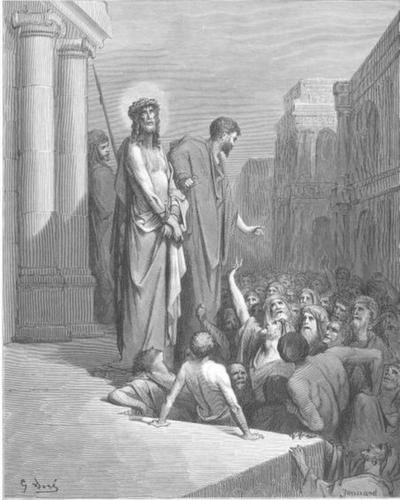
Pilate said to the Jewish religious leaders, "Look, here is your king!" Then they shouted out, "Away with him! Away with him! Crucify him!" Pilate asked, "Shall I crucify your king?" The high priests replied, "We have no king except Caesar!" Then Pilate handed him over to them to be crucified. These verses exhibit to our eyes a wonderful picture, a picture which ought to be deeply interesting to all who profess and call themselves Christians. Like every great historical picture, it contains special points on which we should fix our special attention.
A commentator
J.C. Ryle1816–1900
Expository Thoughts on the Gospels: John (lightly modernized text, Grace Gems edition) (1869)
proposed
Pilate said to the Jewish religious leaders, "Look, here is your king!" Then they shouted out, "Away with him! Away with him! Crucify him!" Pilate asked, "Shall I crucify your king?" The high priests replied, "We have no king except Caesar!" Then Pilate handed him over to them to be crucified. These verses exhibit to our eyes a wonderful picture, a picture which ought to be deeply interesting to all who profess and call themselves Christians. Like every great historical picture, it contains special points on which we should fix our special attention. Above all, it contains three life-like portraits, which we shall find it useful to examine in order. The first portrait in the picture is that of our Lord JESUS CHRIST himself. We see the Savior of mankind scourged, crowned with thorns, mocked, smitten, rejected by His own people, unjustly condemned by a judge who saw no fault in Him, and finally delivered up to a most painful death. Yet this was He who was the eternal Son of God, whom the Father's countless angels delighted to honor. This was He who came into the world to save sinners, and after living a blameless life for thirty years, spent the last three years of His time on earth in going about doing good, and preaching the Gospel. Surely the sun never shone on a more wondrous sight since the day of its creation! Let us admire that love of Christ which Paul declares, "passes knowledge," and let us see an endless depth of meaning in the expression. There is no earthly love with which it can be compared, and no standard by which to measure it. It is a love that stands alone. Never let us forget when we ponder this tale of suffering, that Jesus suffered for our sins, the Just for the unjust, that He was wounded for our transgressions and bruised for our iniquities, and that with His stripes we are healed.
Hath the greater sin - It is a sin in thee to condemn me, while thou art convinced in thy conscience that I am innocent: but the Jews who delivered me to thee, and Judas who delivered me to the Jews, have the greater crime to answer for. Thy ignorance in some measure excuses thee; but the rage and malice of the Jews put them at present out of the reach of mercy.
Modern Voices1 voice
Soldiers have many faults, but they have one redeeming merit; they are never worshippers of force. Soldiers more than any other men are taught severely and systematically that might is not right. The fact is obvious. The might is in the hundred men who obey. …
The words behind it
24 Greek wordsEvery Greek word of this verse in the order it stands, with what it means and the door to its own study. The last column counts the times a word stands in the whole Bible: the rarer the word, the more the places it appears belong together.
| Greek | Sound | Meaning | Word study | In the Bible |
|---|---|---|---|---|
| ἀπεκρίθη | apekrithe | Answered | G611 → | 231 times |
| αὐτῷ | auto | to him | G846 → | 5565 times |
| Ἰησοῦς· | iesous | Jesus; | G2424 → | 908 times |
| οὐκ | ouk | Not | G3756 → | 1664 times |
| εἶχες | eiches | you were having | G2192 → | 707 times |
| ἐξουσίαν | exousian | authority | G1849 → | 102 times |
| κατ᾽ | kat᾽ | against | G2596 → | 468 times |
| ἐμοῦ | emou | Me | G1473 → | 839 times |
| οὐδεμίαν, | oudemian | none, | G3762 → | 232 times |
| εἰ | ei | only | G1487 → | 508 times |
| μὴ | me | unless | G3361 → | 1066 times |
| ἦν | en | it were | G1510 → | 2333 times |
| δεδομένον | dedomenon | given | G1325 → | 412 times |
| σοι | soi | to you | G4771 → | 2973 times |
| ἄνωθεν· | anothen | from above; | G509 → | 13 times |
| διὰ | dia | Because of | G1223 → | 664 times |
| τοῦτο | touto | this | G3778 → | 1381 times |
| ὁ | ho | the [one] | G3588 → | 19766 times |
| παραδούς | paradous | having betrayed | G3860 → | 119 times |
| μέ | me | Me | G3165 → | 1936 times |
| σοι | soi | to you | G4771 → | 2973 times |
| μείζονα | meizona | greater | G3173 → | 243 times |
| ἁμαρτίαν | hamartian | sin | G266 → | 173 times |
| ἔχει. | echei | has. | G2192 → | 707 times |
ἀπεκρίθηAnswered
apekritheG611 →231 times
αὐτῷto him
autoG846 →5565 times
Ἰησοῦς·Jesus;
iesousG2424 →908 times
οὐκNot
oukG3756 →1664 times
εἶχεςyou were having
eichesG2192 →707 times
ἐξουσίανauthority
exousianG1849 →102 times
κατ᾽against
kat᾽G2596 →468 times
ἐμοῦMe
emouG1473 →839 times
οὐδεμίαν,none,
oudemianG3762 →232 times
εἰonly
eiG1487 →508 times
μὴunless
meG3361 →1066 times
ἦνit were
enG1510 →2333 times
δεδομένονgiven
dedomenonG1325 →412 times
σοιto you
soiG4771 →2973 times
ἄνωθεν·from above;
anothenG509 →13 times
διὰBecause of
diaG1223 →664 times
τοῦτοthis
toutoG3778 →1381 times
ὁthe [one]
hoG3588 →19766 times
παραδούςhaving betrayed
paradousG3860 →119 times
μέMe
meG3165 →1936 times
σοιto you
soiG4771 →2973 times
μείζοναgreater
meizonaG3173 →243 times
ἁμαρτίανsin
hamartianG266 →173 times
ἔχει.has.
echeiG2192 →707 times
A shaded row is a word that stands 400 times or fewer in the Bible.
The walk
8 stopsEach card is a verse this one points to, and under it the verses that one points to in turn. Where several paths arrive at the same place, that place is listed first: the text keeps returning to it.
Through
Romans 13:1Everyone must submit himself to the governing authorities, for there is no authority except that which is from God. The authorities that exist have been appointed by God.
it leads to
- Daniel 2:21
He changes the times and seasons; He removes kings and establishes them. He gives wisdom to the wise and knowledge to the discerning.
Reached by 2 separate paths from here.
- Titus 3:1
Remind the believers to submit to rulers and authorities, to be obedient and ready for every good work,
- 1 Peter 2:13–17
Submit yourselves for the Lord’s sake to every human institution, whether to the king as the supreme authority,
- Proverbs 8:15–16
By me kings reign, and rulers enact just laws;
- Jeremiah 27:5–8
By My great power and outstretched arm, I made the earth and the men and beasts on the face of it, and I give it to whom I please.
- Daniel 2:21
Through
John 3:27John replied, “A man can receive only what is given him from heaven.
it leads to
- James 1:17
Every good and perfect gift is from above, coming down from the Father of the heavenly lights, with whom there is no change or shifting shadow.
- 1 Corinthians 4:7
For who makes you so superior? What do you have that you did not receive? And if you did receive it, why do you boast as though you did not?
- 1 Corinthians 15:10
But by the grace of God I am what I am, and His grace to me was not in vain. No, I worked harder than all of them—yet not I, but the grace of…
- James 1:17
Where this verse is studied
On this page
Studies25
On this verse
On this chapter
- Blue, Purple and Scarlet
- Hanged on a tree
- How Greek Works
- Irony in Scripture: More Than the Speaker Knows
- Mary Magdalene: the Witness at the Tomb
- Mary of Nazareth
Show the next 6 titles
About John
This page draws on 21 works. Open the list of works
This page draws on Adam Clarke, Commentary on the Bible; Albert Barnes, Notes, Explanatory and Practical, on the Old and New Testaments (1832-1869); Albert Barnes, Notes, Explanatory and Practical, on the Gospels; Augustine of Hippo, ON THE SPIRIT AND THE LETTER 54; Augustine of Hippo, Catena Aurea by Aquinas; Augustine of Hippo, Tractates on John 116; Bonaventure, Commentary on John, Chapter 19; Cyprian, Treatise IV On the Lord's Prayer; Cyprian, Treatise XII. Three Books of Testimonies Against the Jews.; Cyril of Alexandria, Commentary on the Gospel of John, Book 12; GK Chesterton, All Things Considered, Thoughts Around Koepenick (1908); J.C. Ryle, Expository Thoughts on the Gospels: John (lightly modernized text, Grace Gems edition); Jamieson, Fausset & Brown, Commentary Critical and Explanatory on the Whole Bible; John Chrysostom, Homily on the Gospel of John 84; John Gill, Exposition of the New Testament (1746-1748); John Wesley, Explanatory Notes upon the New Testament; Matthew Henry, Commentary on the Whole Bible; Origen of Alexandria, ON FIRST PRINCIPLES 3.2.6; Theophylact of Ohrid, Commentary on John; Theophylact of Ohrid, Catena Aurea by Aquinas and Thomas Aquinas, Commentary on John.