
John 19:9
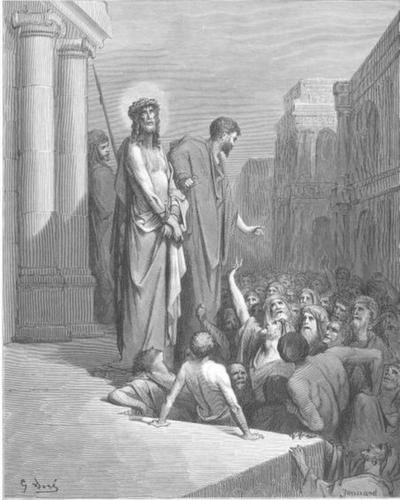
in John 19and he went back into the Praetorium. “Where are You from?” he asked. But Jesus gave no answer.
BSB
The same verse in ASV and KJV ▾
ASV
and he entered into the Prætorium again, and saith unto Jesus, Whence art thou? But Jesus gave him no answer.
KJV
And went again into the judgment hall, and saith unto Jesus, Whence art thou? But Jesus gave him no answer.
⋯
This verse in John 19
Commentary
18 notes on this verseSince he willed to suffer on behalf of the world, he is silent when examined and beaten by Pilate. For if he had spoken, he would not have been crucified from weakness, since there is no weakness in the words that the Word speaks.
This site's exposition
he was even more afraid
on John 19:8-9
The title Son of God drives Pilate back into the Praetorium to ask where Jesus is from. Jesus gives no answer, having already answered this governor at 18:33 to 37 about His kingdom. Isaiah 53:7 has the lamb silent before the shearers.
This site's exposition
Where are You from
Pilate asks about the origin of Jesus. Barnes notes that Pilate already knew He came from Galilee, so the question asks whether He was a man or the Son of God. Origen holds that the silence belongs to His will to suffer.
The record, by era
The Church Fathers4 voices
(Tr. cxvi. 4) In comparing the accounts of the different Evangelists together, we find that this silence was maintained more than once; viz. before the High Priest, before, Herod, and before Pilate. So that the prophecy of Him, As a sheep before her shearers is dumb, so opened He not His mouth, (Isa. 53:7.) was amply fulfilled. To many indeed of the questions put to Him, He did reply, but where He did not reply, this comparison of the sheep shows us that His was not a silence of guilt, but of innocence; not of self-condemnation, but of compassion, and willingness to suffer for the sins of others.
"When Pilate, therefore, heard that saying, he was the more afraid; and entered again into the judgment hall, and saith unto Jesus, Whence art thou? But Jesus gave him no answer." It is found, in comparing the narratives of all the evangelists, that this silence on the part of our Lord Jesus Christ took place more than once, both before the chief priests and before Herod, to whom, as Luke intimates, Pilate had sent Him for a hearing, and before Pilate himself; so that it was not in vain that the prophecy regarding Him had preceded, "As the lamb before its shearer was dumb, so He opened not His mouth," especially on those occasions when He answered not His questioners. For although He frequently replied to questions addressed to Him, yet because of those in regard to which He declined making any reply, the metaphor of the lamb is supplied, in order that in His silence He might be accounted not as guilty, but innocent. When, therefore, He was passing through the process of judgment, wherever He opened not His mouth it was in the character of a lamb that He did so; that is, not as one with an evil conscience who was convicted of his sins, but as one who in His meekness was sacrificed for the sins of others.
A commentator
Romanos the MelodistKONTAKION ON THE PASSION OF CHRIST 20.7-8 · Written before 555.
proposed
The Thunderer stood voiceless The Word, without a word; For if he had raised his voice He would not have been overcome, And, victorious, he would not have been crucified, and Adam would not have been saved: Therefore, in order that he might suffer He …
On this account he no more asks Him, "What hast thou done?" but, shaken by fear, he begins the enquiry again, saying, "Art thou the Christ?" But He answered not. For he who had heard, "To this end was I born, and for this came I," and, "My Kingdom is not of this world," he, when he ought to have opposed His enemies and delivered Him, did not so, but seconded the fury of the Jews. Then they being in every way silenced, make their cry issue in a political charge, saying, "He that maketh himself a king, speaketh against Caesar." Pilate ought therefore to have accurately enquired, whether He had aimed at sovereignty, and set His hand to expel Caesar from the kingdom. But he makes not an exact enquiry, and therefore Christ answered him nothing, because He knew that he asked all the questions idly. Besides, since His works bare witness to Him, He would not prevail by word, nor compose any defense, showing that He came voluntarily to this condition.
The Medieval Church1 voice
2389 Secondly, he mentions another effect it produced: doubt and questioning (v 9). First, we have the question Pilate asked; secondly, the silence of Christ; and thirdly, the reproach of Pilate. 2390 In regard to the first he says, he entered the praetorium again, stricken …
10 more voices on this verse
The Medieval Church2 voices
He asks Him not as before – "What have You done?" – but "Who are You?" Then they were accusing Him as a king, so naturally he asked "What have You done?" But now, when they slander that He makes Himself out to be the …
He entered again into the praetorium and said to Jesus: Whence art thou? He asks about his origin, because they accused him of this: he asks a great question beyond his powers: whence Isaiah 53: "His generation, who shall declare it?" And therefore he does …
The Puritans and the Awakening2 voices
Observe, (1.) The place he chose for this examination: He went into the judgment-hall for privacy, that he might be out of the noise and clamour of the crowd, and might examine the thing the more closely. Those that would find out the truth as it is in Jesus must get out of the noise of prejudice, and retire as it were into the judgment-hall, to converse with Christ alone.
And went again into the judgment hall,....
The Nineteenth Century6 voices
A commentator
Albert Barnes1798–1870
Notes, Explanatory and Practical, on the Old and New Testaments (1832-1869)
Whence art thou? - See the notes at Joh 7:27. Pilate knew that he was a Galilean, but this question was asked to ascertain whether he claimed to be the Son of God - whether a mere man, or whether divine. Jesus gave him no answer - Probably for the following reasons: 1. Jesus had already told Pilate Jesus’ design, and the nature of his kingdom, Joh 18:36-37. 2. Jesus had said enough to satisfy Pilate of Jesus’ innocence. Of that Pilate was convinced.
A commentator
Jamieson, Fausset & Brown1802–1910
Commentary Critical and Explanatory on the Whole Bible (1871)
When Pilate . . . heard this saying, he was the more afraid--the name "SON OF GOD," the lofty sense evidently attached to it by His Jewish accusers, the dialogue he had already held with Him, and the dream of his wife (Mt 27:19), all working together in the breast of the wretched man.
A commentator
Jamieson, Fausset & Brown1802–1910
Commentary Critical and Explanatory on the Whole Bible (1871)
proposed
and went again into the judgment hall, and saith to Jesus, Whence art thou?--beyond all doubt a question relating not to His mission but to His personal origin. Jesus gave him no answer--He had said enough; the time for answering such a question was past; the weak and wavering governor is already on the point of giving way.
quarantine:debris (2026-07-29) — starts-lowercase
A commentator
J.C. Ryle1816–1900
Expository Thoughts on the Gospels: John (lightly modernized text, Grace Gems edition) (1869)
proposed
Pilate said to the Jewish religious leaders, "Look, here is your king!" Then they shouted out, "Away with him! Away with him! Crucify him!" Pilate asked, "Shall I crucify your king?" The high priests replied, "We have no king except Caesar!" Then Pilate handed him over to them to be crucified. These verses exhibit to our eyes a wonderful picture, a picture which ought to be deeply interesting to all who profess and call themselves Christians. Like every great historical picture, it contains special points on which we should fix our special attention.
A commentator
J.C. Ryle1816–1900
Expository Thoughts on the Gospels: John (lightly modernized text, Grace Gems edition) (1869)
proposed
Pilate said to the Jewish religious leaders, "Look, here is your king!" Then they shouted out, "Away with him! Away with him! Crucify him!" Pilate asked, "Shall I crucify your king?" The high priests replied, "We have no king except Caesar!" Then Pilate handed him over to them to be crucified. These verses exhibit to our eyes a wonderful picture, a picture which ought to be deeply interesting to all who profess and call themselves Christians. Like every great historical picture, it contains special points on which we should fix our special attention. Above all, it contains three life-like portraits, which we shall find it useful to examine in order. The first portrait in the picture is that of our Lord JESUS CHRIST himself. We see the Savior of mankind scourged, crowned with thorns, mocked, smitten, rejected by His own people, unjustly condemned by a judge who saw no fault in Him, and finally delivered up to a most painful death. Yet this was He who was the eternal Son of God, whom the Father's countless angels delighted to honor. This was He who came into the world to save sinners, and after living a blameless life for thirty years, spent the last three years of His time on earth in going about doing good, and preaching the Gospel. Surely the sun never shone on a more wondrous sight since the day of its creation! Let us admire that love of Christ which Paul declares, "passes knowledge," and let us see an endless depth of meaning in the expression. There is no earthly love with which it can be compared, and no standard by which to measure it. It is a love that stands alone. Never let us forget when we ponder this tale of suffering, that Jesus suffered for our sins, the Just for the unjust, that He was wounded for our transgressions and bruised for our iniquities, and that with His stripes we are healed.
Whence art thou? - This certainly does not mean, From what country art thou? for Pilate knew this well enough; but it appears he made this inquiry to know who were the parents of Christ; what were his pretensions, and whether he really were a demigod, such as the heathens believed in. To this question we find our Lord gave no answer. He had already told him that his kingdom was not of this world; and that he came to erect a spiritual kingdom, not a temporal one: Joh 18:36, Joh 18:37. This answer he deemed sufficient; and he did not choose to satisfy a criminal curiosity, nor to enter then into any debate concerning the absurdity of the heathen worship.
The words behind it
20 Greek wordsEvery Greek word of this verse in the order it stands, with what it means and the door to its own study. The last column counts the times a word stands in the whole Bible: the rarer the word, the more the places it appears belong together.
| Greek | Sound | Meaning | Word study | In the Bible |
|---|---|---|---|---|
| καὶ | kai | And | G2532 → | 9120 times |
| εἰσῆλθεν | eiselthen | he went | G1525 → | 194 times |
| εἰς | eis | into | G1519 → | 1755 times |
| τὸ | to | the | G3588 → | 19766 times |
| πραιτώριον | praitorion | Praetorium | G4232 → | 8 times |
| πάλιν | palin | again | G3825 → | 139 times |
| καὶ | kai | and | G2532 → | 9120 times |
| λέγει | legei | he says | G3004 → | 1325 times |
| τῷ | to | <the> | G3588 → | 19766 times |
| Ἰησοῦ· | iesou | to Jesus; | G2424 → | 908 times |
| πόθεν | pothen | From where | G4159 → | 29 times |
| εἶ | ei | are | G1510 → | 2333 times |
| σύ; | su | You yourself? | G4771 → | 2973 times |
| ὁ | ho | <the> | G3588 → | 19766 times |
| δὲ | de | But | G1161 → | 2765 times |
| Ἰησοῦς | iesous | Jesus | G2424 → | 908 times |
| ἀπόκρισιν | apokrisin | an answer | G612 → | |
| οὐκ | ouk | not | G3756 → | 1664 times |
| ἔδωκεν | edoken | did give | G1325 → | 412 times |
| αὐτῷ. | auto | to him. | G846 → | 5565 times |
καὶAnd
kaiG2532 →9120 times
εἰσῆλθενhe went
eiselthenG1525 →194 times
εἰςinto
eisG1519 →1755 times
τὸthe
toG3588 →19766 times
πραιτώριονPraetorium
praitorionG4232 →8 times
πάλινagain
palinG3825 →139 times
καὶand
kaiG2532 →9120 times
λέγειhe says
legeiG3004 →1325 times
τῷ<the>
toG3588 →19766 times
Ἰησοῦ·to Jesus;
iesouG2424 →908 times
πόθενFrom where
pothenG4159 →29 times
εἶare
eiG1510 →2333 times
σύ;You yourself?
suG4771 →2973 times
ὁ<the>
hoG3588 →19766 times
δὲBut
deG1161 →2765 times
ἸησοῦςJesus
iesousG2424 →908 times
ἀπόκρισινan answer
apokrisinG612 →
οὐκnot
oukG3756 →1664 times
ἔδωκενdid give
edokenG1325 →412 times
αὐτῷ.to him.
autoG846 →5565 times
A shaded row is a word that stands 400 times or fewer in the Bible.
The walk
8 stopsEach card is a verse this one points to, and under it the verses that one points to in turn. Where several paths arrive at the same place, that place is listed first: the text keeps returning to it.
Through
Philippians 1:28without being frightened in any way by those who oppose you. This is a clear sign of their destruction but of your salvation, and it is from God.
it leads to
- 2 Timothy 1:7–8
For God has not given us a spirit of fear, but of power, love, and self-control.
- 2 Thessalonians 1:5–6
All this is clear evidence of God’s righteous judgment. And so you will be counted worthy of the kingdom of God, for which you are suffering.
- Matthew 10:28
Do not be afraid of those who kill the body but cannot kill the soul. Instead, fear the One who can destroy both soul and body in hell.
- Isaiah 51:7
Listen to Me, you who know what is right, you people with My law in your hearts: Do not fear the scorn of men; do not be broken by their insults.
- 2 Timothy 2:11–12
This is a trustworthy saying: If we died with Him, we will also live with Him;
- 2 Timothy 1:7–8
Through
Matthew 26:63But Jesus remained silent. Then the high priest said to Him, “I charge You under oath by the living God: Tell us if You are the Christ, the Son of God.”
it leads to
- Leviticus 5:1
“If someone sins by failing to testify when he hears a public charge about something he has witnessed, whether he has seen it or learned of it, he shall bear the iniquity.
- Isaiah 53:7
He was oppressed and afflicted, yet He did not open His mouth. He was led like a lamb to the slaughter, and as a sheep before her shearers is silent, so He did not…
- Matthew 16:16
Simon Peter answered, “You are the Christ, the Son of the living God.”
- Leviticus 5:1
Where this verse is studied
On this page
Studies25
- Blue, Purple and Scarlet
- Hanged on a tree
- How Greek Works
- Irony in Scripture: More Than the Speaker Knows
- Mary Magdalene: the Witness at the Tomb
- Mary of Nazareth
Show the next 6 titles
- Messianic Prophecy
- The Messianic Psalms
- Nicodemus at Night. John 3
- Passover
- The Scarlet Thread
- Scribes and the Sanhedrin
Show the next 6 titles
About John
This page draws on 16 works. Open the list of works
This page draws on Adam Clarke, Commentary on the Bible; Albert Barnes, Notes, Explanatory and Practical, on the Gospels; Albert Barnes, Notes, Explanatory and Practical, on the Old and New Testaments (1832-1869); Augustine of Hippo, Catena Aurea by Aquinas; Augustine of Hippo, Tractates on John 116; Bonaventure, Commentary on John, Chapter 19; J.C. Ryle, Expository Thoughts on the Gospels: John (lightly modernized text, Grace Gems edition); Jamieson, Fausset & Brown, Commentary Critical and Explanatory on the Whole Bible; John Calvin, Commentary on the Gospel according to John; John Chrysostom, Homily on the Gospel of John 84; John Gill, Exposition of the New Testament (1746-1748); Matthew Henry, Commentary on the Whole Bible; Origen of Alexandria, COMMENTARY ON THE GOSPEL OF JOHN 19.61; Romanos the Melodist, KONTAKION ON THE PASSION OF CHRIST 20.7-8; Theophylact of Ohrid, Commentary on John and Thomas Aquinas, Commentary on John.