
John 19:3
in John 19And they went up to Him again and again, saying, “Hail, King of the Jews!” and slapping Him in the face.
BSB
The same verse in ASV and KJV ▾
ASV
and they came unto him, and said, Hail, King of the Jews! and they struck him with their hands.
KJV
And said, Hail, King of the Jews! and they smote him with their hands.
⋯
This verse in John 19
Commentary
14 notes on this verseThey dressed him in a purple robe in mockery, of course. But they also fulfilled the prophecy, doing so under inspiration. For he was a King. However much they did it in a spirit of derision, still they did it. His royal dignity was emblematically heralded. So, likewise, though it was with thorns they crowned him, it was still a crown. And it was soldiers who crowned him. Kings are proclaimed by soldiers.
This site's exposition
twisted together a crown of thorns
on John 19:2-3
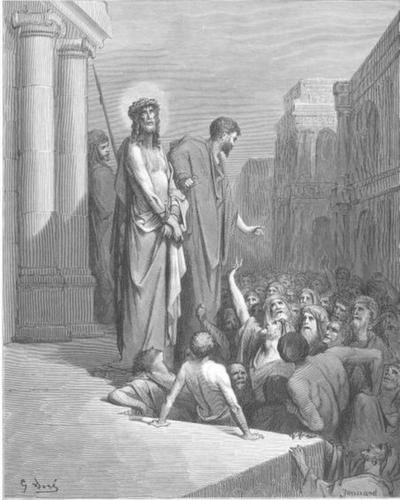
The soldiers stage a coronation: a crown of thorns, a purple robe, and the salute given to Caesar. Thorns came with the curse of the ground at Genesis 3:18. They are pressed onto the head of the man who carries that curse away.
This site's exposition
Hail, King of the Jews
The soldiers act out the title King of the Jews. Cyril of Jerusalem reads the mockery as a proclamation in spite of itself. The robe was a king's robe, and the crown of thorns was still a crown.
The record, by era
The Church Fathers3 voices
(Tr. cxvi) When the Jews had cried out that they did not wish Jesus to be released on account of the passover, but Barabbas, Then Pilate therefore took Jesus, and scourged Him. Pilate seems to have done this for no reason but to satisfy the malice of the Jews with some punishment short of death. On which account he allowed his band to do what follows, or perhaps even commanded them. The Evangelist only says however that the soldiers did so, not that Pilate commanded them: And the soldiers platted a crown of thorns, and put it on His head, and they put on Him a purple robe, and said, Hail, King of the Jews! and they smote Him with their hands. (Tr. cxvi) Thus were fulfilled what Christ had prophesied of Himself; thus were martyrs taught to suffer all that the malice of persecutors could inflict; thus that kingdom which was not of this world conquered the proud world, not by fierce fighting, but by patient suffering.
On the Jews crying out that they did not wish Jesus to be released unto them at the passover, but Barabbas the robber; not the Saviour, but the murderer; not the Giver of life, but the destroyer, - "then Pilate took Jesus and scourged Him." We must believe that Pilate acted thus for no other reason than that the Jews, glutted with the injuries done to Him, might consider themselves satisfied, and desist from madly pursuing Him even unto death. With a similar intention was it that, as governor, he also permitted his cohort to do what follows, or even perhaps ordered them, although the evangelist is silent on the subject. For he tells us what the soldiers did thereafter, but not that Pilate ordered it. "And the soldiers," he says, "platted a crown of thorns, and put it on His head, and they clothed Him with a purple robe. And they came to Him and said, Hail, King of the Jews! And they smote Him with their hands." Thus were fulfilled the very things which Christ had foretold of Himself; thus were the martyrs moulded for the endurance of all that their persecutors should be pleased to inflict; thus, by concealing for a time the terror of His power, He commended to us the prior imitation of His patience; thus the kingdom which was not of this world overcame that proud world, not by the ferocity of fighting, but by the humility of suffering; and thus the grain of corn that was yet to be multiplied was sown amid the horrors of shame, that it might come to fruition amid the wonders of glory.
(Hom. xxxiv) It was not at the command of the governor that they did this, but in order to gratify the Jews. For neither were they commanded by him to go to the garden in the night, but the Jews gave them money to go. He bore however all these insults silently. Yet do thou, when thou hearest of them, keep stedfastly in thy mind the King of the whole earth, and Lord of Angels bearing all these contumelies in silence, and imitate His example.
The Medieval Church2 voices
But the soldiers do everything to please the Jews. They had heard Pilate say, "I will release the King of the Jews"; therefore they mock Him as a king. For it was not by Pilate's order that they did this, nor did those who went …
Then the mockery in the salutation: whence he says: And they came to him and said: Hail, King of the Jews, and this indeed as a reproach: Lamentations three: "He shall be filled with reproaches." — Not only in word, but in reverence, because in …
6 more voices on this verse
The Medieval Church1 voice
2377 Thirdly, they mock him the way they address him: they came up to him, saying, Hail, King of the Jews! It was the custom then, as it is now, for subjects to salute their king when they came into his presence: "And when Hushai …
The Puritans and the Awakening2 voices
And said, hail, King of the Jews!....
But thus hath Christ's holy religion been basely misrepresented, dressed up by bad men at their pleasure, and so exposed to contempt and ridicule, as Christ was here. [1.] They clothe him with a mock-robe, as if it were a sham and a jest, and nothing but the product of a heated fancy and a crazed imagination.
The Nineteenth Century3 voices
A commentator
Jamieson, Fausset & Brown1802–1910
Commentary Critical and Explanatory on the Whole Bible (1871)
And said, Hail, King of the Jews!--doing Him derisive homage, in the form used on approaching the emperors. "And they spit upon Him, and took the reed and smote Him on the head" (Mt 27:30). The best comment on these affecting details is to cover the face.
A commentator
J.C. Ryle1816–1900
Expository Thoughts on the Gospels: John (lightly modernized text, Grace Gems edition) (1869)
proposed
Pilate said to the Jewish religious leaders, "Look, here is your king!" Then they shouted out, "Away with him! Away with him! Crucify him!" Pilate asked, "Shall I crucify your king?" The high priests replied, "We have no king except Caesar!" Then Pilate handed him over to them to be crucified. These verses exhibit to our eyes a wonderful picture, a picture which ought to be deeply interesting to all who profess and call themselves Christians. Like every great historical picture, it contains special points on which we should fix our special attention.
A commentator
J.C. Ryle1816–1900
Expository Thoughts on the Gospels: John (lightly modernized text, Grace Gems edition) (1869)
proposed
Pilate said to the Jewish religious leaders, "Look, here is your king!" Then they shouted out, "Away with him! Away with him! Crucify him!" Pilate asked, "Shall I crucify your king?" The high priests replied, "We have no king except Caesar!" Then Pilate handed him over to them to be crucified. These verses exhibit to our eyes a wonderful picture, a picture which ought to be deeply interesting to all who profess and call themselves Christians. Like every great historical picture, it contains special points on which we should fix our special attention. Above all, it contains three life-like portraits, which we shall find it useful to examine in order. The first portrait in the picture is that of our Lord JESUS CHRIST himself. We see the Savior of mankind scourged, crowned with thorns, mocked, smitten, rejected by His own people, unjustly condemned by a judge who saw no fault in Him, and finally delivered up to a most painful death. Yet this was He who was the eternal Son of God, whom the Father's countless angels delighted to honor. This was He who came into the world to save sinners, and after living a blameless life for thirty years, spent the last three years of His time on earth in going about doing good, and preaching the Gospel. Surely the sun never shone on a more wondrous sight since the day of its creation! Let us admire that love of Christ which Paul declares, "passes knowledge," and let us see an endless depth of meaning in the expression. There is no earthly love with which it can be compared, and no standard by which to measure it. It is a love that stands alone. Never let us forget when we ponder this tale of suffering, that Jesus suffered for our sins, the Just for the unjust, that He was wounded for our transgressions and bruised for our iniquities, and that with His stripes we are healed.
The words behind it
15 Greek wordsEvery Greek word of this verse in the order it stands, with what it means and the door to its own study. The last column counts the times a word stands in the whole Bible: the rarer the word, the more the places it appears belong together.
| Greek | Sound | Meaning | Word study | In the Bible |
|---|---|---|---|---|
| καὶ | kai | and | G2532 → | 9120 times |
| ἤρχοντο | erchonto | they were coming up | G2064 → | 628 times |
| πρὸς | pros | to | G4314 → | 700 times |
| αὐτὸν | auton | Him | G846 → | 5565 times |
| καὶ | kai | and | G2532 → | 9120 times |
| ἔλεγον· | elegon | were saying; | G3004 → | 1325 times |
| χαῖρε, | chaire | Hail! | G5463 → | 74 times |
| ὁ | ho | O | G3588 → | 19766 times |
| βασιλεὺς | basileus | King | G935 → | 114 times |
| τῶν | ton | of the | G3588 → | 19766 times |
| Ἰουδαίων. | ioudaion | Jews! | G2453 → | 192 times |
| καὶ | kai | And | G2532 → | 9120 times |
| ἐδίδοσαν | edidosan | they were giving | G1325 → | 412 times |
| αὐτῷ | auto | to Him | G846 → | 5565 times |
| ῥαπίσματα.¶ | rhapismata | blows with the palm. | G4475 → |
καὶand
kaiG2532 →9120 times
ἤρχοντοthey were coming up
erchontoG2064 →628 times
πρὸςto
prosG4314 →700 times
αὐτὸνHim
autonG846 →5565 times
καὶand
kaiG2532 →9120 times
ἔλεγον·were saying;
elegonG3004 →1325 times
χαῖρε,Hail!
chaireG5463 →74 times
ὁO
hoG3588 →19766 times
βασιλεὺςKing
basileusG935 →114 times
τῶνof the
tonG3588 →19766 times
Ἰουδαίων.Jews!
ioudaionG2453 →192 times
καὶAnd
kaiG2532 →9120 times
ἐδίδοσανthey were giving
edidosanG1325 →412 times
αὐτῷto Him
autoG846 →5565 times
ῥαπίσματα.¶blows with the palm.
rhapismataG4475 →
A shaded row is a word that stands 400 times or fewer in the Bible.
The walk
8 stopsEach card is a verse this one points to, and under it the verses that one points to in turn. Where several paths arrive at the same place, that place is listed first: the text keeps returning to it.
Through
Luke 1:28The angel appeared to her and said, “Greetings, you who are highly favored! The Lord is with you.”
it leads to
- Judges 6:12
And the angel of the LORD appeared to Gideon and said, “The LORD is with you, O mighty man of valor.”
- Daniel 10:19
“Do not be afraid, you who are highly precious,” he said. “Peace be with you! Be strong now; be very strong!” As he spoke with me, I was strengthened and said, “Speak, my lord,…
- Luke 1:30
So the angel told her, “Do not be afraid, Mary, for you have found favor with God.
- Ephesians 1:6
to the praise of His glorious grace, which He has freely given us in the Beloved One.
- Daniel 9:21–23
while I was still praying, Gabriel, the man I had seen in the earlier vision, came to me in swift flight about the time of the evening sacrifice.
- Judges 6:12
Through
Matthew 27:29And they twisted together a crown of thorns and set it on His head. They put a staff in His right hand and knelt down before Him to mock Him, saying, “Hail, King of…
it leads to
- Mark 15:18
And they began to salute Him: “Hail, King of the Jews!”
Reached by 2 separate paths from here.
- Isaiah 53:3
He was despised and rejected by men, a man of sorrows, acquainted with grief. Like one from whom men hide their faces, He was despised, and we esteemed Him not.
- Matthew 20:19
and will deliver Him over to the Gentiles to be mocked and flogged and crucified. And on the third day He will be raised to life.”
- Mark 15:18
Where this verse is studied
On this page
Studies25
- Blue, Purple and Scarlet
- Hanged on a tree
- How Greek Works
- Irony in Scripture: More Than the Speaker Knows
- Mary Magdalene: the Witness at the Tomb
- Mary of Nazareth
Show the next 6 titles
- Messianic Prophecy
- The Messianic Psalms
- Nicodemus at Night. John 3
- Passover
- The Scarlet Thread
- Scribes and the Sanhedrin
Show the next 6 titles
About John
This page draws on 12 works. Open the list of works
This page draws on Augustine of Hippo, Catena Aurea by Aquinas; Augustine of Hippo, Tractates on John 116; Bonaventure, Commentary on John, Chapter 19; Cyril of Jerusalem, SERMON ON THE PARALYTIC 12; J.C. Ryle, Expository Thoughts on the Gospels: John (lightly modernized text, Grace Gems edition); Jamieson, Fausset & Brown, Commentary Critical and Explanatory on the Whole Bible; John Chrysostom, Homilies on St. John; John Chrysostom, Catena Aurea by Aquinas; John Gill, Exposition of the New Testament (1746-1748); Matthew Henry, Commentary on the Whole Bible; Theophylact of Ohrid, Commentary on John and Thomas Aquinas, Commentary on John.